

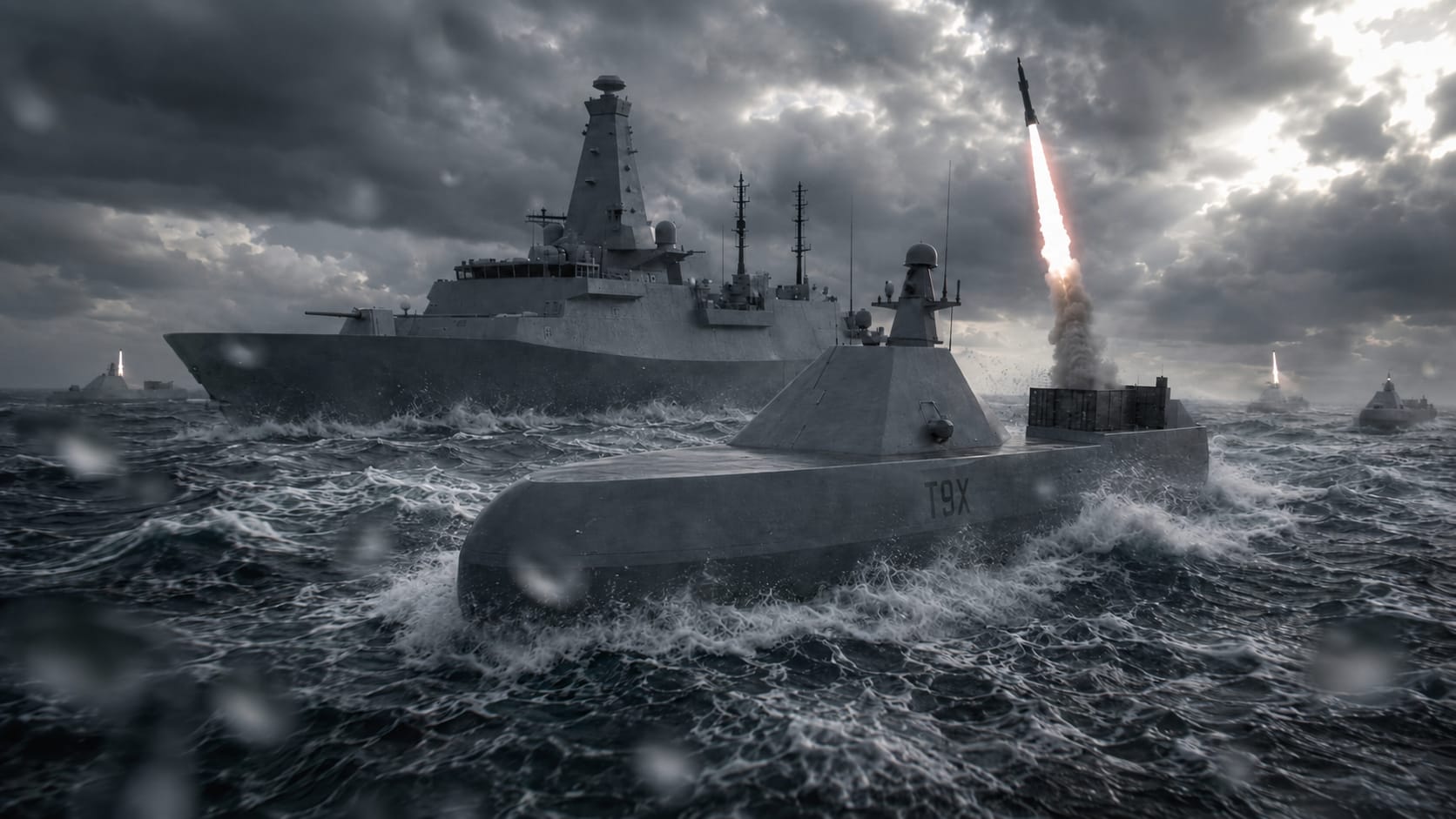
A prototype uncrewed missile platform and extra-large uncrewed underwater vessels are intended to be in Royal Navy service by 2030, the Ministry of Defence has said, committing at least £1.5 billion over the next four years to begin delivering the Hybrid Navy.
The commitments came in written parliamentary answers from Minister for Defence Readiness and Industry Luke Pollard on 10 July, responding to shadow defence secretary James Cartlidge, who asked about the construction timelines, workforce requirements and funding shares of the Type 91, Type 92, Type 93 and Type 94 vessels and the Common Combat Vessel.
“Defence will invest at least £1.5 billion over the next four years to begin delivering the Hybrid Navy, including the integration of autonomous underwater, surface and airborne systems to deliver mass and persistence,” Pollard said. “By 2030, we aim to have brought the first large autonomous vessels into service, including a prototype uncrewed missile platform and extra-large uncrewed underwater vessels (XLUUVs), with payloads developed through AUKUS. The optimal breakdown of this £1.5 billion investment between different types of vessel will now be developed in consultation with industry.”
The £1.5 billion commitment is higher than the £1 billion figure referenced in Cartlidge’s question, and the funding split between the different vessels is yet to be settled, as are the programmes themselves, with the minister saying construction schedules and workforce requirements “will be determined as the programmes progress through their concept and assessment phases.” His answer confirmed that the Defence Investment Plan “set out the Royal Navy’s future approach to a family of autonomous and hybrid naval capabilities, including the Type 91, Type 92, Type 93 and Type 94 systems, alongside the Common Combat Vessel.” The family comprises the Type 91 uncrewed missile platforms, the Type 92 uncrewed underwater sensing platforms, the Type 93 extra-large uncrewed underwater vehicles and the Type 94 uncrewed sensor platforms, which will work alongside the Common Combat Vessels and the eight Type 26 and five Type 31 crewed frigates in what the plan describes as a once in a generation investment in new maritime capability.
The 2030 aim is interesting given the department’s separate statement, given the same day, that no service entry date has been set for the Type 91 as a class, with a prototype in the water preceding any formal decision on fleet introduction. The underwater element, corresponding to the Type 93, builds on ground the Royal Navy has already broken, having trialled the XV Excalibur extra-large uncrewed underwater vessel from Plymouth, and the reference to payloads developed through AUKUS matches the Defence Investment Plan’s identification of weapons and sensors for underwater drones as the signature project under the partnership’s second pillar with the United States and Australia.
The by-2030 milestone gives the hybrid fleet its first firm near-term marker, ahead of the six Common Combat Vessels intended to arrive as the Type 45 destroyers retire from the mid-2030s, and industry is already moving on both the platforms and their weapons, with the department having asked for missile silos able to remain ready to fire for 30 days unattended aboard uncrewed vessels, and Navantia UK setting out this week that its Appledore yard could build two large autonomous vessels concurrently and deliver two a year.
Where the Type 91 to 94 family will be built remains open, with the Scottish Labour MSP Paul Sweeney urging the government this week to settle such questions by designating its core shipbuilding sites and awarding work directly to smooth demand across them.
What’s what?
Type 91 — uncrewed missile platform. The “missile barge” concept: an autonomous surface vessel carrying missile silos to add magazine depth to the fleet, part of the future maritime air defence and strike mix alongside the CCVs. A prototype is aimed to be in service by 2030, no class service entry date set. The May RFI for silos that can stay ready to fire for 30 days unattended aboard uncrewed vessels is almost certainly its enabling technology.
Type 92 — uncrewed underwater sensing platform. A submarine-hunting and underwater surveillance drone, the ASW and seabed-monitoring element of the family. Sits naturally with the undersea infrastructure protection push, though the MOD hasn’t detailed it beyond the designation, it’s likely to pull a towed array sonar and be a surface vessel.
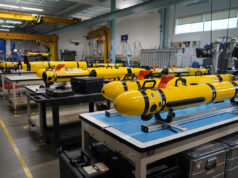
Type 93 — extra-large uncrewed underwater vehicle (XLUUV). The big autonomous submarine, building on the XV Excalibur trials from Plymouth, with payloads developed through AUKUS Pillar 2, which the DIP identifies as the partnership’s signature project. Also in the by-2030 first-vessels aim from Friday’s answer.
Type 94 — uncrewed sensor platform. The surface counterpart to the 92: an autonomous picket ship extending the fleet’s radar and sensor coverage, named alongside the Type 91 in the maritime air defence mix that replaces the Type 45’s role.




It is going to be commanded and controlled by what?
By the T45 or by satellite from anywhere in the world. These are not remote controlled ships.
Makes sense to get the type 91 out now combined with the T45. All it’s needs to do is combine 16mk41 VLS with an autonomous boat. This will be a very useful supplement to the T45.
The type 94 and the command ship can come later.
If they are not remotely controlled ships what are they? Nor is there any mention of the 45’s taking control or satellites. I’m not trying to be awkward but I see another gap coming.
Based on what’s been published, the T91 is expected to be able to:
* Navigate independently.
* Avoid collisions and comply with maritime navigation rules.
* Maintain its assigned position or operate on pre-planned routes.
* Monitor its own systems and report faults.
* Remain at sea for extended periods without a crew (the launcher requirement alone calls for 30 days without onboard maintenance).
The RN has now committed to the Hybrid Navy, so it makes sense to get a prototype in the water early and learn as much as possible before the CCV and production T91s come online.
As for the command ship, it could be a T45 or even a T31 for the prototypes. I don’t think it really matters at this stage. The important thing is getting it to sea, seeing what works, what doesn’t, and using those lessons before the production ships are built.
So how this drone ship protects itself?
Does it will have guns, laser, decoys, CAMM missiles, sonar for self defence?
If not what protects it?
That’s exactly why getting a prototype out there early makes sense. There are going to be a lot of lessons to learn with something like this — what level of autonomy it needs, how it operates with crewed ships, and what systems it actually needs, including defensive systems.
Better to find that out with a prototype than after you’ve built the fleet.
Hybrid Costs will ultimately spiral.
and there only really going down this road to save money…
But the initial and life time costs are probably far higher than they’ve budgeted for…
Someone has sold this as a cheap option…just wait until the maintenance and upgrade bills come in…
Not wrong, but since they are supposed to replace crewed vessels, I would like something a bit more functionally advanced then a POC prototype/
The bit that worries me JJ is “expected to be able to”. I do take your point about trials but if it doesn’t work we are in serious triouble. The other issue is are the drones going to be with their command ship all the time? In peacetime you don’t need a mini task force.
There’s lots of potential issues, but like I’ve said, the RN has made the decision to go for the Hybrid Navy. They planned on using these autonomous ships with T83 (FADS) as well — it’s just that now they have a smaller command ship.
They’ve backtracked on a possible T45 LIFEX, which is good news as a backup. But my point here is that the sooner they build a prototype and start playing around with it, the more we’ll know. So, for me, that needs to happen ASAP
Spot on there, prototypes can’t come soon enough. The concept will live or die upon them. Just hope plan B or even a plan A+ is in the locker. I guess the secure communications being developed for GCAP may be enlightening too.
You’d think they would play about with prototypes first before making ANY Commitment..???
Essentially they have to be honest.. what they have done is turn the T32 unfunded program into the CCV and delayed the T83 program to our money into drones … what happens later we will see.
The R.N. has made the decision or has the government made it for them? I have serious doubts as to whetther your average admirail igven the CHOICE between new conventional destroyers and drone warships would have chosen the latter. I may be wrong, of course, but if we don’t get it right we are five or six years down the line and sunk…literally.
With the onset of quantum computing, which China are the clear leaders in, we are leaving ourselves open to these vessels being used against us. I get the logic behind this, but the investment we will need to make in cyber defense will dwarf the cost of anything else we do, the positive is we need to do this anyway so benefits for wider country, but unless we can guarantee we can fully secure these things at all times we are heading in a dangerous direction
I think you’ll find THAT USA and China are Very close in Quantum Technology..Companies like IBM and MICROSOFT are global leaders…
Britain is sadly some way behind but in reality we don’t have the Resources…
I agree with you the problems involved with quantum ai and Military Drone is far from clear …and Are probably beyond the understanding of us mortals
The point about the strain put on cyber defences by quantum computing is a very valid one, however. Many in infosec are already very worried about the effects this technology could have.
We are pushing ahead with things like quantum PNT, which I think is far more promising for now. QT for optimisation may well be with us in less than a decade, but it will be expensive and centralised. It will take a lot longer to become transformative in Defence, if it ever does.
No need, just require an uber length of fibre optic for cummications, jobs a good un!
It is a very good point. If we can’t control the NHS, banks and the civil service from attacks what hope with these.
USN is aiming for it’s version to carry 2x 40ft iso containers.
Each container only houses 4 vls.
Seems likely that UK will do same/similar.
Is my understanding of remote control erroneous here as I thought that was the definition of remote control if it’s controlled from an external source. At least it was at the model remote control company I worked for, maybe it’s different with full size stuff lol. Autonomous would be different of course.
The technology won’t be able to do it. Utter folly
We’re nanking on the hybrid navy without knowing if it will work. We must at the very least trial these vessels with upgraded T45’s to prove their worth surely.
A spotty kid with a Gameboy and a joystick in a broom cupboard at the MOD
🤔
Maybe Dragonfire will be fitted to some of the ships are there s set of keys to start them? ,😁😁
🫣God help us all.
Andy Burnham! We are fooked!
Definitely same rubbish, different face carry on as you were,! 😡😡😡🏴🏴🏴🏴
Left,left,left…we surrender comrade.
2030??? Someone has been on the columbia marching powder at the MOD AGAIN… NOT A CHANCE THE DESIGN WILL BE STILL ON THE BACK OF A FAG PACKET
2030??? Someone has been on the columbia marching powder at the MOD AGAIN… NOT A CHANCE THE DESIGN WILL BE STILL ON THE BACK OF A FAG PACKET I’ve said before that it will be operated by a spotty kid with a lot keyboard and a joystick in a air conditioned portacabin in . Northwood car park. 🏴😁😡🤪🤪🤪
will they defend a CSG?
Who knows? I amy be getting this all wrong but we are now potentailly sending four ships to do the work of one and if that ship is sunk what do the drone ships do? Wait for a friend?
So a missile barge with no air search and AAW radar?
I wonder if the perfidious enemy might target that effectively defenceless vessel for round one destruction?
I think the idea is it will be networked to sensor nodes…
We went down this route in the late 40’s, 50’s with classes of radar picket Frigates.
You ended up with small vulnerable prime targets hung out to dry over the horizon.
Honestly read what you wrote, we went down this route in the 1940’s did we. 😀
They were probably missing a combined engagement capability or missiles 😀
Actually we did. Leopard class were laid down in 1953 as Just Me suggested.. Radar Picket ships.
Definitely same rubbish, different face carry on as you were,! 😡😡😡🏴🏴🏴🏴 just hope there won’t be a crossed line somewhere it could cause a war🍻🏴
They’ll probably push some sort of vessel with some sort of capability and after a short trial period in perfect conditions declare it a success…!!
In 1914-18 we went down the Battle Cruiser route with Speed is Amour… And that didn’t work out to well..!
I think you mean 1906 and they were great at what they were designed for; chasing down and destroying cruisers. The problem was putting them up against other capital ships in the line of battle where they couldn’t employ the speed is armour idea
In that role there may have been some logic especially pre WW1 but reality is post WW1 realities had been seen first hand and it was deemed a failed experiment and all those ships were greatly up armoured accordingly or were due to be. Hood was in the latter category sadly. Fact is to build ships of that nature that were only useful at dominating cruisers was too specialist a task for the effort put into them and indeed had during the twenties deemed a failed concept during combat conditions. Concepts on paper don’t always work well in practice. Whether that is a lesson for the hybrid fleet we will see, on paper it looks a great idea in practice who knows, so much is untried as yet.
So some corrections here:
First of all;
The Battlecruiser concept wasn’t a failure, it’s issue was that it was in fact too successful. The idea of the Battlecruiser was to sweep the sea’s of enemy commerce raiders and merchant ships. And they where extremely good at that. So good that by 1915 they’d basically gotten rid of all central powers shipping (and proven in combat, see the Falklands). It wasn’t so much that they where too specialised, but rather that the Admiralty didn’t want them just sitting in port. It’s also worth noting that Battlecruiser consistently where involved in surface actions (Dogger Bank, Heligoland etc) and fared decently.
Secondly;
Your timeline is off. Battlecruisers where being uparmoured before WWI. The original Invincibles and Indefatigables had 6 inch belts, but by the time Lion was laid down Battlecruisers had 9 inch belts (compared to the contemporary HMS Neptune that was laid down with a 10 inch belt and FYI several later Battleships like Canada and Agincourt had 9 inch belts). It’s slightly telling that 2 of the 3 lost Battlecruisers at Jutland where the lightly armoured Invi-Indi’s (also slow at 25 knots compared to the later Battlecruisers). The ones you are right about are Renown and Repulse, as they where built with 6 inch belts in a reversion, but the correction was only to go up to a Lion-eqsque 9inch belt. Hood was laid down with a full 12 Inch belt (the Queen Elizabeth’s had a 13 inch belt). FWIW Hood’s fate quite possibly had little to do with her armour if Bismarks shell got under her belt as some suggest.
What really did for the Battlecruiser was A) the capital ship holiday and restrictions of the Washington Naval Treaty, which meant there wasn’t the headroom in the fleet for new Battlecruisers (hence why a lot of Battlecruisers got second lives as Aircraft Carriers, conversions had exemptions in the treaties) and the fact that as Battleships got up to 30 knots (and going above that needed a lot of extra displacement that treaty forbid) the Battlecruiser and Battleship concept sort of merged into a ship that could do both.
It’s really worth highlighting that Battleships in the WWI era where *slow*. QE’s at 24 knots where considered incredibly speedy, most could just break 21. So in many ways it’s as valid to claim the Battleship was a failed concept in the post WWI era, as they where too slow and had to largely be abandoned in favour of faster Battlecruiser esque designs. (Not my position btw just pointing out that you can use the same argument that way.
Wonder if Drones will have the same problem….Depends on what you put them up against…
It’s not just for AAW. You could put strike missiles in the tubes, cued by satellite, to essentially make a marine version of Reaper. This would be a significant capability uplift.
It doesn’t mean it won’t have a radar set of its own..There would need to be sensors for navigation and self protection against threats
One of the SAAD Giraffe variants possibly with moderate range queuing guns or CAMM
If they adapt Aster or CAMM-MR when it arrives to the new VLS tender tech, those weapons have range for it to site relatively close to the manned platform..Up threat 10- 15 miles?
If they pull off the reliability and data link questions it will be some feat in 4 years.
Can one of those perform in a carrier group in the roll currently done by a destroyer
Where do they get plugged in? Going to need a heck of an extension lead
Not everything needs a radar and sensors, it always amazed me that we didn’t put the best radar available on the carriers. As our most protected asset with a massive displacement & height it can take the heaviest most powerful radar going & provide data to the force. The problem as far as I am aware is the RN doesn’t have CEC (or similar).
This will need to be added to the fleet going forward
If im correct the focus of the RN is the North Atlantic
If thats the case i wonder what these small autonomous vessel will be any good in a winter storm
I’m sure sea worthiness in the most harsh conditions will be at the centre of the hull design. That’s the easy bit.
Its not the sea worthiness that will be the problem
In a North Atlantic winter storm these small vessels will be thrown around like a cork in water
Believe you me i know as i spent 20yrs at sea and was also down the Falklands during the campaign
Being so small they will still have to lock on with whatever they will use and communicate with each vessel
These drone cant be less than 2000t and even then will have significant issues.
OPVs manage fine and MCVs globally. The designers will be very well aware of the requirements.
OPV don’t need same stability levels neither have such height and weight higher: many antenna for radar, coms, other sensors.
OPVs are what they are “Patrol ships”
Not ships with top of the range radar or missile carriers
Must say you have a lot of confidence in these new things
The powers that be mess up all things
The carriers should have had cats and traps
T45 with there issues
Once the so called Treasury get hold of things its all goes all over the place and then redesigned and more money in future
I doubt they’ll be getting top-of-the-range radar either. I think they will get cheaper radar to save money on the pretext of quantity over exquisite. Then we’ll skimp on quantity.
Are they going to be classified as front line sshipssoftkill systems? ASW WEAPONRY, or just on the sloops
Radar picket vessels go back to WWII …Best memory of them in the Falklands …. Tough and difficult job…
However are we trying to run before we can Walk with Drones.Perhaps it’s money that’s pushing the pace…!
Worked so well in the Falklands and definitely didn’t result in multiple ships being sank. Lets hope lessons are learnt. In the Falklands the issue was the ships identifying the targets couldn’t hit them due to lack of range of weapons and the longer range ships weren’t in range either as the picket has to be pretty broad.
Lessons learned from the Falklands
You need a bloody big powerful radar, the bigliest and most powerful you can manage.
You need to mount it as high as possible to gain as much ‘hight of eye’ as you can to increase yiur radar horizon.
Radar horizon is life – the more miles, the longer your reaction time
Channels of fire – lots of them, and lots more.
Your missiles need range – as much as you can manage – Yiu start shouting at 100 miles you can get away a second salvo at the leakers.
And then we invent rinky dink 2000 tonne radar pickets
You also provide manned ships(ccv), of at least frigate size that will carry a high end radar as high as possible. The drone ships extend the radar horizon.
Where do they get plugged in? Going to need a heck of an extension lead. Box browning tied to a weather balloon 🎈
So that would be the carriers then
Yep, and radar pickets were to push the radar horizon out to compensate for the relatively poor radars of the day with effective ranges in double digits.
And here we are, we now have very powerful shipboard radars able to reach out many hundreds of miles, and we’re going to remove them from major warships and fit little radars on small ships to act as radar pickets to move the radar horizon out.
Future Navy! Back to the Future!
Offcourse you be aware that the Horizon is still a problem no matter how big your radar is?
The big difference with this concept is that the radar pickets are not manned and are deemed expendable.
What’s the height of eye you can manage on a toy 2000 tonne boat?
Where does it say in the dip that they are removing radars from manned ships? It doesnt.Of course the new ships will have radars. Some people seem to just want this to fail and make up stuff to suit their arguments.
And what radar are they fitting on a 6,000 tonne Frigate?
A. A huge multi band ABM capable set that needs a 12-15,000 hull to carry it.
B. A cheap and cheerful one scaled to fit a 6,000 tonne frigate.
Hunter class 8100 standard displacement. Multi band aesa on a hull designed for asw. Now if we put something similar on an enlarged hull of a frigate designed for aaw ??? Could such a hull exist? Are we already building a frigate with a variant of that hull design? Nah lets just say it cant work instead. Us brits are so dull.
Babcock have already suggested the enlarged T31, named AH160. Where its length is between 150 and 160m. Which would make it slightly longer than a T45. Similarly BAES suggested a hull extension for the T26.
I think an evolved arrowhead design with more length an beam may be a better prospect. I have heard that the type 26 is close to its length depth limit so could not be enlarged to any great extent.
Can one of those perform in a carrier group in the roll currently done by a destroyer
Where do they get plugged in? Going to need a heck of an extension lead. Box browning tied to a weather balloon 🎈
Maybe Dragonfire will be fitted to some of the ships
There’s that 2030 again🙄🙄
Seems hugely ambitious considering they only just put out a tender for unscrewed missile silos. Surely they can’t start designing the ship until they know what the silo would look like.
They already know what the silo looks like they just need to know if it can be maintenance free and loaded for one month.
How do they know, they have put out a tender for a silo that can be used. Until someone designs it and works out what challenges that need to be overcome, it’s impossible to know what shape and size it will need to be surely?
From art work, albeit AI it will be standard shipping container sized, as they also said it must be used for land applications. That means a truck.
Then that means a flat deck space with power supply.
Australia just demonstrated MK41 on a trailer and fired SM2 cued by CAEFAR and a virtual aegis command system.
If we are looking at AUKUS then that’s an obvious solution. MK41 is a shipping container.
Germany is buying Typhon, that’s a trailer system for MK41. Those trailers could be cranes on a ship?
We have no idea what design work has already been done behind the scenes but if it’s from scratch it’s likely there will be a significant difference between what they want on the tender Vs what is practical and affordable for delivery. With these relatively tight delivery times we should start seeing details fairly soon I assume.
Looking to see how they’re refilled at sea however they are powered, they’ll have to be kept full in lubricant oil for the moving parts.
Watch the timetable slip .
By years and price
So the MOD plans more silos able to expand the Navy’s capacity but no money to expand the missile stocks, so that capacity will remain empty.
Guessing game, and a bit of fun?
Type 91: 6 built, pair for the three CCV in use at any time, fourth goes without as a “difficult decision.”
CCV1 Group. HMS Aurora and Andromeda.
CCV2 Group. HMS Ajax and Achilles.
CCV3 Group. HMS Archer and Arrow.
Type 92: 8 Built, pair for the four in use T26, the fifth T26 in use goes without on some excuse or other.
T26 1 Group. HMS Lavender and Lobelia.
T26 2 Group. HMS Sunflower and Snowdrop.
T26 3 Group. HMS Orchid and Oxlip.
T26 4 Group. HMS Clover and Camellia.
Type 93: 6 built.
HMS Odin, Olympus, Orpheus, Osiris, Oberon, Otus.
Type94: 10 built. A pair for each CCV group and singles for the 4 T26.
CCV1. HMS Boxer and Battleaxe.
CCV2. HMS Broadsword and Beaver.
CCV3. HMS Brilliant and Brazen.
T26 HMS Brave.
T26. HMS Banshee.
T26. HMS Black Eagle.
T26. HMS Black Swan.
Each “group” is linked to its mother vessel on SM and has its own website to build identity, twinned with towns in the usual way, and so on.
Just a bit of fun, I hope they get properly named and numbered like the standard warship.
Grumpy,, sleepy,happy, doc, sneezy, bashful,, some sleepy bird I a glass box.
Sounds excellent. 30 years better late than never. I would hope they will eventually be low cost base vessels with option to swap out modules for different missions.
I doubt it will ever work despite being six times over budget as usua
Yes, but the strength of the 45 is that radar so high up, where is the feet defence, the carrier doesn’t have Sampson (stupidly given its even greater height), the AEW coninues to be a point of failure, there should be a 45 on each side some miles out….. this is bean counting stupidity, again, and what isnworse, this has been let happen by the crass stupidity of the navy, this was the best opportunity since 1982 to get the boost that they need.
Sampson on the carriers? Great idea. Lets fry the electrics of the planes as they come into land!
The original design for the QE carriers was to have SAMPSON
Yep, another ‘cost saving’
Can one of those perform in a carrier group in the roll currently done by a destroyer
Thinking out loud, would it not be an idea to have the T91/92 and 94 built on the same hull. Also with the operational area being the North Atlantic, Norwegian and Greenland seas would a trimaran not be the better hull design.
I have also noticed that the CCV primary task is as a AAW replacement for the T45s
A diesel power Frigate will be many things, but a modern AAW Destroyer with enough power generation to drive a large radar and power directed energy weapons and defensive systems isn’t one of them.
Four diesel engines will give you 33 MW if you pop in 4 diesel generators that’s another 12 MW. that gives you 45MW
Let’s hope it’s a universal hull so that tight arse taxpayers aren’t inconvenienced:-
It’s not gonna be maintenance free by any stretch of imagination.
Mk41 vls containers function but are not yet time tested.
UK has camm so can probs pack more missiles into some containers.
50m boats can survive very high sea states (at sea maintenance required)
Vls can survive very high sea states (at sea maintenance required)
I doubt that any Navy is under the illusion that the 50m drone ships won’t require maintenance at sea.
Usn requirement is that the vessel allows containerised missile firing at sea state 3 or 4 (can’t remember which off the top of my head)
Will the concept work or is too much faith being placed in surely what is experimental technology that is expected to operate seamlessly in harsh maritime conditions. Time will tell.
As soon as it starts to get Expensive expect some sort of Review…! In the end its all about COST…! IF that starts to spiral it will be back to lightly manned vessels..
Intresting that Quantum ai may break the Codes of our Drones and we may never know it..!!!
I presume the missiles will have man in the loop to authorize firing? That must mean that the command ship, T45 then CCV , will control the weapons and that the drone vessel will be close enough for that to happen securely.
I can’t believe we will leave launch decisions to a computer programme. Imagine the consequences of an erroneous launch at a misidentified civil aircraft.
The level of autonomous system reliability the RN requires of these naval drones exists…..
In deep space manned spacecraft
And that isn’t cheap, it’s expensive, truly eye wateringly expensive.
The problem with unmanned systems is that there is often no justifiable reason to retaliate against a manned platform that destroys or threatens them in a pre-war scenario, at least not if you’re a progressive, law-abiding nation. There is already precedent for this, with numerous UAVs being lost to enemy action without significant consequences. USVs have also been seized by Iran in the past, and it required a manned platform to intervene and recover them.
With manned systems, an adversary knows there will likely be consequences if lives are lost. That makes them a far stronger deterrent against aggression. In effect, a manned platform allows you to push back more firmly against a potential troublemaker.
Let’s say these unmanned vessels always operate alongside a crewed platform to mitigate the risk of attack. Fine, they’re part of a flotilla. But what refuels them? The mothership (T31/T26)? An unmanned tanker or FSS? A larger vessel such as a Tide-class tanker? Or are they simply not intended for sustained blue-water operations and will return to port for refuelling and replenishment?
If it’s the latter, then Britain’s retreat from a truly global role means they’ll mostly be operating in places such as the Mediterranean or the North Sea. And what happens when one breaks down? Does the entire flotilla stop while repairs are attempted, particularly in heavy seas? Or do you leave it behind and hope an adversary doesn’t tow it away before a support vessel can reach it? I guess seeing they will be in friendly waters it won’t rrelly matter.
Interestingly, no additional vessel types to support these systems were announced. What does that tell us?
I’m actually supportive of uncrewed systems, but can the UK Government deliver a genuinely holistic solution for building and sustaining a blue-water fleet that combines both manned and unmanned platforms? Given the number of seemingly basic questions that remain unanswered, I have my doubts.
I don’t reply life too short 🙂 I don’t need an swer to question above they are rather food for thought
Dream on, dream dream dream. All these pipe dreams and still we have no air defence for the UK except a handful of QRA Typhoons, no Royal Navy to speak of and a tiny fighting army. The government take us all for fools and still we elect them, well except for the PM of course but he is of course the Messiah as we all know so all will be well and we shall win the war.
I don’t elect them, I haven’t for years.
Widdecombe “If you want to get our country back again, then there is not earthly point in voting for more of the same.”
Others do as they please, I’ll do what I believe in, thank you.
My grandfather was a Naval engineer. I understand it was a long time ago but from my understanding it takes a lot of maintenance to keep keep a ship running at sea. Things always braking and appalling weather and ice to contend with. Are these ships really going to operate without anyone onboard, or will they just keep braking down?
In the late 90s the Daily Telegraph reported that the TYpe 23s often had a reduced missile SAM complememt and if operating in home waters none. Will we have the missiles to fill the magazines of these vessels?
#