

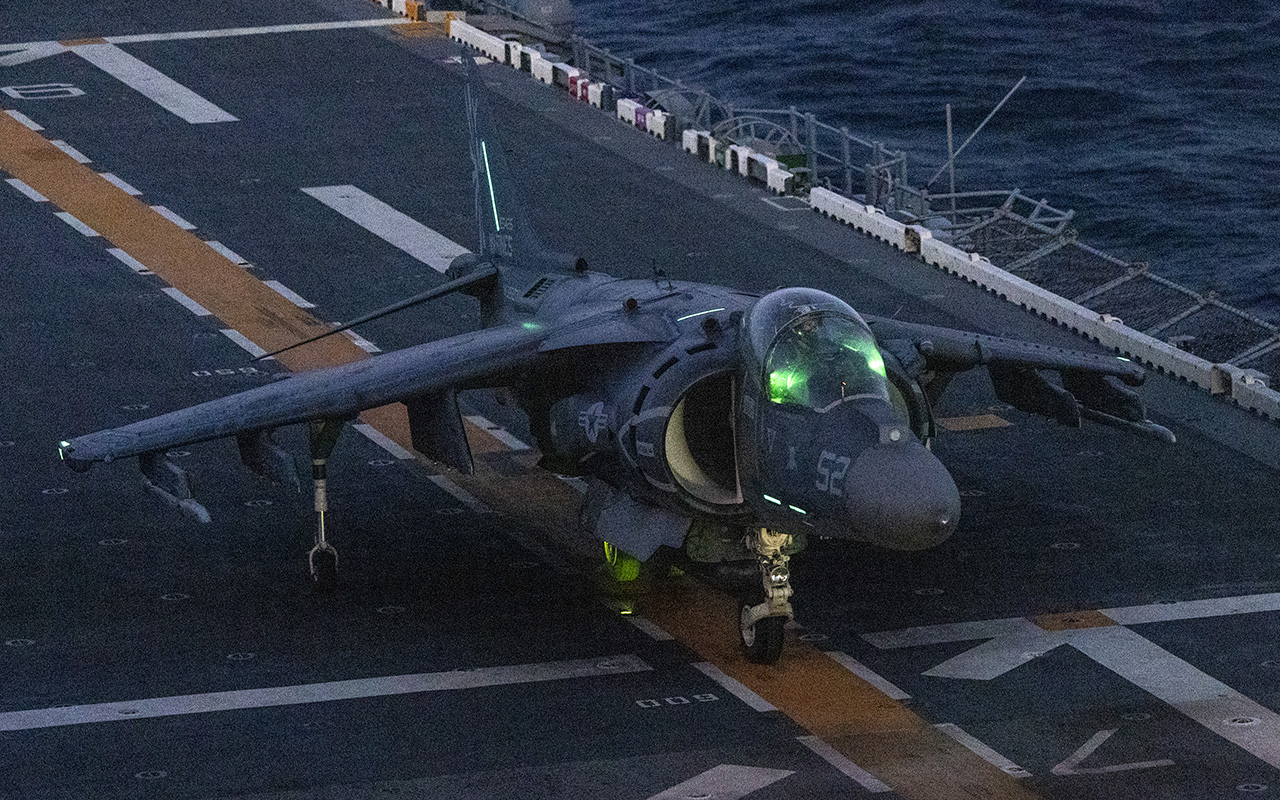
The United States Marine Corps has retired the AV-8B Harrier II, bringing to a close more than four decades of service for the distinctive jump jet, the UK Defence Journal understands.
The end of service was marked with a sundown ceremony at Marine Corps Air Station Cherry Point in North Carolina on 3 June 2026, honouring the aircraft of Marine Attack Squadron 223, the last operational Harrier squadron in the Marine Corps.
Local media has reported that the U.S. Marines had celebrated the end of service for a jet that had been an icon of U.S. Marine aviation for 55 years, a favourite of airshow crowds and, on one occasion, the subject of a controversial Pepsi television commercial.
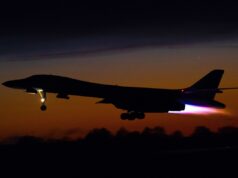
The Harrier’s defining feature was its ability to take off and land vertically or in a very short distance, a capability that allowed it to operate from amphibious assault ships and austere forward sites without conventional runways.
The commanding officer of Marine Attack Squadron 223, Lieutenant Colonel John B. Cumbie, paid tribute to the aircraft and those who worked on it at the ceremony. “As a platform that has continuously forward deployed across the globe, the Harrier will be remembered for its distinguished combat legacy, legendary Vertical/Short Take Off and Landing (V/STOL) capability, and the Marines and sailors that made the community special,” he said.
In its own announcement, the Marine Corps described the sundown of the AV-8B as marking the dawn of a new era. The retirement paves the way for the full transition of the 2nd Marine Aircraft Wing to the F-35B and F-35C Lightning II, it said, the aircraft now replacing the Harrier in Marine service. The ceremony was held at Cherry Point, the long-time home of the U.S. Marine Corps Harrier community.
The AV-8B traces its origins to a cooperative effort between the United States and the United Kingdom in the early 1970s, aimed at improving on the first-generation Hawker Siddeley Harrier. After the UK withdrew from that effort in 1975 on cost grounds, McDonnell Douglas extensively redesigned the earlier AV-8A to create the AV-8B, retaining the layout of its predecessor but adding a larger composite wing, an extra hardpoint on each side, a raised cockpit and other refinements, powered by an upgraded version of the Pegasus engine.
It first flew in November 1981 and entered service with the U.S. Marine Corps in January 1985, with later upgrades adding night-attack and radar-equipped variants. The UK, through British Aerospace, rejoined the improved Harrier project as a partner in 1981, and after corporate mergers Boeing and BAE Systems went on to jointly support the programme, which produced around 340 aircraft before manufacturing ended in 2003.
Across its service the type proved a versatile asset, flying from small aircraft carriers, amphibious assault ships and simple forward operating bases in a string of conflicts. The US Army general Norman Schwarzkopf named the Marine Corps Harrier II among several important weapons of the Gulf War, and the aircraft went on to serve in Afghanistan, Iraq and over Libya in 2011, while Italian and Spanish Harrier IIs flew in NATO coalition operations.




Harrier will forever be remembered as the original “sound of freedom” for us in the Falkland Islands.
❤️
I’ve gained $17,240 only within four weeks by comfortably working part-time from home. Immediately when I had lost my last business, I was very troubled and thankfully I’ve located this project now in this way I’m in a position to receive thousand USD directly from home. Each individual certainly can do this easy work & make more greenbacks online by visiting
following website—.,.,.,.,.,.,.—>>> PayAtHome1.COM
Alongside the retirement report, on 3 June TWZ published an interesting piece on the development history of the US version of the Harrier. Well worth a read.
Oh how i would have loved to see a single Harrier land on a QE. Indian, Italian, Spanish, Yank… Just one, that’s all.
For us Brits of a certain age, an iconic aircraft.
“I counted them all out, and I counted them all back.”
❤️
The plucky Harriers were part of a defining moment for some of us Gen Xers. Some in the UK might be surprised to know how closely some of us here in the States followed the Falklands War, even though it wasn’t ‘our’ war. At the time, I’d have to say I was more excited by Harriers and Invincible class ships than our own F-14s and Nimitz class.
And don’t forget HMS Hermes.
She Outlived (Life Span) all of those.
The Harrier is surely in the top five iconic British aircraft, along with the Spitfire, Lancaster, Vulcan and Concorde – although the later is arguable due to its French content. The Spanish and Italian navies are also having to take their American built AV-8Bs out of service as without the USMC, OEM support for MRO (Maintenance, Repair, and Overhaul) has basically ended.
Ohh, I could add so many to your list…
Mosquito, Lightning, Hurricane to name just 3. 👍
I’ve gained $17,240 only within four weeks by comfortably working part-time from home. Immediately when I had lost my last business, I was very troubled and thankfully I’ve located this project now in this way I’m in a position to receive thousand USD directly from home. Each individual certainly can do this easy work & make more greenbacks online by visiting
following website—.,.,.,.,.—>>> JobatHome1.Com
Today, 6th June about 300 – 400 ex-Harrier engineers meet to pull up a sand bag, grab a pint and talk of days on field deployments, on-board the boat, detachment and deployments and other such tales of daring-do.
See you in Stamford.🍻