

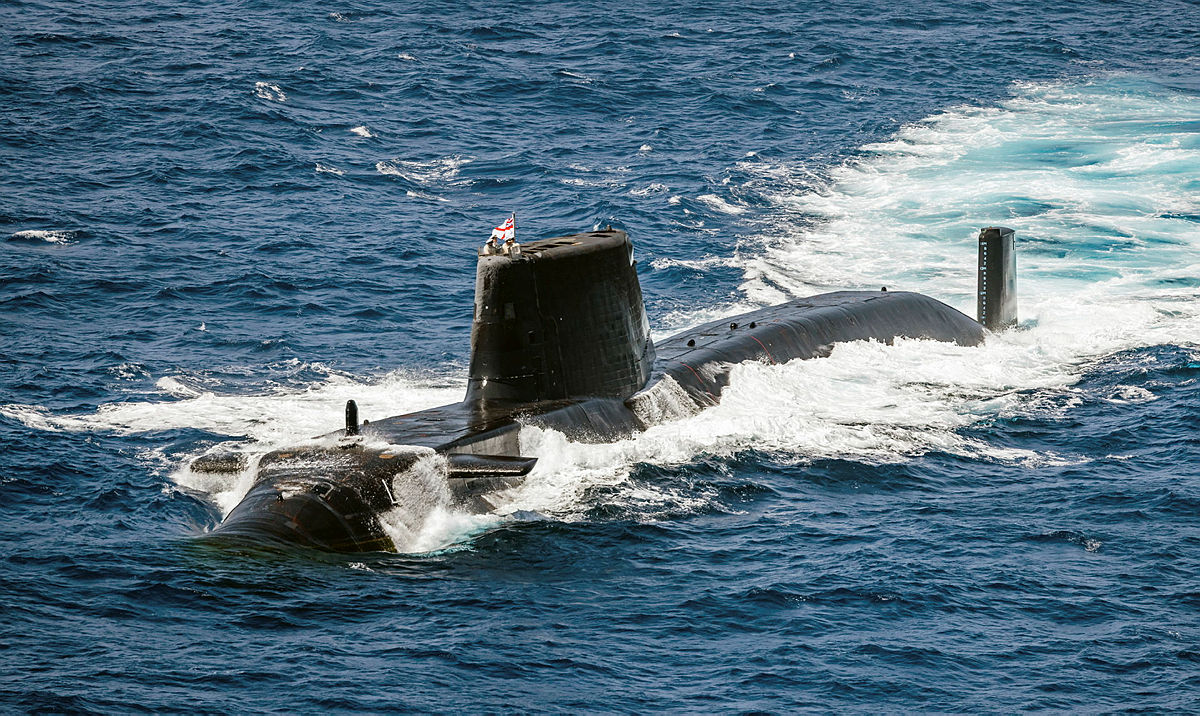
The Royal Navy’s small force of attack submarines has ended up back alongside all at once, with none of the boats currently out at sea, the UK Defence Journal understands.
The exact whereabouts of individual boats is something the Ministry of Defence will never spell out, but the broad picture has not been hard to read for a while now, because availability across the five-strong Astute-class fleet stayed badly depressed throughout 2025, a year in which the boats are reckoned to have managed only around 300 days at sea between them, and earlier in 2026 it was being reported that just one of them was genuinely fully operational at all.
That one boat was HMS Anson, the most active of the bunch, and the navy’s decision to send her halfway round the world only sharpened the squeeze at home, because she spent the early part of the year in Australia, at HMAS Stirling, becoming the first British nuclear submarine ever to be maintained on Australian soil as part of the AUKUS arrangement meant to help Canberra stand up the workforce for its own future boats, and now that she has finally made it home her return really just parks another hull alongside rather than putting one back out on patrol.
The crisis behind Britain’s record-breaking submarine patrols
These are not boats the country can comfortably do without, because the Astutes are the navy’s hunter-killers, carrying Tomahawk land-attack cruise missiles and Spearfish heavyweight torpedoes, gathering intelligence, shielding the carrier strike group and, more than anything else, screening the ballistic-missile submarines on which the whole nuclear deterrent rests, so when the entire lot is tied up in harbour the country loses the ability to slip that firepower or that covert surveillance quietly to sea at short notice, and that is hardly an academic worry given how much more active Russian submarines have grown right across the waters around Europe. The strain is being admitted at the very top too, with the First Sea Lord having warned back in December that the long-standing advantage allied navies once took for granted beneath the Atlantic is now “at risk” and the margin over Russia, as he put it, has turned uncomfortably narrow.
The Ministry of Defence, for its part, would not be drawn on any of the specifics, saying only that it does not routinely comment on individual submarine operations and availability, while insisting all the same that British waters are always protected by a range of assets including warships, patrol aircraft and submarines, and ministers have been similarly tight-lipped in Parliament, with the defence minister Lord Coaker declining to give any figures on how many boats are actually operational at any one time even as he pointed to the navy’s submarine recovery plan as the answer to the docking and maintenance bottlenecks that have been throttling availability.
As for why the boats keep stacking up in port, the answer has far less to do with anything going wrong on patrol than with the sheer difficulty and cost of keeping the fleet maintained, something the House of Commons Library has flagged for years alongside persistent manpower and skills shortages in the submarine service, and at the root of it sits a chronic shortage of the specialist dock space these nuclear boats need, with deep maintenance and refitting able to happen only at Devonport, the sole site in the country equipped to do that work on nuclear-powered submarines to the extent required, and with the unrelenting demands of keeping a deterrent submarine on patrol every single day swallowing much of the capacity that does exist.
The response has come in the shape of a new framework that the navy formally launched on 14 January, the Submarine Maintenance Recovery Plan, which the First Sea Lord, General Sir Gwyn Jenkins, set up explicitly to pull together what had until then been a scattered set of separate maintenance initiatives and to run them under a single structure with clearer priorities and proper resources behind it. Jenkins, who was blunt that “submarine maintenance throughput needs to drastically improve”, travelled up to the Clyde on 20 January, days after the launch and alongside the Chief of Defence Nuclear, Madeline McTernan, to look over the earliest changes on the ground, the most visible of which has been the rapid bolting-together of extra engineering space at the base, a deployable workshop of around 90 square metres run out of containerised defence facilities and meant to come on line within weeks so that vital tasks can be pulled forward.
Even the small print tells the same story, with a modest contract worth just under £69,000 going to the Shropshire firm Beaverfit for a covered, secure workspace built from eight shipping containers and a canopy near a car park on the base, a stopgap while the bigger and slower infrastructure work gets sorted.
Beyond that immediate scramble the bigger fix is supposed to come from expanding the country’s chronically thin out-of-water maintenance capacity, and to that end the Ministry of Defence has confirmed that design work is progressing on Programme Euston, a plan to procure floating dry docks for the submarine fleet that ministers have called a critical enabler both for availability and for the continuous deterrent, with the National Shipbuilding Office consulted and the shipbuilding sector reckoned well placed to bid, although no date has yet been put on any contract.
Day-to-day support at Devonport, in the meantime, has had to be propped up by a six-month stopgap deal struck with Babcock after the previous five-year maintenance contract ran out at the end of March, with a longer-term agreement reported to be all but finalised.
Further out still the navy is pinning its hopes on new steel altogether, the Strategic Defence Review of 2025 having committed Britain to building as many as 12 next-generation attack submarines under the SSN-AUKUS programme with the Americans and the Australians, on top of the Dreadnought-class deterrent boats expected from the early 2030s, while the seven-boat Astute class is itself still being finished off, with the sixth boat, HMS Agamemnon, now commissioned but not yet fully worked up and the seventh and last of them still under construction.
None of that, though, does a thing for the here and now, and with Anson only just back from the Pacific, the rest of the fleet tied up for maintenance and the whole creaking enterprise being asked to do far more than it comfortably can, the question that actually matters is how fast the new recovery plan and all that promised dock space can get even two or three of the existing boats back out to sea at the same time.








Proverbial in a brewery springs to mind.
They have already priced themselves out of that.
I’ve gained $17,240 only within four weeks by comfortably working part-time from home. Immediately when I had lost my last business, I was very troubled and thankfully I’ve located this project now in this way I’m in a position to receive thousand USD directly from home. Each individual certainly can do this easy work & make more greenbacks online by visiting
following website—.,.,.,.,.—>>> JobatHome1.Com
For the same reason that the majority of the fleet is unavoidable l… Bad planning and poor quality workplaces for essential maintenance to be done in decent timeframes
Why are the people who fail to plan properly still in their jobs?
It’s worth point out that with a fleet of 5 boats normal expectation would be for just one and at a push two to be out of port at any time. The situation is bad but the media needs to stop painting everything as so catastrophic just to sell clicks.
Like yesterday with the Daily Mail and the Independent reporting PoW had “broken down again” despite the event having happened a week earlier and the repairs carried out pretty minor.
Bad journalism is a bigger threat to the UK than most CRINK nations.
The constant need to find anything wrong in the UK or with its forces then broadcasting it world wide does nothing but fuel our adversaries great zone operations.
There was an amazing recent piece on the success of SAS and Signals patrols in Ukraine in 2021 covered by several American news channels recently. Due to the work of UKSF and GCHQ the UK was able to predict the Russian invasion and send thousands of anti tank weapons to Ukraine. The US has had to commend the work done and copy much of what the SAS has learned. So it was the UK that was instrumental in thwarting the Russian invasion, not the USa or anyone else by the UK.
Not a single thing covered by UKDJ or any British media outlet as far as I have seen.
Well said.
As always, a military let down by decades of under investment.
Some will disgree, but I’d like to see the Ministers responsible and the Sea Lords who put their career over their service and put up with it for years lined up on TV before HOSCDSC for a grilling.
It’ll never happen, but public shaming is needed, there is no deterent and no learning otherwise.
No issue at all with recriminations, for me a shock to the system is needed.
I agree, unfortunately most of those actually responsible for the current mess and being paid by the Daily Telegraph or Times Radio to come out and tell everyone how it’s the current governments fault and that in their day everything was sunshine and roses.
These people are traitors to the nation, bought and paid for by foreign owned media to sell a narrative or how bad the UK is any everything.
Unfortunately UKDJ is falling in to much the same trap, rarely an article on good things being accomplished by UK forces nowadays, the majority of the content is aimed at the same click bate media. I suppose good news does not sell unfortunately.
Afternoon Jim.
I just emailed George to ask If he could spare some Editing space so that you can post all the many positive articals.
I’ll let you know what he says. 😁👍
😂
Nice article George, from the language used it sounds like a more informational piece for the wider public which I hope is picked up on and shared more widely.
I can think of several other parties more fitting to be labelled “traitors” than the ones trying to shame the public into taking action.
No, I’m going to reject this, and I’d ask you to actually look at what we publish before making the charge, because there’s no difference in revenue for us between reporting a good thing and a bad thing. Our job is to report the thing. When it’s good we say so, when it’s bad we say so, and that’s not a trap we’ve fallen into, it’s the whole point of the publication. We’re bound by the IPSO Editors’ Code to report what we can verify either way.
The obvious place to start is Ukraine, because we broke the story of British weapons going to Ukraine before it was a story anywhere else, reporting in real time as RAF transport aircraft were ferrying anti-armour weapons in. A good few of those were stories only we were really covering at the time, not something we lifted from someone else, including the surveillance effort behind it, which we’d been tracking for months, making the point again and again that people only know this stuff happens because we bother to report it. We’ve also covered the whole long history of British training that made the difference, from Operation Orbital through to the multinational programme that replaced it, which between them have put tens of thousands of Ukrainian troops through their paces.
And the positive coverage runs well beyond Ukraine, right into the territory the complaint says we ignore. We covered HMS Diamond’s finest hour, downing Houthi drones and missiles in the Red Sea as part of a coalition effort that knocked down a serious salvo in a single engagement. We covered the RAF holding NATO’s eastern flank, scrambling again and again over a single week to intercept Russian aircraft and seeing off a Russian jet buzzing an American warship. We covered the long RAF campaign against Daesh, Operation Southern Sovereignty with its joint Navy, Army and RAF mission across the South Atlantic, and the genuinely impressive fact of a whole array of frigates being built at once, including the day steel was cut on one ship and another rolled out of her build hall the same evening.
We’ve hammered the capability story too, from DragonFire downing fast-moving drones and heading to sea years ahead of schedule as the first high-power laser fielded by any European nation, to the Royal Navy’s biggest ever uncrewed underwater vessel entering service, to record-breaking defence exports and the double carrier strike group working with the Americans in the Pacific. And to be honest, some of these we got a bit wonky, like the Operation Shader piece that wrongly suggested RAF strikes were ending when the position was actually still up in the air, which we corrected openly and on the record, because getting something slightly wrong and then fixing it in plain sight is part of doing this properly, not evidence of some agenda.
On the claim that the majority of our content is negative, the front page just kills it. Over the last week or so we covered Britain ordering more air defence missiles and the jobs that supports, the latest phase of the Ukraine training mission, the carrier carrying on with its deployment after sorting a minor issue alongside, a Royal Navy mine disposal support deal, a long-term machine gun supply contract, a Ukraine innovation roundtable in Parliament, a shipyard upgrade and autonomous vessels being named the future of the Gulf presence. Against that you’ve got a smaller handful of critical pieces, the spending watchdog warning of drift, the committee criticism of the Defence Plan delay, the scrutiny of nuclear spending, the row over how you even define a UK firm, and a peer’s remarks on Gulf basing. That leaves the positive and neutral stuff comfortably outnumbering the critical pieces in the same window, so while those critical ones are real accountability journalism and absolutely belong on the page, they’re plainly the minority, not the majority. The balance just doesn’t back up the charge imho.
The bit really worth dwelling on here, and I’ve been thinking how to explain this, is that your complaint assumes if a good-news story exists somewhere, our not running it proves bias, and that’s journalism backwards. We don’t run a story just because someone else did, and we don’t bury one because nobody else has. The fact that a piece exists elsewhere isn’t a reason to run it here. We publish when we can stand a story up, when it’s accurate, when it’s ours to tell and when it’s up to standard. Chasing someone else’s copy just to balance the books isn’t impartiality as it is the exact clickbait behaviour the complaint claims to hate. The thing gets covered because it’s true and it holds up, not because somebody else happened to get there first.
Sorry George, I didn’t mean to disturb your Sunday 😁😁😁.
Keep up the great work.
George, serious question – have you ever considered approaching the Defence Secretary for an interview? You’ve got the journalistic credibility to do it, and I’m sure with your background the conversation would be informed and interesting to read.
It’s a good comment George.
Much of it is media (for my sins I have access to the Daily Numptygraph), and also too many politicians with nothing of their to say, so they throw empty brickbats.
Inter service punch ups and “we want” doesn’t help either.
Lined on TV are your sure that’s where the line should be. I bet I can guess where Lord Nelson would have them lined up. I would suggest keel hauling them but we would have ask our allies for assistance !
Yes there needs to be a spotlight on poor service and no gongs.
No, I think the French routinely manage to operate two at sea regularly, and their force is of a similar size to our own. 1/5 is not the normal operating procedure.
The transplanting of the vague SSBN doctrine that ‘four guarantees one’ to other areas of the fleet is not a good way of checking availability.
I honestly don’t know how the French manage their availability rates. Either they did a whole lot of infrastructure investment last decade, their ships/boats are a lot simpler than ours, or they’re pushing the fleet hard at the moment to make up for and make political capital from the RN’s relative low point.
Whatever it is, I wish the RN had done the same years ago.
I think the French just run their SSNs the same way as their SSBNs, with double crews and a high emphasis on reliability. Their Rubis class boats averaged over 130 days dived per year for 35+ years, meaning they spent over 1/3rd of their service lives underwater so the high French sub availability is not a short term fluke.
The Rubis class is a mess . Saphir was retired prior to Rubis which was also in a parlous state . Perle then caught fire in dry dock destroying half the boat . The solution then was to weld the remaining half to half of the already retired Saphir creating a “ Frankenstein” boat . Not surprisingly this hasn’t worked out and it’s being withdrawn . Rubis is a mini – sub by comparison to Astute anyway . The Suffren class is 7 years late as is every follow on boat of the class . The French aren’t managing any better than us except in convincing the World that they are .
HMS Zubian !
And ? That was broken up two years after the work just like Perle/Saphir will be .
To quote the Philosopher: “There is nothing new under the sun.”
MN availability rate is 80%. Get réal.
Everything I wrote about the French SSN fleet is correct . If you’re going to try to write french words in an english phrase then at least get it right . Réal is a football club in Madrid . Réel is real in french and the expression “ get real “ would translate as “soyez réaliste “ .
Where did you read this Jim?
Hi George check how Cappy Army on You Tube how the British SAS are fighting Russia. Very informative.
Hmmmmmm. It’s known that UKSF have been in Ukraine, I’m interested to see what it claims.
Interesting. Most of a Sqn on rotation by the looks of it.
Cheers. I’ll have a look.
Last century the competition to find ‘Britain’s National Bird’ resulted in a win for the Robin. It really ought to have been the Grouse.
It is obvious to long term watchers that not everything this nation does hits the headlines. Good.
Yep, the awful click bait utterly inaccurate defence articles that pop up, particularly on Facebook are a menace. And the hundreds of uninformed people who comment who most probably know little about defence is a real problem. Its not downplaying the problems we face. But the POW articles were particularly inaccurate and made up crap. And joe public Facebook/X scroller believe it.
Plenty of trolls on this very website as well.
Sure are pal
Interesting that the media have been equally disinterested on the recent fire on the USS Gerald Ford which was rather more serious than originally reported and from a couple eye witnesses that at one point they feared the loss of the ship. The only interest seems to be to expand the myth that we can’t do anything right in this Country which on the scale we see it starts to become a self fulfilling prophecy. Little similar debate however on the disasters the other side of the pond from Musk/Space X/Tesla and now recently Blue Origin and the fact the former gets away with endless failure and missed deadlines ritually never made a profit because the business and promoted image for the US is just too big to be allowed to go under even as the pyramid scheme of a business makes one snake oil salesman the likely first trillionaire. Funny old World which reveals just how different Britain and the US can be in such matters.
Fair to say We (including Politicians) Haven’t Taken DEFENCE that Seriously up to Now this Century..!
It’s scary that a lot of those people actually provided this cllickbait rubbish actually work within the mOD. As soon as the Falklands were retaken plans were afoot to cover the costs of replacing the ships that were lost in the end they simply weren’t and the rot set in which has gone unchecked sinc1982
I’ve seen a lot of comments defending the current readiness state based on the 1:3 rule, however my understanding is that: a) this implies 1 operational boat, 1 working up (so could be pushed into operations quickly), and 1 in deep refit. Unfortunately we seem to be in the position where we can barely manage 1 operational boat, and in reality the 1 working-up boat is actually much closer to deep-refit and not in any position to deploy so we are actually in a much worse position; and b) other navies (France/US) manage a much better availability rate with their SSNs.
The reality is having an availability rate of 0/1 out of 5 is a scandal – this is about about £10billion of investment for basically no sustained capability and I have no idea how anyone can justify this.
There are lots of problems with defence capability but the key issue is that everyone seems to be looking it as an Input problem (% of GDP) rather than an Output/Outcome problem (in line with what the Treasury Green Book tells you to consider when writing business cases). We get terrible value for money from the money invested in defence and single most effective thing that MOD could do is fix the availability of core platforms (which seems to be an issue across the piece) before spending any money on new kit.
That in inself shows how irrelevant we are. If we have 5 boats and only get one to sea what effect can we create? Its pathetic. We sent one boat off to Australia, that then got diverted to the region near Iran. So we know for a fact we have nothing for the Atlantic/North Sea/High North. We just aren’t relevant anymore. Its not good enough.
And how many other countries could deploy a nuclear boat to Australia and then to the Gulf to potentially fire off TLAMS? I’m sure if another country did that you’d be saying how amazing that is.
Its not amazing Robert. Its a bog standard capability for a first world military. So what if we have one boat available? Whats the effect? How many TLAM? 4? 6? Hardly earth shattering. What happens once its fired its handfull of TLAM? Sail all the way back to Scotland or maybe Gib to re-arm.
Its pathetic.
Pathetic?? Do you see China doing that? Nope, Russia? Nope, any other EU nations? Nope. I think you need a serious rethink to what is pathetic and what is not.
I dont need a serious rethink with anything. Firing a handful of cruise missiles is nothing more than a token effort. Hell, we only have 100 TLAM in our inventory in total.
Russian submarines are very capable of firing kalibre cruise missiles and im sure the chinks can too
Well they haven’t against Ukraine. So I’d say they can’t. Or hit anything with any accuracy. Except tower blocks.
To Effectivly Pay for 5 Boats Simply to Get One to Sea Periodicly isn’t What I Would Call Amazing…!
Its not. And things will improve. But you won’t find many other 5 boat fleets that have more than 1 available. When we had 12 only 3 or 4 would probably be available at any one time around refits, maintenance and work up training. The Americans have 11 carrier’s, yet only 4 are are available at any one time. So we have to keep things in perspective. The pain for us is most of the maintenance backlog is of our own doing due to lack of funds and could’ve been avoided if the investment in Plymouth was made years ago. Like over 10 years ago.
Normal would roughly one third in refit/maintenance, one third in training/working up, one third operationally available. 5 in varying states of unavailability should be grounds for some high level sackings, but are they actually unavailable, or are they simply not deployed?
Chickens are coming home to roost. Its admirable steps are now being taken , but it begs the questions as to why this prioritisation wasn’t actioned earlier.
Why doesn’t the UK consider a small conventional sub force to complement the Astutes/SSNRs abd work with the drones? Base up in Edinburgh/Leth area? Interoperability with Norway & Germany and if the Canadians go for the 212CDs surely they’ll be good enough for the UK. Isn’t something needed in the middle between drones and the nuclear subs?
Should be possible by 2060 ish.
We could ask Canada to give us some of their slots. 🤣
Now, come on. Don’t start getting sensible. Healey will have a breakdown. 😊
There are a couple of reasons.
1) The UK needs to sustain a nuclear production drumbeat in order to prevent the atrophy of skills. If production remains at just 11 boats total (within each cycle), work will dry up, and atrophy will begin. Now, you can balance this by slowing down the build rate (as has been done with the Astute-class), but this introduces new problems, mostly revolving around the cost of the platforms and the penalty against readiness.
Building the same class of boats over three decades also stymies your ability to iterate effectively, and introduce new advancements to the design in order to maintain parity with foreign competition, or to adapt to changing requirements. The American Virginia-class submarines now expect dome six different sub-classes to be in operation, almost as many classes as the UK operates individual attack submarines.
All that is to say that an efficient nuclear submarine industrial base needs a strong flow of orders to function consistently.
Now, the French get around this by supplementing their limited submarine production with additional naval nuclear work through their carriers, and through export orders for de-nuclearised conventional attack boat designs. Unfortunately, the UK doesn’t have any nuclear surface ships, nor does it has an established conventional submarine export niche. Given so much of British submarine technology is intertwined with the American industrial base, I think the UK would find it difficult to export what ought to be their biggest selling point over the French – ‘British SSN technology, in a non-nuclear boat’.
So, the resulting consequence is that the UK needs a strong drumbeat of orders. 12 attack submarines, assuming a decade to build the first starting from 2029 and that the ‘one submarine every 18 months’ goal is achieved immediately, then 12 boats would sustain Barrow through till 2055, which would then require an immediate pivot to production of the four replacement SSBNs for Dreadnought in the late 2060s (at which point the first SSN-AUKUS would be coming to the end of its life). In reality, the timeline will be more forgiving in the long run.
Now, diluting those 12 attack submarines with a small force of diesel-electrics will throw off the nuclear industrial balance that the 12 boats could achieve.
2) Conventional boats don’t really bring the UK any major capability uplift. Their major advantage to the UK is their cheaper price, meaning they could be used to bulk out the submarine fleet. Now, even assuming an uplift in defence spending, there is simply not enough money to fund an uplift in submarine capability beyond 16 boats. This means that the UK would be losing out on some of those planned 12 SSNs, to receive cheaper but less capable SSKs.
So, unless the decision is taken to reduce the planned 12-SSN order, committing to a small SSK force is just a drain upon the submarine service.
3) This one is pretty short. They need a new training, maintenance, production, and operational scheme that has been left unused and unsustained since the 90s.
4) This is the most often mentioned argument against additional SSKs for the SSN fleet, but personally, I think it’s the weakest. Politicians, having seen the RN operating a mixed fleet, and balking at the fiscal burden of the SSNs, would be tempted to lose the latter, to invest in the former, thus relegating the UK from a major to a middle power and slashing our global operational capability.
Now, I think this ignores historical precedent – the UK operated a mixed fleet throughout the Cold War – and ignores that our nuclear submarine infrastructure is directly tied to our nuclear infrastructure, no matter how much the RAF likes to pretend otherwise. Lose the nuclear submarine fleet, and you lose the nukes.
But on the whole, those are the most commonly cited reasons.
I couldn’t have put it better myself I would however add to your First point about Drumbeat and it’s not one most non DNE engineering / industrial folks think about.
THE IMPACT ON AUKUS.
As of last week the RAN will not now be buying any New Build Virginia Class Boats just 2/3 2nd hand ones that are at the mid way point in their service lives. That little change means that Australia will probably end up with 3 Virginias and then need 8 new build SSN(A) including the last 3 to replace the Virginias as they get to their LIFEX.
Due to the US / UK mutual cooperation and Defence Treaty and UN NPT Australia cannot have access to the Classified Nuclear internal technology nor its fissile materials.
So Yes they can operate Nuclear Boats, but as to build, fuel, commission, refuel or decommission the reactors and associated equipment it is a massive big No !
And as the US has zero extra build capacity (massive understatement) that means that the UK DNE have to build all of the “Hot bits” here in the UK. So we either fit them in U.K built complete SSN(A) for RAN or we build the entire reactor and propulsion section including the pressure hull and barge them over to Australia.
My bet is we will possibly build RAN SSN1 or 2 here but then transfer the non nuclear build of the remaining boats to Australia.
So that means the U.K DNE have in the pipeline 1 Astute, 4 Dreadnought SSBN’s,10 / 12 SSN(A) for RN plus the Nuclear bits for 8 RAN SSN(A) so as the PWR3 for the Dreadnoughts are pretty advanced in build that leaves 18/20 to build over 30 years and then we repeat the whole lot again 🤞🏻.
Bottom line is no one but a bloody idiot would do anything to put all that at risk, and diverting money to buy some SSK means fewer RN SSN(A) and that jacks up the price due to the effects on unit cost. Which means really annoying the Australians and considering how much money they are pumping into the U.K at Barrow and here in Derby that’s a very bad idea. Nice thing is the same applies to UK Politicians who think they can cut the numbers of our SSN(A).
The whole UK nuclear subs programme is a massive block on our overall defence capability.
The Defence Nuclear Enterprise gobbles up £7.BILLION A YEAR and is now to rise th £9bn a year.
That is a massive amount of money out of the procurement budget. It is nearly 4 times the RN’s total procurement budget, 4 times the RAF’s total procurement budget more than 4 times.the Army’s procurement budget. No wonder we can’t afford.more Typhoons, Poseidons, Wedgetails, or Chally 3s, a proper tracked Warrior successor, enough Sky Sabres to equip more than 2 batteries, or a replacement for the River 1s, HMS Scott and all the MCMVs that have quietly been slipped.out of service.
This Navy argument that, if we don’t have nuclear.powered subs, we will no longer be a major power and just a medium weight one, is positively ridiculous: we haven’t been a ‘major power’ for 80 years, we are a small medium weight nation and there is no way on this earth that it makes military sense to run our forces into the ground so.that we can boast having 11 nuclear.submarines. But that is what we have been doing.for the last 60 or 70 years.
What is it with the Navy and a certain group within Brit society who are so desperate to act as a big power on the world stage and turn a completely blind Nelsonian eye to the fact that the UK no longer has anything like the national wealth to pay for our strutting the stage with our STOVL carriers and our 11 nuclear subs, no can we have 14, no 16 would be better still. I don’t know what these guys are smoking but it must be a powerful, fantasy-inducing halusigen.
In the real world, every conflict the UK has been involved in for decades has relied entirely on the Army, backed up the RAF, with only a minor bit part for the Navy. GW1, Bosnia, Kosovo, Sierra Leone, GW2, Iraq, Afghan etc, etc, the primary need has been for Army combat and CSS boots on the ground. Yet we are splashing half the procurement budget on nuclear weapons that we will almost certainly never use and on a handful of non-working hunter-killer subs that we don’t seem to be very good at building.
The idea that we should increase from the planned 7 Astutes to as many as 12 SSN AUKUS would just be financially ruinous, we just don’t have anything like that kind of money in the defence budget.
I would urge that we build 8 AUKUS subs at very most and order up half a dozen SSKs from one of the many capable international sub builders. Modern SSKs are very capable, which is why just about every other navy is buying them. And they cost about 60% of an Astute, for about 90% of the capability. It seems a complete no-brainer to me.
We really do need to stop pretending to be a world power, it may bring a warm rosy glow to UK tabloid readers living in the past, but our allies know only too well how much we have had to hollow-out our Army and RAF, to the point of both now being somewhat inconsequential, in order to put on this ‘world power’ act.
Goodness, we have spectacularly managed eventually to get one air defence destroyer to the Eastern Med and now an ersatz MCMV somewhere near the Gulf. Whoopy-do.
We’ve got the ships, we’ve got the men and we’ve got the money too’! Or not, as it happens, we splashed what little money we had on extremely big ticket, showboat items in our pursuit of prestige, over more necessary and urgent military capability.
(The whole idea that we should be building one new SSN per 18 months borders on the extremely far-fetched. Where on earth are we going to find that kind of money – and what other essential air and land equipments would have to be ditched to pay for this bumper naval programne ??? With what are we going to galvanise BAE to reach anything like that kind of target – Astute had been running for years and years and they’ve managed to build just 6 of them. So one per 2.5 to 3 years?).
I think we need to give the RN a back seat for a few years, while we concentrate on getting the essentials that the other two services badly need.
I disagree (politely, of course):
‘This Navy argument that, if we don’t have nuclear.powered subs, we will no longer be a major power and just a medium weight one, is positively ridiculous: we haven’t been a ‘major power’ for 80 years, we are a small medium weight nation and there is no way on this earth that it makes military sense to run our forces into the ground so.that we can boast having 11 nuclear.submarines. But that is what we have been doing.for the last 60 or 70 years.’
I think you underestimate the UK, firstly. The nation is very much a major power. The UK has the fifth-largest economy, one of the globe’s two major financial centres, nuclear weapons, possess distinct soft power, and a global network of relationships that gives us major political clout.
In military terms specifically, the UK operates a blue-water capability sustained by a carrier strike group and nuclear submarine fleet. Our tanker fleet and global base network enable to projection of air power (for example, recent operations around Tristan da Cunha). The UK operates globally, and possesses a significant EEZ. It is, by most definitions, a major power.
So, your argument that the UK does not need nuclear submarines, because the UK is not a major power, is based on a flawed assumption.
‘In the real world, every conflict the UK has been involved in for decades has relied entirely on the Army, backed up the RAF, with only a minor bit part for the Navy. GW1, Bosnia, Kosovo, Sierra Leone, GW2, Iraq, Afghan etc, etc, the primary need has been for Army combat and CSS boots on the ground. Yet we are splashing half the procurement budget on nuclear weapons that we will almost certainly never use and on a handful of non-working hunter-killer subs that we don’t seem to be very good at building.’
This would be a really good point…if we were still in the 1990s-2014. The UK, US, and the West in general, have no interest in protracted land deployments any more. That political capital has been exhausted, and recent Western interventions – Syria 2018, Yemen 2023, Iran 2026 – have been stand-off operations with a major naval element.
We now have war in Europe, and a resurgent Russia. These are the Cold War rules, and our force posture should reflect that. Hence, an emphasis on submarine operations.
As an aside, the A-boats themselves are fine boats. The maintenance facilities are the issue.
‘The idea that we should increase from the planned 7 Astutes to as many as 12 SSN AUKUS would just be financially ruinous, we just don’t have anything like that kind of money in the defence budget.
I would urge that we build 8 AUKUS subs at very most and order up half a dozen SSKs from one of the many capable international sub builders. Modern SSKs are very capable, which is why just about every other navy is buying them. And they cost about 60% of an Astute, for about 90% of the capability. It seems a complete no-brainer to me.’
See my other comment for the arguments against SSKs. Mixed fleets are less capable, less flexible, more expensive, and damage the nuclear submarine industrial base due to a lack of orders.
‘(The whole idea that we should be building one new SSN per 18 months borders on the extremely far-fetched. Where on earth are we going to find that kind of money – and what other essential air and land equipments would have to be ditched to pay for this bumper naval programne ??? With what are we going to galvanise BAE to reach anything like that kind of target – Astute had been running for years and years and they’ve managed to build just 6 of them. So one per 2.5 to 3 years?).’
Not particularly. Perhaps, as the SDR indicated, the UK should acknowledge that our land forces are better served by supplementing those of the continental powerhouses in Poland and Germany. Our expertise is naval, our area of responsibility is not only naval, but specifically submarine-focused, and the area upon which we have the greatest effect in a Euro-Atlantic conflict is in the naval area.
BAE is dragging its heels with orders to prevent a loss of skills.
‘I think we need to give the RN a back seat for a few years, while we concentrate on getting the essentials that the other two services badly need.’
As addressed above, this would be a poor idea. Europe doesn’t need another land power. It does need another major naval prime (and as a function of that prime, a major aerospace prime).
If your concern is trusting the navy with investment, I’d ask this:
Of the three major investment programmes of the three branches (QE-class carriers for the navy, F-35B for the RAF, and Ajax for the army), which of the three worked out the best?
I’ll save you answering, it’s far and away the carriers.
Leh on a roll with great explainer posts, I agree completely.
Even more impressive that you managed to write it at midnight!
Thanks mate, I’m in exam season, so sleep is but a distant memory 🙂
I’m deep in A levels at the moment, unfortunately I do the worst possible combination for the number of exams AND I finish after everyone else, which isn’t great.
My coping strategy is doing less work than I really should be.
Seconded.
We did have a mix of SSNs and SSKs until the end of the Cold War, because they were handy for bolstering the GIUK gap. Whether the presence of SSKs undermines the SSN industrial based depends on whether they are ‘as well as’ or ‘instead of’. But then time and technology marches on and Atlantic Bastion may be a better approach.
Great detailed post. But on 3). SSKs like the 212CDs for regional coastal and interoperability with Norway, Germany and others seems sensible as with joint patrols with same partners with the P8s. I’m no expert here so they mayn’t actually be needed operationally by the RN. I’m not talking replacements but more for complementary patrol forces as I can’t see SSNs being drone motherships and doing coastal patrols that easily and drones couldn’t keep up. Hope the last two brand new Astutes are ready to go and not suffer from the current maintenance backlog.
Yes, but I judge that the benefit of interoperability doesn’t outweigh the military utility of securing more SSNs.
I guess the benefit of drones is that they don’t need to ‘keep up’. Because they can be much cheaper, they can be deployed in much greater numbers. A submarine might not operate with the same drone constantly, and instead links with each relevant drone upon a prepositioned chain as it passes by.
As a result, speed isn’t much of an issue, because no one drone is attempting to keep up with the submarine.
Because the costs would be massive.
Cutting spares is the favourite ‘in year cost saving’ – and eventually, you have no spares
I wish there was a simple like button here: that one short line appears to be the main cause of our problems across so many areas of defence.
MOD procurement – gen dit
I required a stand alone A3+ photo quality laser printer for my work.
Spare toners were kept in the stationary store.
Eventually, to ‘save money’ toners were no longer stored and I was told to buy them as needed on my GPC card.
Buying them on the GPC card cost 200% more than buying them from the suppliers in sets.
To ‘save money’ I was ordered to stop buying toners on my GPC card.
With no toners, the printer was now useless.
To ‘save money’ IT services bought me a new printer el cheapo printer and scrapped my £3K plus photo quality printer.
Without the specialist printer, I could no longer provide the printed work required to the high standard required.
So I was told to cease doing that task.
Rinse and repeat similar madness across MOD
Hmmm.
1. Possible answers are –
2. Having a well earned rest.
3. Re-stocking Snorkers and Beans.
4. Annual service, filter and oil change.
5. De-coking the boilers.
6. So as not to offend the Snowflakes.
7. Due to the rising price of Diesel.
8. Trapped In the Doldrums, not enough wind.
9. Waiting for the Press Gangs to bring fresh crew.
10. They are all fucked and successive Governments have failed to bother fixing the many Issues.
There.
Submarines not out at sea because no-one to crew them. They are in OK shape (somewhat improved from a few years ago), apparently.
Automation only gets you so far. It’s no substitute for a crew. They still need servicemen/women to crew them basically.
Also only certain things can be automated. The majority of jobs require human workers – and manpower is lacking.
I guess trans, Muslims and those of African heritage don’t fancy a life below the waves. Perhaps, and I probably will be shot for saying it, but aiming their adverts/ recruitment at a more traditional audience might pay dividends ?
There are Muslim submariners, and there are certainly submariners with African heritage. Your snide generalisations diminish their service.
Exactly Leh
Thanks Leh for seeing off.hat little racist post.
Well Leh perhaps you would tell us how many non whites are in the sub service. I don’t know either and neither do you. What I do know is that the Green diversity bunch running the services would have shouted it to the heavens if there were 20%. I guess 2% or less. Now I am concerned about the defence of this realm and my suggestion has great merit because years ago we had a lot more sub’s and the navy is family tradition so you need to recruit from those who want to serve rather than recruit on a political agenda.
Righttrash retards 🤡🐷 don’t make the best recruits; even the Armed Forces have figured that out, funnily enough 🤣.
Nor are they good for anything else; which everyone else in the world can see – but indigenous morons are too dumb to understand…
Well if the navy could match your tongue in fire power old Britannia would rule the waves. I can just those burly macho SAS/SBS RMs at election time voting Labour, Liberal, Greens !The problem is they will know the real world. They do not have the luxury of basking in as surreal world of left wing University puberty ideology. You do apparently. People like you are the biggest threat to this country.
Neither do the likes of you and your lefttrash retards! In fact you lefttrash retards are pretty unsuitable for most things which need any sort of thought process.
FASZLAMABAD
When it was decided to move all boats to Faslane from Devonport, many strangely decided, mostly the ones with families, that moving to a wind and rain swept shithole in the midge ridden depths of darkest Scotland wasn’t a good move for their kids and left – in droves.
Faslane is a massive turn off.
It’s the Russian troll who writes for the Telegraph everyday he writes bad news stories about our military and talks up the Russian military. He makes out nothing works in all the 3 services . Last week claiming The POW carrier was out of service for at least 12 months . He creates all the bad news fake stories or half truths for all social media groups to swallow and spread the news . At lot of the mainstream media a day later print the stories word for word..
You may have a point, but there is no point denying our armed forces are in a state, not just because of the lack of equipment, but morale is on the floor apparently, hence I suspect the recent inflation busting pay rise.
Decades of neglect, constant delays in investment in infrastructure and generally just kicking multiple cans down the Road. Why we just don’t get the respective Ministers and CS Mandarins to go and visit France and then when they get back ask them why we spend more and get less I’ll never understand.
The standard HMG response is always, “the previous Conservative Government left us with 15 years of neglect and we are spending record sums of money”.
It’s pathetic and we can blame which ever Muppet we like but fact is we are governed by an elite who live in a largely centralist Westminster Bubble and who have spent most of their lives aspiring to a secure sinecure within the same system. Nothing else matters to them except the last soundbite or photo op, and how they get to the top of the Greasy Pole.
Welfare and NHS wins votes.
Tax Cuts wins votes.
Fixing Pot holes wins votes.
Dealing with illegal immigration wins votes (even if you don’t mean it).
Defence and security doesn’t win votes.
So to be quite honest the only way to boost Defence or anything else is to really shake things up and I mean radical change to the system that is letting us all down
1. Don’t waste £20 Billion rebuilding the Houses of Parliament. Move the Politicians to a new site outside of the South East and more central to the U.K. And shift the CS functions out to the regions (The DVLA seems to function quite nicely in Swansea).
Look at a map and Parliament could be somewhere between Birmingham, Liverpool, Manchester and Leeds, that’s pretty well central and costs a damned site less money.
London may be the capital City but when even HM doesn’t want to live there anymore and it costs a fortune, it’s time to get out and do something new. London produces virtually nothing industrial and the only Historic reason it was the Capital in the first place was because the Thames was the natural and dominant Trading Port as it had easy access to Europe (Romans). Hence why in 16/17/18/19/20 centuries we saw Glasgow, Liverpool, Belfast, Cardiff, Bristol and Southampton grow when trade evolved worldwide.
2. Abolish the House of Lords as it serves no democratic purpose whatsoever, it can’t override decisions made in the commons so it’s just a massive committee. The scary thing is we in the UK effectively have Zero Effective Checks and Balances on who ever has a Majority in the commons, they can do what ever they like. Effectively the 2nd chamber is now just a very expensive extra income source for former Politicians, Senior Military and CS, in other words the same idiots that have run this country for decades.
3. Replace it with a proper smaller (say 300 member) 2nd chamber that sits for 6 years with 1/3 up for election every 2 years with a maximum limit of 2 terms. But elected by PR and the members have to actually be strongly associated with the local areas they represent. Lovely thing about that is we are in the process of going through a massive local Government reorg which puts us all in similar population councils, so reasonably easy to do.
4. We need stability in the commons so I’d have a Fixed 5 year Term with no way of calling snap elections, keep 1st past the post GE’s for MPs based on the present Political Party system. But the Prime Minister and Deputy PM are elected separately for a full Parliament from a list of Party Candidates and cannot be booted out unless they break the law or a majority of both houses say so. So you could end up with a Tory PM, Labour DPM and a Parliament that has to cooperate with each other and pass sensible policy’s as the 2nd chamber can just kick them straight back.
That should ensure they all take responsibility and keeps the buggers on their Toes.
The Defence of the Realm starts by ensuring we have people running it that are visible, accountable and have to represent all parts of the UK not just the self serving, London based professional Politician’s we have had for decades.
Think on this little fact, out of the last 12 PMs, only 2 didn’t go to University, 9 out of those 10 went to Oxford and only 3 can be said to have actually ever had a non related to Politics job before getting into Politics. And we wonder why they are all the same ?🤷🏻
BOOM 👊
Seconded.
I loathe the b*******!
I think ABC is so wrong on several of these points. But whatever…
Well don’t just tease me, debate ! Throw your cap over the wall.
I like the central England idea, always wanted the new national stadium to be there and not an updated Wembley.
A location near Coventry where motorways meet, close to the WCML, central to everybody without putting even more people into London.
No, it had to be Wembely…. no it didn’t!
It’s all the same Cesspit.
Best avoided.
Hi M8, Now you just hit the nail on the Head with the very problem I was trying to address. As I have said before I am a Scot, a Unionist, British and European in that order but am as hostile to Westminster as I am to Brussels.
Don’t confuse England and the UK which is why I suggested going a bit further North then you are pretty near the centre of the U.K, Wales, Scotland and Ireland are nearer and it might just make the North of England a bit happier.
The biggest problem is unless you want to stick it in top of the Pennines the logical choice is somewhere between Liverpool and Manchester (ever wondered why the BBC bugged out to Salford then look at a U.K map.
We are “The United Kingdom’s of Great Britain and Northern Ireland” and 3 of those bits are getting a bit fed up and thinking of leaving because they feel ignored and alienated from a Political and Government structure that is Westminster Centric. In many ways Reform are voicing the same dissatisfaction with that detached system in England as the devolved Governments are.
I’m just suggesting someone might want to make a few changes so it doesn’t all fall to bits. Hence my Sunday musings.
As for the England Football setup, it’s the same issue the as the FA are London based so it has to be at Wembley but due to cost of land they put the St George training facilities up at Burton upon Trent. Which is worth a visit as it’s actually a fabulous setup there, and it was chosen logically based on the Geocentric point between all the Clubs who provide players. Spookily the EFL are at Preston and I have no idea why ?
👍
Intresting Arguments…However I Would Suggest the House of Lords is Not the Problem …I would Say the House of Commons is the Main Problem…!
The Lords does have its Problems Some of the Ex Politicians are there for the Wrong Reasons…!
But it Does Contain Experience as well.!.
However the HoC is Awash With Career Politicians Who’s Whole Goal Since leaving School was to Enter University as Students Reading for Some Sort of Political Career..!….Why have we had so many u-turns in this Parliament.?… High Ranking Politicians With No Experience in any way of the Real World…!
Abolishing the Lords and you’ll get two Similar Pathetic Houses.!
Mmm we effectively have a system with zero checks and balances and as it is a 1st past the Post system any party can have a massive majority based on a minority of the vote (see 2024 election results for example).
What that means is you could have an elected 5 year Dictatorship which due to its majority can do what ever it wants. So if Miliband were selected by a majority of the Labour MPS as PM he can do whatever he wants with zero way of stopping him.
All members of the Lords are Political appointees anyway so are part of the same system.
So I think an elected 2nd chamber with PR is a way to go but by doing it in 3rds you take account of public opinion changing !
I’m not saying that’s a perfect solution just an idea.
The Alternatives Ain’t That Appetising..
Permanent Coalitions and full of Compromise With No Stability…!
How about a Labour, Green ,Nationalist, LD.. Coalition…? -Or a Reform, Tory , LD Coalition…?
Imagine the Money Markets then!
It’s provided a lot of checks and balances for nearly 400 years now.
There are problems – yes, but we are still standing.
But yes – I’d support some electoral and political donations reform, that is an easy call.
I think I would start with Alternative Vote for the next election, no external jobs since we pay our MPs very well, Lords’ Reforms as proposed and some next steps, and zero overseas or business donations. My MP is Agent Anderson, who gets more from a political TV station than he does from the Commons, so I am a little stymied in putting forward the argument.
This situation is so sad and it seems that it’ll get even worse for the next 5 years before it can get better by the mid-2030s. It’s crazy that there is no accountability whatsoever for those responsible of this.
Politicians Never Imagined the Current World 10/20 years Ago!….Defence Spending Was just a Cash Cow to Dip into to Pay for Other Things…!
Expecting the Only Super Power Then Around to Police the World (America) Indefinitely..!!!
Seen as Rathet NAIVE Now But at the Time it Was seen as a Safe Bet…!
Remember Puntin Was Someone we Could do Buisness With and China Was the Base of Cheap Manufactured Goods…!
Perhaps a Warning to Politicians Present and Future..!
A total lack of planning and leadership is the cause of this. The RN and the MOD is to blame. Yes the politicians determine the budget but the MOD and the RN make decisions and prioritise what and where the money is spent. A broken submarine hoist cable and a lack of dry docking facilities, really!!! Hang your heads in shame leaving the UK without a credible attack submarine fleet.
Indeed I’m sure I’ve Read years Ago that target availability was 40% ??…Which is 2/5 !!!
The EUSTON floating Docks Will Help but to Design, Build And Commission The first of the Nuclear Certified Floating Dry Dock into Operation is Probably 7 Yrs Away..!! Can’t Blame this lot for our Current Position but the Delay of 9mths For DIP is Pure Criminal..!.. And Underlines that our Defence is Never That Safe in Politicians Hands…!
I think we have to consider that the reason for the delay in publucation of the DIP may well not primarily be a financial arm-wrestle between Treasury and MOD, but within the MOD.
The money picture has been clear for a while, the £28bn procurement hole will be closed by HMG providing ‘up to’ £18 bn and the services cutting their wishlists by £10bn over the 10-year plan.
I would think a lot more likely that there has been a big arm-wrestle between the services, with Army and RAF trying to prevent the RN running off with the lion’s share of the cake again, as they tried to do in the 2023 estimates. If the RN gets 12 AUKUS SSNs, at vast cost, while the RAF’s F-35As bite the dust, the AEW Wedgetail order remains at a woefully inadequate 3 and the Army, as usual, gets the square root of SFA we’ll know that nothing has changed really, we are back in the ’60s thinking that naval power is the big key factor in modern warfare.
The Media is Reporting £18b Over 4 Years ! It Will be Intresting to See how they Calculate that….!
Would like to have seen it as % of Gdp..!
I hope its Not Creative Accounting like the Blair Era….!
What used to happen before? The UK has had nuke subs for decades with few reported problems of this sort. (That I know of). Is there some new factor involved, or was it simply not reported?
Listened to an interview with Steve Aiken today (Northern Irish UUP MLA) who is a 32 year RN veteran including commanding two submarines. He made a great point about the degradation of experience that is now happening right across the RN, but especially with submariners, due to lack of vessels at sea. It’s one thing to get the ships back in the water, but building up that experience again is going to take even longer.
I see two choices. Admit we are defenceless (we are) and allow the Russians to come in without a fight and take over. Or lwe stop buying foreign crap, stop giving money away to every Tom dick and Harry here and abroad, tax the rich properly, tax companies on their turn over here, sack 99 percent of the civil service. Including all of those in the MOD and spend all this money on defence, scrapping all the age limits on service and cutting the recruiting from ethnic minorities targets, just get people in who want to serve
You’d be surprised how much of the country would stop running if you sacked the civil service. You really don’t understand what the civil service actually does. Hint – most of them are not in plush London jobs, you really want to sack prison officers, probation officers etc etc? 🙄
Yes, sitting at home making rules on their tablets that are unnecessary red tape. They are moved every 2 years so never learn from their errors. 100000 has been added since 2020 what for ? Ditto admin in NHS 800 diversity czars on 60 to 70 k a year and a diamond studded pension no doubt.The game is up you will have to listen to the money in the end.
I think most of the country would work a lot better with out all the jobsworths getting in the way
🙄 I suggest you don’t know much about how Defence works. There are plenty of civil servants doing more than pen pushing at Abbey Wood.
Listening to Phone in this Morning…Shocking Number of PACIFISTS On.!…Few seem to Realise the Implications of a Russian Dictation…! More Intrested in Welfare.!..Little Realising I Suspect Such Luxuries Would be first to Disappear..!.
The problem with pacifists is that they never realise that not fighting just allows the guy that is willing to fight to win. Pacifists think not going to war is wonderful and clever BUT its just not.
What are all the submariners doing if there boats are in dock? Or do we not have that many submariners therefore the boat problem will become a manpower problem if and when the submarines return to active duty.
Who needs spy’s these days 😆
Don’t ask a question in the title of your article. It’s bad form
Because the people running defence are idiots.
Need to take a look back at how things were done in the past. Just been reminiscing with an old colleague and saying with 400 engineering civil servants in the submarine program we were managing R,S,T,U and V class in various stages of the CADMID cycle fairly comfortably. Therefore what has changed to make it like it is today?
my guess would be because sailors prefer to be in port
Problem is with the treasury. We need to start associating decisions at the treasury with strategic failure and eviscerate the careers of those who made the short term decision.
As long as HM Treasury is the real centre of power in Government the defences will continue to be weakened. The Treasury is only there to provide the financial resources for the policy departments to be able to implement policy. Treasury is full of civil servants whose only job seems to be worrying about the next quarter’s public sector borrowing requirement.
The foremost responsible of all Governments is the security and wellbeing of its citizens and yet we hardly capable of defending our islands, we have no air defences to speak of, or capable of mounting any lengthy military campaign. God forbid we have to go to war again over the Falkland Isles!