

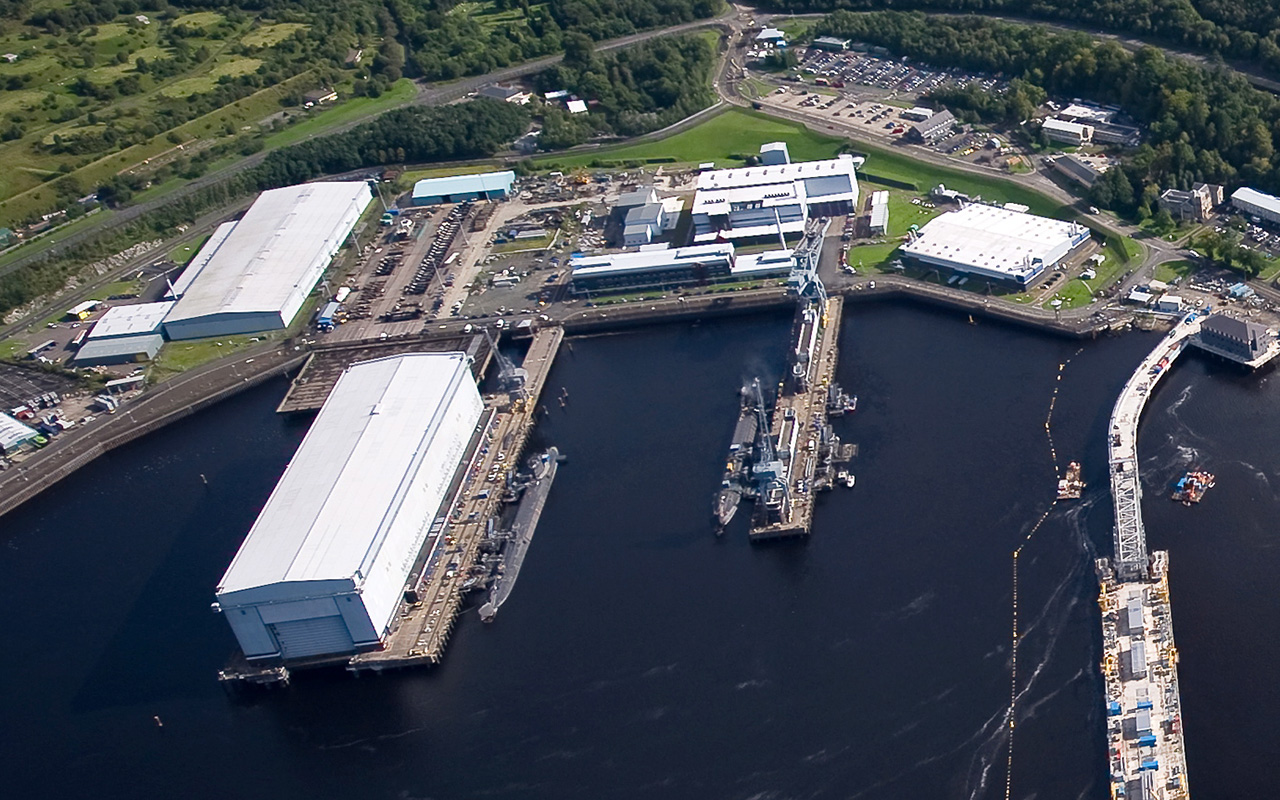
The Ministry of Defence has awarded a contract for a temporary container-based storage and working facility at HM Naval Base Clyde as part of efforts to increase submarine maintenance capacity.
The £68,890 contract has been awarded to Beaverfit, a Shropshire-based company, to provide an ISO container-based temporary covered storage solution supporting the Royal Navy’s Submarine Maintenance Recovery Plan.
According to the contract notice, the requirement covers the procurement, delivery and installation of a temporary structural solution near a car park area within the Clyde base. The structure will consist of eight ISO containers integrated with a canopy system to create a covered and secure working environment. The facility is intended to provide additional engineering and maintenance space while longer-term infrastructure improvements are developed as part of the broader recovery effort.
The Submarine Maintenance Recovery Plan was formally launched in January and is designed to increase the pace and productivity of submarine maintenance across the UK’s submarine enterprise. HMNB Clyde, the operational home of the UK Submarine Service, is central to that effort as the location where routine upkeep of the fleet takes place.
During a visit to the base earlier this year, First Sea Lord General Sir Gwyn Jenkins said improving submarine maintenance throughput had become a priority for the Royal Navy.
“Submarine maintenance throughput needs to drastically improve,” he said. “We want to put a radical engine for change in the middle of our enterprise, to recharge and refocus our priorities and get us ready for the warfighting footing we need.”
The recovery plan aims to bring together previously separate initiatives across the submarine enterprise under a single framework, with clearer priorities and improved coordination between Navy Command, the Submarine Delivery Agency and other parts of the defence organisation.
One of the early steps in the programme has been the rapid creation of temporary engineering facilities at Clyde to increase available workspace and reduce delays in routine maintenance tasks. Containerised workshops have already been used to add around 90 square metres of engineering space at the base, allowing maintenance teams to carry out additional work without waiting for permanent infrastructure projects.
The newly awarded container structure supports the same objective, providing covered workspace that can be deployed quickly while the wider recovery programme continues.
The recovery plan is expected to deliver improvements in maintenance productivity over the coming years as the Royal Navy seeks to ensure its submarine fleet remains operationally available while preparing for future platforms, including the Dreadnought-class ballistic missile submarines and the SSN-AUKUS attack submarine programme.









I do wonder what this really means.
Something very specific.
Has an existing engineering facility been condemned or is ‘something’ that used to be outsourced being done in house?
NTD was a massive facility that housed as much engineering support as was required for around twelve boats cannot see an obvious answer as to what the containers will bring to the party. The building still seems to exist with while additional row of three buildings in front of the workshops now.
Looking at Google Maps it all seems to still exist. I was in Faslane off and on 78-91 (Reso, Sceptre) and towards the end of my time it was starting to look a bit out dated and is probably beyond economical repair.
You’re right that we used to maintain a larger number of boats, more successfully, with less facilities. It would seem that the availability of boats is not down to the facilities!
When I first went to Faslane the vast majority of the are in the phot was the ship breaking yard!!
It’s a tempory ‘building’ placed in a carpark, allowing them to increase the capacity of submarine maintenance.
Search google for BeaverFit UK, and go to “Shelter Solutions”.
It’s an Anglo-American Business.
I admit, when they said ISO Container storage, I expected just them… Not the Tent that they’d got out of them series on the website.
Handy them.
The question is more ‘why?’
There is loads of workshop space onsite.
So how does a relatively small workshop add anything…..
I smell internal politics that necessitated a reorganisation to give some critical function autonomy…..
… ever the sceptic / cynic; never sure if you are of the Pyrrho school of deduction or the Antisthenes one, definitely not leaning towards any form of ‘lex parsimoniae’ rationale … maybe all the workshops are hard-pressed, occupied and/or otherwise engaged.
Could you extrapolate on “internal politics that necessitated a reorganisation to give some critical function autonomy”, sounds interesting, sounds like a need for extra workshop space.
If you’d ever managed a unionised engineering facility you’d know exactly what I meant.
I haven’t managed a unionised engineering facility … and to be perfectly frank, I do not want to. I imagine the difficulty arises not from the existence of the union itself, but from a breakdown in communication channels where management and union representatives view the relationship as zero-sum rather than cooperative.
My learned experience in managing people has taught me to treat them not as obstacles, but as stakeholders and moving away from any perceived adversarial model, they become an advocate in enforcing the very standards that keep said ‘facility’ operational and ticking along smoothly … most of the time.
… please share that, that is triggering your olfactory bulb.
I was on the board of one engineering company and the in-house workshops were an ongoing nightmare of intercine politics and lack of productivity. Basically down to a clique of guys who ruled the roost.
The solution was to break the workshops up into smaller subunits and put the doers in charge on the new sub units. Night and day.
Birds of a feather … and all that.
So whats going on at HM Naval Base Clyde then, I’m sticking with Bill of Occam’s proposal, more space for the big billy can in the corner.
Recently there has been a big increase in senior naval officers against a background of fewer fighting ships. 2 aircraft carriers, 7 frigates, 6 destroyers, nine submarines and no amphibious assault ships are directed by 134 Admirals and Flag officers and 260 Captains. The individual ships are mainly taken to sea by Commanders. Captains are too important to command frigates and destroyers.
It’s just taken them 10 days to get the Type 45 destroyer HMS Dragon ready for service in the Eastern Med. Phew, good job its not the Rusiians bombing us instead of Ukraine. Oh, and five of our Astute class SSN are unavailable awaiting maintenance
Grade title inflation is a thing in civvy street.
The manager of your local estate agents chain store is a ‘director’.
DoJSCOD Director of Janitorial Services Community Operations Directorate = toilet cleaner….
Joking apart there has to be promotion pathway to retain talent.
Temporary solution to address a pressing need.
Good to see progress.
90 square metres equates to a tiny box about 9.5 X 9.5 metres. Which Latin speaking bright spark in the MoD thought this one up?
surely this facility needs to have more covered dry docks, it always surprises me how this site seems to be fairly basic considering its importance.
A helicopter port is probably also required was we need to recognise people probably live/want to live somewhere else and will need to be flown in as well as the best air defence system we can buy.
Bench and some racking in a container in a car park