

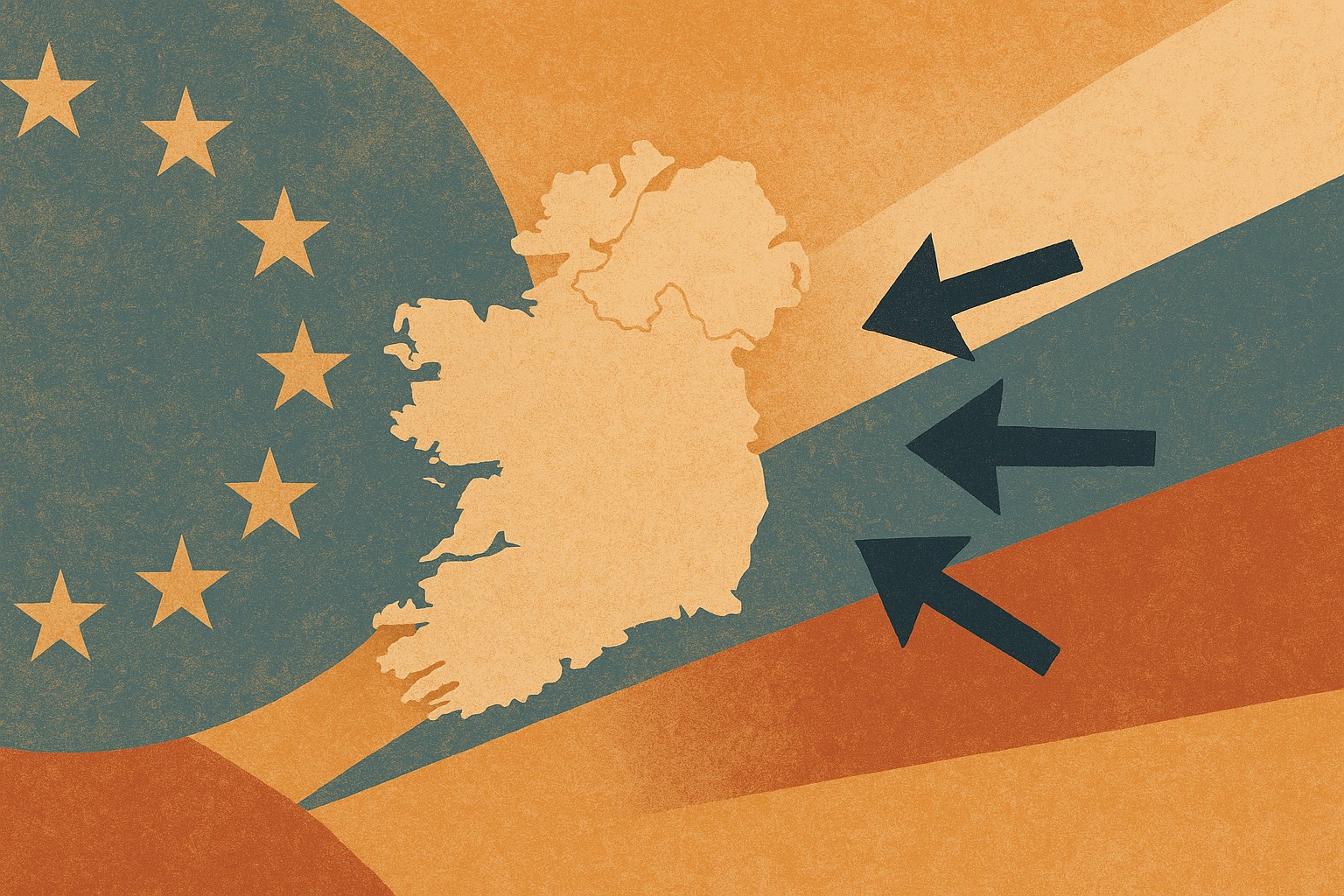
Ireland’s long-standing policy of military neutrality does not insulate it from Russia’s expanding campaign of sabotage, coercion and hybrid pressure across Europe, senior analysts from the Centre for European Policy Analysis (CEPA) warned during a press briefing on Russian shadow warfare.
The discussion was shaped in part by a question from the UK Defence Journal about whether the UK is doing enough to protect its undersea infrastructure and how Ireland should think about its neutrality when hybrid activity can spill across borders, as seen during President Zelensky’s disrupted visit.
The panel’s reply was straightforward. Neutrality does not stop this kind of activity reaching Irish territory, and incidents aimed at partners can have knock on effects for states that are not involved in the conflict. Their view was that both the UK and Ireland will need quicker political decisions, clearer coordination with allies and firmer response options if they want to limit the scope for these operations to keep spreading.
Much of the discussion centred on the structural weaknesses that Russia exploits. Sam Greene argued that the key problem is governments’ inability to move quickly in recognising that an incident is hostile, determining its source and deciding what it means for national security. He said governments must shift away from treating these cases as routine policing matters and instead develop a political security process that can act at speed. “Needing to move this out of law enforcement… and into where necessary and where feasible, a national security logic,” he said. He added that deterrence fails if governments cannot shorten the lag between recognising an attack, attributing it and determining its implications, noting that the question is fundamentally one of political process.
Eitvydas Bajarūnas reinforced that deterrence depends on coordinated and predictable signalling among allies rather than improvised national steps. He used Lithuania’s experience to show how punitive actions, if taken without alignment, can prove ineffective or even counterproductive. “Whenever you do this… you should coordinate with your allies. You should coordinate with the neighbors,” he said, stressing that punitive measures must be planned with economic and societal effects in mind rather than rushed for political effect.
Both Greene and Bajarunas underlined that Russia does not view Europe as outside the conflict sparked by its full scale invasion of Ukraine. From Moscow’s perspective, Europe is a legitimate arena, regardless of whether individual states consider themselves neutral. “Russia is in the state of war with the West… from Russian perspective, it is the same war,” Greene said. That framing removes any expectation that neutrality protects Ireland from infrastructure interference, cyber activity or maritime probing.
The experts also warned that the prevailing Irish approach of treating incidents as isolated technical or criminal matters is no longer viable. Greene said outright that “we can no longer look at this as a law enforcement problem… we can no longer look at this as a nuisance.” He argued that hybrid operations target political will and societal resilience rather than infrastructure alone and therefore demand a coordinated allied response.
The UK Defence Journal understands that the panel’s consensus was clear: Ireland will need to accelerate political response mechanisms, coordinate its messaging with allies and design punitive tools that are credible and realistic if it wishes to deter further hostile activity. Neutrality, in the current security environment, offers neither protection nor leverage.
A broader analysis of Russia’s shadow warfare strategy, including the patterns and methods highlighted during the briefing, can be found in the report discussed by the panel, available here.




Neutrality does not, but the UK does. Freeloading shall continue.
Yes, Ireland’s unique policy of unarmed neutrality (freeloading) may not deter aggressors but it does save a lot of money
That money can in turn be used to offer generous tax breaks to US tech companies keen to dodge taxes.
This is the nation that in the face of Nazi tyranny, while the free world was hanging on by its finger nails managed to do fuck all but still claim some moral superiority, if they can turn their backs on Europe and the world at a time like that then Putin and Ukraine in 2022 men’s nothing to them.
According to goggle AI search recent research suggests that about 70,000 Irish volunteers served with the British Forces during WW2. So while the Irish state might pretend to be neutral the people of Ireland have a history of stepping up.
Besides, Ireland is a member of the EU and the EU is far from neutral. Plus Ireland has provided Humanitarian and non-lethal military aid to Ukraine totaling about £300m. Not bad for a small country.
Nevertheless neutrality isn’t working and if they insist on trying to maintain that stance they are going to come seriously unstuck. They need to put the past into the past and see the world for how it actually is today, an increasingly hostile place with some very big aggressive states throwing their weight around. More than a few EU countries have made their feels clear to Dublin about what they think about Ireland’s neutrality.
Support for neutrality in Ireland is still strong with a poll at the beginning of the year show 75% in support of the position, but another poll more recently put support at 63%, suggesting attitudes might be changing, although two polls a trend do not make..! There is also significant support for increased defence spending so that Ireland can reduce reliance on foreign stated such as the UK. That might explain recent suggestions in the Irish press that they are considering the procurement of modern fighters…
Russia’s actions this week with drones shadowing Zelensky’s aircraft in Irish airspace might bring it home that they are seen as a weak point in Europe’s defences, not as a honest neutral state capable of providing honest and independent council in any peace efforts, which is how many Irish people see themselves and take pride in.
Ireland could see itself as a quiet little back threatening no one. Now, like their British neighbours they are increasingly on the frontline of Russia hybrid grey zone war against Europe.
The above article suggests the UK needs to go further as well to be honest.
Cheers CR
Support for neutrality comes and goes in Ireland. When Russia invaded Ukraine and Sweden/Finland joined NATO, support for NATO membership was over half in support of joining in the polls.
There is also the hundreds of thousands Irish-North Americans who fought for Canada and US in WW1 and WW2.
I find the military and civilian doctrine of Ireland as ‘peacekeepers’ was similar to a lot of thinking of Canadians. The military brass of Canada discouraged subsequent Canadian governments for any involvement in UN blue helmet ops. Bosnia left a bad taste in the Brass and lower ranks mouth.
Ireland should do the same as the UN’s street cred on the world stage, with all of the global conflicts currently, is less than stellar.
“goggle”? Is that an Irish search engine?
Yes, you are absolutely correct. Tens of thousands of Irishmen took up arms by joining the British forces and fought the Axis powers. Upon returning home, many were ostracised by their communities, leading 90% of them to emigrate to the UK with their families. I live in an English city where a good third of the population was made up of Irish immigrants who benefited the country by working in the car and aircraft industry. In fact, three of my great-grandparents came from southern Ireland when it was still part of the UK. My great-grandfather fought in WWI with the Royal Warwickshire Regiment and in WWII with the Oxfordshire and Buckinghamshire Light Infantry. The silly bugger got killed crossing the road while being totally plastered outside his favourite pub in 1952. A Morris Eight managed to do what Germany failed to do in 10 years of war!
All that still does not provide a good enough reason for the UK to pay to maintain the security around the Republic’s part of the British Isles. Of course, their inaction results in the United Kingdom having to take action to protect itself in extension.
My granddad and nan booth came over to do their part. Nan an army nurse and grandad to fight. Obviously they both settled here as going back to Ireland they knew they wouldn’t be welcome for helping the British.. even though it was the right thing to do
Good comment CR.Generalisations are the curse of debate that seeks to find some truth. People talk about Jewish people, the Irish, Yanks, Russians etc as though they are monoliths in thought and sentiment. There are those in the Republic that hate or dislike the British but many that feel a strong kinship and did indeed step up to fight against Hitlers evil. I am of Northern Irish Unionist heritage but have no generalised dislike towards the people of the Irish Republic, the opposite in fact
Ireland does need to participate more in European security and I hope that they do. However, I can’t think of anything less conducive to that end than having us Brits being obnoxious and imperious about it, justified or not. This is a job for the EU members of NATO and the UK should be ready and willing to lend a helping hand.
They can start to pay for some of the costs then. Instead of being the self righteous freeloaders that they are
I doubt Ireland will do a damned thing about this, but it will be interesting to see how Ireland reacts to a threat that actually bothers them, and all I can say is that it has been a long time coming !
Daft as it sounds it’s just possible that the U.K Government may have just played a blinder and undermined Irelands freeloading, neutral, gravy train.
Ireland’s largest earner is US Pharmaceuticals who use Irelands low tax environment to their advantage, that was fine but as Irelands exports are now subject to Trump EU Pharma Tariffs and the U.K. isn’t, solife may be about to get interesting.
Best bit is the EU isn’t likely to be too supportive of Ireland as they aren’t too happy with what Ireland has been doing either.
Trump is no fan of Ireland, he isn’t Biden and the Irish American diaspora isn’t what it used to be.
Irish-North America is doing alright. Carney is Canada’s 6th Irish-Canadian PM and has steered Canada more EU and UK.
The Irish-American voting block and involvement in US politics, in general, is still going strong.
Ireland does need to do a lot more….. a lot more for island security. Air/Sea security investment is a high priroty.
Irish-Americans basically do not exist anymore. America is white/black/latino/asian. Any European political identities are long gone.
Considering I interact with Irish-North America everyday, I would say they are very much around and quite well.
Is thst real “Irish American,” or those who claim to be 13% German, 10% French, 47% English/Scots, 2% Chinese, 1% Japanese, 0.5% Spanish, 2% Mexican, 5% Arab, 5% African, 2% Hebrew, 7.5% Italian and 5% Irish? Those “Irish Americans?”
Forget fact, forget reality. When the legend becomes fact, print the legend.
Haha Ex RM! When you think about it there is nothing in the blood that means much considering there is only one species-H.sapiens, but we learn by nurture to adopt an identity. Mine was forged when my Aunt took me down to the Shankill as a six year old to watch the 12th July parade 🙂
..and you forgot half a percent Apache 🙂
No, ones who have significant Irish blood. They exist in vast numbers across the continent and they typicaly settled in areas with other Irish for economic reasons.
North Eastern US, Atlantic Canada and Eastern and Southern Ontario have whole communities founded by Irish with significant populations to tis day. Lots of immigrant groups did not start mixing outside their own ethnic groups in North America until the 60s.
If there is a mix in these communities then it is typically the Irish would marry Scottish. Those mixes are quite common in Canada.
Long since time to turn drone/counter drone into a professional contact sport. That’s the way to improve the beast.
I for one have no idea how Ireland or the Irish for that matter, care anything about the protection of their borders both above, and below the waves. The impression is that they couldn’t give a fig most of the time.
Supposedly there was an increase in unidentified drone activity, when Zelensky landed at Dublin airport, as reported by crew members of the Irish naval vessel LÉ William Butler Yeats. That drone activity was even reported by RTÉ however, as to how serious or how much of a ‘drama’ it was to the Irish authorities… only they would know.
Certainly worth noting that drone activity over the airport occurred around the time the flight was expected, as it was it arrived early one presumes by design as such risks are hardly unknown to the Ukrainians.
On a side note I think we can see why Dragonfire is being pushed into service, this is the sort of threat it’s cut out for eliminating as it’s only a matter of time before we are targeted.
Where is the evidence that they were Drones, beyond the say so of whom?
I’ve not seen any film, is there any?
Our airports, civilian/military, have already been subjected to drone incursions in the last few years. The police and intelligence services have invested significant resources in combating it. The issue is that there are enough useful idiots around who are more than willing to put up a drone in exchange for some free crypto. Little do they realise that, while it is treated as a terrorist event today, in the event of any sort of conflict, the Treason Act will kick in, with consequences that could be terminal. The headsheds have been talking about that premise since 2024.
Speaking about neutrality as a protection? Belgium has something to say!!
Did not help Belgium at the start of WW2 did it, mind you Belgium did not stick its nose in things to do with those that boarder it,ever now and then. Or harbour terriosts, just saying.
To be fair, Belgium wasn’t originally neutral by choice.
We will protect them, patrol thier air space etc, all for free. Not bad for country that does not like us that much and has been an issue for over 100 years. Very leftie, helping those that won’t help them selves.
TBF it’s in our interests to intercept any potential threats before they are on our doorstep!
The point remains however they should do a lot more!but hay ho everyone loves the Irish don’t they😉😂
not me 3 tours of N.I. not a big fan of country that does nothing off the backs of others and interfers in things
Tongue in cheek mate! Living here in the North (2tours) it’s bloody annoying how they want to poke their noses into virtually everything to do with our executive!
Agree we stay thier politics be nice they stated out of ours and our law making.
The Irish may prefer to work with the French rather than have UK, their choice, unarmed neutrality is not sustainable.
It is for them, every does part of thier job for them for free. Neutrality but not in not every matter, they still like to interfer in some things and do noting about others,
OK so What actually happened then ?
These drones, what were they and where were they and where did they come from ?
All very confused here.
Where has it been established for certain that they were Drones?
On what the MSM say?
Well that’s really what I’m asking as I see the assumptions that Russian Drones were involved yet I can’t find any actual details 🫡
What actually happened ?
There is an article earlier about it mate.
There has never been any proof they’re Russian, ot that I’ve seen. Just the usual finger pointing as they are the obvious culprits.
The authorities know all right, mark my words.
Russian, whoever, they know. There is an agenda behind all this.
Thanks, I just took a look at it, ha ha, what a funny report “Two Drones of military spec, up to two hours flying” and a lot of nothing !
Possibly Sun Spots or strangely shaped clouds. !!!
Don’t take that in isolation, though.
This started above RAF Stations used by the USAF a year or two back. Then add Denmark, Belgium, the waves across the US. Some get more headlines than others
Did they ever investigate that Russian ship it was suggested was a launch platform?
Covered up again?
.
Yes, I have seen many such articles over the past couple of years, to be honest, every one seems to have no actual substance, no published details of type or origin and no real Idea what these sightings actually are. It’s a bit like Drone Paranoia !
Drones are just the latest UFO’s. Or they could just be Sun Spots.
There is a recurring theme of anti Irish Republic sentiment in these blogs. I do think the Republic should join NATO. I think they will in time. But freeloading? Ireland was raped and pillaged by the English for centuries, so a little payback is due. I’m Welsh, so biased (Wales was raped and pillage a few centuries earlier and it’s largely forgotten.) Where is the equal cry about Switzerland and Austria? Both are under the NATO shield. Are they not freeloading too, if Ireland is? I don’t see them being singled out.
Austria and Switzerland maintain defense forces that can deal with a full spectrum of threats if needed, Ireland has no real capability to protect not only itself but key European infrastructure that flows through its areas of responsibility. They are aware of this and for decades have had the UK unofficially protecting those areas as it is in their best interests too however, the UK can’t do everything and as hybrid warfare from Russia has expanded Ireland really needs to look at establishing the basics to protect what it needs too not only for their own sake but for the rest of the EU as well.
I do agree though some people do take a strong anti Ireland approach for the sake of it on this site.
not anti irish just anti free loaders who always do nothing then complain. They did next to nothing during the Troubles yet expect the UK police thier air space. May be its time they step up and do something useful, neutrality suits them as and when it can be used as an excuse.
Does not stop them having as say in our laws and the way part of the UK is run. Do not see us telling them what bits of thier laws we do and do not like or how the boarder should be.
Thank you Rowan, I actually agree with you. A courteous and well reason reply. Apparently others think England started after the Normans.. hmm well, it’s a point of view, I suppose… but King Athelstan 927AD might be a bit niffed by that statement as he is generally considered the first King of a united England! Admittedly they hadn’t quite subjugated the Welsh at that point.. that would take another 300 years, the Scots another 600 years and the Irish… well, that’s a long story!
Ireland has the same population and similar Gross National Income to Finland ($70K per person per annum)*… but their defence spending is very different (Ireland €1.1bn (rising to €1.7bn by 2030) Finland €6.7bn.. still only 2.4% though). (Sorry to mix $ and €!) (Interestingly the UK GNI is $47.7bn per person per annum.)
However if you’ve visited Finland you know that they are happy to pay tax for the social benefits.. at least they were when I was there and I think it hasn’t changed much! I’m not sure about how happy we are to pay for social benefit!
(There is the Irish phenomenon called *”leprechaun economics”… the big multinationals making profits registered in Ireland but these not trickling down to the residents, that distorts this GNI this figure, to be fair)
I am of Irish Catholic ancestry and do not live in the racist fantasy world you do.
Both countries were conquered by the Normans before there was an real English identity.
Prior to the Reformation they were developing a joint identity and could have been one country now abet with regional identities.
For a variety of reasons they chose different sides in the religious wars of the 15/17 centuries during which most modern national identities were forged across Europe, but those riffs were healing and as late as 1914 unity could have been preserved if the UK Gov. had crushed the Curragh mutiny as Churchill to his credit urged.
A weird fact is that Sinn Fein is one of the parties most open to increasing defense spending.
I see that factual history is not your strong point, but political whining about shite that isn’t real is! Nice one.
Yea, kind sir, do correct my poor grasp of history, or do you deny the English treatment of the native peoples of Brtiain. (English aren’t really British of course, the name predates them – Prydain).
This could take a while so I will keep it short, the English as a group came roughy from the North coast of Europe, roughly North Holland, Denmark and Northern Germany, and we weren’t the English at that time. Came over between 4-6th century initially as mercenary troops in small numbers for the later Roman Army, in Britain. The rest as they say is history. The English as a people was not actually considered that until the later 9th Century after efforts by the Kingdom of Wessex, Alfred the Great and then his son.
Their is not in fact any race who are actually Welsh, the Welsh are the Britain’s who moved Westward (along with West Cornwall) and the term Welsh is actually a bastardised version of a derogatory name the Anglo Saxons gave the native Britain’s. Once again the rest is history, and early and later medieval times was brought with warfare, both civil and dynastic, and nope, the Welsh did not suffer any more or any less than other areas, peoples or localities. But as an aside, history is history, it’s factual but can be spun to anyone’s agenda, so the to get over the fact your ancestors did not fight hard enough, or were clever enough to win. Right I’ve kept that quite simple, you should be ok.
It’s been a century. Get over it.
Switzerland? Not likely. Swiss have F18’s, and will be getting 36 F35A’s, Elbit drones, and have decent kit for Army, and conscription.
Enough to make them very prickly to chew on.
That is the point really?
Ireland don’t need full spectrum warfare they need primarily naval assets supported by air assets to defend the infrastructure that enables their phenomenal tax siphoning take!
I’m not too sure fast air is the very best investment where some P8 would be less controversial with some ASW surface navy.
Oh dear, how sad, never mind. Welcome to the 21st century for a country that thinks it’s still living in the 1930s. If they think the present day USA are their friends and protectors then they are even more stupidly delusional than we are.
As an infamous United States President has said, European NATO members have been “freeloading” off the US “for decades.” In the same vein, so has the Republic of Ireland, all the while stabbing the UK in the back in the EU. When you add the tens of billions earned by Tech companies that trade from the low-tax Republic of Ireland, the hurt is more. No doubt if we asked them to contribute, they would prefer to buy arms from France, Germany, Spain, or the United States. In fact, anyone but us, which is a shame.
I live in the Republic of Ireland. The total disinterest in security and defence at all levels – from the quarter of the population that are immigrants (e.g. 3% of the population are Ukrainians that have arrived since 2021) to government ministers is unbelieved. If pushed the response is basically “We are Irish, we have a great Craic and everyone loves us!”. So its head in the sand whilst supposedly taking a morale ground on things like Gaza, and more than happy to let the Brits effectively defend the country (“Its least they can do after centuries of oppressing Ireland – remember the famine!”).
on one alive remembers the Famine, nor has for 100’s of years, old grudge handy to bring up when it suits. The peope who caused the famine are all dead, long dead.
I’m Welsh, and standing by the ruins of a house in County Kerry (as I have) where everyone died in the famine, it’s not too hard to remember. It’s less than 200 years – it ended in 1852 just 30 years before my grandmother was born. (I won’t go in to her punishment for speaking Welsh in school). The whole of the UK was made by English force. Any other understanding of history is false. Yes, plenty of colluders, Welsh, Irish and Scots, but by force none the less. We’re a strong UK but it doesn’t help when some (only some) of the English re-write their history… I remember being told in my English Primary school (I went to a Welsh one as well) how awful the Indians were during Indian mutiny, and the poor British were innocent…. That attitude can still be found today.. despite the fact we should know better.
did it effect you? were you alive then ? no so get over it
And again I refer to my previous response to you, history is factual but can be manipulated to suit any agenda, very much like what happens often with politicians and various “ethnic” groups. The great Famine in Ireland, oh dear, done and dusted, not nice. But then again living in a slum in Victorian England, both prior to the industrial revolution and certainly after, high mortality birth rate, low life expectancy, horrendous living conditions, infection and disease…..I could go on, but how many Victorian English (and immigrant workers) died please, or do you only care about issues which suit your agenda. And its only the English which rewrite history yes? You have to get that anti English chip off your shoulder it does appear to be weighing you down somewhat.
I have lived in England most of my life and only slowly came to understand the dirty history of the “United “Kingdom. I didn’t want to believe it for a long time. I remember visiting Culloden battlefield and trying to find every excuse I could for the English actions. True, the Cambells took the English side, which just shows how complex history is.
History is not facts, but points of view. Just look at any news item reported by different journalist.. the same story but told in so many different ways. The job of Historians is to work through the evidence as dispassionately as possible to find the most honest and rounded account. That’s never a completed task.Some new evidence will change the story and the meaning. The Life of Brian (film) should remind us that reality and history aren’t the same. Brian is a hapless victim but his story is that of a great leader.
You can’t ask a nation to just get over its past. The Russians have a history seared into their brains that Mother Russia has been mistreated by the world. The trouble is there is more than a grain of truth in this. Putin isn’t just a megalomanic wanting to control the whole of the Donbas for financial benefit for Russia (though that’s true)… he’s tapping in to a deep historical narrative that the Russias (plural) have a destiny that nobody else in the world recoginizes. That’s why he’s so well supported, much to the West’s astonishment.
So, back to Ireland. Getting over what happened to your great great grandparents isn’t that easy. And there’s a biological reason why. See a very good clip of Prof Brian Cox explaining how trauma changes your physical make up and this is passed on down the generations so that children and grandchildren react to certain stimuli without understanding why. We can’t “just get over it” when it comes to the past. If we could we’d have no wars! Unless you think it’s time we stopped Remembrance Day for WW1.. who remembers that? It’s all way more complex. And if you don’t like complex you’re in the wrong area of interest!
By the way, I’ve no chip about the English. I’ve married two!! Not at the same time, you understand. I’m trying to explain how I understand the Irish reticence. It’s not just the English… Irish refugees from the famine didn’t always get a welcome in Wales either, I’m ashamed to say.
Thank you, that’s very helpful. I was in a West of Ireland town once and went in to a bookshop. It was jam packed with books about the freedom struggles of 100 years ago. Then I went into the chip shop next store and was chatting to the owner (as I supposed he was). I mentioned how Scotland might do well to be independent… this is about 10 years ago… his response was, “What on earth do they want independence for?” I found the juxtaposition of the bookshop and the shop owner a bit confusing!! By the way, I’m not sure I’d support Scottish independence now. The world has changed.
Thanks for all the above… but no one has explained why we aren’t asking the Austrians and Swiss to join Nato… The fact that they have better military that Ireland doesn’t really answer this.. who would they fight on their own, and who would they fight with? Unless they see NATO countries as much as a potential threat as Putin’s Russia? What else can neutrality logically mean?
Hi Wyn. In the case of Switzerland it is all about the attraction of neutrality as a safe haven for your money and not taking sides , so having the madness of war happen around you, leaving your country intact, and it seems to have worked well for the Swiss over many years. Irelands neutrality was necessitated by the impossibility of aiding the British through the front door but also recognising that the back door had to accomodate the realities of geography and centuries of entanglement with the peoples and Island of Great Britain!
Thank you. Indeed, but the Swiss can only do what they do when surrounded by a free Europe. If the Germans and Italians had won WW2 Switzerland would have disappeared. Austria…
Wow, these comments !!!!
😂😂😂
Nothing will change in the short term, the Irish Defence force is understaffed and under funded. While there may be a will from the Military to actually protect their nation (and wider Europe) the political will is not there. It would have been interesting should anything have happened to Zelenskyy’s flight, with no combat aircraft or any C2 capability to control the air that would have been a huge embarrassment, and a disgrace that a country could not even provide protection to a visiting head of State.
Ireland will keep freeloading claiming neutrality is best, and the proverbial “CAN” will keep getting kicked down the road for decades until something actually happens, and by then it will be too late.
God bless the Irish.
Plenty of Irish(Eire) past & present living & working in the UK & our armed forces, especially in the world wars.
Always in our best interests to monitor & defend our western flank. Considering the nadir of our forces at the moment we’re in no position to call anyone freeloaders when for 30+ years we’ve been bringing less every year into the NATO alliance.
Today we’re talking the talk whilst delaying any meaningful increase in mass when we could be into WW3, even without USA support literally any time. At least in the late 1930s we had an armaments plan & huge armed forces. We’re even still seeking cuts.
From the media it seems that recent activities by Russian ships and submarines in the seas surrounding Ireland is prompting a slight reaction by the Irish government. In particular a Thales CAPTAS-1 sonar system is being purchased which will be fitted to one of the OPV’s operated by the Irish Naval Service. But there is no indication that the Irish maritime agencies responsible for approving and overseeing underwater infrastructure have been given new ministerial guidance.
The irony being that Ireland could adopt a minor force of vessels for their seaborne enforcement and several Air Defence Regiments. I’m not against them utilising the RAF for QRA over them, but if they could secure the seabed infrastructure and the surface by bolstering Naval oomph with their own vessels, say a triplet of Type-26’s and associated navy helicopters.