

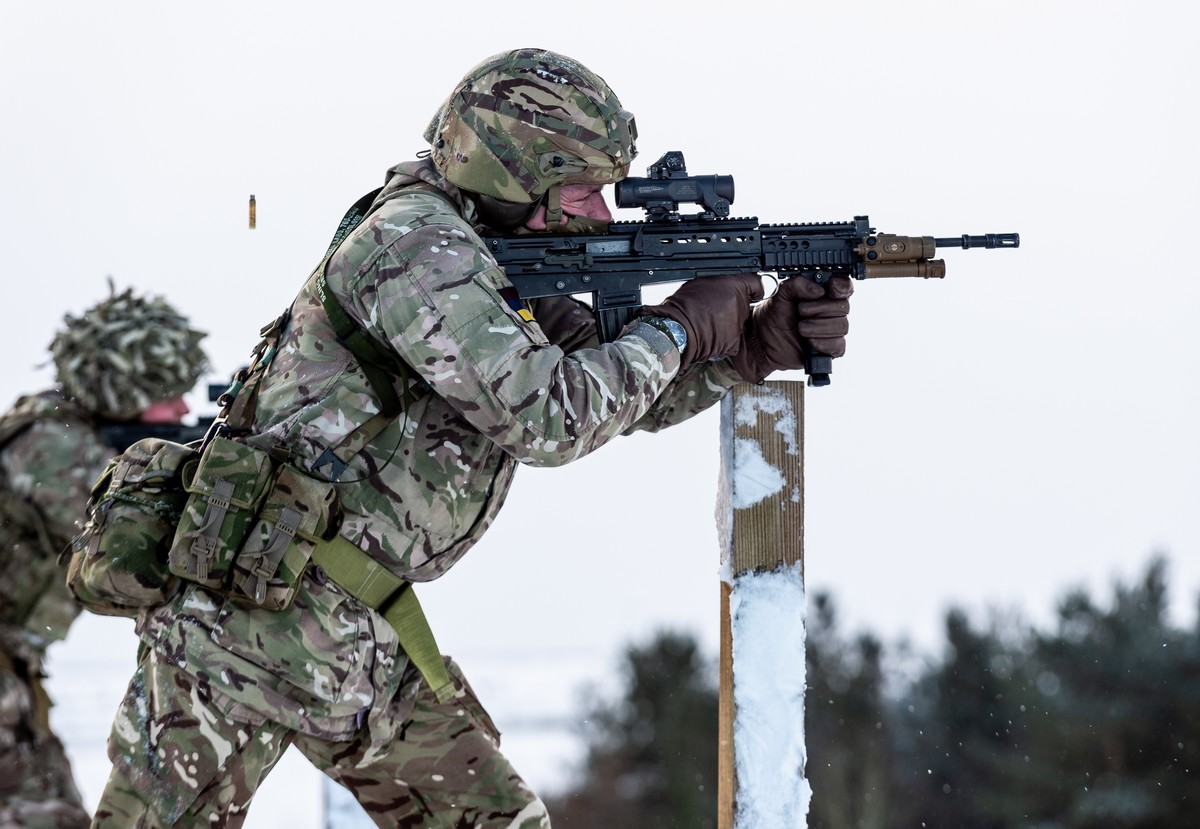
New Ministry of Defence figures show that prospective Army Reserve recruits face a wait of around seven months from application to entry, highlighting persistent friction in the Reserve recruitment pipeline.
In a letter dated 4 December 2025, Defence Minister Louise Sandher-Jones wrote to Sir Andrew Mitchell in response to a parliamentary question on recruitment timelines. The data relates to Army untrained Volunteer Reserve Other Ranks with no prior Armed Forces service who joined in the 12 months to 1 July 2025.
Sandher-Jones confirmed that “of the Army untrained Volunteer Reserve Other Ranks who joined in the 12 months ending 1 July 2025, the estimated average time from application to entry was 209 days.” The minister clarified that this figure applies only to individuals with no previous service.
The 209-day figure represents the median rather than the mean, meaning half of recruits entered more quickly and half took longer. As the letter explains, “the average is expressed as the median number of days… half of those that entered the Reserve Other Ranks did so in 209 days and half took longer.”
The minister also acknowledged that the published figure likely understates the true scale of delays. “Because the Reserves application process is complex and some data is inconsistent, certain groups were excluded when calculating this figure,” she wrote, adding that “including them would make the average longer.”
Those excluded include individuals commissioned through the University Officer Training Corps, anyone with recorded prior Armed Forces service since April 2007, and applicants who joined the Reserves through alternative routes such as Regular service or officer entry.








How complex is rocking up to a reserve centre express a desire to join and then said recruitment team does a criminal record check etc?
Not very.
But then that’s not why there’s a waitlist.
How long would the wait list be IF they were to bring in conscription?Will it take seven months to get someone into uniform then?
Depends. How much of the Army’s fighting strength would you draw down in order to facilitate training conscripts and what conscription model would you employ?
Not what I asked was it? Obviously conscription would not happen (and even then might not)until war was imminent! How did they manage before/during WW2,but if the CDS comes on saying prepare for war not up to me to do his planning is it?
You asked if it would take seven months to get people into uniform if conscription was introduced.
I pointed out that that would be entirely dependent on what proportion of the army is set aside to training conscripts and what model of conscription is employed.
If the army was reorganised to be entirely about getting conscripts through training (as most conscript armies are) then probably not, since the training capacity would be there, but it would be at the cost of other outputs the army has. If the Army adopted a voluntary or lottery based conscription model and remained at it’s core a professional expeditionary focused force, then yes it might very well take 7 months from recieving your papers to getting stood up.
As for how the army managed it in WW2:
For starters it didn’t happen fast. The Army that deployed to France was almost entirely pre-existing Regular and “First line” TA formations. The only “Second line” formations that where actually sent to France where used in rear echelon logistics and pioneering roles because, even 13 months after they’d been created, they where still not combat ready.
Secondly the Army did it by effectively culling the TA, effectively taking a lot of formations and either temporarily reducing their combat capability and splitting them up to form new “second line” formations that would be staffed with conscripts, or permanently redesignating them as training formations to provide BCR’s to existing units.
Well you have answered the question thank you.
Now has the CDS got a plan? It could even start by opening up drill halls and catering for any potential volunteers to have a chat with the TA cadres etc. Even old codgers like myself would be quite capable of pulling a guard stag if needed to help out! Surely everything doesn’t have to be last minute.com. If we are going to prepare let’s actually do it!
I don’t know, I’ll ask CDS next time I see him. But some of the stuff you suggest is already available; Pretty sure MPGS is hiring if you’re keen to stag on.
No need for sarcasm is there?
Have a nice Christmas! Scots on duty for Crimble,everybody else new year?
I mean if you ask me a question I’d have to be psychic to answer I’m not sure what else you expected?
And people wonder why Putin thinks he has the upper hand. Heads should roll for this, exactly what this country does not need right now.
Seven months to join the RESERVES!!! This can only be described as ridiculous. Then you’ve got this statement: ‘Those excluded include individuals commissioned through the University Officer Training Corps,’ – but those commissioned wouldn’t have waited seven months before they were accepted for the OTC! Why should people on ‘normal’ recruitment be treated any different to those joining a university OTC?
Because OTC’s are a non-deployable training/social club.
Pretty much true – though still with access to most of the things a soldier in training would have access, still has to sign the officia secrets act, and guess who would be the first people conscripted in time of war? The simple fact is that it takes a couple of weeks to get an enhanced DBS and any further security checks can be made while induction and training are ongoing. It shouldn’t take seven months.
Except you notice I didn’t claim anything about security checks, Official Secrets acts or enhanced DBS did I?
Again true – but what other viable excuses could there be? If you are talking sabout a company hiring staff every private company in the country can advertise/interview/recruit in the space of a couple of weeks (or, at entry level soldier, send in application and hired!)
Nope. And no “excuses” but reasons.
As I said, OTC is primarily a social club doing a bit of in house military-ish training on the side. It doesn’t have to worry about things like, Phase 2 instructors being available, and spaces at depot.
Most of the time that recruits wait to start the application has been sent in and they have been hired, and it’s a case of waiting for a spot in training.
Not really an acceptable reason. The article specifies ‘wait of around seven months from application to entry, ‘ Note ‘to entry’. I would take that to mean before you start getting paid. Being hired then told you won’t start for several months… really? and if it’s a case of waiting for a training spot then there needs to be an overhaul of training!
As for ‘doing a bit of in house military-ish training on the side. ‘ – When I was in the OTC many years ago we went on our annual training. Normally we took our own guns, but this time we be borrowed 3 105s from a Junior Leaders unit. 2 of the 3 guns were U/S! That was a regular unit – ours were composed of people in a social club who repaired the guns and gave them back in good working order.
I don’t really care if you think it’s acceptable, the army doesn’t answer to you, the point is that the Army only has so many NCO’s with relevant qualifications and has to balalnce them between operational units and training establishments.
You not considering it acceptable is especially hilarious since you seem to be surprised at finding out what the joining process is. Yes, you go through your initial look at life, medical and interview/assesment which takes a month or two, and they, depending on how well you did and what career path you want to go into, you get offered a job with a start date. You start getting paid the day you enter your Phase 1 establishment and *sign the contract*. Not before. And easy from the sidelines to shout about wanting the training pipeline reformed, but if you know absolutely nothing about the subject that’s a useless demand. Everything looks easy from the peak of Dunning and Krueger.
As for you random unrelated annecdote, I really don’t give a crap about it. OTC’s are students playing at soldiers and if they sit in a OTC unit for their entire uni career without completing training it’s not a big deal. But that’s an argument that seems to have gone entirely over your head.
Taking your points in order.
What you or I care about isn’t relevant.
If the army only has so many NCOs with relevant qualifications, then that is the fault of past funding and recruitment. The army needs to train enough people to do the job. If there’s a war and the army has to expand rapidly ‘not enough NCOs with relevant qualifications’ is not going to cut the ice.
Your second paragraph basically means ‘I’m happy with a system that would result in any private organisation failing’. The current system of delays is one reason why the army can’t recruit the people it needs! As for being a ‘useless demand’ – it’s the recruitment process that appears to be useless if it doesn’t do it’s job properly.
As for random unrlated anecdote – it as neither. It illustrated two points – firstly, the OTC unit I was in produced a lort of people that became officers after leaving Uni. Likewise, it included a lot of competent people, certainly waya above the level in terms of expertise and standards than the unit who provided us with broken equipment!
As for completing training, I did a google AI search (hence needs to be used critically but still a good indicator) that came up with two statements regarding ‘real’ soldiers: ‘Overall Trained Strength: The Ministry of Defence (MOD) statistics consistently show high percentages of total personnel who are “trained,” often around 90-95% across the services (Army, Royal Navy/Marines, RAF). Army Infantry Specifics: A significant concern is the high dropout rate (attrition) during the first few months (Phase 1) of Army training, with figures suggesting nearly 30-33% of recruits don’t complete it, a notable increase since 2019.’ So there is quite a dropout rate there. So why are they considered any different to OTC? Perhaps a lot of new recruits also consider it to be playing at soldiers? – most OTC recruits have an interest in the army and if it wasn’t an effective source of officers it would soon be abolished.
Actually as an after thought I did a similar search on OTC members joining up after university. ‘While many UK University Officer Training Corps (OTC) members intend to join the military, only a minority actually commission as officers; a 2016 study showed about 40% of OTC graduates went to train as regular Army officers, and around 65% for reserve officers, with many joining the OTC for general military interest, skills, and experience rather than a guaranteed commission’
So not much evidence of treating it as ‘playing at soldiers’.
Its absurd . Privatised recruitment . I recall just turning up during a weekday then doing the full army aptitude test a bit later. Then maybe 4 to 7 months later i did the full recruits course. That was early 90s
Only seven months. Things are looking up!
I turned up at the barracks in Cardiff in 2005, signed up and 9 months later i was in Iraq getting blown up!
I am well out of date on this. Did my research:
‘The process to join the Army Reserve involves several steps:
Online Application: Start by filling out an online application form on the Army’s recruitment website.
Meet Your Unit: After applying, you will be invited to meet your chosen unit to learn more about available roles.
Assessment Centre: Attend an assessment centre for a two-day evaluation, which includes a medical examination and fitness tests.
Background Checks: Background checks will be conducted, but these are standard and not usually a cause for concern’.
So why does this take an average of 7 months? Is Capita involved?
Training pipelines. Generally getting through the four steps you outlined only takes a relatively short amount of time. The wait now is for spaces to open up in phase 1 and 2 training establishments.
Good points, on phase 1, could the ITG be expanded somehow, like using FTRS?
I also read that ATR Winchester is due to close, that won’t help either.
Non Infantry phase 1 seems to be gradually centralising at ATR Pirbright, which has expanded, where’s before I recall we had ATRs at Glencourse, Litchfield, and Bassingborne as well.