

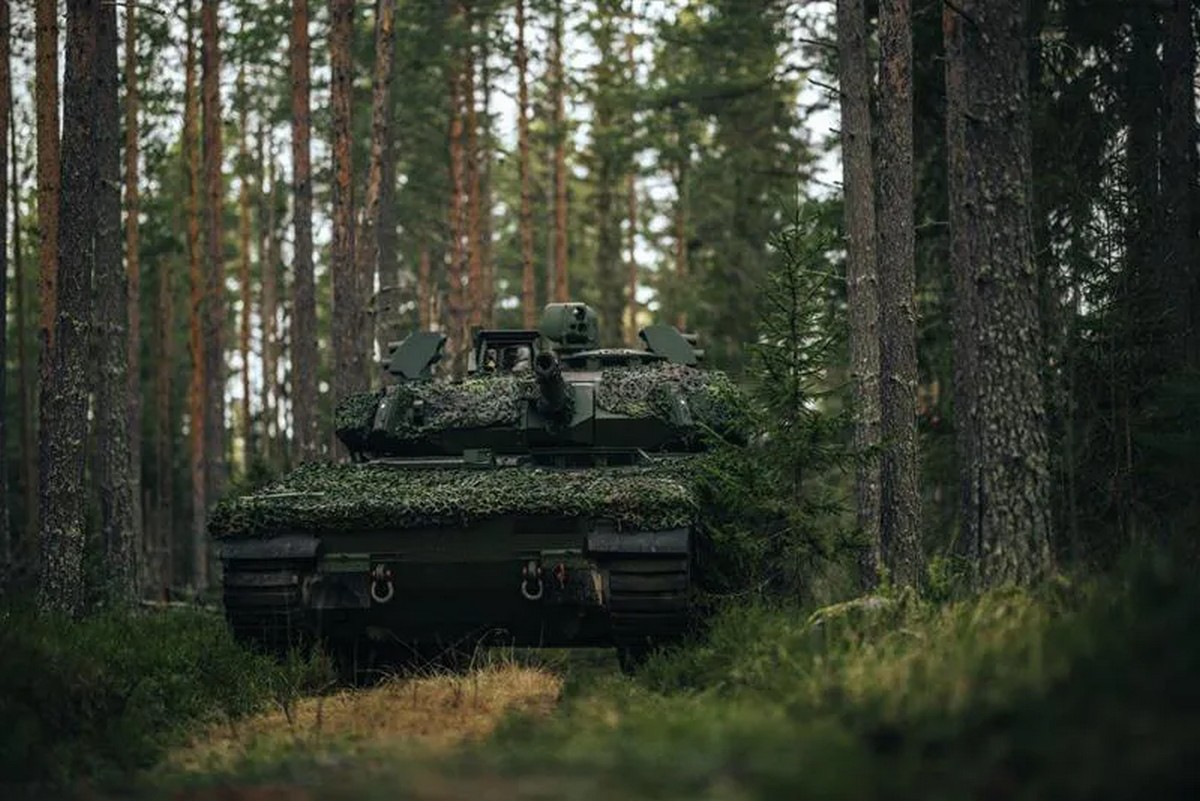
Elbit Systems has secured contracts worth a combined $150 million to supply its Iron Fist Active Protection System for integration on CV90 infantry fighting vehicles operated by European NATO member states, according to the company.
The awards were placed by BAE Systems Hägglunds as part of an existing strategic partnership between the two firms. Elbit Systems states that the contracts cover the integration of Iron Fist on CV90 platforms, with the aim of improving vehicle survivability against a range of modern battlefield threats.
The announcement follows a live-fire demonstration conducted in Europe in September 2025. During that event, Elbit Systems states that Iron Fist successfully intercepted more than a dozen 120mm kinetic energy armour-piercing fin-stabilised discarding sabot rounds. The trials were intended to validate the system’s ability to counter advanced anti-armour threats and were attended by senior military and defence industry representatives.
Iron Fist is described by Elbit Systems as a hard-kill active protection system designed to provide all-round protection for armoured vehicles. The company states that the system is intended to defeat threats including anti-tank rockets, anti-tank guided missiles, certain unmanned aerial systems, loitering munitions, and kinetic energy tank ammunition. Elbit Systems also notes that the system has been designed with relatively low size, weight, and power requirements to support integration on a range of platforms.
Iron Fist has been selected by several NATO and non-NATO armed forces for installation on different combat vehicles, though Elbit Systems has not disclosed specific customer numbers or fleet sizes associated with the CV90 contracts.
Commenting on the awards, Yehuda Vered, General Manager of Elbit Systems Land, said: “Elbit Systems’ Iron Fist continues to strengthen its presence among Western armies, reflecting growing confidence in the system’s capabilities across Europe and beyond. The results of our recent live-fire trials only reinforce this trust.”
He added: “We value the strong partnership we have developed with BAE Systems Hägglunds, which plays a key role in expanding our footprint across Europe, and we are proud that our innovative, highly advanced solution will enhance the protection of more forces around the world.”









A much needed capability for our Ajax and boxers, should we ever get around to placing some orders for kit. However for Europe 120m isn’t going to buy much.
If only we had gone for CV90.
Beyond me how anyone could have selected General Dynamics as a contractor with a Spanish base design known for vibration issues. Im guessing a UOR purchase of CV90 built anywhere but the UK will be the solution they come up with to Ajax.
Hardly, that’s even more money and totally chucks out the investment on Ajax
You want to give GD another five years and a few billion more to fix it then?
There’s a few options but I’d say it’s more likely they can the whole program than buy CV90
Could always bring forward Warrior replacement and tag it onto that 😀
Warrior upgrade program was cancelled remember, there wasn’t going to be a new IFV
And the OSD has been confirmed.
And the Americans cancelled m10 booker based on general dynamics ascod2 due to weight
Jim, I have a feeling that more fixes will be ordered for Ajax, and that this time MoD might contribute some of the money for them. Possibly there might be involvement of a 3rd Party to ‘police’ the work and validate the result.
The Ajax project is too big to fail and GDUK has got most of the £5.5bn (and are unlikely to repay much, if anything).
Sunk money faliacy
*fallacy
I agree; that is the most likely outcome, and the DIP is being reworked with revised costs and timings.
Ah yes the fixed priced £5.5 Billion oft cited on here as being a brilliant piece of business- How’s that looking now. I wonder if that £5.5b is included as a loss in the £28 billion recently identified as necessary to ‘sort our armed forces out’.
Looks likw a good bit of kit. I wonder why so many countries are ordering CV90’s when we have Ajax. They must be mad!!!!
Geoff, I have not heard of anyone buying the CV90 recce variant except for Norway.
I was more thinking about across the board of avaiable variants. Nearly all the JEF countries operate the CV90and our joining in makes seems a good idea to me but with our glacial decision making it will no doubt be too late now.
And the rest of Europe moves on into the 21st Century.
Just goes to show how large budgets don’t equate into army strength. Look at the US vehicles fleet and ours then look at countries like Finland with a budget that’s not even a % point of US military spending.
Fighter jets and warships need to operate at the threshold of what’s technically possible. Armoured vehicles don’t, off the shelf purchases should be the norm and domestic production is a nonsense when a company doesn’t have any UK facilities before making the bid.
Jim, as we tinker with Russia behind the might of the USA, the UK still can’t publish the military spending plan!
Happily for Starmer, any UK involvement in the Ukraine ceasefire might require Warrior and possibly many Mastif family, which would be ideal vehicles for the role. These machines are well protected, and I don’t know how many have been knocked out in the war, but I’m sure the UK did supply some? As for MBTs, I don’t think Putin will sanction their deployment for obvious reasons.
I think we gifted Ukraine some Mastiff family protected patrol vehicles and some Bulldogs, but not Warriors. I read on the front page of today’s DT that the DIP is now expected in March. ‘Military chiefs’ are saying there is a £28B shortfall in the defence budget over the next 4 years. The DIP was originally scheduled for Autumn 2025 so it looks like Starmer has demanded a detailed rework.
For those that don’t know. Israel produces two types of vehicle mounted active protection system (APS), Trophy and Iron Fist. The UK is supposed to be purchasing Trophy for Challenger 3. There are no rumours of it being used by other UK vehicles including Ajax?
Trophy has now been in service on Israeli military vehicles since 2013. It has been successfully used to defend vehicles from RPGs and ATGMs, where up to 7th October 2023, no Israeli Merkava MBTs fitted with Trophy had been lost in action. Hamas used small commercially bought drones (quadcopters) to drop RPG-7 and high explosive anti-tank (HEAT) grenades directly on top of the tanks (wonder where they got the idea for that came from?). The loses were due to Trophy’s “effector” turret not having the elevation range to engage, plus there is a sensor black hole directly above the vehicle. During the Gaza incursion by Israel, Trophy equipped vehicles again defeated multiple attacks from RPGs and ATGMs launched by Hamas. Since 2024 Rafael Advanced Defence Systems who designed and manufacture Trophy have upgraded Trophy, so it can now engage threats that are directly above the vehicle.
Iron Fist is made by Israeli Military Industries (IMI). As per Trophy, it uses an active radar to scan the direct environment around the vehicle. Which after validating a threat, tracks it and works out an interception point for its turreted effector. However, unlike Trophy’s explosively formed fragments of directed tungsten cubes. Iron Fist instead uses a blast projectile, which is initiated next to the threat. The concussive wave from the blast, is sufficient to either destroy the threat or deflect its path away from the targeted vehicle. In some tests Iron Fist has shown that it can deflect the path of 120mm armour piercing fin stabilized discarding sabot (APFSDS) round fired from a MBT, something that Trophy using its current effectors can not do! Iron Fist has been more successful in deflecting the path of slower moving HEAT shells. However unlike Trophy, Iron First has not yet (publicly) been tried and tested in combat.
Initially Trophy had one ready effector and one reserve effector per turret, that was loaded automatically. Subsequently working with Leonardo, the number of reserve effectors has increased. Neither company has said how many reserve rounds are now carried in the magazine, obviously! Iron Fist normally carries two ready effectors per turret. However, IMI have displayed turrets that include more effectors. Once these effectors are expended, they have to be manually reloaded “outside” of the turret. I believe Trophy is the same in this respect, once the magazine is expended.
Both APS systems can operate in either an active or a passive mode. Where in passive mode, an infrared sensor is used to initially detect the threat, that then activates the radar. Making it much harder for an enemy’s electronic surveillance kit to detect. The sensors (IR and radar) can also be used by the vehicle for counter-battery detection. Which is where the radar pin points the firer’s location, then slews the turret and gun onto the position. Where the commander can then authorize a response either by using their own firepower or calling in an airstrike or artillery.
The APS sensors are capable of detecting and tracking small drones, i.e. those used for first person view (FPV) attacks that carry a HEAT warhead. It would make perfect sense to link the sensors to a remotely operated weapons system (RWS). That can then be used to kinetically take out the drone beyond the effective range of the APS effector. Leaving the APS effectors to take out faster threats.
I can guarantee Ukraine has asked for Trophy, but it seems it has so far been refused. Perhaps people are worried Russia will develop an effective counter? However, it would make a significant contribution to not only defending vehicles, but allow vehicles to be able to manoeuvre again. Yes, you can swamp APS, but it will change the operational dynamic!
Excellent summary.
Israel comparison isn’t 100% fair, although still a solid analysis.
Their tanks were built from the bottom up to operate in urban environments where top attacks were likely. It isn’t just their APS that has saved them it’s the total design. They learnt this in conflicts they had been involved in.
Chally and all NATO tanks were instead built for combat in open fields of eastern Europe with combat of the 70s/80s in mind, and so top attacks was not part of the design thinking.
Just like most of our vehicles now have been built with v shaped holes, after the lessons from Afghanistan /Iraq
Hi Steve, I’d agree the Merkava 2, 3 and 4 were definitely designed to overmatch MBTs that neighbouring states used, i.e. mostly export versions of the T72 and T90. But as you rightly point out, lessons learned from fighting in urban environments heavily influenced the design as well, e.g. rear access door and 60mm breech loading mortar. The Merkava 2s and 3s did suffer very badly in the 2006 Lebanon war against Hezbollah, along with some of the early Mk4s. As Hezbollah had access to the then new Russian Kornet ATGM. However, much of the fighting was done in urban areas, where Hezbollah were using RPG-7 and 9 to fire down on to the tank. These losses led to the urgent requirement that became the Trophy APS.
The majority of Russian, Chinese and Iranian ATGMs use direct attacks, using a much larger warhead than found on comparable Western ATGMs (apart from TOW). Whereas a lot of the Western ATGMs now include either a top attack mode (eg Javelin) or an over flight mode that then fires the HEAT warhead downwards as it passes over the target (eg NLAW), due to the thinner armour and no explosive reactive armour (ERA) bricks put on top of the turret. Irrespective of the tank’s design, the Trophy APS was initially designed to counter either the direct attack or the attack from a high building. Trophy in later tests was shown to be capable of defeating top attack ATGMs such as Hellfire. Which dive down on to the target at around 45 degrees.
Trophy’s radar is an X-band AESA that is canted back, giving it a good view looking up. Thereby allowing Trophy to detect threats being fired from high rise buildings. However, directly above the tank, there’s a radar dead zone. Which Hamas during the 7th Oct attack, took advantage of. As they flew the drone above the effective range of Trophy’s effector, but also directly above the tank, so the radar couldn’t see it anymore. According to Rafael’s blurb, since 2024 they have modified Trophy to counter this threat, but haven’t said how this is achieved. Hamas were also advocating firing multiple RPGs at the tank, but from as little as 50m. As they believed Trophy wouldn’t have time to reload and cycle through its effectors, they got this tactic wrong and found out the hard way!
I think it is a fundamental flaw in the our Army’s attitude in regards to APS. Ukraine has clearly demonstrated that the one way attack drone has been significantly more effective than ATGMs in halting mechanical advances. Yes a lot of this is down to neither side having local air superiority. Where close air support cannot be employed without suffering significant losses. But a major part is down to how plentiful drones now are. Which tips the advantage towards the defender. A mechanized brigade whose vehicles are fitted with an APS such as Trophy would have an advantage, especially if the APS sensors are linked to the RWS as well. Allowing the vehicle to engage the drones from a greater stand-off range. As this would mean the brigade, will stand a much better chance of punching through a defended line, as it now has a better means of defeating not just ATGMs, but also drones! If we haven’t the funding to dramatically increase the numbers of personnel or vehicles in the Army. then at least we should spend what’s available at protecting what we do have!
Thanks for the detailed summary 👍
Nice post DB. And isn’t the UK ordering just 60 sets? What if you need to send more than 60 tanks into action and attrition for losses? Seems very silly to not provide for all tanks or 100+, considering small numbers of a such a prime asset.
Yep, sadly true. Typical MoD and Governmental window dressing.
Nice to know but doesn’t really effect us since we don’t have any kit to put it on.
We have all the boxers coming off the production line, along with the various protected vehicles that returned after Afghan/Iraq that are still in service, the archers, plus Ajax if they come into service. The system is designed to work on pretty much any military front line vehicle, more or less.
CV90 the one that got away 😟 🇬🇧