

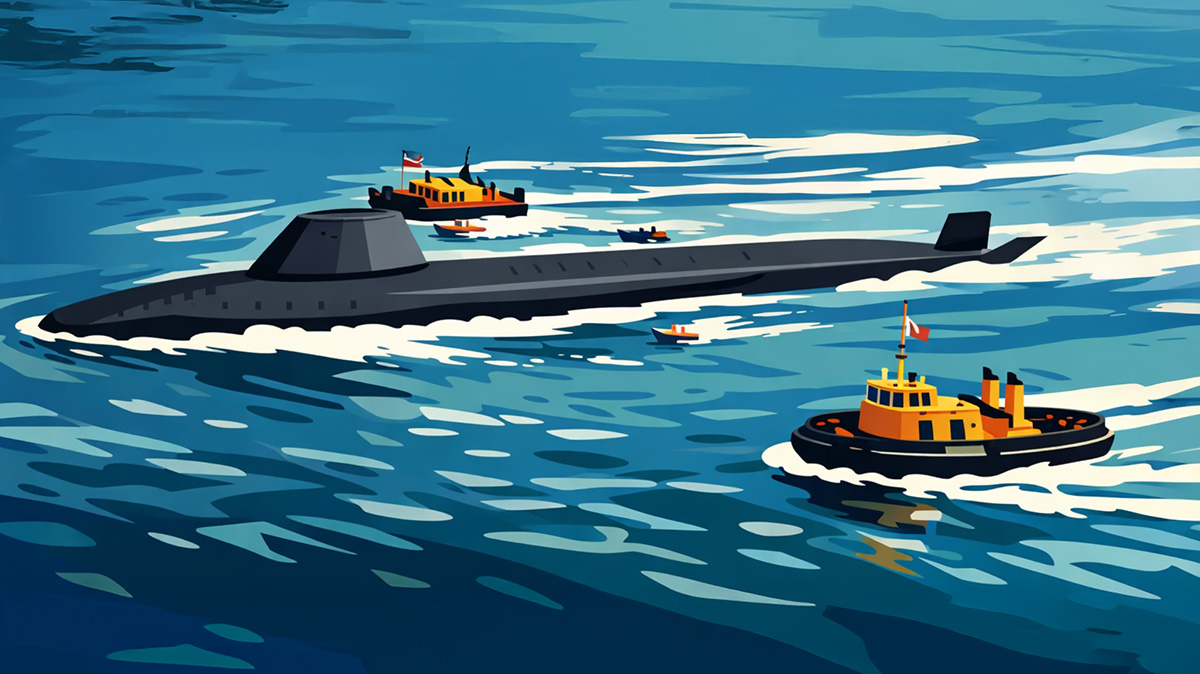
EXCLUSIVE – New tugboats intended to support operations at HM Naval Base Clyde, the UK’s nuclear submarine hub at Faslane, may be constructed in China under a major fleet replacement programme, depending on how the contractor applies its global production model.
Update: Following publication, the Ministry of Defence has provided a clearer and more explicit statement on the build locations for vessels procured under the Defence Maritime Services programme. The department now says that vessels ordered as part of this contract will not be built in China, addressing uncertainty that arose from the contract structure, the prime contractor’s freedom to select its supply chain, and Damen’s established use of overseas yards for similar classes of support vessels in other programmes.
At the time of the original reporting, neither the Ministry of Defence nor Serco had confirmed specific build locations for individual vessels, and previous official lines referred only to construction taking place outside the UK. That lack of specificity, combined with Damen’s documented production model and comparable overseas cases, led to questions about whether Chinese shipyards could be involved. The updated MoD position closes off that possibility and will be reflected in ongoing coverage as further detail emerges.
The vessels form part of the Defence Maritime Services Next Generation programme, under which Serco is replacing a wide range of Royal Navy harbour and support craft. The programme covers tugs, pilot boats and barges used at naval bases across the UK, including Faslane, which hosts the UK’s continuous at-sea nuclear deterrent.
Under the current arrangements, the Ministry of Defence pays Serco to provide support services at the Royal Navy’s principal bases, and allows Serco, as the prime contractor, to determine its own supply chain for vessel replacement.
Build locations and Damen’s production model
Damen operates a distributed shipbuilding model, with construction spread across a network of yards in Europe and Asia depending on vessel type and production capacity. The company has historically built a range of smaller commercial and support vessels at yards in China and Vietnam, including certain classes of tugboats, while other workboat types are constructed at European facilities in countries such as Poland and Romania. Final outfitting, integration and delivery preparation are often carried out in the Netherlands or at European partner yards, depending on the contract.
Neither Serco nor Damen has publicly confirmed the specific build locations for individual vessels within the programme. However, Damen’s established production model suggests that some tugboats could be built outside Europe, including at shipyards in China that form part of Damen’s wider manufacturing network. The official contract announcement from Damen confirms the delivery of 24 vessels to Serco between 2027 and 2028. The mix includes ASD tugs, reverse stern drive tugs, pilot boats, barges and crane barges. The announcement does not identify individual shipyards or countries responsible for construction, focusing instead on the scale of the programme and delivery timeline.
In the UK, political commentary has often assumed that the vessels would be built in the Netherlands, reflecting Damen’s headquarters and branding. Parliamentary questions and media scrutiny have focused on why UK shipyards were not selected, but have paid less attention to how Damen’s global supply chain may be used under the existing contractual framework. The prospect that vessels supporting infrastructure at Faslane could be built in China has attracted concern in defence and industrial circles, particularly given the strategic sensitivity of the base. While harbour tugs do not handle nuclear material directly, they play a critical role in the safe movement of submarines and surface vessels within confined waters.
Not the first time
A similar issue emerged in Australia in 2025, when the national broadcaster ABC reported that a new fleet of tugboats ordered for the Royal Australian Navy had been built in China under a contract awarded to Dutch shipbuilder Damen. The report said certification documents showed the vessels were constructed at Damen’s Changde shipyard in China, before being delivered to Australia under a civilian-operated support arrangement.
In response to the reporting, Australia’s Department of Defence confirmed that the tugboats had been built in China, while stating that they were not commissioned naval vessels and would be operated by a civilian contractor. Defence officials emphasised that sustainment activity would take place domestically and that the vessels were intended for harbour support roles rather than frontline operations.
While the Australian case relates to a different national programme, it demonstrates that Damen has previously constructed naval support vessels for allied defence customers at Chinese shipyards under commercial contracting models.
Wider security context
In a separate but related context, the Ministry of Defence has in recent months issued internal guidance concerning the use of vehicles containing Chinese-manufactured components, amid broader concerns about information security and connected systems. Media reporting has said warning notices were placed in some MoD-leased vehicles advising personnel not to discuss sensitive matters inside them or connect official devices, and that certain vehicles were restricted from accessing sensitive military sites. The measures were described as precautionary, with no publicly confirmed security breach.
Parliamentary questions have also raised wider issues about reliance on overseas-manufactured systems within defence and government operations. Ministers have acknowledged the need to assess potential vulnerabilities linked to global supply chains, while maintaining that decisions are taken on a case-by-case basis and that there has been no evidence of compromise.
Competing views on cost, transparency and social value
Those defending the programme argue that the arrangements reflect commercial shipbuilding norms rather than a deliberate policy decision. They note that hull construction in Asia can reduce costs and production timelines, with final outfitting, systems integration and acceptance carried out later in Europe under established regulatory oversight. Critics argue that the lack of transparency over build locations risks undermining confidence, especially where vessels operate at nuclear sites. They contend that clearer public disclosure is needed on where vessels are constructed and what safeguards apply during the build process.
Louise Gilmour, secretary of GMB Scotland, said the decision to source the workboats overseas represented a missed opportunity to support domestic shipbuilding capacity, particularly at Ferguson Marine, where the union represents the largest section of the workforce. She said the vessels were well suited to the type of work the yard had carried out for generations and argued that contracts of this scale could play a role in sustaining skills and employment in Scotland.
“These navy workboats are exactly the kind of small ships that Ferguson’s has successfully built for generations and exactly the kind of contract the yard needs to help secure its future,” Gilmour said.
She added that locating construction overseas, rather than close to Faslane, risked undermining local industrial capability at a time when shipyards were seeking to rebuild confidence following recent challenges. Gilmour also said GMB had written to Defence Secretary John Healey and Scotland Secretary Douglas Alexander calling for the contract to be reviewed, with a view to exploring whether work could be shared among UK yards. She argued that greater engagement with domestic industry was needed if long-term industrial capacity and workforce skills were to be maintained.
The row has prompted a broader debate about the long-term effectiveness of outsourcing models that are driven primarily by cost, particularly where they intersect with national industrial capacity and resilience. In recent years, defence and industry figures have increasingly questioned whether such approaches remain fit for purpose, as governments place greater emphasis on securing supply chains and reducing reliance on overseas production for critical infrastructure.
Against that backdrop, there is growing political and institutional pressure for contractors operating in strategically sensitive areas to demonstrate greater flexibility, especially where long-running service contracts include future phases that could allow for domestic involvement or work-sharing. Some analysts see the Faslane case as a potential indicator of whether defence support contracts begin to shift towards a broader assessment of value, one that weighs resilience and national capability alongside commercial considerations.
The Ministry of Defence has previously said that Serco is permitted to determine its own supply chain under the Defence Maritime Services contract, and that the UK Government has no automatic legal grounds to reject Damen as a subcontractor.
Government position and contractual arrangements
A Ministry of Defence spokesperson told the UK Defence Journal:
“The Defence Marine Services Vessel Replacement Programme is one part of a larger In-Port Services Contract, which was awarded to Serco in April 2025 following a competitive tender process. As part of this procurement, Serco selected Damen as its shipbuilding partner to deliver the Vessel Replacement Programme as a sub-contractor. In accordance with the requirements of the procurement, Serco was permitted to select their own supply chain. The vessels will be maintained in the United Kingdom but will be built in shipyards outside the UK.
The UK’s maritime sector continues to thrive, with BAE Systems securing a £10 billion export contract for Type 26 anti-submarine frigates this month – supporting 4,000 jobs across Scotland and the UK until the late 2030s, including 2,000 roles at Glasgow shipyards and opportunities for 103 Scottish businesses.”
UK Defence Journal has contacted both Serco and Damen seeking clarification on where the vessels supporting Faslane will be built, and where final outfitting and delivery preparation will take place. At the time of publication, no response has yet been received, but we’ll update this when they come back to us.









Everything we as consumers buy (pretty much) Is made In China, What’s the actual Issue with this ? Look at the Chinese EV’s that are flooding our market, names we have never heard of yet people are buying them because of the price. What’s the difference here ?
Happy Monday !
Israel and other countries have banned those EVs from being on their bases because it was shown that it was sending data (video etc) back to china, they use everything to spy. I wouldn’t want them anywhere near nuclear subs, it would be very easy for them to track movements. Knowing them they’d probably put a passive sonar system on it to record sound and send back to china lol.
How do you feel about the Goliath Crane used at Rosyth ?
Worried id imagine
Israël…which is one of the reasons for China’s advanced on military tech…
Go figure…
In terms of “stuff” you can touch and move, roughly 1 in every 3 non-food items in a modern UK home is likely to have been manufactured or significantly assembled in China.
I agree, any person in that base with a mobile phone has a communication device made in China. A tug boat is the least of anyone’s concern.
Serco – an outfit with a history of blunders, controversies and scandals around franchises, immigration, prisons, public service outsourcing, oh, and handling of sensitive duties. Good to know our defence contracts are in such safe hands. Maybe Serco can step up to build a few AUKUS submarinee for us. Who let this contract?
Most of those EVs will be in the junkyard in 5 years and hopefully people will have learned their expensive lesson.
Cope harder 😂
Complacent magical thinking by the oh so advanced *cough* west is still alive and well 🤡
To be honest. Some things I don’t mind being made in china some things I do.. and floaty boats are on my naughty list. China has turned itself onto the defacto maritime power and one of the key elements of a maritime power is building everyone’s floaty boats.. the thing to remember is the defacto maritime power has throughout history defined and essentially sculpted the age it was in..
I try my best to avoid buying anything in China, it’s a battle I often fail at but I extend this to clothes and renovations in my house, harder with tech, even my new shower cubicle last week was selected based on made in the UK. Everything costs me more but I’m happy to pay it. Anyone fancy a mandarin orange?
Damen pre-builds hulls “build-for-stock” in China, a cheaper method than the “build-to-order” strategy used in the Europe or the UK. China controls the supply chain for marine components like cranes, winches, steel etc. reducing lead times and logistics costs, plus favourable exchange rates and Chinese government incentives allow their shipyards to underbid European competitors while maintaining profit margins.
However, while Serco may save around £60 -70 million through Damen leveraging China’s shipbuilding strengths, it continues to undermine the foundations of the UK shipbuilding industry. The UK gov. could ‘provde’ Serco with a a financial inducement ~ a douceur (a sweetness) to keep the work in the UK, if yards are available.
Using that £60 -70 million extra to build locally, would be money well spent, bolstering; jobs, industry and finance and the trickle down £££ would seep into the local economy … and a lot of it ends up in the gov coffers anyway.
You have to invest in yourself.
Yes let’s spend hundreds of millions up the wall to get some tug boats built in the UK when we can’t get enough trained welders to build frigates and SSN’s.
Great idea.
👍🏻
But it’s not hundreds of millions, please don’t misconstrue and distort my words, that’s a very weak-minded position to take.
Is training more welders is a bad idea? Calm down Jim!
It will be hundreds of millions at a minimum. Even for a foreign design you will need to set up an entire shipyard, supply chain and train a workforce to build it.
The Scottish government has already had to put £750 million into Ferguson to get two ferries out and the yard will soon run out of work.
Then after the 24 tugboats are built what then? Is this yard going to keep selling tug boats internationally with no subsidy?
Probably not so we have to keep subsidising the yard are see it shut down after a few years.
Not just🧑🏻🦯 to the facts, but ignorant too.
UK Gov investing £20m in a new training establishment as part of Inchgreen upgrade. There’s your new welders and shipbuilding capability seed money. Tugs etc ideal for a starter?
Scottish Gov meddling, and an untried design, caused the overspend at Ferguson’s.
OK, so you start to
– build a training centre; and
– recruit new starters; and
– hire experienced guys; and
– form teams; and and and
How long does that take?
Also for tugs you absolutely do not need a dry dock to build them. They are best built in a large industrial shed and barge launched.
Also need to establish which military capabilities will be removed from the budget so we can pay for our home grown supply of tug boats.
The money at inch grave is paying for a security fence and CCTV along with pretty minor improvements. £20 million doesn’t go far.
Tugs are a highly specialised low value naval product. Trying to build them at a Shi repair facility seems like a very bad idea.
Large docks like inch green are needed for more important work.
Or we could just make sure they are built in say korea or Japan.. but we have a few small boat builders that could do the work and the more small boat builders we have the jobs create and the more welders we will have in 2030.. sometimes it’s about the whole thing.. ask china they will be the ones essentially subsidising these boats of we get the hulls from china.
We can easily insert a clause on supply chain risk that has them built anywhere but China which seems like a very good idea as opposed to trying to revive the UK domestic tug boat industry.
The only other thing I would add in would be reciprocation.. essentially if its government money spent abroad there should alway be a reciprocation clause.
There is a lot of aluminium workboat expertise at Cowes, but I don’t think that’s applicable to tugboats?
About 25 years ago the MOD/RMAS purchased the Storm class from FBM Cowes, there was a big hope of more orders, but none happened
Invest in yourself… Nah, I’m gonna pay someone else for the privilege of keeping an Airbase in the BIOT because some legal concern form a court that has no legal authority except our silly adherence to it because, moral high ground, despite it being in a ditch and surround by threatening ramparts.
I am Dutch and as such not neutral on Damen. However I also very much understand the need to support your own industry. Something the UK historically actually does betreft than The Netherlands . Apparently stil nog good enough to some.
Still, there are two strong reasons, besides budget, to stop complaining about this.
The first us that the UK as we speak apparently does not have the programs, designs, yard space and skilled workers to build these boats domestically.
Secondly in this day and age we need to strive towards a much stronger European cooperation on these matters.
The threats are everywhere..even to the West of us.
As long as there is no real downside , since the UK doesn’t lose a single job, let alone yard to this contract…let’s make it European at least!
Now.. China.. Not a fan! But also no real extra risk from this particular deal if the hulls come from there.
Much easier ways for them to do mischief than to do what..bug a hull? Of a tug?
I do hope our yards will get the financing, from our governments showing for sight.. for once…to set up more modern automated construction, with welding robots and such, so production can return, competitively!
No small boat builders in this country?
I live down the road from one. They build high speed ferries and clippers. They could build these I suspect. Whether there is any money to be made is another issue. I’m sick to death of hearing about Ferguson’s and how they could do it. They are like a shipyard in search of a ship.
Like wise. There are small ship repairers and boat builders near me that could certainly manage .
On the IoW? Cowes build a lot of fast aluminium workboats, I’m not sure about tugboats.
The issue is the control systems and reporting systems.
If you know you are pushing a boomer – observable with a pair of binos and engine settings can you then take control of the engines and run them hard at the wrong moment.
You could do a lot of grey zone damage that way.
Theyre just buying hulls from China
Not necessarily Hugo,
We know nothing about the support contract for these vessels. Do they have Chinese engines and pumps fitted? If so do they have logistical support and diagnostic computers fitted to them like modern cars. I bet they do, and I bet that the detail would be surprisingly comprehensive..!
Cheers CR
Agreed mate,
This is just daft. We know that Chinese cars come with tracking fitted as do pretty much every other modern car, difference is the Chinese state insists that it has access to the data and Chinese companies comply. If they didn’t the CEO / owners would be guests of the Chinese state! Understandably, there are few you would refuse the state! So the tech exists and can be disguised as part of the maintenance and diagnostic systems that will likely be fitted. Compare that data to satellite data and you have a very clear intelligence picture of our SSBN / SSN movements in near real time..!!!!
Then there is the point that clearly tax take, social value and GDP growth impacts of this type of contract have clearly not been taken into account which is foolish enough given our stagnant economy, but how many other government contracts across the UK state have been let on the same terms. Surely, letting contracts that take secondary tax take, social value and GDP growth (including possible positive impacts of investment opportunities) would be a much better way to develop and sustain much needed industrial and economic growth as opposed to old fashioned state subsidies?
This is a case of old fashioned short sightedness on the part of a government department that should know better and a contractor that is putting profit ahead of national security. Trump’s recent shot across the US MIC bows regarding executive bonuses at the expensive of nation security would apply well here, and I am no Trump cheerleader!
It is time our government, parliament and state machine along with everyone else in the country woke up to the geopolitical threats that we face and just how vulnerable we really are. Paying China out of the defence budget no matter how indirectly would be laughable if it wasn’t so serious. Governments would have been lambasted if they had done similar during the Cold War with the Soviet Union..!
I despair sometimes. Utter stupidity. Healey or whoever let this contract needs to answer some very very tough questions.
Cheers CR
I worked at two Damen yards in Dunkirk and in Haarlingen (Netherlands). Damen are good at the Project Management but they rely a lot on sub-contractors for labour.
A typical example is using Romanian welders and platers for the hull work. Damen could easily sub-contract work back into UK yards under their authority, it’s the project management that yards such as Ferguson are really crap at.
What incentive would they have for doing that though other than us paying them more money than a usual contract.
I’m more concerned at only 24 vessels.
There are well over 50 by my reckoning, spread between Faslane, Greenock, Kyle of Lochalsh, Portsmouth, Devonport, Gibraltar.
If is tugs only, there are about 25 of which some are very new and specialised (SD Tempest which is built for the aircraft carriers, for example) on the other hand some of the others are very old, dating back to 1980. I cant see the newer additions being replaced. the tenders area mixed batch as well with some being 35 years old and others which are newer
Ahh, I thought all the existing were newer SD types, not old ex RMAS. Interesting.
So,others will remain. Good.
I would say it would be pretty likely. The Impulse class which are over 30 years old are for moving the Vanguard class. One them was overhauled about 7 years ago, but they may now be both replaced. SD Helen left service about a 2 years ago, she had been in service for nearly fifty years!! But there is newer tugs purchased by Serco that are 15 years old or less
Thanks for this. Not an area I’m knowledgeable on.
LOL.
Only in the UK.
Only in the UK what? Theyre not MOD controlled, they can buy from where they like. A chinese crane build the carriers.
The order is for ASD & RSD tugs and pilot boats, barges, and crane barges.
UK yards are currently investing in Shipyard 5.0 technology, Ferguson Marine, Port Glasgow, just down the road from Faslane (10 miles) is struggling with progress only at 30% of new equipment installed.
Ferguson is in “critical need” of work for 2026 and that these 24 vessels would have secured the yard’s future for a decade. If they don’t get new orders soon, they risk losing their specialized workforce. Then what?
Shipyard 5.0 technology is a collaboration between people and robots … Co-bots, robots working alongside people and AI.
Shipyard 5.0 is a fascinating subject, eveyone should read about it
While Ferguson has the skill, they lack the capital. Because they aren’t part of a massive global group like Navantia or BAE, they haven’t been able to afford the £100m+ 5.0 upgrade costs. This is exactly why they are so desperate for the Serco/Damen tug contract—they want the work so they can prove they are worth the investment to modernize.
There are quite a few specialized workboat builders in the UK –
– Ferguson Marine (Port Glasgow) This is the most vocal critic of the deal. They specialize in complex commercial vessels and ferries. Union leaders have argued that Ferguson is in “critical need” of work for 2026 and that these 24 vessels would have secured the yard’s future for a decade.
– A&P Appledore (North Devon) This yard has a history of building small-to-medium vessels and is currently building modules for the massive Fleet Solid Support ships. They have the capacity and the specialized workforce for workboats and tugs.
– Harland & Wolff (Belfast/Appledore) While they’ve had financial struggles recently (now under Navantia’s wing), they have massive facilities. They have successfully built tugs and auxiliary craft in the past.
– Holyhead Marine (Wales) They are experts in pilot boats and specialized landing craft.
– Wight Shipyard (Isle of Wight) Known for high-spec aluminum and steel workboats.
– MST Group (Merseyside) They already build high-speed patrol craft and workboats for the MoD.
The “Small Yard” specialists like Holyhead Marine, Wight Shipyard and MST are competent global leaders, these yards specialize in high-speed, high-spec small craft. They are available, they are agile and could have started construction almost immediately.
Damen is currently fighting two massive, separate criminal cases in the Dutch courts:
The Bribery & Money Laundering Case. This covers a decade (2006–2017) of alleged “excessive commissions” paid to middlemen in Africa, Asia, and Brazil. If found guilty of corruption, Damen could be banned from all government contracts across the EU for up to four years.
also –
The Russia Sanctions Breach. This is the most damaging for their reputation with the UK MoD. Prosecutors allege Damen exported “dual-use” technology (including 14 deck cranes) to Russia after the 2022 invasion of Ukraine. In December 2025, two directors were even arrested in connection with this.
–
The irony is that the UK has finally built the “Shipyard of the Future” in Belfast, but it is owned by a Spanish company and is being used to build ships designed in Spain. This is why the Damen deal is so sensitive—it feels to many like another example of the UK “outsourcing” its maritime soul just as the technology to do it at home is finally arriving.
Very informative post. Thx
Seconded.
It is an interesting post.
Honestly it would be more credible if we ignored Fergusons in the argument as that tends to side track it into their inability to manage the design and challenges etc.
Design License Model … Damen is actually well known for design license model, They have a “Technical Cooperation” program where they sell the blueprints, engineering support, and “kits” of parts to local yards. So they could license their designs to Serco / Ferguson to build a portion of the craft.
Ferguson have been Totally Fscked over the years, but the new management are trying to ‘right the ship’ and become a trusted yard. They need the work to finnance the yards upgrade. The UK needs all the yards it can get. What happened in the past through fscked managment and a dysfunctional workforce should not preclude a reinvigorated yard.
Ferguson is on life support from the Scottish Government, but the support is strangled. Of the £14.2 million promised for modernization, needed for things like a new plating line to actually be competitive, LESS than 5% has actually been handed over. The government won’t give them the rest of the money until they show a “robust business case” with new orders. But they can’t win new orders because their costs are too high due to their outdated equipment.
There are three “hooks” being used to force a renegotiation of the serco deal –
The “Corruption” Clause -Serco’s chosen partner, Damen, is currently facing major legal proceedings in the Netherlands over bribery and sanctions-busting. Critics argue that the MoD has a “moral and security obligation” to halt the deal until those cases are resolved.
National Security (The “China” Factor) – It was revealed that many of these tugs—which will move nuclear-armed Vanguard submarines at Faslane—are slated to be built in China and Vietnam. MSPs are arguing that this is a massive security risk, giving the government a “National Security” reason to tear up the subcontract.
The “Mersey” Precedent – Proponents point to the Mersey Ferry deal in 2023. That was also a Damen design that was originally going to be built abroad, but after political pressure, it was “renegotiated” so that Cammell Laird in Birkenhead did the actual construction under license.
the UK gov. would look for a “Workshare Agreement” –
Keep Damen’s designs to ensure the boats actually work.
Negotiate a “technical cooperation” deal where Ferguson Marine or other UK yards builds the hulls or does the final outfitting.
The government would likely have to pay Serco a “premium” to cover the difference between Chinese and Scottish labor costs as I wrote earlier.
Appranently the UK Government is monitoring the Dutch court cases against Damen. If a conviction happens, it should give the MoD a legal “out” to force Serco to find a new, British-based building partner.
The only fly in the ointment is … The UK is BUST and HM Treasury will save every tuppence it can, even at the cost of UK jobs and security.
The Dutch gov needs to stop these court cases and intervene in other ways to clean up the mess.
This is typical Dutch ‘ being holier than the pope’ nonsense, specially the bribery stuf.
Everyone knows that shipyard and other defence contractors have only 2 choices in many parts of the world : pay ‘incentives’ , ‘ brokerage fees’ or whatever else you call bribes…or don’t compete.
Most compete!
There are scandals galore named after some of the biggest contractors in the world..and they got away with it, because …’ strategic national security concern’.
Boeing is building the refueling tankers , despite being caught cheating…
There are even places where you can use bribes as a tax write off…
Unless we change out contract with Serco, for a cost im sure, theyre free to pick who they buy their vessels from.
How is Ferguson going to build a tug? The yard under a previous owner last built a tug in 1995. So where would they get the design much less the experience to build a tug from.
It’s daft thinking like this that lead the SNP into the Ferguson debacle in the first place and cost the Scottish tax payer the best part of £1 billion and has lead to devastating cuts in western isles ferry services.
Who will be paying for all this, the MoD? The navy probably needs every bit of ship building capacity at Ferguson to keep the T26 build on time. Why would they pay money to build commercial boats and a shipyard that would then increase the cost of the navy’s frigates.
I agree with everything that has been said but with Scottish elections on the Horizon HMG might decide that it would be worth having a quiet chat with Damen.
Damen have stupidly been destroying themselves in the name of profit. They have good designs & are good at managing builds, but have morally lost their way. Of specific note, Damen is a Dutch company & it is the Dutch themselves that are taking them through the courts. Companies often forget that they are also a corporate citizen of any country they are incorporated in. If any form of spy sensors is found in one of these tugs, their insurance company will hang them out to dry & their directors may find themselves guests of his magesty.
“If any form of spy sensor is found in one of these tugs…!”
Good point DJ,
Thing is this could be applied to Serco as the UK MoD contract is with them and I bet there is a heap of security stuff in the standard MoD T&C’s..! So Chis’ point about having a ‘quiet chat’ would be equally applicable to Serco board members.
If I was the PM or SoSD I would be less than subtle about ‘talking’ to Serco’s CEO. I would call them into No 10 or MoD, suitably leaked before hand, and then make a very public statement afterwards that we had had a honest and open ‘discussion’ about Serco’s behaviour and lack of consideration of national security..! In private, it would be a bollocking, with blacklists and security driven home hard..!
Making a reasonable profit is fair enough, but putting profit above the national security of the country in which they operate is pure greed. Using defence money to boot is adds insult and contempt!
Cheers CR
PS. The more I think about this the more irate I get, so sorry if this is a rant.
Damen is the last fully fledged Dutch military shipyard left, out of many.
There is a reason for that, well there are more than one, but the main ones come together under one term : the Dutch Government.
We have seen the peace divident, followed by even more unhealthy cutbacks on our security. The Neo Liberals in power loved to use defense spending as a piggy bank also in the last decades.
A Dutch yard could have build a large number of submarines for Taiwan, which already owned two of the design, financed by the Americans.
Our gov blocked it…because of China.
And now we had to order French subs. Well, Damen was in the race in cooperation with Saab, untill the French came knocking in The Hague.
Damen has , like many yards, a hard time dealing with the unreliable , protracted and arduous government decision-making process. It has to stay afloat..so it competes where it can… and like EVERYONE who compete in these markets it pays incentives. Also called bribes.
I don’t particularly care about Damen perse but They Netherlands needs a viable yard and The Hague needs to realise this.
All this talk of “Chinese” is making me incredibly hungry…
I’ll be popping down the local as soon as they open — just need to remember not to ask for a tug!
‘told me tat’?
Don’t know where it’s getting approved but DE&S just instant no. Only a little contract but the Commercial Officers would ping a mile away surely? They aren’t performing what happens now? I’d not be taking that over to be approved “Where is it they’re from?” “Eh… China”. You’re talking a world where if your brief is more than a single double sided page it gets balled up in anger and thrown at you.
More profits going to support the PLA rather than our own forces. The CCP has been using the greed of our “elites”against us for decades. Meanwhile we’ve been destroying what could save us in any future conflict.
OT, sad to see the demise of “Warship World” bi-monthly magazine recently.
the “National Security” argument is no longer just a theory, it is a specific legal mechanism under the Procurement Act 2023 that is currently being tested by the UK government.
The “National Security Exemption” allows the government to ignore the standard “fair competition” and “lowest price” rules if they determine that a contract is critical to the defense of the UK. The MoD is currently choosing not to use this exemption for the Serco deal because they don’t want to pay the “Scottish Premium” the extra millions it would cost to build the boats on the Clyde rather than in China.
As I said before, your Bust and every penny must be saved … even though it’ll cost more in the long run, just like the E-7 Wedgetail radar situation that has become the poster child for what critics call “shambolic” UK defense procurement policy. Cutting their nose off inspite of them selves. Fscking awesome.
Are we sure this article wasn’t intended for publication in April? along with storys about pasta trees in Italy?
There is a number of questions that come to mind,
1st, why is the MoD allowing companies like Serco and landmark along with a lot of other defence contractors to undermined the UK’s ability to pay for its defence by maximising their profits while sending those profits overseas mainly to America so that our defence budget is paying for the 401Ks of the American retirees via the bank of America which have quite an interest in Serco, Landmark and Damen.
2nd, It is quite naïve to think that the Chinese will not have a simple tracking system (at least) in the vessels so that they can plot the movements of the RN vessels mainly SSBNs entering and leaving port.
3rd,We have companies in the UK like McDuff who build fishing boats and tugs who could do with the busines that Serco is sending overseas.
I just wounded who in parliament is sitting on the board of the Bank of America knowing that for every £ spent on UK defence the Bank of America and other American companies gets 10p to 20P of that £
Good to see “The adults” back in charge!
If you think if these boats were built in UK 20 to 45% of the wage bill would be returned to the chancellor plus national insurance and the British builder would pay tax on any profit how can it be cheaper unless China is using slave labour. What we have here is another example of the civil service brandishing their Euro credentials because they thought they would be built in the Netherlands. As none lethal ships they think they can get away with it. Remember those Ajax hulls built in Spain, another fine example.