


Senior NATO military leaders have underscored the importance of air and space power in maintaining collective defence during a visit to Allied Air Command in Germany.
Admiral Giuseppe Cavo Dragone, Chairman of the NATO Military Committee, led the visit to Ramstein on 25 and 26 March, where discussions focused on the role of integrated air capabilities in deterrence and defence across the Alliance, particularly along NATO’s eastern flank.
The visit examined how NATO’s Integrated Air and Missile Defence framework underpins airspace security, combining air policing, ballistic missile defence and ongoing vigilance activities. Officials reviewed how these systems operate together to provide continuous monitoring and protection of Alliance territory.
“Mutual trust, cohesion and reliability among Allies are the elements that ensure our collective resilience,” said Admiral Cavo Dragone. “In the modern warfare scenarios, trust remains our most critical strategic asset.” He added that the effectiveness of combat aircraft depends on integration within a wider multi-domain environment.
The discussions also highlighted initiatives such as Eastern Sentry, which involves the deployment of fighter aircraft, surveillance platforms and ground-based systems to reinforce NATO’s presence on its eastern flank. The programme is intended to strengthen operational coordination while addressing emerging threats, including one-way attack drones.
Lieutenant General Jason T. Hinds, Commander of Allied Air Command, said: “Allied Air Command will continue to leverage national capabilities to adapt and address current and future threats, ensuring the defence of our skies now and into the future.” He added that ongoing operations and training, alongside approaches such as Agile Combat Employment, are central to maintaining readiness and resilience across the Alliance.
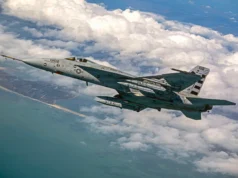


If we have seen anything from recent conflicts it’s just how important air and space power has become. Drones and long range precision fire is making land conflict untenable. Surface ships have to operate further and further from land.
The number one most important thing the UK government could do to increase our combat power and make a major commitment to NATO is to double the size of our fast jet force. Order the full 138 F35’a we committed to, get the tranche 1 typhoons back from storage and order some more tranche 5 typhoons.
Such a force could defeat the Russian airforce on its own and completely decimate any attempt at either a ground invasion or a surface naval incursion in the Baltic on North Atlantic. It would also be the best way to guard the UK from any no ballistic aerial threat.