

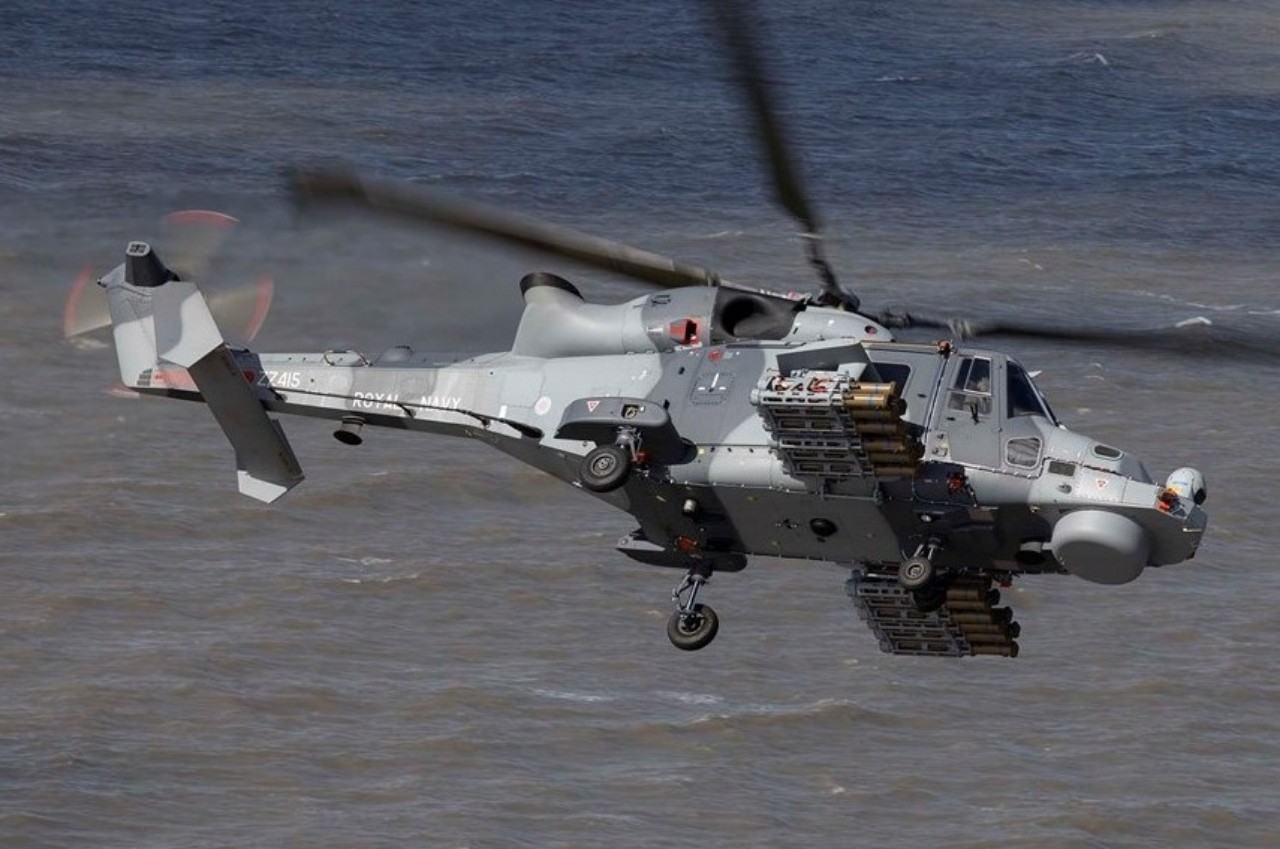
The Martlet lightweight multirole missile has achieved full operating capability with the Royal Navy, Thales has announced, in a significant expansion of the Wildcat helicopter’s operational envelope after a series of trials that extended the weapon’s firing parameters.
In service on Wildcat since 2020, Martlet has undergone extensive trials to broaden its capability beyond its original design parameters. The system was initially cleared to fire from altitudes above 500 feet against surface targets. It has now been successfully trialled firing from as low as 50 feet, allowing Wildcat crews to engage targets while operating below adverse weather and with greater precision against small to medium surface threats including fast inshore attack craft. The weapon has also been proven effective against aerial threats including unmanned aerial systems and helicopters.
Commander Andrew Henderson, Commanding Officer of Wildcat Maritime Force, described the milestone as transformative for the platform. “Martlet achieving FOC is a step-change for Wildcat. It has transformed the aircraft into a true multi-role strike platform. Already employed in the defence of UK interests in the Middle East to great effect, it allows us to engage and defeat a variety of threats from surface ships to airborne drones with precision and confidence, in all environments.”
The achievement makes Martlet the Royal Navy’s primary air-launched effector for strike, counter-UAS, and fast inshore attack craft missions. The weapon’s combination of low collateral damage, precision guidance, and now expanded altitude envelope positions it as a versatile tool across the range of threats Wildcat crews are likely to face in contested maritime environments.
Martlet has already seen operational use in the Middle East, where Royal Navy Wildcat helicopters have been flying defensive missions protecting British interests and partners in the region. The weapon is manufactured by Thales and is a derivative of the Starstreak high-velocity missile, adapted for the air-to-surface and air-to-air roles from a helicopter platform.






Cost-effective C-UAS munition?
May be against some of the threats yes I’d say so, but then against I guess it all depends on what the hell the UAS is heading for. A carrier and you might well be willing throw anything at even a cheap drone if it has leaked through the layered defences..!
What’s the cost of even the most expensive missile against the repair bill for a seriously damaged carrier worth billions or a flight full of expensive jets and loyal wingmen drones? Cost-effectiveness isn’t a always a simple calculation.
Cheers CR
I’ve gained $17,240 only within four weeks by comfortably working part-time from home. Immediately when I had lost my last business, I was very troubled and thankfully I’ve located this project now in this way I’m in a position to receive thousand USD directly from home. Each individual certainly can do this easy work & make more greenbacks online by visiting
following website—.,.,.,.,.—>>> JobatHome1.Com
Anyone know how much these are per missile?
£39,000 per missile
Thanks Jim
Some good news at last.
Good news. Whatever happened to Sea Venom?
Yes IOC was achieved during Operation Highmast so it’s now in front line operational use.
It’s pretty important as the RN now has its favourite type of weapon.. a small ship flight launched ASM.
Thx. So I can see Venturer and Active entering service as ‘patrol’ frigates with Wildcat, Martlet and Sea Venom leaving NSM until ‘capability insertion’.
Can we get these on the 24 Army Wildcats, please???
Interesting to consider the future of the AAC Wildcats if their function is replaced by Apache drones.
Obs: transfer them to the navy.
The Army has rather sensibly opted for the superior APKW
Not on their Wildcats they haven’t.
And though APKW is cheaper, and smaller, it has less range, fewer fuzing options and isn’t built in the UK.
(The Army use APKW on Apache, but LMM (aka Martlet) on Stormer and LML GBAD.)
Hi Chris.
Small correction.
34.
62 Total, 28 for the FAA as HMA2.
APKW is cheaper, and fire and forget –
classic Britain, develop a more expensive, less capable me too
I think the 2 missiles have different guidance systems. I wouldn’t say APKWS was superior, just different. As you say, Martlet is not fire and forget. It does not require that the target reflects a laser beam. I think there is an option for a seeker but there is none fitted for the RN. As I understand things, RN rules of engagement require manual SACLOS guidance to discriminate a target in crowded littoral scenarios. The missile operator can compensate for counter measures.
How so less capable? Martlet is supersonic for one thing and more manoeuvrable than a converted pod rocket. It isn’t vulnerable to laser dazzling which as DIRCM get more advanced will be a problem for SAL missiles. APKWS is not fire and forget, it’s SAL. Recently a variant has been developed with an IR seeker to help with targeting drones which allows fire and forget, but dual seekers are much more expensive and probably push it over LMM in cost.
APKW hits M2.9 – twice the speed of Martlet.
So it does; I have learnt something new today, and I am sorry for so confidently being wrong.
However the manoeuvrability problem will be even more difficult at such speeds as the control surfaces also carry the guidance sensors, making them heavier than a dedicated anti-air missile like Martlet.
Martlet IS NOT a derivative of Starstreak. The weapon itself is a derivative of Starburst, which is a VERY different beast, although the launch tube can be attached to the same posts and sights as Starstreak.