

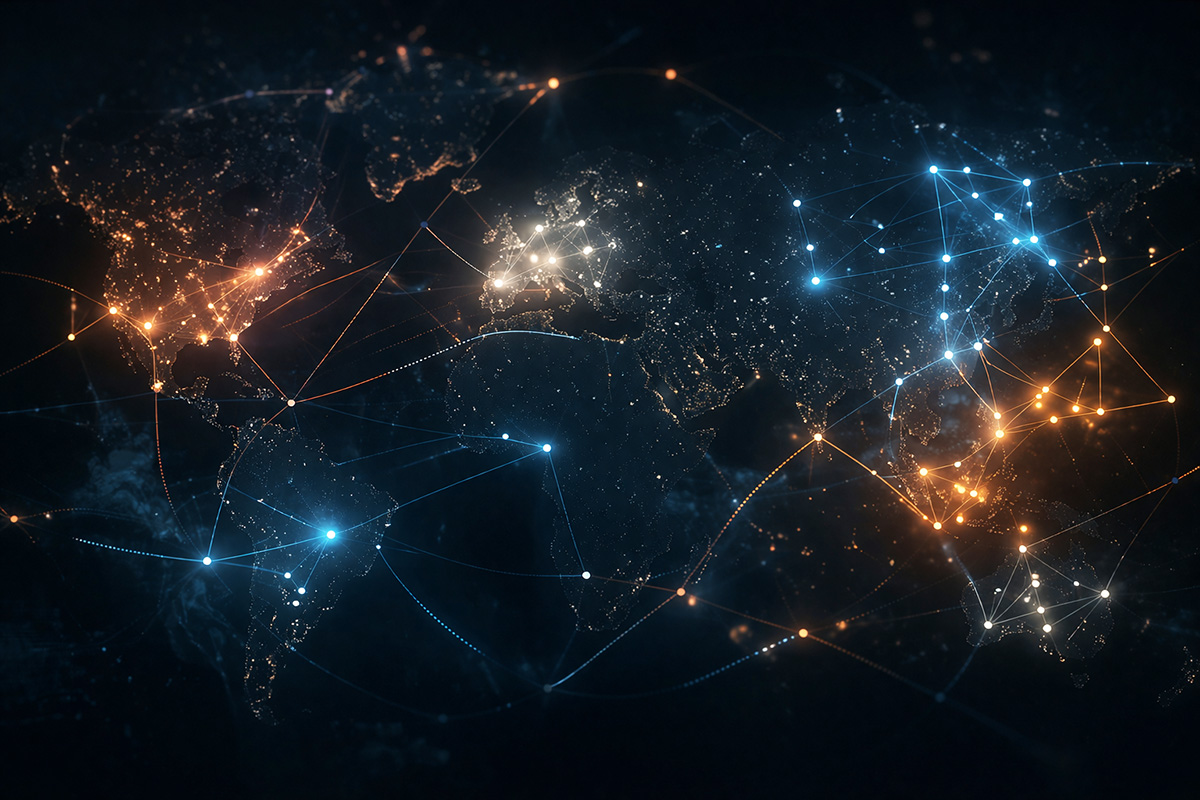
The liberal international order is dying, or so we are told. It might be argued that it has come close to its funeral many times over the last decade. The United Nations appears paralysed, overcome by its size. NATO is divided and trying to manage the shift from an expeditionary focus to territorial defence.
And the US, grappling with its place in the world, is talking about the current administration’s “quick wins” while there is plenty to distract. China and Russia’s increasing revisionism, from a patient and a disruptive approach respectively, provides a distracting backdrop. They are testing boundaries.
It is, therefore, very easy to conclude that the post-war architecture is finished, that the liberal international order is dead. Many commentators have done so. But what if it is not vanishing, but changing form?
The decades following the Second World War were unusually stable. There was a genuine period of broad, institutional liberal international order. That order does not, by definition, have to be US-led, although in this period it was. It worked, by and large. It was never perfect, but it did result in a rare period of durable alliances and deep economic integration, underpinned by US hegemony. For all its flaws, it prevented direct conflict between major powers.
Let us fast forward to today. The settled decades are well and truly over. It is easy to observe a steady accumulation of crises. Geostrategic events in the Middle East and the Far East are spilling over into Western politics at an unprecedented scale. Consensus on key issues has proved harder to sustain, and emerging powers do not share liberal assumptions. The liberal international order is under stress.
However, is it dying, or shifting? Trust, rather than size, is becoming the decisive currency of cooperation. Where the liberal international order was once expansive, it is now selective. Smaller coalitions can move faster precisely because they agree more.
Consider the Five Eyes intelligence alliance. It is underappreciated. It rarely makes headlines, although many in the intelligence world would argue that this is the point. Stemming from US and UK intelligence cooperation following the Second World War, it now includes Australia, Canada and, albeit reluctantly, New Zealand. It incorporates an extremely high level of shared systems and mutual trust through the intelligence sharing it enables.
From years of success within this structure came AUKUS, a trilateral agreement to develop the next generation of nuclear submarines and advanced defence technologies. AUKUS did not emerge from a multilateral conference or an inclusive forum. It was driven by senior officials and ministers across all three nations. Despite initial scepticism and some relatively minor strategic costs, such as backlash from France and industrial strain, it gained traction. That confidence was rooted in the history of the Five Eyes relationship.
Smaller alliances are not confined to the West. The expansion of BRICS demonstrates a degree of order, as does the Shanghai Cooperation Organisation, even if these are more about political symbolism, signalling dissatisfaction with Western-led financial governance. The Gulf Cooperation Council has had significant impact in areas such as energy and defence, acting as a unified, at least in aspiration, regional political actor. None replicate the depth of integration seen in Five Eyes, but all reflect the same instinct. In a fractured world, states are investing in clubs.
Smaller alliances do, however, create multiple “us and them” dynamics. There is a risk of bloc formation, questions about the inclusion of smaller states, and clear challenges in bringing together the great powers. But in a fragmented world, effectiveness may matter more than inclusivity, and there may be more to come from such arrangements. The challenge for governments will be to identify the connections between these groupings and deliver progress through them effectively.
The post-war liberal international order was built in conference halls, both literally and metaphorically. Today, it is being sustained in smaller rooms. Given how the world has evolved in recent years, the liberal international order is increasingly shifting towards a collection of smaller alliances that are more efficient, more aligned, and more numerous. In the years ahead, liberal order will not be measured by the size of its institutions, but by the strength of its coalitions and alliances.
This may unsettle those who prefer universal rules to selective alignment, but in a fractured age we need systems capable of acting together, not merely convening. The liberal international order is not dying, it is morphing into something new.
This article is the opinion of the author and not necessarily that of the UK Defence Journal. If you would like to submit your own article on this topic or any other, please see our submission guidelines






Wake up…it’s already dead
Thanks Dan – If it were dead, we wouldn’t still see states contesting its norms so actively. As argued, what we are seeing looks more like transition than collapse.
It was always going to happen. Demographics have shifted power away from the West and towards the East, where liberalism is largely ridiculed. China will be the next superpower undoubtedly, initially in a multi-polar world alongside the US, but both will be superseded by India within decades. The India – Pakistan cold war could well be the most dominating conflict of the next century, given their huge size. And what makes that conflict much more dangerous than Russia-USA, or China-USA; is their land border (especially Kashmir). If it turns into an explicitly Hindu vs Muslim conflict then it could also draw in Bangladesh, not to mention India’s huge muslim minority. Three countries with a combined population of nearly 2 billion, and growing fast.
But the main threat to western liberalism isn’t from abroad, its from our own domestic policies, and in particular immigration policies. I think western populations are slowly waking up to that, but it may be too late to reverse.
Europe with exception of baltic countries was massively reluctant to arm up and refused to see American annoyance. 2 muscular export of western like democracy was a farce that went on too long. 3. Drone warfare has made asymmetrical warfare more viable.
The old UN World order is washing away like a sand castle on a beach.
There was almost zero reporting of the BRICS conference in Russia in 2024. It is surprising that while Russia commits war crimes daily, Brazil, India, China and South Africa should all attend. But it is astonishing that another 32 countries also attended! But surely the most outrageous fact is that the UN Sec Gen, Guterres, attended officially, and stood on the same platform as Putin, who is wanted for WAR CRIMES !
BRICS is engaged in trying to build a New World Order. It is constructing mechanisms that aim to overthrow Western institutions. These institutions are based on the ideals expressed by Western values. Ideals that these 37 countries reject, even despise.
How can the UN any longer be taken seriously when Russia and China, by use of their vetoes, and aided by the “Global Majority”, impose their agendas?
Russia’s war and China’s theft of the South China Sea are both violations of the UN Charter. Yet both remain sitting on the Security Council using their veto. Since Putin came to office in 2012, Russia has vetoed 25 UN resolutions, China 13.
The failure of 52 UN members to condemn Russia’s war shows the Western values and idealism, that gave birth to the UN, have been abandoned by a much of the rest of the world.
The UN is dominated by nations who use their majority to promote their own self-interest and try to extort as much money from the West as they can.
It is time for Western left-wingers to face the reality, that the UN is morally and financially corrupt and the rise of a hostile, totalitarian BRICS.
It is time for the West to abandon its delusions and recognise that the UN has been turned by Russia, China and aided by the “Global Majority,” into a hostile, rottten absurdity.
It is no secret that the majority of UN member countries are not pro West to say the least. With France and UK each equal to the other three permanently on the security council and the US not wanting to fund, the whole thing is becoming sidelined.
Liberalism has ruined the West so its not sad to see its had its day. Weak men create hard times indeed.