

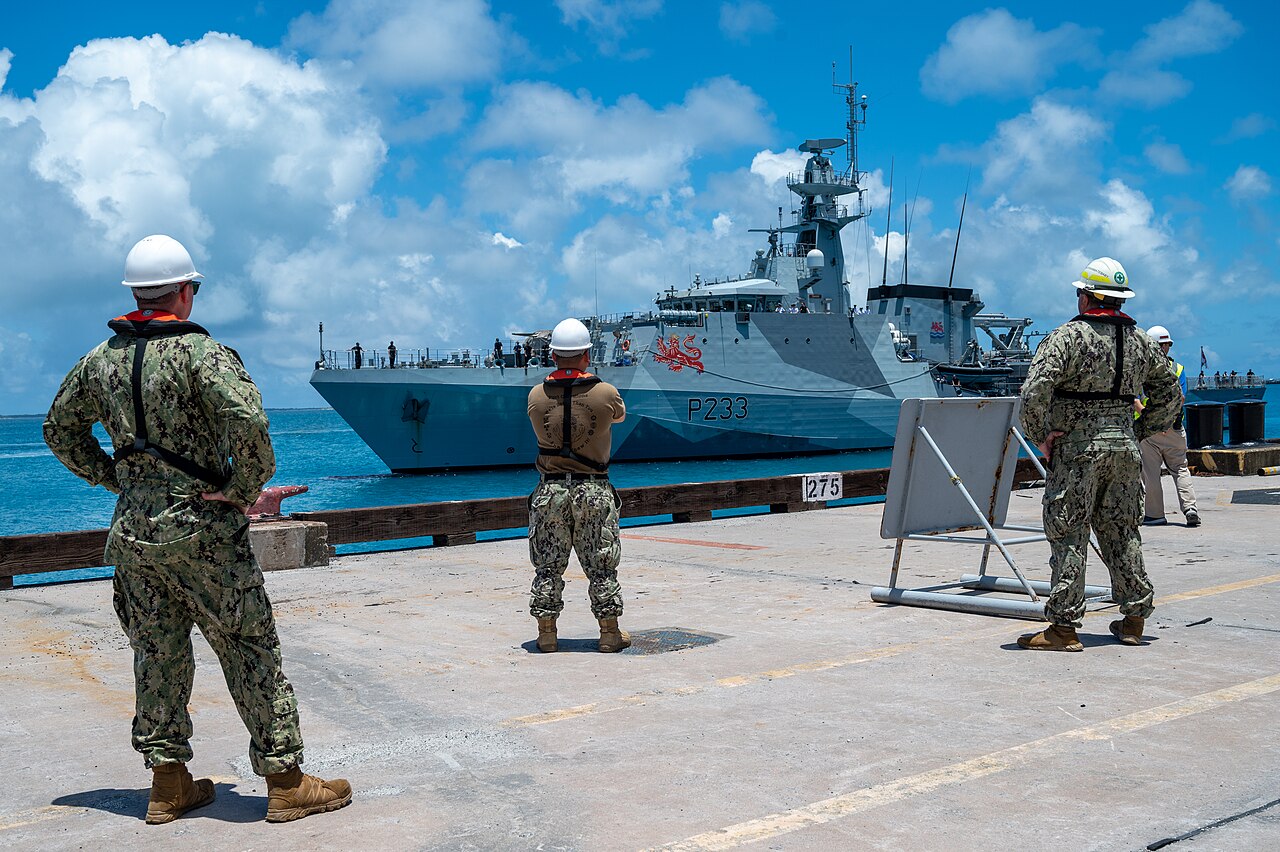
The recent public debate over the poor operational condition of the Royal Navy brought attention to the deployment of the Astute-class attack submarine HMS Anson to Australia.
Given the vessel was at the time the only such fully operational nuclear powered attack submarine (SSN) available to the UK and the ongoing threat from Russian forces in European and North Atlantic waters, this seemed an incongruous move at best.
Yet while the current UK Government has sought to move away from the ‘Indo-Pacific Tilt’ of the previous administration, the deployment of Anson served to highlight part of the UK’s underappreciated commitment to the region. This has implications for how the UK may find itself drawn into a potential conflict between the People’s Republic of China (PRC) and a US-led coalition over the fate of Taiwan.
As I outline in my book War Plan Taiwan: OPLAN 5077 and the US Struggle for the Pacific, the territory now governed as the Republic of China has featured in US war planning for over a century: since 1950 in the form of contingencies to defend it from attack by the PRC. Following the end of the Chinese Civil War via the victory of the Communists on the mainland in 1949, Taiwan became the refuge of the defeated Nationalist government. While that government initially retained its status as the internationally recognised representatives of ‘China’, this fell away under the pressure of realpolitik until the US itself switched recognition from Taipei to Beijing in 1979.
While Washington’s plans for defending Taiwan were quietly maintained even after this point (and comprehensively reinvigorated after the turn of the millennium), the US officially refuses to fully commit to protecting the ROC as part of its stance of “strategic ambiguity”. For its part, the PRC maintains that unification – or as it terms it “reunification” – is a critical element of achieving the “great rejuvenation of the Chinese nation”, and has not ruled out the use of force to accomplish this.
Like the US, the UK does not recognise Taiwan as a sovereign state (having withdrawn recognition from the Taipei government in January 1950), and while it “acknowledges” the PRC position that Taiwan is part of China, it does not explicitly endorse it. Today, the tensions over control of the territory is recognised as a security flashpoint, and London has emphasised that disputes should be solved “through dialogue, in line with the views of the people on both sides of the Taiwan Strait.”
None of this is an indication in isolation that the UK is consciously seeking involvement in any war. Politically, the impossibility of UN Security Council endorsement for intervention, the legal ambiguity of Taiwan impacting on its ability to participate in collective self-defense, economic reluctance in London and the already thinly stretched UK Armed Forces’ commitments in Europe would count against such a move. Yet Britain’s network of alliances and partnerships means that in the event of conflict, there is more potential for British participation than is generally appreciated.
At the most basic level are the responsibilities that come with the UK’s NATO membership. While the alliance in general and the UK government’s current “NATO First” approach conjures up visions of a European focus, Article 6 states that member territories or their military forces, vessels or aircraft under attack must be in Europe, North America, the Mediterranean Sea or the North Atlantic area north of the Tropic of Cancer to fall under the agreement’s Article 5 which stipulates that an armed attack against one member is an attack against all. This excludes the state of Hawaii and the US Pacific territories such as Guam. However, the continental US (including Alaska) is encompassed. Were China to launch a war for Taiwan, there is a meaningful risk that territory covered by NATO would be subjected to attack from Beijing – either as an opening ‘Pearl Harbour’-style gambit or as part of an escalation spiral should the US opt to become involved in defending the island (a decision ultimately made by the president). It should be recalled that the only invocation of NATO’s Article 5 reflected the alliance’s commitment to North America. In the aftermath of the September 11 attacks, NATO Airborne Early Warning and Control (AEW&C) system aircraft based in Europe were deployed to support US air defence. While Article 5 does not mandate an automatic military response from the allies of a member state under attack, a refusal by the US’s European allies to render assistance (barring some extenuating circumstances such as an in-progress Russian attack) would likely be a death-blow to the alliance. Certainly, it is difficult to see how the UK could deny the US intelligence, cyber warfare, sanctions and basing support (including in Diego Garcia) were it to be subjected to an unprovoked attack.
Less formal commitments are also prominent. The visit by HMS Anson to Australia was in support of the AUKUS security partnership between the UK, Australia and the US, the submarine component of which will eventually see a new class of vessel delivered to the former two nations. Another component of this deal is the establishment of a forward deployment of US and UK submarines based at HMAS Stirling in Western Australia which will be known as Submarine Rotational Force – West (SRF-West). It is planned that one Astute-class boat will be part of this deployment from 2027.
AUKUS is not a mutual defence treaty. Nor is the Five Powers Defence Agreement between the UK, Australia, New Zealand, Singapore and Malaysia. Yet cultural connections alone make it near-unthinkable that Britain would not render assistance to Canberra in the event of an attack, to say nothing of more practical path determinants such as the deep intelligence integration between the two countries. Given the basing of US forces in Australia and the country’s likely role of a semi-secure rear area for the US in the event of a war (replicating a similar role during World War II), such a requirement may easily materialise. Given the presence of a UK contingent in the country, an immediate British commitment to the protection of Australia is likely to be politically unavoidable. Yet even if the UK opted to simply support the securing of Australia’s territorial waters and sea lines of communication, this would constitute becoming a combatant. Given the recognised effectiveness of the Royal Navy’s SSNs, there would also be pressure to take a more offensive role. Similarly, it is difficult to imagine the UK standing by should Japan, the largest host of US forces in the Western Pacific, be subjected to attack as part of a Chinese effort to take Taiwan – not least given the around 20,000 British citizens living there who may need evacuating.
Beyond political commitments, it would also be impossible for the UK to escape the economic implications of a Taiwan war. The 2026 Iran War has underlined the entire world’s vulnerability to disruption of critical commodities production and the obstruction of sea lanes. The 2025 UK National Security Strategy treats peace in the South China Sea and Taiwan Strait as a UK national interest in the context of trade and prosperity. The ROC is well-known as being at the centre of advanced computer chip manufacturing, and the likely wide scope of any conflict would create hazards for the sea lanes across East Asia. Restoring something approaching a status quo ante bellum in the aftermath of what would likely be the biggest global economic shock in over eighty years would not just be in the UK national interest, but an imperative of survival.
None of this is to ignore the current moribund state of much of the British Armed Forces, nor the more proximate threat posed by Russia. Yet a conflict over the fate of Taiwan is unlikely to occur tomorrow: my book provides an illustrative scenario set in 2029 – in my view, likely the earliest point where a PRC invasion would have any hope of success. We also know that the global situation can shift remarkably quickly: less than a year after the fall of the Berlin Wall, tanks from the British Army of the Rhine were deploying to Saudi Arabia as part of the build-up of the force that would liberate Kuwait from Iraqi occupation. While the prospect of a Pacific War in the near future dominates US defence discourse, in the UK, there is something of a petrified silence in public debate.
This article is the opinion of the author and not necessarily that of the UK Defence Journal. If you would like to submit your own article on this topic or any other, please see our submission guidelines
Rowan Allport is a deputy director at the Human Security Centre, a London-based foreign policy think tank. He has previously worked as a lobbyist in Westminster, and as a senior analyst for RAND Europe’s Defence, Security and Infrastructure team. Rowan has written for outlets including Foreign Policy, The Diplomat, and Defense One and is the author of the book War Plan Taiwan: OPLAN 5077 and the U.S. Struggle for the Pacific, published by the Naval Institute Press. He holds a PhD in politics from the University of York.








This is the problem with UK “think” thanks on the far east, they have no idea about the far east. If we took two seconds to listen to our five powers defence agreement Allie’s, the only people we are treaty bound to support in the far east we would know that none of them are willing to enter into a conflict over Taiwan and us entering into a conflict would make them a target.
The Trump administration has made this all very simple for us, we now have zero obligation to America over Taiwan.
Why does it have to be all based on Trump? Obligations could be directly to Taiwan. Whatever China’s claims over Taiwan are there are fundamental issues of respecting another country’s sovereignty, its democratic right to exist under international law and like Ukraine isn’t that what the West is defending and will fight to uphold anywhere? There’s huge potential acquistion of major microchip production, two top 10 shipping lines, Evergreen and Yang Ming, other IT industry and IP, other foreign investments, all up for grabs. It would be empowering for China and loss to the West and likely be non reverseable. Not sure hiw workd trade woukd adjust yo it. Might force more relocation of industries and investments. Got to show respect to China in the mean time, keeping talking and trading, participate in regional dialogue, trade forums and know what we stand for with like minded countries.
That’s the problem. Both the Beijing and Taiwan government claim to the legitimate government of the entirety of China. Taiwan isn’t a separate sovereign nation but a competing government
Yes exactly, we are too quick to paint the issue over Taiwan in black and white primarily because that is how the US wants them painted.
I’ve gained $17,240 only within four weeks by comfortably working part-time from home. Immediately when I had lost my last business, I was very troubled and thankfully I’ve located this project now in this way I’m in a position to receive thousand USD directly from home. Each individual certainly can do this easy work & make more greenbacks online by visiting
following website—,,,,,,,,,,,,…—>>> JobatHome1.Com
Yes and no. It is a sovereign nation to the Taiwanese people but a “competing government” to the mainland as you say but a different proposition to what HK was/is in having its own elected government and armed forces supported largely by the US. Its got a bit of a Crimea/Ukraine feel about iit being right up against very big brother. Lots of hi tech, industry, ip, investment at risk and importantly a loss of a people’s freedom to be their own. I think unfortunately the US has shown China “how to do it” albeit their way, with Venezuela. Peer pressure, international law, leading by example, seeking mutual benefit, all are good but the bigger boys seem to call the shots when they like. Hope the UK and wider West never loses its sense of morality and freedoms and what it stands for (acknowledging our imperfect past) to differentiate itself from others and we get our strength from that.
I don’t think Trump would ask! However, if Japan, South Korea and Australia become involved, that could tip the scales for the UK along with NATO.
Australia would for sure but only if it is attacked, not if it goes to war with China in support of the USA, we don’t have any treaty obligations to South Korea or Japan. South Korea was very slow to provide support to Ukraine. I feel for Japan for sure but not to get into a war with China over an island that’s legally still part of China. China is not making any territorial claims on Japan.
We can’t come running half way around the world to support a country that no longer supports us.
America has made its decision on NATO and we need to recognise that a move on, if anything Europe should be doing a deal with China.
We must make clear that Article 6 is in effect and its geographical limits will be respected. NATO is not the USA ‘s water boy, there to pick up the can in any Asian adventures the USA chooses to embroil itself in
Beyond Taiwan China appears to have no territorial ambitions, technically Taiwan is part of China by its own admission and it does not appear the people of Taiwan want there country turned into rubble to assert their independence. We can probably work with both sides to achieve a compromise (call Taiwan a Dominion and allow it to keep its armed forces for instance) the UK excels in this kind of ambiguity and if we can kick the can far enough down the road it’s likely China and Taiwan can eventually peacefully ratify their relationship.
If we can get past the Taiwan issue then no reason that China poses any kind of security threat to us and it can actually be a very valuable partner. A counter weight to an expansionist Russia and a US increasingly willing to throw its military weight around the world for nefarious reasons.
China are not particularly interested in a military conquest of Taiwan. Western media paints the PLAN as the modern bear.
In reality, changing economic and social conditions will eventually lead to a peaceful reunification (in the eyes of the mainland).
Maybe not in an obvious sense as Taiwan is likely to put up a fight but maybe try for a more psychological and overwhelming smothering sense which might also strengthen the Taiwanese people in response. An invasion of Taiwan and its industrial system, assets and IP addded to what mainland China already has now will be quite a power house. Not sure if current Western vested interests will just sit back and watch this one out.
🤣
If China invades Taiwan (after Trump has gone), then the domino effect would immediately awaken Pacific states, and a collective call to arms would ensue between South Korea, Japan and Australia, if only to make a token presence in the theatre. The need to demonstrate a naval presence would be vital in reminding China that the region is aware and willing to show it can respond. The likelihood of any of the afm engaging in direct conflict with China is very remote.
Trump is the only thing holding all this s*** show together. This is the collective of gimps
And China knows that
China and Russia knows that old Trump is the very best for their interests.
I get paid over $220 per hour working from home with 2 kids at home. i never thought i’d be able to do it but my best friend earns over 15k a month doing this and she convinced me to try. the potential with this is endless…,
This is what I do…..www.giftpay7.vip
I haven’t read the article just yet. Just up front on a practical level, does or will the RN ever have any spare vessels doing the rounds in the Indo Pacific? Does the UK want to be there even if the US at times gives the impression it doesn’t and that the UKs focus shoujd Euro North centric. As the RN rebuilds i hope indeed it spreads its wings, keeps up with its alliances, especially with like minded middle powers and strengthens its trade and military relationships. Doesn’t have to be blowing its trumpet but just to show it still is and can be there if needed. Might need a few more T31s to build up masse and deployable presence and get the MRSS happening.
The Royal Navy certainly wants to be there; maintaining relationships with allied forces, exotic runs ashore to draw recruits in, the ability to respond quickly to the crises that always crop up in the Middle East.
The UK government though? A US-China war would be a nightmare; our biggest trade partner and ally, at war with our fifth largest. Choosing a side would be easy, but the consequences for the economy and public opinion would be a shitshow.
“ I haven’t read the article just yet.”
But you’re going to comment anyway… 🤔😆
In the event of military action and the UK deciding to participate, the only real military effect we could apply would be an Astute class SSN.
By the time it arrived in theater I suspect the action would be over anyway. Any direct military attack on Taiwan would be an absolute blood bath, leading to a wider war between the US and China. In factnits hard to see how an escalation could be avoided. That in turn would usher in a world wide economic shock wave that would make the 1930’s great depression look like a stroll in the park, at best, at worst, WW3 would be triggering.
I am slowly changing my mind on this.
First my view on the likely hood of war.
People first need to understand that the reunification of Taiwan and China is not considered “optional” by the CPC ( CCP) or the Chinese people. It is essentially none negotiable and an engraved part of Chinese identity.. “The empire, long divided, must unite; long united, must divide. Thus it has ever been”. To fully understand why China will inevitably go to war you much understand that essentially reunification is a national religion and belief system it is core to Chinese identity and national self belief.. it’s chinas version of the USAs manifest destiny but build up on the steroids of a communist education system. China even has a date 2045.. this is not a start date this is an all smiles and one loving country date.
The next bit is leadership, Xi Jinping. Forget every western leader, forget power grabbing opportunist authoritarian. This man is probably the most effective leader of the 21c, but at his core he is an extremist believe in Chinese destiny as dictated by the CPC. He’s intelligent, massively capable but an utter believer.. this man’s parents were CPC generals arrested for treason, as a child he and his siblings were cast onto the streets essentially, he was threatened by the state, in the end his sister killed herself, he was then rounded up in the cultural revolution and sent to be a child peasant labour on a farm, he escaped was captured and spent the first years of his adult life in the cultural revolution era political re education prison doing hard labour ( this was a time when 20 million Chinese people died in the cultural revolution) .. after that he went back to the farm with nothing but a box of political books and worked as a peasant, he kept applying to become a member of the CPC after a few years a rejection he was accepted and after a while sent to university as a peasant soldier to study chemical engineering and later communist theory to doctoral level. He then did every hard knock job the communist party had in the provinces.. until he controlled everything.. from political prisoner doing hard labour to absolute control through essentially hard work talent and belief.. this man is the Antithesis of the modern western leader like Trump.. or any western political leader.. the US naval institute called him the greatest navalist leader of his generation and one of the greatest of the modern era ( that’s the last 300 years). So if anyone thinks that man is backing away from chinese destiny they are bonkers he has the ability and solute will.. but does he have the power.
It’s actually quite likely that Xi is the most single powerful individual ever.. even absolutist monarchs had stops on their power and control ( mainly through poor communications and intelligence gathering), the modern democratic leaders have huge limits on their power, even Putin has to take care… Iran has diffuse power structures..
China has zero diffusion of power, Xi controls everything and he does for life.. he has total power because China has a number of bodies that balance each other and Xi individually heads and controls all of them. He is the general secretary of the CPC and has total control of the party.. he runs and controls the central committee every person is his and the central committee runs the CPC that’s 1100 million believers who are on the boards of every business and every organisation.
He is chairman of the central military commission and commander in chief of the PLA joint battle command.. and in this he has completed control of the armed forces
He is head of the national security commission and has direct control of all security and police forces.
He heads the central political and legal affairs commission.. overseeing legal and security enforcement
He heads the central commission for discipline inspection.. which oversees the activities of party members
Essentially Xi is the chair of any and all group’s committees and commissions that hold and power..
Finally power needs control..that’s the 5000 million security personnel he essentially directed controls and the 700 million surveillance cameras linked into “skynet” an artificial intelligence monitoring system.
Also most Chinese people have the same national belief as Xi does anyway.
So yes Xi will go to war and China will follow him to hell with flags waving and similes on their faces.. because the ones who really protested ended up in prison or executed.
Capability
The true is China does not see war as the west sees war, for China war is essentially societal and never ending.. it’s a continuum and shock horror China has been fighting a war with the west since Xi took power in 2012.. the 2012 Chinese dream was the start and belt and roads in 2013 was the first obvious move to attack.. for China kinetic war is essentially the very last step when you have done everything else when you have weakened your enemies political will, it’s economic power, split it internally by creating distention between the population and political leadership, even split it apart, destroyed its alliances, destroyed its industries, removed it from markets and resources… only when you have played all that out do you go kinetic.. and in the Chinese paradigm even then kinetic is not the point your simply using the kinetic battlefield to amplify your political, economic and industrial attacks.. and to do this kinetic warfare must make the other side suffer hard.. the civilians and politicians are the targets, by making the kinetic long and widespread and you must directly attack your opponents populations wellbeing.. killing armies and navies is a secondary effect.
So the question is not can China win individual battles its can China draw the US into a years long war of mutual suffering.. because China knows it has absolute control of its political systems, population and to a great extent its industrial systems ( it’s been war Harding its supply chain )..
Beyond that it now has more surface combatants than the US and is our building it surface combatant wise about 10 to 1, its planning to have 6-8 large carriers by 2035, as well as probably 5+ 55,000 ton small carriers and god knows how many 20,000 ton drone carriers.. its now got the capacity to launch about 6-8 SSNs a year and will have the type 095 which is essentially a preset generation SSN by the late 2020s.. by 2035 the US will face essential parity of carriers, almost parity of SSN numbers, as well at 60 AIP boats, at least double the number of destroyers and frigates.. and a ton of corvettes… as well as a nation that can throw 1700 merchants a year in the water.. and just for kicks it will essentially have near as does not matter parity of nuclear weapons ( it’s at MAD with the US already, it’s just making sure it can MAD the US, Europe and Russia all at the same time ).
No nation has ever in the history of humanity created such a naval power buildup.. even those at war.
China has essentially willingly cost itself 1-2% growth to shift its economy to a more war robust system over the last 5 years.
It practices its war drills using whole Provences the size of nations.. it’s practiced every single part of a war over Taiwan.. up to and including building replicas of US western pacific bases and firing missiles at them..
Taiwan will be part if mainland China one way or another that is the Chinese view they will go to war with Taiwan over this that is not in doubt, any nation that gets in the way of this will be at war with China again have no doubt. The only real doubts are will the US step in the way and if it does will it still be part of NATO when it does so.. because also have no doubt the Chinese paradigm of war means it will attack in anyway it can ( sub weapons of mass destruction) the US mainland and if NATO still exists as it does now we will be at war with China.. and it will be the most damaging since WW2 and possibly one of the longest in history.. how does China knock the US out of a war if it keeps its will ( it cannot ) and how does the US knock China out of a war if it keeps its will ( it cannot) .. so it will come down to pain. Years and years and years of pain.
Hi Jonathan, your perspective fails to take into account the biggest factor.
Would Taiwan fight to be independent?
I’m no lover of Xi or the CCP and I don’t see any great strategy on part of the man. However I don’t see China as necessarily war like or even that well prepared for a war.
Logic would dictate that Xi would be willing to prop up Allie’s in both Iran and Russia if he was soon preparing to go to war and yet he has done nothing.
With his major naval build up, the biggest in history apparently he has failed to send any kind of naval presence to the Indian Ocean where China is currently facing the biggest naval blockade affecting it in history.
I just don’t see the guy playing any 4D chess nor do is see him having much interest outside of the western pacific.
I don’t think anyone would want it to happen but a question remains as to how would the Chinese forces and Chinese mainland would handle the likes of what Israel and US have thrown at Iran?
One obvious side effect with Chinese expansion that other countries are upping their militaries and defences and navies. Down here in Aus they have just signed a AUD10bn deal today with Japan for 3 Mogami GP frigates, the remaining 8 to be built in WA. I hope the UK can make its T31s to be on par with the Mogami’s and order a few more.
That’s the whole point really a world war is only about Taiwan, China will not destroy its economy and wage a war of destruction over anything else. But over Taiwan it will, to China this is a civil war that must be finished and it will be one way or another.. the PCP sees Taiwan as existential… imagine if the UK was to fight a bloody civil war and the losing UK government flees to the Cornwall and fortifies it and takes control maintaining it is the real UK government, would the main government ever just go.. OK… and if France started supporting and saying it would defend that second UK government..
To China Iran and Russia are simply political warfare tools against its enemy.. the belt and road is to gain access and recognition.. they have zero interest in kinetic war in these areas
China is and always has been about China. Because of that they will almost definitely go to war over Taiwan, because to China Taiwan is China.. in their minds it’s self defence essentially..
you are correct there is very little else they would go to war over and shatter their economy.. but Taiwan only guaranteed destruction would deter them and if the US does step in the way there will be a US Sino war.. infact if China is completely convinced there is a 100% chance the US will be involved it will possibly attack the US as part of any attack on Taiwan.. but only if it thinks there is no hope of keeping the US out..
One of the variables is Trump, if China thinks the best way to keep the US out is a Trump administration it may go early in a the Trump term or if the US drops out of NATO otherwise it may show patients and wait till 2035 and essentially dare the US to intervene against a larger more powerful navy… but I would lay very good money on China moving for Taiwan between 2027 and 2035.
There can’t be a war over Taiwan though if Taiwan doesn’t want to fight. There main opposition party was just in China for talks and it refutes independence. Lots of young liberal Taiwanese would prefer independence but are they prepared to fight for it? Would they be prepared to see their country in rubble and millions dead to obtain that victory like Ukraine has done, if not then we can’t help them and we should not interfere less we make it worse.
Given the cohesion on both sides of the strait I feel a deal can be done that keeps both sides happy enough. Taiwan swears off independence and adopt some kind of dominion status.
China doesn’t station military forces on the islands and Taiwan is granted defacto independence much like the Channel Islands.
The major issue is no one trusts Xi. However he can’t last forever. Putting treaty points fifty years in the future like we did with Hong Kong can probably solve enough issues. Before Xi the UK Hong Kong deal was working amazingly well.
With Trump all but pulling the US out of Europe and NATO, Europe could now have the potential to step up as an honest broker over Taiwan perhaps in exchange for a grand bargain between Europe and China over Russia.
It’s unfortunate we now have to revert to thinking this way but America is leaving us with little choice. We can’t keep blindly waving the flag for the rules based order and international law if no one else is willing to play by the rules and China is the only big player other than Europe that doesn’t seem keen on Trumps new world order.
China and Europe are natural Allie’s, have significant shared goals and common interests, They both share a common enemy and have done for nearly 1000 years (Russia and before that the Mongols)
If we can solve the Taiwan issue the no reason we ever have to come to blows but that solution is not going it be letting people in Taiwan do what ever they want.
If California votes for independence tomorrow the US president would reject it and send in the troops. The US would view this as an insurrection and any leaders of that insurrection would be executed.
Legally speaking Taiwan is no different to California no matter what young liber Taiwanese people think.
I would imagine California will go independent soon, in the next few years.
John, the mid terms will be exciting. If old Donnie attempts to over turn the results, I expect California, Oregon and Washington to begin their exit, from an abusive relationship. Very, very abusive. Marriage have ended for much less.
It is not surprising if China waits for US to self destruct with a long over due civil war. The R tribe is completely different from the D tribe. It is a union made for hell. Scientists have evidence that brain waves are different in the 2 groups. If Europe is 44 countries then US should be at least 6. Even UK needs to be more united or fracture.
Hi Jonathan,
That is a very bleak assessment and frankly I tend to agree. China is the big enemy and has been for sometime, Putin is a wild card but he doesn’t have the patience to rebuild Russia before committing his forces.
If the West wants to survive the 21c with any kind of independence and sense of freedom we will have to rebuild our industrial capabilities and in a similar manner to that China has achieved. In short, we need to build in resilience to kinetic attack as well as cyber attack into the very fiber of our economies and industries. Europe is making some progress on the rearmament front, but is it even thinking about economic and industrial resilience to the extent that will be necessary to withstand the kind of conflict that may be coming down the line? My sense is that they haven’t grasped the the true nature of the threat and worse still the politicians are not preparing their people for what is yet to come. Just look at the naivety of the UK Green Party with regards to defence. Worse, the likes Starmer and Macron are both weakened, Trump – need I say more – and then there is the rise of populist parties on both the right and left across Europe causing confusion and amplifying disenchantment with the ‘system’ all happily stirred by Russia and China.
The West is weakened, militarily, politically and economically. Phase 1 of China’s plan is looking like it is going pretty well.
Can we rally ourselves? Can we unite to meet the threat? Is there still time?
I am no longer sure that the answer to those questions is yes. In which case what kind of world are we leaving to our children and grand children? If China goes kinetic against the continental US that is an attack on NATO as you outline and therefore Europe will be involved and China will take chunks out of us.
CR
Some good long posts here. Need another whole day to read and digest. If there’s conflict over Taiwan and the West responds there’s got to be huge repercussions for China too internationally, its trade and industrial system, employment and feeding of its huge population, access to foreign markets and credibility on the world stage. It might lead to some economic bloc isolation and damage to all the countries that export into China. Look at Europe, the West and the rest of the world adjusting now to the US-Iran conflict. We are looking at our familiar and new partners to trade with for mutual benefit. I liked what the Canadian PM Carney was speaking of the other day about the middle and lesser powers sticking and working together and choosing what level of relationships to have with the bigger powers.
Sadly not our war, when come to China best we stay out of it regardless of whos right or wrong. We a tiny player in big world and its not our fight. Biggest worry is getting dragged in to it but Trump he does tend to mood swing a lot and acting with out asking or thinking. Biggest danger to world peace is his crazy mind just now.
Yes uk unable to get involved for Taiwan, but if china made its move we should try to support other western democracies in region. India has not been mentioned in the interesting comments here.
Not sure its any thing to do with use, as for India they might want stay out of it. I can not see what they would gain by getting invovled. YThey are no match for China.
I would expect our involvement would begin with a carrier group sent to Australia or Singapore. The RAN has no fixed wing carrier capability currently, and a deployable, mobile forward airbase from which to launch defensive/ offensive action would be welcome for them. I expect the yanks (regardless of who the president is) would welcome that since it frees up one of their carriers from that task. How quickly we could do that and how well well we would perform is another question.
As to if we should, if Aus is under threat from a wider war over Taiwan, I think we should. That opinion is based on the grounds of the history of ANZACs coming to fight for us over the wars, and that they are one of our closest, if not closest, Commonwealth partners. But thats just me.
That’s the thing, I lived in Singapore for many years and in the event of a shooting war with China, Singapore won’t be letting ours or any US carries anywhere near the place.
No one in SE Asia wants any confrontation with China for any reason and most now distrust the west and especially the USA way more than China. Economically these regions are completely tied to China.
We need to break out of our older world order view where we (the west) as the good guys and China is the bad guy.
They don’t see it that way even though they are wrong.
Yep I think the US would likely see and evaporation of allies in the western pacific.. even Japan and Korea.
A very interesting bit of political warfare went on between China and japan over the last 4 months. The Japanese PM pissed China off by saying that a Taiwanese intervention may trigger its self defence requirement to undertake military action.. China said it better not and take it back.. it then simply told its population, Japan has threatened China you may not wish to go on holiday there this year.. Chinese airlines then offered full ticket refunds for this year and over the last quarter Chinese travel to China has half and Japan has lost almost 2 billion dollars in 1 quarter.. a 8 billion a year hit.. no sanctions, no trade war or tariffs.. just a shed load of Chinese people who when their government said “ they were mean to China” pissed off to holiday in Korea instead.
Since then that Japanese prime minister has said it was “only a theoretical discussion “ and it will not be said again.
It’s funny people often think the Chinese government is somehow separate from its people.. I don’t think they get how profoundly patriotic the Chinese are and how very willing they are to take hits for their nation.
Can you imagine half of British holiday makers just up and cancelling their Spanish holidays because Spain said something about Gibraltar.
China is a profoundly cohesive nation.. it’s what we were 120 years ago…
The question here isn’t should we get involved or not, if the government doesn’t wake up soon there won’t be a question as we won’t have anything to contribute.
I personally think we should be there in support of Japan/ Australia/ US but tha will be a matter of opinion at the time the question is asked, the UK military has to give its government of the day the option and currently as the HMS Dragon fiasco demonstrates, this is borderline without large investment.
Earth to you Brits. When it comes to the Pacific, the UK is totally irrelevant. The UK is a third-rate power without the military forces, economic assets, or will to engage in that arena. A nation that can only muster one limping destroyer two weeks after a war breaks out involving its vital economic interests can’t play in the vastness of the Pacific and Indian oceans. The Aussies know you couldn’t save them in 1940 and they certainly know you are of little use in 2026. So, pretend that your still a major power and wax poetic about grand strategy, it does amuse one.
Feel free to ask for a pay rise your doing very well.
He isn’t wrong whoever is paying his wages
He is, because in a major war the UK could send a carrier battle group anywhere and that has meaning and it’s not just about the UK it’s about European nato and that is 5 carriers, 12 SSNs, 120 destroyers and frigates.. 50 diesel electric boats, with a mass of ASW assets the USN can only dribble over like teenager over dirty magazine. Its also 25% of the worlds wealth and 700 million people.. so yes Europe matters a fuck ton in a US Chinese war..
European NATO will be out munitions in no time, we all know theres nothing behind the facade. Also my guess is most of ENATO won’t even be there. They have zero appetite for war, and what would it be to do with NATO anyway?
It would have everything to do with NATO because NATO has a western border and that is the west coast of the US and China will attack the continental US if they end up at war…
When did Taiwan join NATO?
Its nothing to do with us at all.
And if you think ENATO will have any appetite to send forces to help Taiwan you’re deluded.
Umm Luke you understand that if china goes to war with the US and launches an attack on the US mainland that is an article five. It’s irrelevant if Taiwan is in NATO or not. The US is and the US mainland is covered by article 6
As for cannot send ships have you noticed the fact that in the last 3 years there have been 3 different European carrier battle groups in the pacific. E NATO a lot of warships.
China isn’t going to attack the US mainland Jonathan. You need to put down the fiction novels.
European NATO won’t be useful for anything in a Pacific war. They are fundamentally cowardly. Theres zero chance of them participating in a war between China and Taiwan. I would’nt be confident in half of them participating in a European war involving Russia either.
Luke if china and the US enter a war china will attack the US mainland, to think otherwise is pure fantasy and goes against the Chinese doctrine of warfare which is entirely based on making a population suffer over the long term, as this puts political pressure on the enemy government and forces a peace.
A RN Carrier ‘Strike’ Group in its current form has almost zero strike capacity – certainly nothing that would be effective against a peer navy like the PLAN.
It’s F35Bs currently have no effective stand off weaponry. Paveway 4 has a 20km range if launched at altitude. Stealth will provide little protection given that an aircraft at altitude at 20kms is essentially in visual range – not to mention that any PLAN sea launched SAMs have ranges in the 100+kms. Even when Spear 3 is fielded (2030s??) standoff range will only increase to around 140kms.
By contrast the USN already fields JSOW (130kms), JASSM (370km), JASSM ER (900 kms), LRASM (370kms – 500+ kms) and even the venerable Harpoon (up to 250 kms when air launched). Incidentally the RAAF also has all of these same stand off weapons in inventory so an RAAF F35A with a JASSM ER could strike a target up to 2,500 kms from the Australian mainland. Air to air refuelling from the RAAF’s KC30 tankers can extend this by around another 1,000 kms which covers a big chunk of the South China Sea. Reach into the SCS is even greater if RAAF aircraft deploy to Butterworth in Malaysia or the Philippines which they do routinely.
Combine that with the EW capabilities of the RAAFs Growlers, the ‘bomb truck’ payload versatility of its Super Hornets, the air combat management capabilities of the Wedgetail, the EW capabilities of Peregrine and ISR UAVs like Triton and Ghost Bat and the RAAF isn’t exactly short on long range strike options..
The RANs Hobart Class destroyers can launch their Tomahawk Block V missiles at maritime targets up to 1,800 kms from the ship, while the Australian Army’s HIMARS will be able to be deployed on islands in the archipelago to Australia’s north and launch PRsM missiles at targets over 500kms (Increment 1) with Increment 2 upgrades against maritime targets up 1,000kms.
So tell me again exactly what ‘strike’ capabilities a QE carrier group is going to bring to a conflict in the Pacific?
Well it’s getting the small diameter bomb.. and in reality if the UK is sending a carrier group to assist the US in a pacific war then I’m sure the first thing that will happen is a sudden supply of long range strike weapons for the f35B..
But in reality If there was a sudden pacific war between the US and the PLAN when the shooting starts there would be an intense early campaign.. this would happen before any European navies could be involved.. whatever happens to Taiwan.. China takes it or is beaten off.. this will see massive losses in the USN and PLAN.. huge numbers of ships will go to the bottom and vast numbers of planes will be destroyed.. the entire arsenals of USN and PLAN ships will be fired and many 10,000s of thousands will die and be claimed by the Ogin.. it will without doubt be the biggest and bloodiest naval battle in history as two vast peer navies tear each other to pieces.
Now no matter what happens to Taiwan it will not stop there.. the US could never accept defeat and would fight on if Taiwan was lost and the Chinese paradigm is to essentially ignore the result of any battles and just grind your enemies until they collapse politically.
It would be at this point the European navies would arrive.. essentially the cavalry.. we know very well by 2035 the PLAN is going to stupidly outnumber the USN.. it’s designed on the understanding that every naval war in history has always been attritional and a numbers game ( it’s probably going to have about 250 frigates and destroyers by 2035 if it keeps chugging away)..
And it will then turn into a long drawn out naval grind.. trying to essentially cut off and choke the enemy.. and a UK, French and Italian CBG along with manybe 20 frigates and destroyers from Germany, Spain, Norway etc will at that point probably double what the US has left to play with.
Ah Jonathan what a great plan. Wait till the all the ships with high end stand off weapons have taken each other out then the QE can arrive to save the day with their shiny new Small Diameter Bomb with a (wait for it….) stand off range of 74kms!
FYI these are already in U.S. and RAAF inventories.
Just be sure not to arrive too early in case there are any of those PLAN ships left with SAMs or AShMs with a range longer than 100 kms.
It’s not that it would be a Choice it’s simple geography… it’s 45 days streaming from the uk to the western pacific.. so most ships including USN ones have a 1-4 week readiness.. so essentially assuming that the RN are not fucking idiots and feed their ships in to be destroyed in detail it will take 30 days to raise a large carrier battle group then 45 days to sail it into the pacific.. so 2.5 months..
Now the US will have 2-3 carrier groups and 2ish MEUs.. if the ballon went up they would be fighting for their lives.. the USN will probably try and concentrate as quickly as possible at the second island chain and try to then break the Chinese sea control around Taiwan.. this will all happen when the RN will be heading on the long journey..
But what will be the difference between the US coming out on top or a defeated husk of a nation is not that first months bloodbath but the next 2 or more years of Hellish naval attritional war in the pacific and Indian Ocean.
Or Europe could just go FU and let the US spend years on its one fighting the PLAN I’m sure that’s your preferred option 🙄
PkCasimir is quite wrong. The UK is never irrelevant in international affairs. When there is a need, we will fight, as we did in the Falklands, Gulf War 1, Gulf War.2, Afghan, plus all the little wars in Libya, Bosnia, Sierra Leone, Kosovan etc. As we have done for the last 400 years.
Compared to the USA, with its rapidly dwindling number of enthusiastic allies, we are a member of a Commonwealth of 54 nations, of NATO Europe with another 27 and have close alliances with a dozen other nations. That totals about half the planet. We are pretty good at forming wartime military alliances.
When the nutcase in the White House criticises the UK and Europe, he overlooks quite a number of things. Population of USA: 340m. Population of UK and Europe: 530m. We are 50% larger than the USA. Should it be necessary to re-arm on a war scale, Europe forces will dwarf the USA.
US GDP: USD.30 trn. UK/EU: 26 trn and the world”s second largest economy. If MAGA pulls out of NATO, great, the rest of us will change up to third gear and begin to match the USA in military equipment.
In many ways, NATO actually holds Europe back. Its command structure does not really match what we need to fight a war in Europe. If the USA left NATO, I think we would soon see a different European dynamic. PkCasimir pours scorn on the RN, so let’s think navy. Without the USA getting in the way, I think ENATO would move towards having three standing fleets, in the Atlantic, Pacific and High Seas (AKA out-of-area). Europe has a lot of interest in Asia-Pacific because of trade, alliances with our friends there and a commitment to support democracies against assorted.political and military threats.
Even now, a joint European expeditionary.naval force could field a couple of carrier battle groups, a packet of SSNs and SSKs, a combat air flotilla. We do not do so at present because.NATO is currently confined to a defensive role in the Euro-Atlantic, which is the box the USA wishes to keep us in, so they can strut the rest of the world, bullying everyone.and bagging lucrative deals and defence sales for their MIC.
PkC and chums across the pond fail to see that ‘ the US Century’ is in its twilight now, unable to put boots on the ground to win its Iran war, falling behind China’s Pacific Fleet, losing the tolerance and respect of allies everywhere.
And as for criticism of HMS Dragon he should look closer to home: US naval production is in a right old mess at the moment, miles behind on both submarine and moder surface ship construction, and pretty clueless about what a frigate is and how you build one.
We may be 50% larger than the US in population but their economy is nearly 1 and a half times larger than the Eurozone, and moving away all the time. In 2008 the US and Eurozone economies were the same size. The Eurozone share of global GDP is dropping all the time.
And Russias economy is about 2.2 trillion dollars vs the EU and UK 25 trillion dollars.. so Europe is 11 times the Russian economy and has 4 times the population..
The US economy is 30 trillion vs the Chinese economy of 20 trillion.. China has a population of 1.4 billion vs the US .3 billion.. that a who different level of power.:
The other big issue is shipbuilding capacity..
The US is struggling to get over 1.2 escorts per year that’s throwing tons of money at it..and about 1.4 SSNs
The European nations are able to knock out about 6-8 escorts a year
SSN wise Europe can build about 70% of the rate of SSNs of the US SSN construction..
China knocked out 11 escorts last year and has move to a capacity to build about 6 SSNs a year..
Russia is building about Zero escorts a year and 1 SSN.
If you look at the US and China
Be aware he is an angry troll, who’s missus left him for a Brit Squaddie…..hence he is an angry internet infused crispy tissue special.
I heard it was an entire squad, not just one member 😏
FFS don’t tell him that, he may increase his number of froth induced comments 👍
Ah you found the Union flag printed underpants in Mrs PkCs laundry again! Damn Brits……
🤣😂🇬🇧
🤡
Theres no need for us to concern ourselves in the least, we have nothing to send regardless. Whatever happens there we will have no bearing on whatsoever. Lets be real here for a moment.
You do not really get that economies and populations are what win wars.. when you group the US and Europe together it’s over half the world’s economic might and almost a billion people..
That was essentially an unassailable power block.
As for stuff ENATO has more total escorts than the USN. It’s has all of NATOs ASW frigates, it can generate 2 carrier groups.. it can generate SSNs it has 1700 fixed wing fighters.
The idea of Europe having no military power is so beyond untrue.
The fact china hasn’t tried to take Taiwan yet shows their is more going on behind the scenes than what our primitive understanding of the subject shows, they would prefer a diplomatic solution to reunification and are willing to plan the long game in timescales the west cannot comprehend.
If they decide hypothetically to invade there is diddly-squat we could do to prevent this and even the might of the United States would struggle to defend or retake the island without the resorting to nuclear Armageddon.
The real quest for western governments should be the uncoupling of our economies to the over reliance upon Taiwanese silicone, even the current administration understands this and are currently investing 10s of billions to move these critical factories stateside. We however are typically lethargic in any decision making and unfortunately will more than likely only understand the implications after it has happened, this issue should be near no.1 for all western governments.
The reason China has not invaded Taiwan is because it did not have the capability to do so and it only decided it was reunification at any cost in 2012. Before then it has decided it was not happening.
Chinas navy is vast and brand new.. 15 years ago it was a regional force that the USN would have eaten alive.
The PLAN is profoundly new
The 10 Type 055 cruisers are all 9 years old or less
The 35 type 052Ds are all less than 14 years old
44 of the type 54A and B frigates are less than 15 years old
That’s 90 of its modern combatants all built in 15 years.. these were not replacements as the PLAN simply do not have these ships.
I had no idea we did not recognise Taiwan as a sovereign state! Ah but we do for Palestine! Am I missing something here?
Essentially almost no nations recognise Taiwan as a separate sovereign nation from China, not even Taiwan… in reality Taiwan does not want or ask anyone to do so.. its the geostrategic version of walking up to the 6.5 foot, 6th dan karate , ex para and telling him your 5.2 60ib mate just shagged his wife and they are moving in together.
And that is the easiest way to understand such geo politics mate, much obliged 😂
China demands that any nation that wants diplomatic and economic relations with it must renounce any recognition of Taiwan as a state.
I’ve gained $17,240 only within four weeks by comfortably working part-time from home. Immediately when I had lost my last business, I was very troubled and thankfully I’ve located this project now in this way I’m in a position to receive thousand USD directly from home. Each individual certainly can do this easy work & make more greenbacks online by visiting.
following website—,,,,,,,,…—>>> PaYatHome1.Com
The Taiwan issue changed when the PRC was recognized by the UN and others as the “real” China. As for the Pacrim and the UK? Forget it. The Pacific will soon be a Chinese lake, the US is in serious decline. Thats the reality. For us in the UK? The north/Atlantic and southern Atlantic should be our national focus. As for the article? Written by a lobbyist…..those people with vested interests in bending politicians ears, usually for profit.
People do seem to have completely missed the self-interest of the author 🤷🏻♂️
The simple reality is if china and the US go to war.. it’s world war 3.. it is a global catastrophe no ifs no buts.. global trade will evaporate everyone will be asked to take a side.. the seas will be a global warzone as will space and cyberspace.. there will be no trade at all, Zero.. the whole world will shut down and millions will die.