

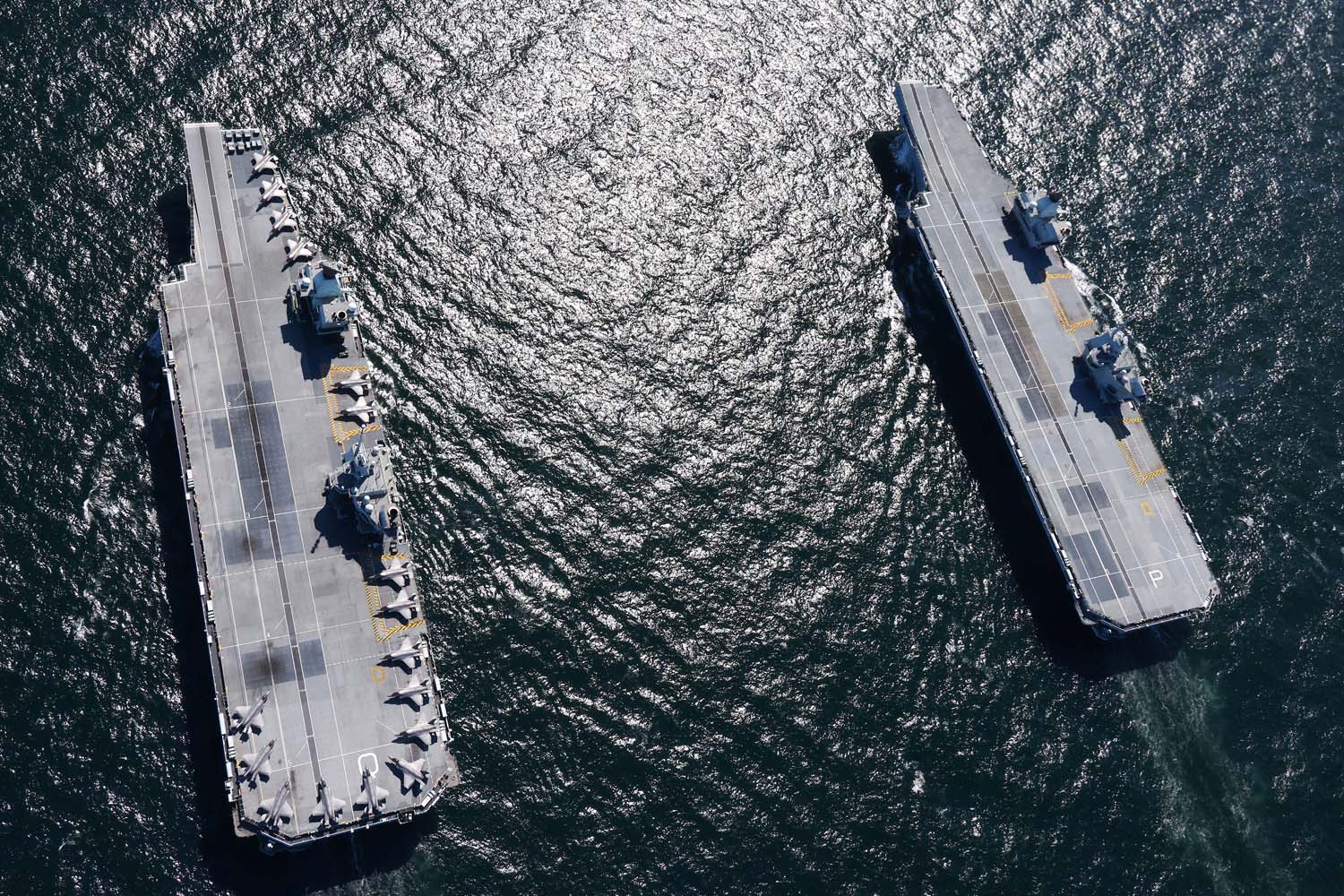
Donald Trump calling British aircraft carriers “toys” is not especially surprising in itself, he has said similar things about allies before and usually ties it back to defence spending or what he sees as weakness that week.
What is more interesting this time is who is on the receiving end of it, and what it might say about how he looks at Keir Starmer rather than just the Royal Navy.
A lot of the reaction has gone straight to whether the claim holds up, which it does not in any serious technical sense. The Queen Elizabeth-class carriers were never designed to match US supercarriers, they operate differently, they were built around different assumptions, and that has been understood for years. But even getting into that feels slightly off track, because the remark was not really about ships in the first place.
Trump tends to blur capability and political standing together, or at least treat one as evidence of the other. If a country’s military looks smaller or more constrained, he often reads that as a sign that the leadership behind it carries less weight, or is less willing to act. Calling the carriers “toys” fits neatly into that habit, it is dismissive on the surface but it also places Britain somewhere lower down the order without having to say it directly.
That is where Starmer comes into it, and it is hard to separate the two. Trump’s tone towards other leaders is rarely random, he tends to make an early call on people and then stick with it unless something forces a rethink. Leaders he sees as assertive, or aligned with him in some way, get handled one way, others tend not to. This feels closer to the latter, even if it is only an early impression.
A lot of this seems to come back to Iran, and the way that played out. Starmer did not back the initial US and Israeli strikes, and there was a pause before British bases were made available in any meaningful way, with the government arguing it was not in the UK’s interest and pushing for a diplomatic route instead. That hesitation did not go down well with Trump. He criticised the UK for moving too slowly and at one point suggested the US had little use for countries that only step in once things are already decided. Seen through that lens, it is easy to understand how he has landed where he has, reading it less as caution and more as a lack of commitment. Even though the UK did later allow defensive use of its bases, by then his view looked fairly set.
For Starmer, the issue is less the comment itself and more what follows from it. Trump has shown before that once he decides how he ranks a leader, that view tends to carry through into everything else, meetings, negotiations, even the tone of public remarks. It does not shift easily, and it can shape how seriously a government is taken.
None of this means the UK-US relationship is about to change in any fundamental way, it is too embedded for that, particularly in defence and intelligence. But tone still filters through into how things actually work day to day, it affects access, priority, and how much effort is made to accommodate British positions when it matters.








12 Adverts on the home page, 8 Adverts on this article page.
The quick U-turn probably made it worse, Trump would have respected Starmer more if he made a rant on Twitter about swift retaliation against America if it dared to fly near our bases.
Being brutally realistic, carrier strike is an expensive disaster. It started with the RN accepting a STOVL configuration to stop the RAF and Treasury opposing the CVF Main Gate decision in 2005. But twenty years later we have two large and expensive aircraft carriers that are operationally almost useless due to the lack of adequate air groups, capable AEW platforms, escorting destroyers and frigates, an accompanying SSN, and supporting auxiliary ships. With a lot of investment things could perhaps be turned around by the mid-2030’s – but the need is now.
Trump is just trying to get a rise. I’m not a Labour supporter but on this Starmer is 100% correct. The UK should measure itself by it’s own standards not those of a man who thinks being the opposite sex is a weakness. As for long term, well unless Iran surrenders the expert opinion is oil remains expensive. We all know who benefits from that, our other problem in the Kremlin. Coincidence? Who knows. The United States is in decline, every civilisation has spates nationalism when it happens. Trump is one such episode in my opinion.
A UK PM has to put the UK interest first.Trump probably quite shocked to be initially denied airstrips but we were NOT forewarned of Israel USA war plans. It’s not a NATO war. Of all the airbases they have access to, ours very strategically important for usa long range stealth bombers. Trump has verbally pissed on all western allies not just Starmer.
A UK PM has to put the UK interest first.Trump probably quite shocked to be initially denied airstrips but we were NOT forewarned of Israel USA war plans. It’s not a NATO war. Of all the airbases they have access to, ours very strategically important for usa long range stealth bombers. Trump has verbally pissed on all western allies not just Starmer.
The operational issues around the carrier strike group will get fixed over time, as more T45s come out of dry dock, the T26s start to arrive, more Astutes get fixed and to sea, more F-35Bs arrive, the new FSSS replenishment ships get built and the carriers hopefully get a better defensive weapons fit. Problem is that it will take the best part of a decade to get all these elements in place.
For now, we will need some allied ships to fill the gaps in the Strike Group, but that is not a big issue. We can still show the flag around the globe and play a (limited) part in any future kinetic action.
But looking at the whole carrier issue, I think we can safely say that (a) we couldn’t afford carriers in the first place, (b) we got the wrong carriers, (c) we did so at considerable long-term cost to both the fleet and the RAF and (d) their operational value in a peer war is likely to be much-reduced from the great expectations of 2005.
On a spend of 2.3 or 2.4% of GDP, we have nothing like the money to be buying aircraft carriers and their air wing. (Especially as we also have the nuclear millstone costing almost as much as the total procurement budgets of the three services)hl. The total cost of carriers and air wing is £12 bn, plus the development costs of the F-35b. The RN’s procurement budget is only £2.4 bn a year, but most of that goes on equipment support plus things like LIFEX and PIP. I doubt that more than a third of the budget is available for new ship construction, so max £800m a year. So the carriers represented something like 8 years of the full naval construction budget. If anyone suggested buying two carriers in today’s financial climate, they would be laughed out of court.
The carrier configuration we ended up with is flawed in many respects. BAE was meant to design it so that cats and traps could be fitted retrospectively if desired. It was probably an impossible spec anyway snd no such provision was built in. The real driver was that BAE had one card to play to become a Tier 1 partner, and that was its technical capability on STOVL. So we got in effect a big Harrier-carrier with considerable built-in limitations, viz no capability for a long-range fixed wing AEW aircraft, which is vital for the carrier’s survival, and a short-range, low payload, very expensive jet that has a poor serviceability record.
The cost to the surface fleet had been considerable. The money was there to either build frigates, replenishment ships and the other surface vessels needed, or to build large carriers, but not both at once. The sorry state of the surface fleet today is a direct result of the RN’s agitation to have carriers to fly the flag around the globe. People blaming past Governments’ parsimony also need to factor in the strategic wisdom of the RN top brass of the day in pursuing the unaffordable at a great cost to the escort fleet in particular. Instead of building a new escort every 18 months or so, NOT ONE has been built since 2012, so creating what will be a 14 or 15 year gap in renewal of the frigate fleet. No wonder the gallant T23s are dropping like flies.
The other knock-on effect if course has been on the RAF’s air combat fleet. The F-35s are paid for from the RAF’s combat air budget, the RN pays nothing towards them. That budget has been £1.72 bn a year. Again, about 30% of that is available for new aircraft, so about £600m a year. The full F-36B fleet will cost about £5.5 bn. So the reason we couldn’t afford any more Typhoons is that the entire budget for nine or ten years has had to go into the carrier air wing. The latter’s contribution to the bigger air picture is a moot point, due to limited range and weapons load and the likelihood of getting them back from the RN if they are needed in European airspace.
Then the question must be asked about the CSG’s role and capability in a modern peer war. Sure, it could do a strike-attack job against a second or third tier power like Argentina or Libya. But other than that, it has little to offer in the Atlantic ASW role, does not have the range to strike the Kola peninsula, could only play a secondary role in a USN carrier group in any peer action
It is quite a high cost to pay for the capability it brings.
Many people would have been happy with something bigger than Invincible’s probably in the Cavour size and I don’t disagree with the commentary on the configuration of the carriers but you fail two mention two fundamentally important factors that have gutted U.K. defence.
The carriers were ordered just before the financial crisis and the U.K. economy has not recovered to pre crisis growth levels so in effect our 2% ish defence budget has been significantly eroded by inflation for nearly two decades, which has had a impact on how far the budget goes in real terms.
Secondly the U.K. military was severely run down by two large scale wars fought on a peacetime budget. Whilst most of the £20Bn plus direct cost was paid from the Treasury contingency our equipment was worked harder without any additional resources provided. The Harriers, Tornados, Airlift and the helicopter force ran up flight hours way in excess of what could have been expected and this led to consequences on the service life’s of these forces and then came along Cameron and Osborne who managed to increase the cost of the carriers and the renewal of the deterrent amongst other things.
Specifically for the RN our political class and civil service must also take the blame for introducing the disastrous single source (monopoly) arrangement with BAE for surface ship procurement that led directly to the affordability problems with the Type 26. The RAF (and politicians) cannot get away with things because they blew at least £4Bn on Nimrod MR4 that delivered precisely nothing when we could have had some P8s and Typhoons on the money wasted.
More broadly you have huge waste that is endemic in the MOD, which has still not been addressed and is seen more as a job creation scheme then anything to do with delivery a coherent defence capability.
Then you have the ultimate choice our politicians must make, which is do we wish to maintain our standing in the world as a nuclear armed P5 member because if they do then you need credible conventional forces and that requires 3% of GDP on defence as a minimum.
The carriers are not the problem but they are the symptoms of over two decades of poor political management of U.K. defence.
possibly the way to look at the carriers is they are air strips at sea, mostly empty of f35 until needed. f35’s can be deployed anywhere any time to the carriers but are not tied. cats n traps required maintaining pilot skills and dedicated f35c wing to a carrier, f35b pilots likely just need quick refresh for deck landing. arguably they are too big but there are decades of service ahead who knows what modifications will come. global, presently means planned visits with other western democratic countries, is that so terrible. bottom line they are are paid for and why not use them.
The problem with the carriers is that the Government of the time was either mislead by the RN or accepted the carriers would only be second rate. The reason why I say this, is that the carriers never had the FAA/RAF order the two key force multipliers, needed for a strike carrier to be capable against a peer force. Which is an AEW platform with a radar detection range of around 600km, or an organic air to air refueler, that enables the air assets to reach further or stay on station for longer. The aircraft that the carrier can operate are either rotary wing or STOVL. Therefore they are either incapable of providing these two services or are severely constrained due to the take-off weight limits imposed due to STOVL.
The Crowsnest Merlin was never really suitable for a strike carrier. Especially a carrier that would operated 5th Gen jets like the F35B. It’s Searchwater mechanically scanning radar although old (with upgraded back end), is still really good at finding very small targets in or near to the sea. However, it is not very good at detecting anything beyond 250km. Which means something like the Mig-31 with its horrendous radar cross section, will still detect Crownest emissions far sooner than the Merlin can see it. As the Mig carries the ultra long range R37M, with a “stated” range of between 300 and 400km. Means the Mig can launch at the Merlin and not even see the launch. It will detect the missile but not until its well within 200km (probably a lot less). Thereby forcing the Merlin to evade, put the radar in standby, leaving a gap in the early warning.
A MQ-9B with a STOL wing and the radar Saab have proposed will not meet the 600km detection range requirement, as the antenna size is not large enough. It will however, provide a greater detection range than Crowsnest, possibly in the 300 to 400km range. The MQ-9 STOL’s wing generates higher drag, but will still have a duration over 24 hours, though operate at a lower altitude (Still much higher than a Merlin) compared to the normal high aspect ratio winged variant. The passive STOL wing won’t provide enough lift for a heavier STOL aircraft to take-off from the QE’s deck. An active STOL wing using boundary layer control will be needed, but nobody is making them apart from NASA.
Project Ark Royal (if it’s actually funded) could/might be a half way house in solving or at least mitigating some of these problems. If the carrier was fitted with the medium weight capable EMALS. It would allow fixed wing aircraft such as the MQ25 Stingray to be operated from the deck. Which would go a long way to solving the range/duration issues of the F35B. But it would also enable the ship to operate a heavy drone that could carry a long range radar, such as the Erieye-ER.
Until the carriers get CATOBAR of some type, that allows them to operate aircraft that can fulfil the long range AEW detection and refuelling requirements. The carriers will always be judged as second rate.
thankyou DB. not having better AEW is a major draw back (costs emals £££ + Hawkeye E3’s £££ + more deck crew ) and it might have been anticipated that there would be an unmanned drone solution, as there are other f35b navies with the the same problem, alas not yet. my understanding is the f35b has same range as super hornets F18 probably less payload for f35b . emals is a game changer but it is only just now coming to be nearly as reliable as steam. peer to peer navy conflict we currently looking at china though in decades to come different threats.
Hi Simon, I believe on internal fuel, the F35B has greater range than the F18E/F, unless the F18 then includes drop tanks. But in a clean configuration, where the F35 is only carrying weapons internally. The F35 has better drag value, so it doesn’t burn fuel as quickly, giving it a longer duration on patrols. Payload wise, if the F35B only carries weapons internally, it can only carry about 1/3 of what the F18E/F can. However, in beast mode, the F35B just exceeds what a F18 can carry. In beast mode the F35B needs to start the run up to the ramp about half way long the deck. Though the F35B cannot recover to the carrier with a full weapons load whilst in beast mode. I’m not sure if this is only for vertical landings, as I’ve not seen any “comeback” figures for the short rolling vertical landing.
In an ideal world, we would have a carrier capable aircraft that could carry and power the Wedgetail’s MESA radar. But at nearly 3000kg and being nearly 11m x 3.5m. The aircraft that could carry this needs to be pretty hefty. There are no off the shelf UAVs that could carry this. Unless you went down the dual control route. Even then you’d be looking at medium-ish STOL transporter, like a C27 Spartan. Which due to the internal volume, you might as well include an ops crew. The wingspan is nearly 29m, but the carriers have a deck width of 230m near the towers. So there’s space for it to taxi. Take-off and landing wise, it can take-off at max take off weight (depending ambient temps) between 580 to 640m and can do tactical landings in 300 to 450m (again depending on weight and ambient air temps). So would need assistance for take-offs and landings. Even with a boundary control wing, that can shorten the take-off distance by 50%. The Spartan would need to start at the very end of the carrier’s deck. Not sure how it would perform using the ski ramp, but it definitely does not have a 0.8:1 power to weight ratio, which is normally required for ski-jumps. For something like a Spartan, it really would need both a catapult for launching and arrestor wires for stopping.
However, the Spartan, is probably a little too small for the nearly 11m long MESA antenna, where its measured length is 22.7m long. Then when you compare it to the Wedgetail’s B737NG at 33.6m the radar array is fitted just in front of the fin. So perhaps after fixing the airflow, the Spartan could carry this monster of a radar. It would definitely be capable of carrying the smaller and lighter Saab Erieye ER radar.
Sadly there’s no simple or cheap answer to providing our carriers with the AEW platform that is really needed.
A well argued post which I am sure many with Defence knowledge would agree. I know there is lots of sentimental support for carriers and super Harriers harking back to the Falklands war and before that HMS Ark Royal etc. Given the wider demands on the Defence budget there isn’t the funding for major changes (EMALS) and less complex Strike/CAP aircraft (F18). The acid question has to be in what circumstance would the UK PM commit one or both carriers to a Real World strike mission without substantial allied support (AEW, CAP aircraft and missile defence.). There has to be a question mark now about USN support given the direction of travel of the US Administration. So we are left with two big ships which we are unikely to commit to a fighting war which are sucking much needed budget out of the RN and the RAF. Frigates (Nelson’s favouraite)and submarines are probably the order of the day now for defence of our shipping lanes. Just like HMS Hood the RN loves them as they are impressive vessels to the uninitiated and just like Hood are great for port visits overseas but how effective would they be in a fighting war even with 2 or 3 T45’s (when serviceable) + the needed logistic support but can we afford them?
I can’t really disagree with that except for the bit about budgeting, yes the RAF paid the bill but the RAF wanted 5th Generation Aircraft and when you look at the operational allocation of the F35B that’s what they have got (just not the A version they really wanted).
The whole issue is the decisions made by Blair, Brown and Cameloon were all Politically motivated and were all flawed in one way or another, but fact is we are stuck with the consequences.
The ships themselves are the optimum size required for their intended tasking, any smaller effected the sortie rates, size of CAG, range, overall crewing and a margin for future expansion.
Unfortunately we made the catastrophic decision to opt for VSTOL rather than CATOBAR which has led to a CAG that is fundamentally flawed in both its capabilities and future options. How much of this was down to Blair’s desire to suck up to the US and gain work-share on the F35 I have no idea, but the F35B is the least popular of the 3 versions, the most expensive, least capable and probably will be the first to go out of production.
If only they had decided to go for CATOBAR in the 1st place and stuck to it, we could have had Sea Typhoon, F35C’s, E2 and that’s a pretty potent CAG, and who knows we may even have exported some Sea Typhoons.
If anyone wants to see what it would have looked like just pop into the FAA museum and have a look at the 2 Thales / BMT Options died by side.
As for the lack of defensive armament, well if the last few weeks has proven anything it’s a very dangerous joke ! The size of the RN escort fleet just negates the argument about the Carriers being well protected by the layered defences of the escort group.
It is quite simply a cost cutting exercise which put 600 folks lives at risk, save on missiles, don’t even fit half the planned armament and save on crewing.
We are the only operating Navy to not fit adequate AAW defences to a carrier ! Just goes to show how wrong Russia (past tense), China, India, France, Italy, Japan and the USN are 🤭 !
No adequate self Defence.
No adequate AEW.
No interoperability capability with other Nations CVF or CAGS.
An Aircraft choice short of range, no real stand off capability and we didn’t even buy the gun pods so they can shoot drones down.
SADLY TRUMP HAS A POINT !
F35B is more popular than F35C. But not everybody needs its unique capabilities.
Hi ABCRodney,
I think it’s worth considering the issues around CATOBAR. With nuclear ruled out, we’d either have to wait for EMALS a long time or get creative with the powerplant, adopting a COGAS/COGES system to generate steam for the cats or return to COSAG which would be old tech with no extant expertise in running it. There would also be the increased crewing to consider for CATOBAR ops…
Sea Typhoons would never have happened, unless you are talking euphemistically about the Rafale! I don’t think in the early 2000s the RAF were too much upset about getting F35B because at that time Typhoon was only just coming online and Tornado was still down to be replaced by FOAS…
The iraq and afghan wars, the financial crisis, the shift of the deterrent to main MOD budget and bad timing has all played a part, esp in the cuts to T45 order and the delay to ordering frigates.
It would’ve been great to have ordered 2 CATOBAR carriers after falklands and typhoon could have been designed for naval ops, but they prob would’ve been cancelled after the cold war ended.
The lack of on board defensive weapons is concerning. I never really bought the FOD explanation – if a carrier has to fire a missile at an incoming threat thats evaded the defensive screen then post-launch debris on deck is surely the least of everyone’s worries!
Stop reading more into the things the orange idiot say, than there is
He is a spiteful, malignant narcissist. He is just acting out because he didn’t get his way.
He is also very stupid, so don’t expect him to go understand anything more complex than big = good
better analysis of that comment than I’ve seen elsewhere