

The replacement of the Land Rover is more than a vehicle decision. It will show whether defence procurement can manage integration risk and deliver platforms that are properly proven.
By Ross Crowther, Head of Defence Business Development, HORIBA MIRA.
The British Army’s decision to retire its Land Rover fleet has been widely framed as the end of an era. In practice, it marks something more significant: a test of how well defence procurement can respond to a more complex engineering environment.
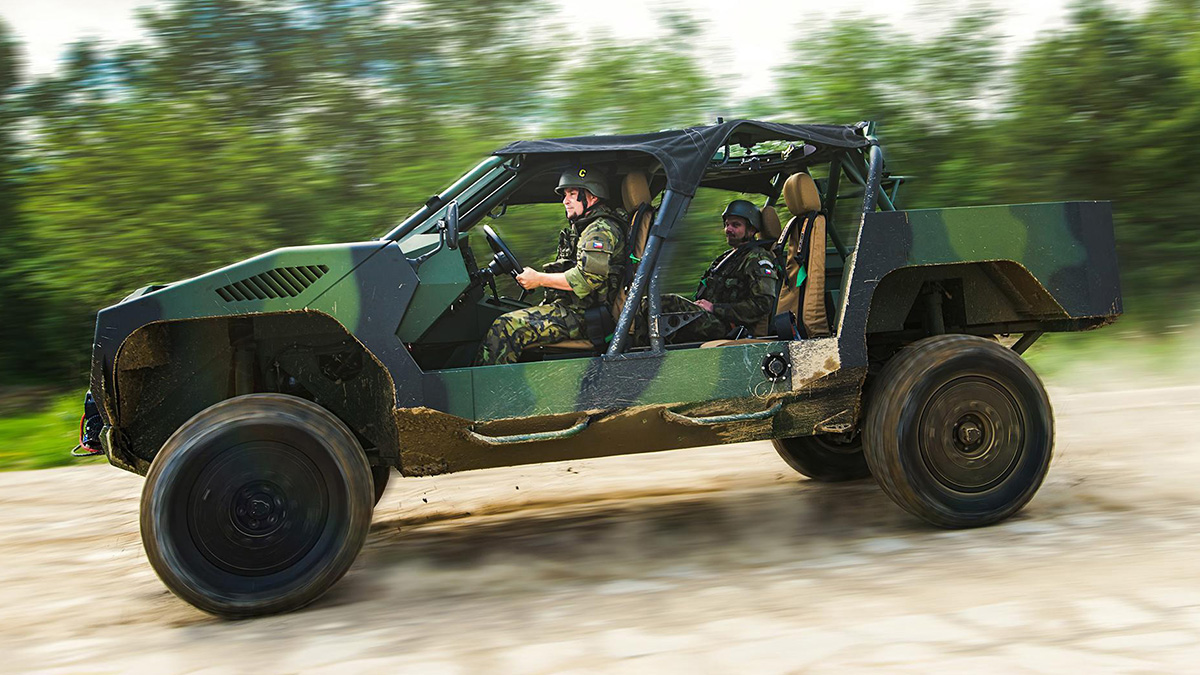
The Land Rover endured because it was simple, adaptable and well understood. Its replacement will be none of those things. The Light Mobility Vehicle (LMV) programme is not selecting a direct successor, but defining a new type of platform, expected to operate as transport, power source, sensor carrier and digital node, often at the same time.
That shift is reflected in the range of contenders. Militarised commercial platforms, such as the Toyota Land Cruiser, Ford Ranger, Jaguar Land Rover, Chevrolet Colorado, and Ineos Grenadier, sit alongside bespoke military systems like Rheinmetall’s Shadow Wolf. Each reflects a different approach to cost, capability, complexity and support.
The absence of a clear frontrunner points to a deeper issue. The requirement itself is still evolving. The Army is not simply replacing a vehicle; it is trying to define what light mobility should look like in a more electrified, software-driven and operationally demanding context.
That creates risk. Procurement decisions tend to focus on visible characteristics such as payload, range and cost, while the more difficult problem sits beneath the surface. Integration has become the defining challenge. Power, thermal, mechanical and software systems are now tightly coupled, and early design decisions can introduce risks that are difficult and expensive to resolve later.
Recent history in UK procurement has shown that the primary risk no longer lies in the mechanical failure of a chassis, but in the System-of-Systems integration. When power, thermal management, and digital architecture are treated as secondary to the physical platform, the result is a ‘performance cliff’ where the vehicle functions in isolation but fails when fully loaded with mission systems.
That lesson applies equally, if not more, to light mobility platforms. The assumption that lighter vehicles are inherently less complex is becoming increasingly difficult to sustain. Electrification, increased onboard power demand and software-driven functionality are introducing new layers of complexity into platforms that were once relatively straightforward.
Validation, as a result, carries more weight than it once did. Demonstrating compliance with a set of requirements is no longer enough. What matters is whether those requirements, and the way they are tested, reflect how the platform will actually be used.
Time pressure adds to the challenge. Programmes are expected to move quickly from concept to deployment, which can encourage risks to be carried forward rather than resolved early.
A more effective approach is to bring validation forward and treat it as part of system design rather than a final checkpoint. That depends on having environments capable of replicating operational conditions with enough fidelity to expose integration issues early. It also depends on having the independence to question assumptions as they arise.
Organisations such as HORIBA MIRA are increasingly supporting this shift. Drawing on experience across automotive and defence programmes, they combine systems engineering with secure, standards-aligned validation to help programme teams build evidence alongside design development. The emphasis is on understanding how a platform behaves as an integrated system, not just how individual components perform.
This matters in the LMV competition. With multiple architectures under consideration, confidence in integration, safety and durability is likely to carry as much weight as headline performance. The ability to demonstrate that a platform has been tested under representative conditions, and that its risks are understood, will influence decisions as much as capability.
There is also a longer-term dimension. Future light mobility platforms will not remain static over their service lives. Electrification, autonomy and evolving mission requirements will drive ongoing change. That places greater importance on how platforms are engineered and validated at the outset, particularly in terms of adaptability and supportability. In this context, validation becomes a lifecycle concern. It must support initial deployment, but also provide a foundation for future modification and upgrade. That requires a more integrated approach, where engineering and assurance are aligned from the beginning.
The Land Rover earned its reputation through reliability in service. Its replacement will be judged in the same way, but under more demanding conditions. The challenge for the LMV programme is not only to select a capable platform, but to ensure that its performance is understood, evidenced and sustainable. The question is whether that experience will shape the way the next generation of platforms is delivered.
This article is the opinion of the author and not necessarily that of the UK Defence Journal. If you would like to submit your own article on this topic or any other, please see our submission guidelines









Whatever the decision I think it is safe to say once MOD procurement get involved then it will be:-
Late
Over budget
Won’t work
Only get a minimum amount of vehicles. Due to cost over runs
They have a lot of previous form
Plus a bespoke design with little/no commonality with the choices allies make.
All correct and entirely true however, the simpletons guide to what will happen translates to:-
Late intentional
Over Budget corruption
Wont Work corruption
Minimum number only corruption as all the money by that point was stolen, through layers of mismanagement and profiteering
Let us not forget also bonuses for said civil servants
Ah yes silly me.
Much more interesting than I was expecting. Although I did chuckle a bit at the assertion that mobility platforms won’t remain static. I truly hope not.
Don’t know Ajax has for the most part. Though not sure that is even deemed a mobility platform.
Babcock have teamed up with Toyota and are offering the GLV a mix of a Land Cruiser and H-lux! Reported in The Defence Blog👍(with pictures)
Looks like the front runner i would have thought. Can’t go wrong with Toyota.
Looks good.
GLV – Such and obvious and on point solution, you know with 100% certainty, MOD reject it.
I’m thinking the MOD should simply look for something that has 4 wheels, can go off road and gets you from A to B. That’s all that is needed. All the other gizmos is going to make it more expensive, harder to maintain and more likely to break.
I was wondering the same. I’ve read that the milspec versions are more robust, but will five times the price, or even ten times, be worth paying rather than buying twice the number at less than half the price? Milspec Land Cruisers and Land Rovers cost over a quarter of a million quid. I think adding armour plating does some of that, with the knock on consequences of the extra weight on suspension, engine spoecs and so on. I also read that even non-armoured versions can cost an extra £30K-£40K for a strengthened chassis. Is it worth buying vehicles with heavy weapon mounts if you are never going to buy the weapons?
While it feels like the Army would be goldplating again in fitting armour plating, it all depends on the mission. I’m aware that IEDs are a thing from below and of course FPVs from above. But isn’t that why we went for Boxer APVs? Aren’t these light mobility vehicles supposed to provide transport well away from the front lines? The story about mission systems is also interesting, and I’d like to understand better why they need mission systems requiring such great power. Are they going to fit lasers to a runaround based at Catterick? The average civilian car already supports a lot of tech these days. What exactly are these systems and where will they be used? The magic invocation of “system of systems” isn’t really an excuse.
You are sort of conflating three vehicles here.
General Milspec Landrovers/Rangers/Land Cruisers etc are unarmoured. The militarisation has normally been reinforcing chasses, adding antenas, mounting points for radios, hardening the electronics etc. They don’t have (much) armour and they don’t have heavy weapons mounts.
Heavy weapon mounts are for WIMIK style vehciles. Those are generally sent to SF/SOF/Recce units. They’re still generally unarmoured because their main job isn’t as full on combat platforms, they are supposed to give suppresive fire to break contact and enable a get away, or, less docrtinally, provide overwhelming firepower for ambushes and the like. Most of the units that take these vehciles do have HMG, GMG or GPMG in their armouries for them.
CAVs are the really armoured variants. They are generally externally identical to the Civilian version, but have bullet resistant glass, dead bolts and armour lining. They don’t have heavy weapons mounts, and are really bad combat platforms since you can’t really shoot out of them. These are also the really expensive ones AFAIK because the armour is a somewhat custom job and they weight a tonne (you literally need a Cat C licensce to drive them legally since they’re so heavy).
Re Power generation; back in the day a light vehicle was just a mobility platform. But back then, you had maybe one decent radio with the platoon commander, and the rest of the platoon needed a resup every few days of AA’s for their PRR’s. You could send the batteries back the the CQ or QM for charging, not a huge drama. Even then the Coy HQ would usually have on FFR in their TO&E for the Company Commanders comms. Now, each section might have a few ATAK’s, FPV drones, SMASH sights, I can go on but I think you get the point. You need to generate power for all these systems, it’s typically the vehicle that provides that. And that’s just now. If you are operating drones a vehicle can be a much more capable platform than a hand held system.
Good point about power requirements but I’m not sure it needs to be complicated. Ukrainian drone teams manage a plethora of tech just fine using mostly donated civilian vehicles. I’d even say it’s better to avoid to much integration, because electronics evolves much quicker than vehicles (look at the dated stereo in a 15 year old car). Just chuck in an inverter and a shedload of power sockets.
As stated below, Ukranians use whatever they can get their hands on, not what works best for any given situation. Ukraine also operates a lot more statically and defensively than what NATO forces want to operate like. I don’t know what the optimum solution is, but just going “Well the Ukranians are muddling through with this” and buying some civilian vehicles instead of working out what works best is not the way.
Well no, that’s really what’s not needed. If you read the article it sets out the problem in its complexity. Otherwise give them all bicycles. And a 12 bore shotgun would take out most drones, surely. Well, within 50 feet anyway.
Built for but not with an engine. Due to cost over runs, our single vehicle will actually accommodate a state of the art strategic pedal operator.
Don’t worry chaps, we will only need a couple of dozen for what remains of the Army.
Reckon a Green painted Trump Golf Cart or Pope mobile should do it.
Well If they are good enough for Jesus and the Pope !
Let us not forget the MODS net zero mandate on all vehicles
The UK MOD, aligned with national net-zero strategies, mandates that 100% of new cars and vans must be zero-emission by 2035.
Does this include this mythical beast yet to be procured?
No, It’s only for people who want to see the British car Industry collapse and buy Tesla’s and BYD’s !
(Not being serious, just joshin)
Many a true word…
I’ve gained $17,240 only within four weeks by comfortably working part-time from home. Immediately when I had lost my last business, I was very troubled and thankfully I’ve located this project now in this way I’m in a position to receive thousand USD directly from home. Each individual certainly can do this easy work & make more greenbacks online by visiting
following website—.,.,.,.,.—>>> JobatHome1.Com
DE&S have proved their abilities on Ajax. Partner with Toyota. The obvious choice. Avoid US reliance and Rheinmetall
Could get plain vanilla land cruisers if not meant to be fighting vehicles.
That’s the White Fleet, though.
These runabouts will be widely issued to units so will need to deploy with them.
Designed by a committee with zero military experience except going vroom vroom on the carpet with a Matchbox toy car.
Don’t make the same mistakes as other procurements. This is UK tax payers money and we must design, develop and build this ourselves. We must have a home grown skill base and supply chain. Get some exports out of it too.
Land Rover was the vehicle that matched all those requirements.
Trouble Is LR no longer fit the criteria.
The problem is that you’re then trying to enter a heavily-saturated market with an unproven vehicle. If we were trying to outfit an army of 200k men using a strong domestic auto industry, developing our own would make sense, but that just isn’t the case.
The best approach for us at this stage is to give any domestic manufacturing significant weighting in the decision process, but ultimately choose a relatively safe bet. If JLR or an SME can put out a platform that works, they should get it, but whatever they build has got to be at least comparable to better options.
Whatever is chosen it needs to be 4×4, light and simple to repair on the battlefield. It also needs to be adaptable and the eventual vehicle needs proper manufacture support for parts. Finally it has to have a sensibly fuel source. Charging batteries in a conflict won’t work, fuelling needs to be quick and not fussy. Finally it should be adaptable and cover a number of jobs from basic transportation in peacetime to medical evacuation to name a few. Look at the old Land Rover and consider all the rolls it achieved and places it operated grim wet and Cole hot and dry. Once this is done you can make an informed requirement to industry!!
Any replacement vehicle should be entirely UK built, meaning money does not leave our economy or leave us with a skills shortage.
Personally, I believe Ineos should be excluded, as it’s owner Ratcliffe moved to Monaco during the pandemic to avoid a huge tax bill.
Its built in France in any case so it would’nt fit your criteria.
i know where it’s built, however a production line could be set up in the UK, as it should be for any choice made. I guess that went right over your head.
The article mentions JLR as a potential candidate but I can’t imagine which one as they don’t make any ladder frame vehicles any more.
“Defender” would be a good name but I’m afraid they are just for multi tasking Phone texting Mummies with young kids on the school run (and drug dealing Pimp types)
Sorry, I was thinking about the neighbours there !
Series 70 Landcruiser family
We’ve been fighting and losing against people who rely on these for decades – go with the winning off the shelf team.
2004:
Please put doors on it. For the love of God and sweet Jesus put doors on it.
2026: Please can you add an anti drone cage.
For the love of God just Ask the Ukrainians – use what they they have developed through so much lost blood and people – come to an agreement to produce it in the UK to develop skills and jobs – everyone benefits – soldiers, UK, Ukraine – use the millions normally spent on procurement decisions to build the factories/machinery to produce it – pay the Ukrainians royalties for all produced to help their struggle and keep the design upto date with battlefield updates and evolution… Please use common sense.. .
The Ukranians for mobility use whatever they can get their hands on, and whatever is donated to them.
Toyota all the way