

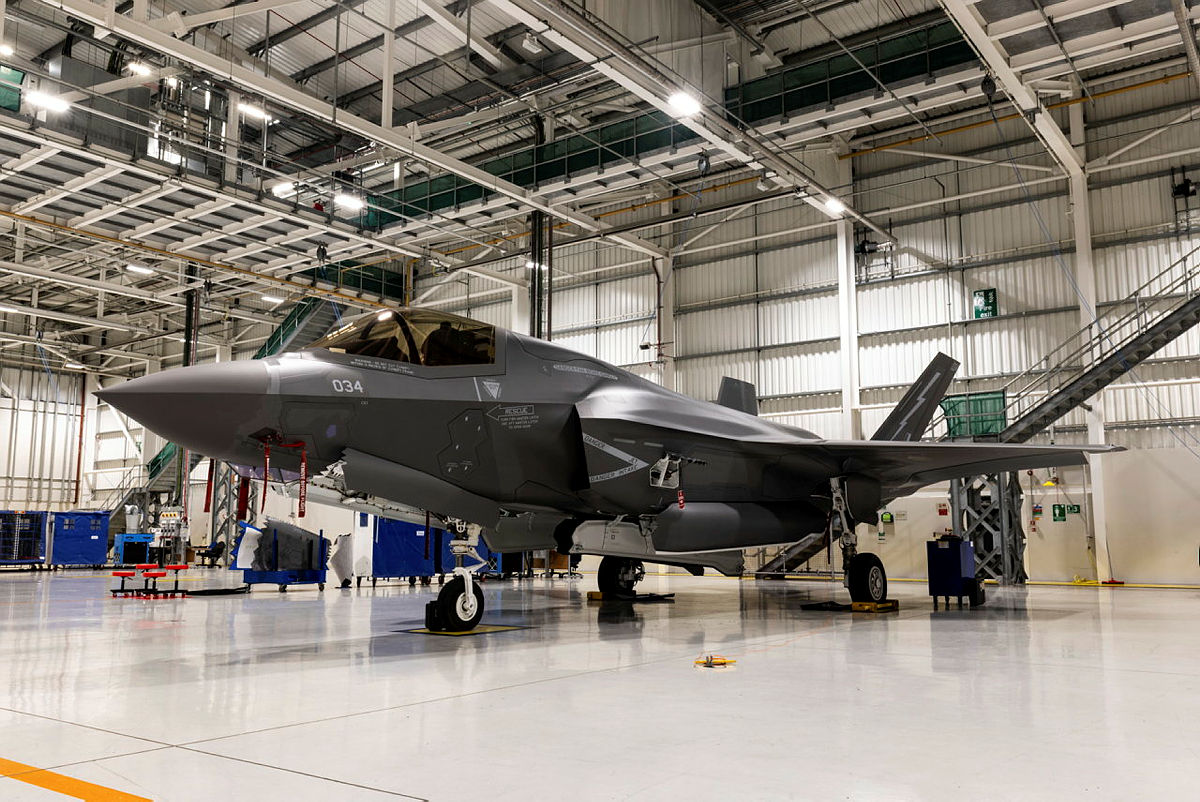
Lockheed Martin has delivered the 46th, 47th and 48th F-35B aircraft to the United Kingdom, fulfilling the initial procurement phase of the programme and completing the first contracted batch of jets for the Royal Air Force and Royal Navy, according to the company.
The three aircraft arrived at RAF Marham in Norfolk, home of the UK’s Lightning force, with Lockheed Martin describing the milestone as reflecting “close collaboration between defence forces and global partners, building readiness and capability to strengthen allied deterrence.” The company said British workers contribute to the broader F-35 programme, supporting more than 20,000 skilled jobs and contributing an estimated £45.2 billion to the UK economy over the life of the programme, with £22 billion already realised.
The delivery completes the 48 aircraft covered under the UK’s initial procurement contract. In addition, the Ministry of Defence recently reaffirmed its long-standing position that the UK will procure 138 F-35 aircraft over the life of the programme, though without providing further detail on how or when that total will be reached.
In response to a written parliamentary question, Defence Minister Luke Pollard said: “The Ministry of Defence remains committed to procuring 138 F-35 Lightning aircraft across the life of the Programme.”
However, when asked whether the government intends to maintain a fleet of 138 F-35B aircraft specifically, and how future tranches would be structured, Pollard added that “decisions will be taken across the life of the Programme,” pointing to the forthcoming Defence Investment Plan as the mechanism through which future procurement decisions will be set out.
The completion of the initial batch also arrives against a backdrop of ongoing challenges with the F-35 programme more broadly. The Block 4 software upgrade, which is a prerequisite for integrating new weapons onto the aircraft including the UK’s SPEAR 3 cruise missile and the Meteor beyond-visual-range air-to-air missile, has run late. Until Block 4 is delivered, the F-35B’s weapons options remain more limited than originally planned for the UK, with SPEAR 3 integration now targeted from financial year 2028-29 within the joint programme and Meteor integration not expected until the early 2030s.
The Strategic Defence Review published last year also reshaped the UK’s F-35 plans, introducing F-35A variants alongside the existing F-35B fleet and reducing the second batch F-35B order from 27 to 15 while adding 12 F-35As, meaning the eventual fleet will no longer be the single-variant force the original commitment envisaged.









A genuine question, as I really don’t know and I’d like to hear people’s ideas….. .. but if we stuck at 47 (plus 10 “nuclear” A versions)… would it matter… how many 5th gen do we need and are 4th gen absolutely fine… or are Typhoon/Rafale/Grippen obsolete? … How do decide on the mix? Of course we need to move forward – but 6th gen Tempest is still some time away. It’s no surprise that the DIP has been delayed, the game is complex and ever changing… something the “give ’em muskets and fly Sopwith Camels” brigade don’t understand. Having said that it really is time for DIP to be finalised.
4th gen are not obsolete but look how many F15’s the US has lost over Iran and A10’s compared to F35.
That’s more to do with the dumb leadership rather than the aircraft.
4th generation aircraft are not obsolete. They are fine for the air defence role, as only China so far has superior 5th generation stealth aircraft coming on stream. In attack though, they will increasingly act as a second wave behind the stealth/SEAD F-35s, for those forces that are acquiring F-35.
That said, it all depends on the 4th generation aircraft having been regularly upgraded, like the latest F-16s. In our case, the Typhoons are currently operating a 10-year old mechanical radar that is not up to scratch for modern air combat. The 40 tranche 3 Typhoons are going to be upgraded with a new AESA electronically scanning radar, the ECRS, at considerable cost. However, there is no intention to fit it to the 67 tranche 2 Typhoons, which will have to soldier on with inadequate kit until some far-distant point when Tempest arrives.
This seems like madness to put these aircraft at grave risk, but is dictated solely by lack of funds: our share of GCAP development requires some colossal funding over the next 10 years, maybe as much as £18 bn and no doubt a lot more when the real complexities of the project kick in. So there is little enough money to pay for the next batch of 27 F-35s, the 3 Wedgetails, the 14 Chinook ERs and the 23 AW-149s.
Thank you foe an intelligent and not a halfwitted reply.
Hmmm, I wonder who you are with the new name (again).
Maybe I’ll ask ChatGPT !
🤔😁🤦♂️
I’ve gained $17,240 only within four weeks by comfortably working part-time from home. Immediately when I had lost my last business, I was very troubled and thankfully I’ve located this project now in this way I’m in a position to receive thousand USD directly from home. Each individual certainly can do this easy work & make more greenbacks online by visiting
following website—.,.,.,.,.—>>> JobatHome1.Com
Does the radar on each individual fighter matter so much in the modern world of Datalink? Can’t the older Typhoons get their targets from a newer one or a Wedgetail, etc?
Fair comment.
The MOD never directly replaced the Tornado GR4 fleet. At its peak (1996-2003) RAF had 142
90 F35-A’s would do the job, if we could get the right weapons fitted / functional.
But how long would it take to procure that many and train up the pilots and support crews?
That’s a really big if.
The part of the block 4 upgrade that will allow integration of new weapons still seems to be a long way off. It’s likely that it’ll be avaliable in the early 2030s, you can factor a couple of years for the existing fleet to be upgraded, then we are in the mid 2030s and (assuming things go to target) Tempest will be the preferred platform
Tempest may be the preferred platform – probably by politicians too as it will defer spending the big £££££ until 2035+ when production will be ramping up.
Trouble with waiting for that is that it can’t be an established force until 2038 or so….which leaves a massive F35A sized GAP.
Also Tempest will not be a carrier aircraft so will still need F35B.
I gather the RAF have 2,500 pilots… exactly what that actually means is another question.
“4th gen are not obsolete but look how many F15’s the US has lost over Iran and A10’s compared to F35.”
What ?! 1+1 is not relevant and we don’t know flight mission profiles.
To be fair, 3 of those 4th gen losses were due to the ghost of Kuwait and A-10s can’t be compared to any 4th gen aircraft, they’re sitting ducks.
Three of those four F-15Es were “Blue on Blue”. They were reportedly hit by short-range, infrared; heat-seeking missiles, which explains why the aircraft’s advanced electronic jamming suites, like EPAWSS didn’t warn the pilots in time, as those systems are primarily designed to defeat radar-guided threats. EPAWSS is an all-digital “invisibility cloak” for radio waves. It detects enemy radar and “spoofs” it before the enemy can get a solid lock. In the current conflict, EPAWSS has been credited with allowing F-15Es to penetrate deep into contested Iranian airspace without being targeted by heavy radar-guided missiles. Without EPAWSS, the loss rate would likely be much higher.
At the time of the downings’, Kuwait was under Alarm Red conditions due to a massive wave of incoming Iranian Soumar cruise missiles and Shahed drones. The Kuwaiti pilot likely mistook the clean profiles of the F-15Es for high-speed cruise missiles heading toward critical infrastructure.
Why didn’t Identification Friend or Foe (IFF) protocols work?
Why didn’t the U.S. Central Command have a “hard link” backup between that specific Kuwaiti patrol and the returning F-15E strike package?
The sheer volume of friendly and hostile signals in the air, including hundreds of U.S. and allied drones may have caused a “lag” or “handshake failure” in the Mode 5 IFF transponders. Intense U.S. jamming aimed at Iranian radars may have inadvertently interfered with allied communication links including Link 16, leaving the Kuwaiti pilot blind to the F-15s’ positions on his data link.
Link 22 (“NATO Improved Link Eleven” aka NILE) is newer and more Naval-focused, and Link 16 which is older and air force-focused. They require a data link processor or a ‘gateway’ to talk to each other. When the Kuwaiti pilot, defending a coastline, and likely using Naval-integrated data feeds and the U.S. F-15s using Air Force Link 16 were in the same area, its possible that the “translator” between their different link versions failed to keep the two pictures synchronised.
The F15 couldnt have even been over Iran without the F35 first
The dependency is on what the jet will be facing and if it’s getting any AEW help. If facing off against Russian Su-35s, the F35 armed with AMRAAM AIM-120D has a massive advantage, due to the Su-35’s large radar cross section (RCS) compared to the F35’s. Even when facing off against the Su-57, the F35 should still have the advantage, as the systems on the F35 are better. But the F35 must stay in the beyond visual range air to air missile (BVRAAM) zone, if it gets in the within visual range zone, the Su-57 will balance the playing field. Though, if the F35 is armed with ASRAAM rather than Sidewnder, the F35 should be able to get the shot in first due to the speed and range advantage ASRAAM has over other within visual range air to air missiles (WVRAAM), such as the R74.
Typhoon vs Su-35 depends a lot on what radar is fitted. If it has the legacy Captor-M, things will be fairly even, as the Su-35’s Passive electronically scanned array (PESA) radar, is very powerful, more so than the Captor-M. However, with Meteor, the Typhoon will be able to launch earlier even though its being tracked. Unless the Su-35 is carry the very long range R37, the Typhoon should be able to evade this missile, whilst the normal R77s are much shorter ranged than Meteor. However, this completely changes if Typhoon is fitted with the AESA Radar 2.
The Radar 2 is a lot more powerful than the Raven used by Gripen and the RBE2 used by Rafale. Primarily because it has a larger surface area of transmitter-receiver modules crammed in to the array, as the Typhoon’s nose is much larger than the Gripen’s or the Rafale’s. The Radar 2 will be a game changer for Typhoon, as it means there is a greater chance that it can illuminate the Su-35 without being detected. But importantly use the radar to stay outside the R77s engagement range and let Meteor do all the work.
The problem comes when 4th Gen aircraft are facing jets such as the Chinese J20 armed with PL-15. We always knew PL15 would be a dangerous opponent. The latest spat between India and Pakistan clearly demonstrated this. Compared to AMRAAM, the PL15 is wider and longer. The dimensions taken off the Pakistani fired PL15E India found nearly intact, showed it was 1″ wider and nearly 1ft longer. In stark terms this means it can hold a lot more fuel than AMRAAM, so will accelerate faster and go further. India suggests the weapon has a range of at least 200km (120 miles). Which would significantly outrange AMRAAM, and possibly matching Meteor. Plus the PL15E, is the “dumbed down” export version, the Chinese only version is expected to go that bit further.
If Typhoon with Captor-M is up against a J20, I would suggest the J20 will have an advantage. If the Typhoon has the Radar 2, it might be fairly even. A lot will depend on whether the Typhoon detects the J20 from the side or rear, as its frontal aspect has a pretty low RCS, especially compared to the Typhoon.
In a one on one fight at BVRAAM ranges, the 5th Gen aircraft will always have the advantages, due to its inherent stealth, but generally better sensors and how information is relayed to the pilot. Even though Typhoon is getting Radar 2, which by all accounts is awesome. The airframe is still a non-stealthy 4th Gen airframe, so it will have an immediate disadvantage against 5th and 6th Gen aircraft. Sadly the radar and other upgrades are 10 years too late. Which is probably why the RAF want more F35s, even though it has a limited weapons availability.
However all is not lost. If Typhoon was teamed with a 5th/6th Gen uncrewed air system (UAS)/loyal wingman, that included some decent sensors and a covert data-link. Typhoon would be able to stand-off a lot more, letting the UAS “recce” forwards. Which could balance the playing field against 5th Gen aircraft at least.
I am uneducated in all this but if f35 does its paint burn off after >10 minutes supersonic flight?? Thinking typhoons this less of problem. Would imagine typhoon flying hours availability is up on f35 too. Apparently f35 typhoon area good combo.
Typhoon and f35 good combination together
Agreed. Possibly Typhoon and Tempest might be even better. The biggest issue with F35 in combination with 4G+ is availability. One reason why 47 F35s are nowhere near enough is the amount of downtime when they get a few years on then. It’s no good relying on one F35 to two Typhoons if you only have 20 F35s available, split between Navy and RAF.
No, the paint does not come off.
Years ago the USN tested the F-35C by operating it at full afterburner, exhausting almost all the fuel, refueled it from a tanker, operated it at full afterburner exhausting most of its fuel again, and then did it a third time. When the C variant landed an inspection found that portions of the fuselage had gotten so hot that the stealth coating had been degraded severely. So the USN found a way to improve the coatings but it was expensive. So instead of limiting the amount of AB use to a single tank of fuel, they reduced it to (in most instances) approximately 1 minute of AB use for the C and B variants, no limit on the A variant.
The test pilot was surprised, he thought the short AB limit was idiotic, but it has remained in place for the B and C.
DaveyB
I’ve read that as of 2026, the J-20/PL-15 combo has effectively ended the era of “unopposed” US air superiority. It is the first time since the Cold War that a rival has a missile that can out-stick the standard American loadout. Being a heavier, faster, long-range interceptor, its goal is to use its stealth to get close enough to fire its long-range missiles at high-value assets, like tankers and AWACS or to engage Western fighters from a distance where they can’t fire back.
Simon hector.
To prevent the Radar Absorbent Material (RAM) from blistering and the structural parts of the tail from warping, US F35B/C pilots follow these general advisory limits (Unless in an emergency.)
At Mach 1.2: Roughly 80 seconds of cumulative afterburner time.
At Mach 1.3: Roughly 40–50 seconds of cumulative afterburner time.
After hitting these limits, the pilot must fly at sub-supersonic speeds for about 3 minutes to allow the airframe temperatures to stabilize before “restarting” the clock.
The Typhoon can supercruise. Fly at supersonic speeds up to Mach 1.5 without using its afterburners (reheat). The F-35 must use its afterburner to exceed Mach 1. Afterburners dump raw fuel into the exhaust, creating massive heat that ‘cooks’ the rear of the jet and its stealth coatings.
The typhoon’s twin EJ200 engines provide enough ‘dry’ thrust to push it past the sound barrier and since it isn’t using afterburners to stay there, it doesn’t generate that same localized, intense heat that causes RAM to blister. The Typhoon has just enough RAM to make it harder to see from the front, allowing its electronic warfare systems to do the rest of the work. It trades total invisibility for the ability to fly at Mach 2 without its … skin falling off. Besides, instead of using RAM to hide its backend the Typhoon uses its Praetorian DASS (Defensive Aids Sub-System). This system detects an incoming radar wave from the rear and shoots out a digital ‘decoy’ or jamming signal that makes the Typhoon appear to be in a different location.
Somewhere between the first 4 & up to 14, UK F-35B, may be too difficult/expensive to upgrade. So we need to order another 14 F-35B just to stand still.
Under BW the commitment was that only the first one would not be upgraded and that the other two orange wired ones would be upgraded.
I wonder what will actually happen….???
Bruce Willis??
Not obsolete. Although I’m not an expert so if I’m wrong please correct me.
They have overlapping capabilities, like air to air capabilities, ground stike, so can both do air patrols, interceptions, dog fights etc.
However, for much of those roles, 90% of the time you are going to chose a typhoon to do it. This is because it has better kinematics meaning it’s faster and more agile, it also has a bigger weapons payload, making it better for air policing, interceptions, close range encounters and so on . But most importantly, it’s much cheaper per flight mile to operate and easier to maintain, so it’s logistically better to deploy on a day to day basis.
However, the F35 has much better stealth and sensors, meaning if you want to operate in enemy environments, F35 is really your only choice as it can avoid enemy defences and has a much higher chance of staying undetected because of it’s sensors and stealth, a typhoon simply couldn’t do this and would be shot down without a high degree of control over the skies.
It’s also mainly a beyond visual range fighter, so it can lock onto enemy aircraft much further away than they can lock onto it and shoot.
Not only that but an F35 is also an information gathering node, it can gather vast amounts of battle field data, analyze it and sent it to ground forces, other aircraft, to command etc. to create a much clearer battlefield for its allies. So its really is more than just a fighter jet.
So they compliment eachother quite well and if we switch purely to 5th gens, it would definitely weaken us Vs having a mix of 4th and 5th gens. it would mean slower interceptions of threats, and more money spent on a daily basis just to patrol and maintain our skies.
As for how much and what mix of 4th and 5th we should have, well that’s something only someone in the MOD, who has a lot more information than any of us, can answer. But I’m willing to bet the answer for how many 4th and 5th gens we need, is more than we currently have.
Hi Wyn,
For my 2 pence, The question is less about the balance between typhoon and F35, and more about the balance between F35 and GCAP. With our typhoon order likely complete, The trade-off of any future investment is how much HMG dedicates to buying more F35s Vs to developing/ordering GCAP. It’s that future ratio that will be defined by this government’s investment decisions.
Very broadly, the key criteria for that trade-off would be carrier capability, per-unit cost, and speed of delivery on the one hand, Vs absolute per-unit capability, range, and industrial strategy on the other.
F35 is a less capable jet than GCAP will be, but it will be available faster for less money and, if we order more Bs, carrier-compatible. As things stand, our existing order is enough to surge one full carrier air wing, or maintain a continuous availability of ~half an air wing on a continuous basis. Overall that would represent a credible sovereign force, particularly for regular or lower-intensity operations, but would not be able to employ the carriers to their absolute full potential capability in an all-in crisis deployment akin to what was scrounged together for the Falklands War.
GCAP will be an overall more capable aircraft, and a direct replacement for the Typhoon, but it is likely to be much more expensive on a per-unit basis, reducing platform numbers, and it wouldn’t be ready until 2035 at the earliest, and even then only in basic form. It represents a longer term bet and a de-prioritisation of carrier strike in favour of land-based airpower.
Fwiw I would argue we are at a point where both options are just about viable, it would be a matter of subjective priorities rather than a clear “x is better than y”.
Just need to order 90 more and buy storm breaker.
And maybe some JSM and or LRASM.
Or make the americans actually integrate the weapons we want – spear 3 and stormbreaker seem to be fairly equivalent capabilities with spear 3 having the big advantage of being non US MIC.
We need more than 48 – my view is 80 is the bare minimum giving us 3 wings of 24 +8 for testing etc. this will also need replacements on a 1-2-1 basis so that would already make it 81 (as we have already lost 1).
this gives us 2 carriers worth + a maintenance / surge capability – although the reality is probably 24/36 will be available at any given time.
They are fairly maintenance heavy from what I understand.
the A variant is madness – it is parasitical to both the navy and tempest for little benefit. Whomever proposed this should be fired immediately
👍👍👍
Agreed. A is a money saving exercise dressed up as an enhancement, which hits the B force.
Depends on how many we get. If we get A as part of a broader move to complete 138 ( a boy can dream) and we end up with a mixed force of F35A and F35B then it’s a worth while to operate both. This is what was being indicated in the strategic defence review by lord Robertson. But if we are buying 10 F35A to run an OCF and then buying 62 F35B to save a few quid then it’s a waste of time and money.
Agreed. A big A order run alongside enough Bs to furnish Carrier Strike is another story.
Not happening with GCAP and the rest of the non military voices eating at the defence table, all cordially invited by HMG.
The B is looking increasingly redundant. The carriers aren’t going to be going far enough from allied bases to warrant deploying it. The A has far greater Europezn allied support. Its has more range and weapons load. The A can sprint for longer also as the B can’t use afterburner for more than minutes. And yes the A is much cheaper to run and for every 3 Bs you can almost get one more A. The question shouldn’t be A vs B but does defence policy warrant the B, if we’re deploying carriers globally then absolutely we need a larger fleet of B proper AEW, Carrier based airborne refuelling etc. But if we’re deploying carriers to areas where other assets could be used its an expensive folly. As of late 2025 the PoW was effectively under European command as part of the pivot towards Europe so we don’t actually command our own carrier.
“The carriers aren’t going to be going far enough from allied bases to warrant deploying it.” That’s the kind of absolute certainty in your knowledge of the future that has never held up in the past. The unexpected always bites you in the bum.
As I understand it it’s 12 “A” and 17 “B” so 12 and 64. The A’s are supposedly for an OCU, but with a nuclear capacity “should we be asked” to deliver an American weapon! So by the mid 2030’s we will have three squadrons of 12 operatioinal of the “B” version and the “A” ?? doing what.? So yes, it is a waste of money.
The A being the Operational Conversion Unit/ Dooms day tactical nuclear strike force.
Correct.👍
I dont agree with the logic of A at all – as its just parasitical in all ways
you buy a big fleet – treasury says why do we need Tempest
you buy a small fleet – treasury targets it or the B’s for cost cutting as its too expensive
Remember b’s are interchangeable with the USMC corps fleet – a key consideration in their selection as we work a lot with USMC
you buy either of the above and it takes money away from B fleet / typhoon / Tempest
what value do we get?
if we can get a good loyal wingman at £10m per unit and start using those with F35B’s that gives us space to develop Tempest.
Realistically we would then have a Naval fleet of F35B’s a diminishing fleet of Typhoons and a build up of Tempest
the plan should be for something like 240 manned fighters with 1k drone loyal wings. this probably means 80 F35b, 160 tempest (with interim of 80 typhoons +80 tempest)
we will be lucky to get 160 across both – which is not enough – The USMC has more fighters than the RAF – its a joke.
As a minimum the UK should look for a land force that is sized and equipped similar to USMC + a navy + home defence which should bring us to around 250k serving personnel (about same as France btw) – we are well short.
The B force will be quite large enough to equip the one operational carrier and have some aircraft over for the B’s other primary role, close air support for the land forces. It is completely unrealistic these navy fellows demanding 70, 80, 90 or 138 and a second operational carrier, just getting the Bs up to 62 is already more money than the RAF can afford.
The RAF is quite right to switch 12 of the order to the A version, which is a more capable fighter than the B, considerably cheaper and without what sounds to be the heavy maintenance burden that the B is imposing. Would that we could get more than 12 As!
I recall the Sea Harrier FA2 force was smaller? Not by much mind.
Yes and the Harrier FA 2 force was also uniquely British where as the F35B is an identical fleet of over 300 aircraft all sharing spares and upgrades.
I don’t see us having an issue operating A or B even in small numbers due to commonality (both are near identical to fly) and due to the large pool of NATO spares and expertise we are tapping into. It’s an eco system of thousands of planes.
My consideration is what’s the best way to combat Russia for the least amount of money and a massive increase in our F35 force is the quickest, cheapest and most effective way to do that.
A UK force of 3 F35A and 3 F35B squadrons backed by 6 Typhoon squadrons would allow the UK to dominate Russia in any European operation by decimating their air defence and removing any threat from their Air Force.
With no Airforce and no air defence the armies on the eastern flank of NATO can deal with Russia with no assistance from the British army.
No other conventional weapon system can change the balance in Europe so much for a few tens of billions over thirty years.
That’s a very RAF biased view though I feel.
Yes of course the RAF are in dire need of new/upgraded platforms, and that’s also clearly the same for every other arm of the service as well, but it is truly a mistake to limit the effectiveness of the UK’s naval air power, especially as we are a maritime nation who’s defence is best served from the sea, and a nation with overseas commitments still. The F35B can do conventional and carrier roles, The carrier strike capability the RN can just about muster is vital to ENATO, it’s the only fully 5th Gen carrier they will be this side of the Atlantic, and it’s an asset Russia doesn’t have, and most importantly it isn’t fixed.
Plus Argentina can’t compete with a carrier strike group. With Chinese backing they will have another pop, and an F16 is a great stepping stone to a possible v cheap 5th gen Chinese fighter.
So the ability to project 5th Gen air power in the form of F35B pretty much anywhere in the world is pretty important. Weakening Carrier Strike is weakening the U.K.
Dont get me wrong, I would genuinely love to see the RAF operating a few Sqns of F35A’s, clearly not at the expensive of Tempest which is 6th Gen, but also, and I think most importantly right now, not at the expensive of ensuring the correct amount of F35B’s for the Carriers. The joint lightning forces can and do serve both purposes, naval strike & long range (close) support, the F35A is great but it the F35B can land on a carrier/anywhere.
Get enough F38B’s and if the RAF really want the F35A, then by all means take the remaining smount from the 138 we have ‘on order’👍
Sharky Ward in his book, ‘Her Majesty’s Top Gun’ gives some very good examples of why having a strong Navy/Naval air capability is vital for the U.K.
A’s? to drop somebody else’s bomb at decision, in somebody else’s war……. all at our expense. What needs to happen is that there is a full air group for each carrier and spares. The RAF has no need of the A whatsoever, they can wait for the Tempest, possible with a few extra Typhoons.
That’s a good summary Daniele. It must be a cost saving measure -expect more A models!
As many people have calculated 72 was/is the minimum viable number for credible F35B CSG.
You can do something with 60 frames but anything less than 72 is weaving in compromises.
Pacman, you suggest 8 for testing etc. We need a fair number for the Training Org (OCU), Repair Pool, Attrition Reserve, Trials. Just 8 would not be enough for all that. 1SL in 2021 talked about 60 rising to 80. Recent indications are that we might order 27 aircraft in Tr2, thus taking us to 74 (47+27).
Hi Graham
What I said ( or meant to say) is 8 for R&D/testing (but meant OCU) and 24 for maintenance, as part of the operational fleet, any attrition would need to be replaced outside of the 80 (81 stated due to attrition) and in my opinion this is the bare minimum.
My view is 1 carrier wing active (24), 1 in maintenance/ training (24) 1 in deep maintenance(24) & 8 R&D / OCU
I do believe we should stick to the 138, not least as that is what we committed to, but if the US continues to not integrate our weapons then we should move on to Tempest.
Hope that clarifies
Surely we need enough to put on the carriers, with spare for maintainence, training etc. Have we even replaced the one that fell off the boat.
If criminal to spend millions of pounds on this equiment to have all of it sat not even ready.
What have we got ready like 20. Its not good enough.
A very expensive aircraft that can drop one one type of UK bomb and maybe fire an single UK Air to Air missile type.
Am I missing something?
A great deal but who cares?
😂
ASRAAM/AMRAAM and Paveway 4. The APG-81 radar also has electronic attack modes. Typhoon for 15+ years also only had 3 weapon types available until StormShadow/Brimstone integration from 2018 onwards.
Sorry I did not realise AMRAAM was a British missile. I was careful with my words. That looks like one British bomb and one British missile, unless I am missing something else. PPG-81 sounds like an American Missile. You highlight that we weren’t much better with Typhoon, not sure that is a cause for celebration, At least we had Tornado then.
Ultimately it demonstrates a significant lack of capability.
The Americans have demonstrated it is mass that counts, we do not have it. Even if the Carries look ‘cool’.
AMRAAM Is an American missile. It’s not ideal, and SPEAR 3 will greatly increase capability. But Paveway 4 is a very capable weapon. All weather day/night precision strike against fixed and moving targets. 6 weapons can target 6 separate targets in one pass. It can also be re-targeted in flight.
Sorry I was being sarcastic.
Not only is it not ideal, it is not as good as the British alternate the Americans have successfully kept off the aircraft.
What I originally said was only 100% correct. SPEAR3 is years away. Wow 6 bombs, still only 1 British bomb which is what was originally stated.
Typos meant I should have referred to APG-81 being an American Radar.
F35 is simply a Boondoggle project the world has swallowed.
What it is, is the most capable mass produced 5th gen fast jet money can buy. Meteor is more capable, but AMRAAM is perfectly good enough for the next few years.
I thought it was the only Western 5th gen fighter bar the F-22 which is not available. Hence the market was limited. I will stick to the term ‘Boondoggle’. An Amercianism, but hey they must be good for something.
F35 is operated by 19 nations and 1325 aircraft have been delivered to date.
And is there a 5th gen choice?
Why are the Americans and Israelis operating so many different types?
IIt is expensive and manpower intensive to operate. The UK will never get near 138. Like many things however it is too expensive, and with too many interested parties to fail. My last words, I think.
Well, you can have the F35A, the F35B (STOVL) or the F35C. (Carriers) The UK is committed to 138 F35s over the life of the project. They will be in service until at least 2070
To be fair, the weapons integration delays are due to Lockheed dragging their heels on block 4, even the Americans are struggling to get some of their weapons integrated.
Pause F-35A/B orders, and fund the procurement of extra P-8 Poseidon MPAs. They’re (only) about $50 million more per unit than current F-35Bs. Or, if that’s an impossibility, fund the procurement of unmanned MPA-variant Protectors. Or, fund the purchase of additional Merlins, with their full ASW capability.
A conflict with Russia will see the carriers take on an ASW role, ahead of a strike role. In that situation, F-35s aren’t running strike sorties against Murmansk – they just don’t have the legs or armaments for that kind of mission. They can, however, provide top-tier air defence for an ASW task group.
That mission, though, could be filled by the current fleet as it stands.
Or crazy suggestion, use the 16 MQ9B’s that we already paid for that are now useless for their primary mission to do MPA like everyone else in NATO.
Yeah, that too. They’ll need the full MPA kits though.
I’d be tempted by this….
The RN needs to remember that it’s primarily an ASW navy, and the RAF needs to remember that it’s primarily there to support and enable the RN.
And the Army. Thus Close Support, the RAF SHF and the RAF ATARF.
I’d go further and say the Army could be a projectile fired by the RN and the RAF when expeditionary warfare is concerned.
If we are headed back to a BAOR, though now further east, then that though is outdated.
ATARF? Please enlighten me!
Sorry, the RAF Air Transport and Airborne Refuelling Force. The transports move the army, as do the Voyagers.
Thanks! I was wracking my brain thinking of what it could be 😅
yes, but it also has an air defence function – that is significantly important.
Definitely. There were predictable sniping comments today that the carriers shouldn’t be used up North as it’s not their ‘primary role’ and instead should focus on land attack. But there’s no way we can get within F35B strike range of Russia without rolling back their submarine threat (MQ9B+JSM combination notwithstanding) so ASW it is.
So the short term plan would be converting 8 of our new MQ9Bs into shore-based MPAs using the SeaGuardian kits and then in the medium term a transition to a sea control-based air wing using the F35s as top cover for a combined fleet of 18 ASW MQ9s and 6 AEW sets. Would also be handy for Pacific operations, the sea is quite big and F35 range circle is small.
Those comments about up north are cobblers. Even in the Cold War HMS Ark Royal was to operate in a NATO role up north, striking at the Kola.
And our carrier has an ASW Merlin Sqn.
Sure the sub threat needs prioritising but that’s one of the beauties of a floating airfield, it’s flexible.
I think it’s fair comment that carriers should not do the high North, realistically we should cover this with other assets, as others have stated.
Carriers project force and are expeditionary in nature, when the GIUK gap is about area denial, search & destroy
Not sure why you would put a carrier in harms way like that. The only thing I can think of is we don’t have the proper assets,so are sending the carrier instead
Projecting force doesn’t just mean projecting it onto land. To negate the Russian SSGN threat means hunting the submarines down 2500km away from the UK, which means Svalbard and the Barents sea. To do that needs a carrier as air bases in effective MPA range of those areas would be priority targets in that sort of war. Just look at how difficult it was for us to sustain a P8 on station near the SW of Norway, just 800km from Lossiemouth.
As there is no wide area ASW asset as cost effective as a MPA or Merlin aircraft carriers are absolutely of use up there. In addition Russia still retain some of the TU95 and TU22 forces defending any ships up there needs air power and early warning. Being able to directly strike at Russian bases (if F35 got given cruise missiles) is a convenient bonus.
Given the pressure on budgets and the likely reduced number of RN T26, at least in the short – medium term, additional P8s makes a lot of sense. The T31s, suitably customised and with additional Merlins might be used in a Bastion ASW role rather than as global patrol frigates.
Are all the F35Bs at the one base at Marham? Isn’t that potentially risky? If the fleet gets much bigger wouldn’t a bit of dispersion across 2-3 bases be a better way to go? Hope there’s some GBAD happening there and no gaps in the perimeter fencing.
Yes.
Yes, applies to all fleet types.
Yes, but more bases means more people and certain enhancements.
No, nothing beyond what minimal Rapid Sentry and ORCUS are available.
There are, in certain places, airfields have huge perimeters!
We have four ORCAS systems in operation and only three fast jet bases in the UK. 11 Rapid Sentry systems operate by the RAF regiment.
Based on current defense procurement records and recent reports through early 2026, here is the breakdown of the UK’s acquisitions for these two counter-drone systems.
ORCUS Counter-UAS System
The UK Ministry of Defence (MoD) initially purchased four baseline systems from Leonardo.
• Status: These were acquired as part of the Royal Air Force’s (RAF) SYNERGIA research and development programme.
• Purpose: ORCUS is a “soft-kill” system designed to detect, track, and jam the radio-frequency links of hostile drones. It achieved Initial Operating Capability (IOC) following trials and has been used to protect major UK airports and RAF airbases.
• Composition: It integrates technology from several UK companies, including Blighter surveillance radars, Chess Dynamics electro-optical trackers, and Enterprise Control Systems (ECS) RF inhibitors.
Rapid Sentry System
The exact number of Rapid Sentry systems purchased remains unconfirmed in public government records, though industry indicators point toward a specific quantity of integrated sensors.
• Estimated Numbers: While the MoD has not released a final tally for the launchers themselves, the UK purchased 11 Saab Giraffe 1X radars in 2023 specifically to support mobile counter-UAS capabilities. It is widely believed that these radars form the sensor backbone for the Rapid Sentry units currently in service.
• Role: Rapid Sentry is the “hard-kill” layer of the RAF’s layered defense. It uses the Lightweight Multirole Missile (LMM), also known as Martlet, to physically intercept and destroy drones that bypass electronic jamming.
• Deployment: As of 2026, the system has seen active combat validation, having been deployed to the Middle East (including Kuwait, Iraq, and Jordan) to counter regional drone threats.
Comparison Summary
Yep, that’s my understanding too, 4 Orcus.
11 RS seems logical by the number of radars.
Far too few.
Thanks to you both. I seem to remember some story a while back about some people managing to nearly get through onto the tarmac through a gap in a hedge/fence at Marham. Not sure how true it was.
Google paid $200 a hour on the internet..my close relative has been without labor for nine months and the earlier month her compensation check was $51005 by working at home for 10 hours a day….. Everybody must try this job now by just use this
GOOD LUCK.:) http://www.giftpay7.vip
Good news that 48 aircraft have been delivered, these should be given to the RN and a second batch of 48 ordered for the RAF. With the savings order another squadron of Typhoons and some additional P-8 Poseidon and let’s see a tempest prototype in the air.
What savings?
If they’re given to the RN, where is the RN budget for them? I don’t believe the RN has such a budget. And where are the FAA crews for 47 jets?
Then they’re at an RAF Station. Are we going to make that a RNAS, with the thousands who work there too?
In an ideal world, yes, an all FAA asset.
In the real world, the aircraft I believe are RAF owned.
The wider fleet is a joint RAF FAA undertaking regards crews, ground support, and command.
Thought we had ordered 137 aircraft. 48 delivered to RN and 48 for RAF. Left over cash as above. Sharing aircraft across the services does not work. Let the RN have the current aircraft for the carriers and the RAF get the next batch.
Armchair, we have only ordered 48 in Tranche 1 and the last one was just delivered on 27th March this year. Most think that a further 27 might soon be ordered as Tranche 2, perhaps 15 x B and 12 x A models.
Your 137 figure should be 138, which was stated donkeys years ago as the total number we might order over the lifetime of the programme. That figure was constructed to determne workshare percentage I believe.
As Graham says.
Yes, but what of the issues I raised with that?
Ownership means running costs, crews, real estate, all of which the FAA lack.
Where’s the budget for that in the RN?
Which is why they’re a joint command.
The aircraft are not shared. The crewing and operation of them is.
Sounds like a win win for the RN. They get to use the kit without the costs. Who decides on when and where the F35’s are used? RAF or RN.
I know that the figure of 138 aircraft is a long shot but that was the original figure discussed and confirmed recently by Minister of State at the Ministry of Defence Lord Coaker over the life of the program.
The “Over the lifetime of the project” wording was not actually used at the time, It was only used some years into the project by various Ministers and now after all these years, we still actually only have 48 (including the Baptised one).
It’s all spin and bollocks.
In reality (not just on this comments site) we should all be up in arms as to the state of the armed forces.
I do my bit as and when I can but I’d suggest we all should badger our MP’s rather than just type away here.
Sorry If I upset anyone again !
Good god, what have they possibly done to deserve being “badgered” by a halfwit???
Duh. The budget would transfer to the RN along with the aircraft.
Just like the FAA budget for fast jets was transferred to the RAF many years ago.
It seems like almost every article on here right now in some way or other links to the defence investment plan. When this thing arrives it had better be something special. Not perhaps in terms of lists of shiny things we are going to buy, but perhaps as importantly in terms of what it says about how things will be specified, selected, paid for and delivered in future.
It’s almost more the issue of how they fix procurement that matters now and less so what they actually buy (though I’m certainly not ignoring the urgent need to buy stuff).
My prediction is much will be already known, but reannounced for effect.
Standard HMG.
There’ll be a few carrots, hopefully, but beware the small print.
It’s the way this site works.
Scottish ferry articles have little support In the comments section, whereas anything DIP related normally gets many “Hits”.
It’s a Social Media thing ! (go check out the FB site and you’ll see many more serious comments).
Or Scottish ferries only interest Scots people. A minority here. But what would I know?
Thank you Armchair and agreed that the F35B’s should all go to the Fleet Air Arm, ideally with a follow on order on 12 F35B’s for the RN and 12 or more F35A’s for the RAF. Retain Tranche 1 Typhoons, such as are left, and order 24 Tranche 5 Typhoons for the RAF. We can then start to repair the damage done by 2010 Defence Review!
Agree – With all the commitments and temp Typhoon Force will be near exhaustion. The Force needs more resilience.
There may be an argument for aiming to hold a total fleet of 70 F-35 ‘A’s and ‘B’s and investing in more unmanned drones and Tempest with the allotted type budget? Air warfare is likely to undergo huge changes as a mixture of advanced technologies, such as AI and robotics, plays a significant role in air warfighting. Within the next decade we could see many of today’s so-called advanced defence systems witnessing early obsolescence.
I wonder how many of the current fleet of F35B’s are fully serviceable (or useable) and have a long term operational future of greater 5+years? I suspect a good number of the early F35Bs are limited in what they can do for software reasons and are likely a maintenance nightmare? Would they be better employed as pure Fighter ac for defence of the Carriers rather than use then for Strike missions. Just a thought.
PS: I still don’t see the military need for large carriers in the North Atlantic if that is to be our future ‘playground’. More P8’s and E7’s would seem more useful for that region.
The Invincibles were very successful against The Bear…..QEC are a quantum leap forwards….as is Merlin over Sea King.
It all makes a lot of sense.
From an AAW PoV F35B and T45 is perfect with T26 perfect for ASW with P8 and Merlin as well as drones augmenting the sonar buoy dropping capabilites.
AB Boy, I have often heard that F-35 aircraft availability is poor, and surely the B model is more complex as it has a LiftFan, so more to go wrong!
Military Watch magazine gives the US experience as typically only 50% of airraft are available.
It is surely very pessimistic to doubt that such expensive aircraft might only have a service life of 5 years! Why say that? Our first few has been in service for 14 years already….unless of course you mean that the very early deliveries might only have about 5 more years life left from now.
Hello Graham, that’s pretty much the case as I hear from certain people who work on them.
It won’t have gone unnoticed in the Treasury.
We need a sizeable Budget uplift just to get back to a balanced state, before any noticeable uplift In Equipment orders.
DIP Delay pretty much says It all, my guess Is the Government have a massive problem that won’t go away easily.
At least 138 and up to 150 units were to have been ordered by 2012 as per original plans and financial provisions. This entire project is a story of delayed capabilities and subsequant / concurrent reduction in commitments.
24 years since F35 was first contracted and it still has not fullfilled adequate weapon integration….sad!
I have a feeling we may never see all the 138 planned F35s. But I suspect some of the later orders will be used to replace the first batch and so on. The other reason for my pessimism is that the RAF have not increased their headcount or recruitment. If we do get lots more aircraft, who’s going to service them let alone fly them?
Indeed Davey. only light is that the current lead times for such aircraft mean the Airforce / navy would have several years to endeavor to recruit and ramp up. Present an organisation with growth, opportunity and reasonable conditions and recruitment itself will become easier. A future of stagnation and decline is generally always going to deter the brightest.
That’s all down to the “Ever decreasing Circles” we have seen for many decades now.
Nothing easy can stop this.
I’m sick and tired of the vile Labour Government using the “Defence Investment Plan” to hide behind.
The serial liar Starmer and his disgusting cronies are taking the country and the military for utter fools.
The sooner Labour are decimated the better.
Do you really think the other team (Reform or The Conservatives) will make a difference? There is no money to spend, the Welfare state will not be pruned back, i suspect most on this site probably long for the Triple Lock to be maintained, forever.
Apologies for getting ‘Political’.
So we now have 1/3rd of what we need with the balance not even ordered? The pattern of failing to ordered equipment for some reasons that amount to planed avoidance is negligence on a colossal scale. War is coming and we sit on our hands.
Can’t resist saying that uk govt is getting the most sophisticated aircraft F35A in order to drop free fall ( so last century) tactical nukes, most likely on invaded friendly territory. Come on, really?
The most disturbing but unsurprising revelation, the fact there is no solid order for more F-35’s.
5th Gen = Door kickers
4th Gen = Bomb trucks
After Day One ops, most 5th Gen go to ‘beast mode’ and defer to flashy 4th Gen LO
“Little Pickers
Wear big Nickers”
Here’s a radical idea!!,
The F35b experiment is not going very well with cost over runs along with delays in the aircrafts ability to carry not much more than 1 bomb and/or an AAM, but the F35 A and C far cheaper and are easer to maintain along with the fact that they can carry a lot more that the B’s so how about fitting the PoW and the QE with arrester wires so that we could then have the carriers deploying with F35C’s. The RAF could have the A’s and the RN could then have the C’s. As was pointed out above there is at the moment only RAF Marham can operate F35’s so there would be extra costs in equiping other bases but those upgrade will have to be made what ever new type of aircraft the MoD decides on.
You will need much more than Arrestor Wires for the QE’s to Operate F35C,EMALS would cost a small fortune.This idea was looked at and rejected in 2010.
You are right, but in 2010 we were led to believe that the B’s would be up and running correctly and we did not realise (through lack of insite) just how the costs mount up in running a fleet of F35B’s.
The QE class were originally designed for “Cats and Traps” but the powers that be at the time decides to go all STOVL so the C & T were never installed but the actual design of the deck is for an angled flight deck so that side of it would be a relitivle cheap fix, the expancive bit would be to get the arrester gear installed but compeared with the cost of aquiering more B’s it would pay for its self relitivly quickly.
If the QE and PoW had an angled flight deck along with an arrester sysyem we could have a more balanced aircraft fleet on each vessel and as pointed out above a Hi/Low mix (5th gen/4th gen) seems to work quite well at the moment with F35s in air superiourity mode and say a Grippen or F18 doing the heavy lifting. This has to be more effective than what we have at the moment. As if you start putting an external load of a stelth aircraft it stops being stealthy so you are limited to what it can cary internally which in the case of the B’s in not a lot.
There is talk afoot about having a loyal wingman type operation for the F35’s but all current deigns will need an arrested landing so the QE class will still need an arrester systen installed so why not bight the bullet now and get it done.
Wow! That only took 20 years to build and field 48 jets from Contract Award!
I’ve gained $17,240 only within four weeks by comfortably working part-time from home. Immediately when I had lost my last business, I was very troubled and thankfully I’ve located this project now in this way I’m in a position to receive thousand USD directly from home. Each individual certainly can do this easy work & make more greenbacks online by visiting
following website—.,.,.,.,.—>>> JobatHome1.Com
F35b is a marvel of engineering agreed. Just read a national interest article jan 2026 a USA website, is there a kill switch? Apparently there does not need to be one, f35 is dependent on the software updates and supply chain from America. Their example was Greenland and Denmark having F35.
Two aircraft have not been delivered. Sat in a hangar at Lajes. Broken
The initial order complete. It remains to be seen if any further F35 orders will transpire. We all await with interest that fabled DIP.
Norm, Healey said last July that Tr2 would comprise 12 A models and 15 B models. Such delay in signing the contract! Why do these things take so long?