

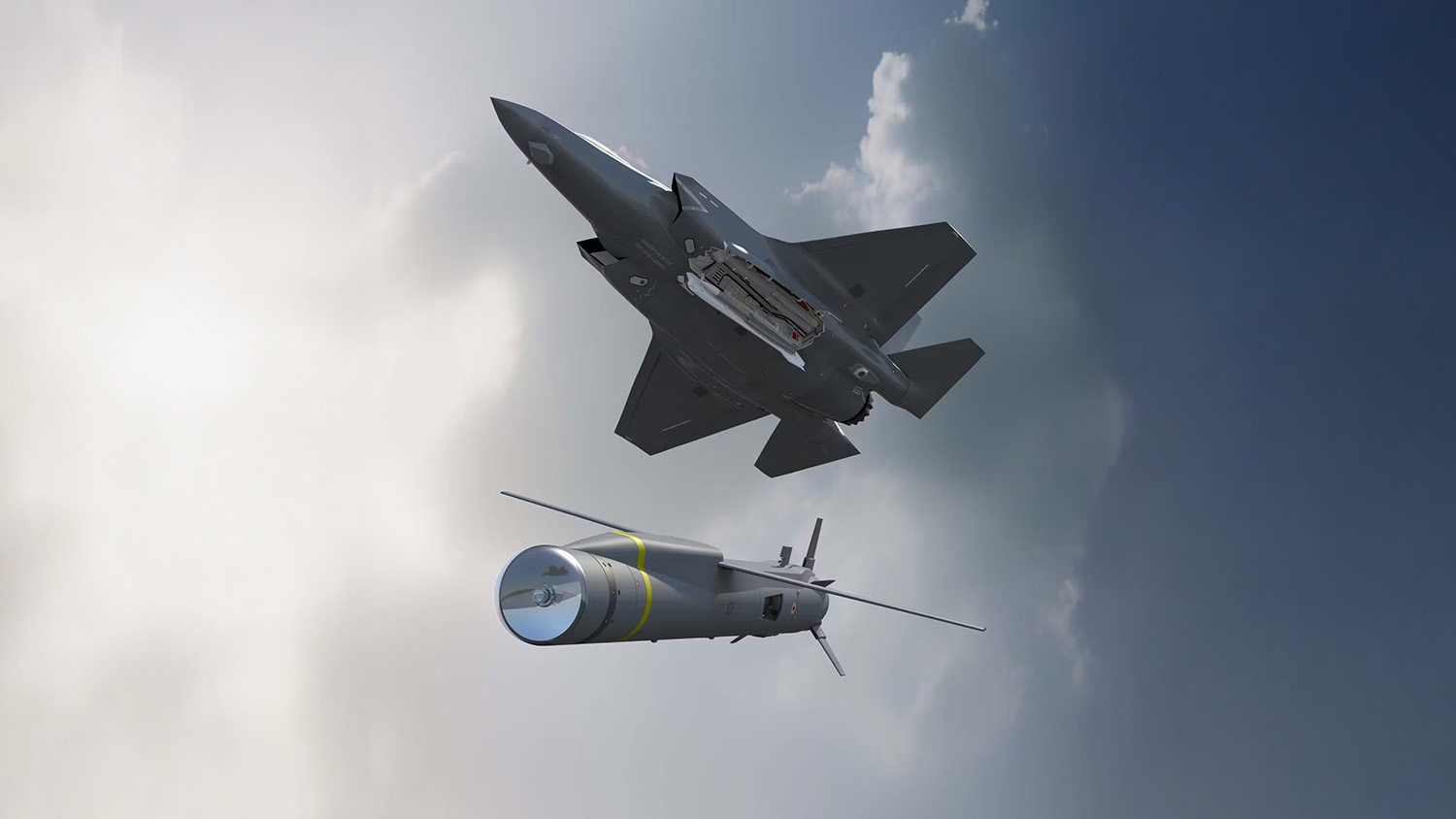
A long-delayed review note that will formally set out a new timeline for the SPEAR 3 missile programme is close to being submitted for approval, Minister of State Luke Pollard told parliament on 21 April, confirming that an extended consultation phase has now been finalised.
The note was originally expected to be submitted by the end of 2025, meaning it has already overrun by several months, and until it receives approval the re-baselining conducted throughout 2025 cannot be formally locked in, leaving the programme’s timelines in the same low-confidence state they have been in since May last year.
Pollard also said that fielding of the capability is targeted within the joint programme from financial year 2028-29, though that figure needs some context, given that Q4 2028 was actually the target before the re-baselining process began, a date that was subsequently pushed to the early 2030s when the MoD acknowledged in May 2025 that all timelines were draft and of low confidence pending the review. Whether 2028-29 represents a genuinely improved outcome from the re-baselining or simply a restatement of the pre-slip figure is not yet clear and will only become apparent once the review note is formally approved.
SPEAR 3 has been in development for years and has slipped repeatedly, originally planned for service entry in 2025 before technical challenges linked to the F-35’s Block 4 software upgrade pushed the timeline back, and until the weapon eventually arrives the UK’s F-35B fleet remains limited to Paveway IV guided bombs in the air-to-ground role.
What is SPEAR 3?
SPEAR 3, or Selective Precision Effects At Range, is a miniature cruise missile developed by MBDA and intended to be the F-35B’s principal long-range air-to-ground strike weapon, designed to be carried internally within the aircraft’s weapons bays to preserve its stealth characteristics, with a full internal load of up to eight missiles across both bays alongside additional underwing carriage options.
The missile is powered by a turbojet engine giving it a range of over 100 kilometres, and uses a combination of inertial navigation, GPS and a datalink to engage targets with precision in all weather conditions, including moving and manoeuvring targets, making it particularly suited to operations against integrated air defence systems where the launch aircraft needs to remain at a safe distance from threats.









Spear 3 was test fired from a Typhoon. It should get a basic integration for Typhoon operations. That way the UK could sell it to other Typhoon operators. Given the limited stock of Storm Shadow, an extra stand off weapon for Typhoon would be handy.
The issue is that SPEAR 3 is a bit short ranged for typhoon and if your not attacking a radar or something heavily defended where you would use storm shadow you would use Brimestone as it’s cheaper.
However SPEAR EW would add Major capability to Typhoon that it doesn’t currently have.
For peer-to-peer conflicts there’s not much distinction between a heavily defended target and everything else. Enemy targets whether its armoured formations, bases, depots, infrastructure, or weapon systems are all operating within a broad cover of long range air defences so you are really going to struggle to operate with Brimstone without facing threats from GBAD. Spear’s 100-140km range is still on the cusp for some AS systems but it offers a lot more safety, especially when launched from a stealth platform.
Brimstone still have their uses (e.g. with low threat environments where they are cheaper like you say) but the standoff capability is pretty much mandatory for a high end threat like Russia or China with sophisticated and resilient AD networks.
MBDA SPEAR (not SPEAR 3, thats the programme name…) has a range of at least 230km (125nm+)….dont fall for the 140km (75nm) public figure nonsense….
SDB2, which has no engine, is the same weight, dimensions and is so close in shape that its hard to tell them apart….but has a range, gliding only, of 111km+(60nm+)….but it has a warhead twice the size of SPEAR. SPEAR uses that spare warhead space for a jet engine and fuel….and they’re not installing a costly jet engine and fuel system for a mere 29km (15nm) additional range….
If you do some basic calculations on the weight and fuel burn of the engine (the TJ-150, there are 2 of the same name..its the P & W TJ-150, NOT PBS TJ-150) and the available fuel onboard….you end up with a figure well in excess of 230km (125nm). Don’t forget, dependent on flight profile that the SPEAR could glide for a portion of its flight like SDB2…which remember can glide for 111+km, with a warhead twice the size….SPEAR would weigh less than SDB2 once the fuel was consumed, it would have the deadweight of the engine and fuel system, but that would be less than SDB2’s larger warhead (drag from the SPEAR intake will be a factor though).
Incidentally….SPEAR-EW, which has no warhead and replaces the seeker head with a BriteCloud derived EW payload, has room for far more fuel as a result (no warhead at all)….MBDA have stated that its range is ‘at least 3 times greater’ than SPEAR….a range of at least 700km+ (375nm+) based on the available data (the additional fuel burn on the TJ-150 tracks beautifully…) would put it directly in the MALD-J category…its main competitor…which also uses the TJ-150 engine (though MALD-J is a little bigger…). If you think about it that makes sense…MALD-J and SPEAR-EW share roles (although SPEAR-EW is more advanced)…Decoy for missiles strikes or manned aircraft and Stand In Jammer….so need a similar range (and time in the air crucially) to perform their function of escorting larger missiles (like Storm Shadow, which MALD-J has done in Ukraine) or staying aloft long enough to cover ingress and egress of a strike…
Marte and JSM are also ready options for Typhoons. Considering the times wouldn’t 20+more new and 20+ more upgraded Typhoons be a sensible purchase? Or, if the UK is serious about getting more F35Bs and then the balance in F35As you think they’d be a lot more urgency on getting this integration done can way sooner. Another 4-5 years wait for early 30s, forget it! What’s taking so long, is it games of “silly buggers”? Wasn’t any of this foreseen before purchasing the F35Bs? Probably could have rejigged the carriers to hybrid airwing and bought Rafales or done q navalised Typhoons before all this is finally sorted.
Let’s get a tighle on or is the Prime Minister going to sit on this as well.
This is the most important weapon the UK currently needs. Every effort should be made to get it back on time line and we should desperately consider a buy of Storm Breaker as an interim capability.
Even buying just a few dozen Storm breakers would make a massive difference to our SEAD capability and even when SPEAR becomes available the two weapons are largely complementary.
Given the pace of integration of weapons, Brimstone will be integrated on Rafale before F35 😉
Brimstone integration on F-35 was cancelled a decade ago…
Stormbreaker is in most respect the direct competitor to Spear-3. However it a a US weapon, so gets priority over Spear-3 on the F35 program. Spear-3 does have quite a few advantages over Stormbreaker, range and release altitude being two key ones. BUt also that Spear-3 has a psuedo loitering capability depending on release range to target., which Stormbreaker being an unpowered glide bomb doesn’t have. Spear-3 is a mini-cruise missile, so it can do the nap of the earth flying towards its target, thereby reducing the chances SAM systems will have at detecting it or taking it out. Whereas Stormbreaker must be released at height to have maximum range, which puts the launch platform at risk. I believe Raytheon who designed and build Stormbreaker are looking at a jet powered version. Which would make a direct sales threat to Spear-3.
The MOD recognize that our F35s lack a stand-off capability, but the only immediate answer is to buy off the shelf, which means it has to be US products. I think it is right to point this out as political espionage by preventing non US weapons being integrated, thereby giving the US a significant sales advantage to their products.
set for imminent submission, umm that Labour imminient? so any time really, a few more meetings, chats, statements before it is released? or will it be like in days?.
They are ‘working at pace’ to imminently form a committee, to discuss and develop a strategy that will then be considered in line with other germaine matters. In the fullness of time an decision will be made at an appropriate juncture.
@Martin: I hope that spells out the sense of urgency clearly enought?
yeah state normal, from the MOD/Defence Sec, bugger all about doing bugger all dressed up to look like it matters.
“Minister, we don’t measure our success by results but by activity and the activity is considerable and productive.”
Is it sense of urgency like appointing Mandelson or SOU of molasses?
As Labour Together’s stooge, Starmer embodies their obsession with inclusivity. In practice this seems to mean hiring as many ‘wrong uns’ as possible; preferably ‘at pace’.
In the meantime, we really need to integrate the storm breaker asap so that we have some kind of standoff weapon.
After attacking the UK aerospace industry, USA, of course, attack the UK missile industry. This was mentionned, in numerous reports… I don’t know who does not do it’s job.
So, F35 can be considered underguned compared to Typhoon, Rafale, Grippen, Su35, J20, J35 in air to air. The Amraam is definitely not the best weapon today.
In air to sea, F35 is not as well armed as Rafale, S35, J20. Let’s put it simple: it can attack an unprotected cargo with a paveway IV. This will at least deal with a derelict.
In air to ground, F35 is inferior to Rafale, J35.
The cell is far from perfect, not that bad, but the armement is obsolete today. No stand-off weapons… The F35 only works against an unprotected airspace…
For European security, I really hope it is transitory.
Only F35 from the second software version have some limited combat capabilities. They are the only engagés in Iran. The first and last batch have none, according to the US GAO. And it still be an understatement.
May be it is a déception plan, intended to lower the guard of ennemies. May be it is the truth, and buyers are in deap trouble.
“In air to sea, F35 is not as well armed as Rafale”
Thats not true. Rafale has the AM.39 Exocet…thats the same missile that was used in the 1982 Falklands War, literally the same version….its range is c30nm…
Truth is a Rafale delivering AM.39 is more vulnerable than an F-35 delivering Paveway IV on a ship…neither is a satisfactory weapon for the role, but F35 will get JSM in the near future though, which is a different class of weapon….and then it will get LRASM which is pretty much as good as it gets for anti-shipping. Rafale may get the Stratus RS in anti-shipping mode c2035.
“The F35 only works against an unprotected airspace…”
I’m as unhappy as anyone with F-35’s weapon integation progress….effectively it has the same capabilities that Typhoon Tranche 1 had almost 20 years ago, and everyone thought that wasn’t enough then….
But F-35 can clearly penetrate protected airspace far better than most other platforms…includig Rafale…we can all see it doing that for the US and Israeli’s over Iran recently…
Exocet Block 3 does not have the range of the original exocet. Range is 180km (annonced). So Paveway IV may not be a good comparison.
But at this point, I think may be their is just a big lie in F35 armement. May be it is a big deception manouvre. They have perhaps real armement onboard and all this is just a big scam. Because if F35 still rely on paveway IV, it is simply useless in anti-Shipping. This can’t be true. USA knows a thing or two about air power. They surely would not do so to their navy. Nor would UK.
Exocet’s latest version that you refer to (MM40 Block C) is surface launched only….
The only air launched Exocet is the AM39 version. This is the original missile from the 1970’s, with some limited upgrades over the years (current is B2 Mod 2). Max range in perfect conditions is 70km…which involves a higher, and more vulnerable transit, before then running in the last 25km at low level.
JSM will have a 300km range in a comparable flight profile (HI-HI-LO)
LRASM has a range of at least 500km..with a monster of a warhead…
Both of the above will be on F-35 in the next 2-3 years….
Rafale will continue with AM39 until at least 2035 when Stratus RS in anti-shipping version may arrive…
Thanks, yes I did make an error of range for AM and MM Exocet.
Btw, UK is involved on « Stratus » as well. Anti shipping will be the stealth one or the fast one? And for which UK plane?
Boeing have done several successful live tests this month of the JDAM-LR which was tested to a range of around 400km, with potential to go over 500km. It was developed from the 70km JDAM-ER by adding a small turbojet engine. Since JDAM is already integrated in F35 & Ukraine has managed to operate JDAM-ER from SU-27 aircraft, it should be a valid option. It’s not stealthy & no anti-ship ability, but it is a relatively cheap long range land attack munition & the B should be able to carry 6-8 of them.
The problem with all flavours of the JDAM is they don’t fit in the weapons bay of the B variant. As a result, they’d have to go under the wings and loose stealth.
With the storm breakers, eight can be fitted internally alongside a pair of AIM120 missiles.
As I understand it, F35B can internally take both 1,000 & 500lb JDAM (not not the 2,000). It is the winged & powered versions that are in question. The 1,000 JDAM-ER is questionable internally, but the 500lb JDAM-ER is considerably smaller. The powered JDAM-LR is unknown all round (internally) & has only been test fired on Super Hornets so far..
I’m more concerned about the lack of anti-shipping capability.
At the rate this Labour Government are going, we’ll be lucky even to have Spears to throw at the enemy 🤔
Spears, fitted for but not with points
Spears are bladed weapons, so first you have to be over 18 to buy one, but with the proposed licensing rules, you’ll have to be certified to own one.
So Spear and Meteor? Ironically named really. Both progressing at the pace of a snail. No, that’s not right. The snail is quicker!
I’ve gained $17,240 only within four weeks by comfortably working part-time from home. Immediately when I had lost my last business, I was very troubled and thankfully I’ve located this project now in this way I’m in a position to receive thousand USD directly from home. Each individual certainly can do this easy work & make more greenbacks online by visiting
following website—.,.,.,.,.—>>> JobatHome1.Com
In reality the carrier battle group is one of the things Russia does not have much of an answer to, unless it wants to throw its few modern SSNs at a highly concentrated ASW screen. But the carrier battle group does need teeth for it to be an effective deterrent… for sea control it works as it is, but it probably needs to be able to inflict more pain..
So
JSMs when they become available for high value Targets a bit further into ruissia.
AGM-154C For hardened targets
Storm breaker as a cheaper way to suppress air defences and throw stuff at lower value targets
That would give an RN battle group everything it needs/
Wow
.. other than an SSN, some escorts, how about some refueling capability and some other effective weapons?. Other than that, you’re ready to take on Putin.
What will be that highly concentrated ASW screen? 4 T26 and 1 SSN?
Well considering the T23 is still considered one of the best ASW boats on the planet.. and the T26 will be the best on the planet.. the Merlin is the best ASW rotor on the planet by a very long way and the UK carrier group will have plenty it will be supported by ground based P8 as well .. so yes it will make any other carrier battle groups ASW screen look like a park stroll…
4 x T26 and 1 x SSN (plus 8+ Merlin HM.2) would be the best ASW screen that has ever set sail…anywhere.
For comparison….the USN operates the inferior MH-60R as its ASW helo….a CSG may have 1 SSN along for the ride, but UK and USN SSN’s are directly comparable.
Plus…Stingray is way better than Mk.54….
But T26 vs. Arleigh Burke at ASW???
Literally no contest….not even close…..AB’s are notoriously noisy….plus, and this is something most people don’t know….1/3rd of AB’s have no towed array whatsoever, 1/3rd have the passive only TACTAS towed array that dates back 40 years….and the final 1/3rd of AB’s, which are all deployed to the western Pacific exclusively or new Flight III’s, do have an Active Towed Array….but its inferior to S2087 or CAPTAS 4….
Right now USN ASW screens for their CSG’s are actually not great….
There is a good reason why every time a Type 23 has been attached to a US CSG as an escort they ALWAYS end up as ASW screen commander, because ther capabilities with S2087 are so far ahead of the Arleigh Burkes…
Purchase another squadron or two of Typhoons and learn a lesson from this fiasco. If you have no control over the product development cycle then you will get left in the slow lane or in the case of SPEAR 3 and Meteor on the side walk! The UK needs access to the source code for the F35B so we can develop / integrate Spear 3 and Meteor. We can all see from the Commons statement this missile capability will not be available until 2030++. Time to play hard ball with LM or considerably speed up Tempest development. Stop pissing about!!!
how do you play hard ball with LM? we have no leverage and nothing to threaten them with, we are stuck with F35 and we need them. All due to short sited thinking and a belief the US will always be there
The F35 software was started so long ago most can’t remember & it has not kept up with modern standards. F35 software wise is 20+ years out of date. The likes of SAAB are way in front. They (SAAB) were prepared to reinvent the wheel if they thought it necessary. LM seriously dropped the ball on F35. Poor design by those that knew better, has left the rest of us in a mess.
Is everyone typing on broken keyboards? Another symptom of chronic underinvestment that definitely has nothing to do with the previous government, who were in charge for fourteen years.
New Labour started well with SDR 98, but went down hill from there. Non stop cuts under Blair, Brown, Cameron, Clegg, May & now Starmer. Boris & Sunak were a mixed bag.