

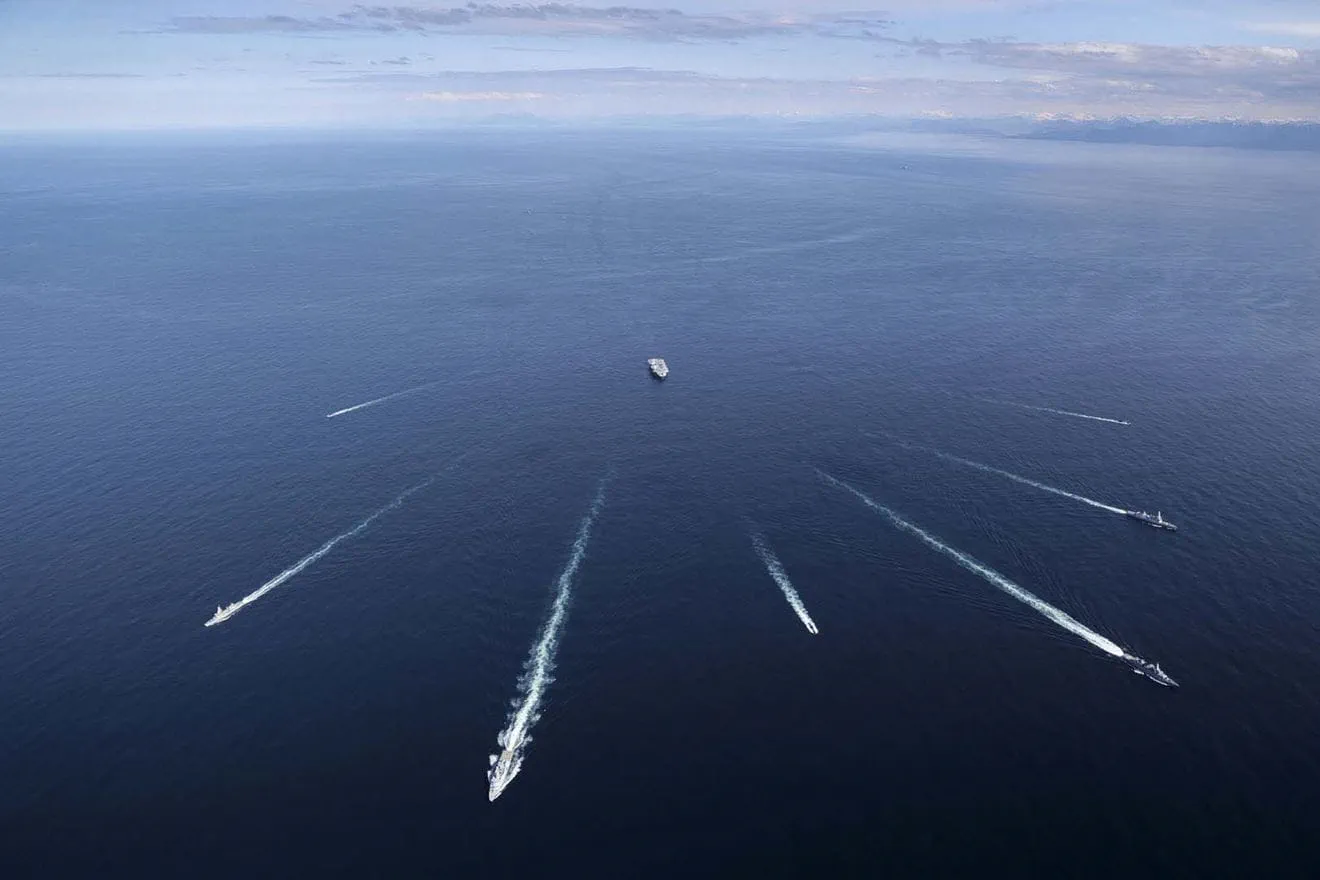
The northern approaches to the Atlantic are more secure after a two-week NATO anti-submarine exercise off the west coast of Norway that drew in hundreds of Royal Navy and RAF personnel and was bolstered by the aircraft carrier HMS Prince of Wales and her group, the Royal Navy has said.
Three ships and aircraft from four squadrons made up the United Kingdom’s contribution to Dynamic Mongoose 2026, the largest individual national input to the exercise, which has now completed. Shared between hosts Iceland and Norway, with Norway leading this year, the exercise drew in six NATO nations committing both personnel and hardware for the game of cat-and-mouse that submarines and surface forces have contested for over a century.
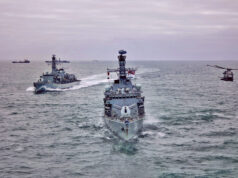
Beneath the waves were a German U-boat and submarines from Portugal and the Netherlands, while above them operated six warships and an auxiliary of NATO’s Standing NATO Maritime Group 1, reinforced by the Prince of Wales carrier group. The standing group, currently commanded by the Royal Navy under Commodore Maryla Ingham aboard the German frigate FGS Sachsen, led the hunt, assisted by Merlin helicopters flying from the carrier’s flight deck and by RAF P-8 Poseidon maritime patrol aircraft from CXX Squadron sweeping suspected submarine routes with sonobuoys.
The involvement of the destroyer HMS Duncan and the carrier brought extra air power into the mix this year, the Royal Navy said, with not only Merlin Mk2s for submarine hunting but Wildcats from 815 Naval Air Squadron providing force protection with their Martlet and Sea Venom missiles. Exercise directors also committed drones and autonomous systems to the effort, with the results of the various serials to be studied by NATO experts and the lessons folded into the alliance’s new Arctic Sentry mission, introduced in February to step up vigilance in the High North, the Norwegian Sea and the North Atlantic in view of Russia’s increased activity in the region.
Commodore Ingham said the exercise had been a real success for all involved, both individually and collectively. “We proved the successful integration of advanced capabilities and technologies,” she said, as well as refining tactics during an increasingly complex series of exercises against live submarines. Dynamic Mongoose, she said, had provided “first-class training” for the crews of maritime patrol aircraft, anti-submarine helicopters, ships and the submarines themselves, and the integration of nine different nations across the force had shown an ability to work together “seamlessly.” The area in which the exercise took place, she added, “is of strategic importance for the Alliance and training here helps us understand the environment.”
The carrier’s commander, Commodore Rich Hewitt, said Dynamic Mongoose had been “a great opportunity to fully immerse the Carrier Strike Group with our tailored air wing into NATO’s premier anti-submarine warfighting exercise.” The group was constantly developing its warfighting readiness alongside NATO allies, he said, and anti-submarine warfare was “a critical part of defending NATO’s Northern Flank.”
Dynamic Mongoose is one of two NATO exercises focused on anti-submarine warfare, testing forces in very different waters, with the Dynamic Manta series held in the Mediterranean, where depth, salinity and temperature all play differently for hunter and hunted. The exercise comes as the High North draws ever greater allied attention, with Russian submarine activity in the Norwegian Sea and the wider North Atlantic having climbed in recent years and NATO standing up Arctic Sentry under the leadership of the United Kingdom.






ASW some thing we were good at and getting back to being good at, we can not do every thing but some things we do very well.
I think we still have the premier anti submarine capability on the planet, between that and special forces and SIGNIT are our three main top of the pile capabilities.
Both the Chinese in 2021 in the South China Sea and the Russians in their latest escapade into the North Sea seem to have been caught off guard about how good the Astute, 2087, Merlin and P8 combined capabilities are for hunting submarines. Both were left red faced after having their submarines detected.
Agreed to all. Another reason why I don’t want DSF reduced mate! ( in our last conversation ) or Cyber, or EW, which is all linked.
Agreed Daniele, I don’t want to see reductions in SF and certainly not SIGNIT, the details coming out about 18 (UKSF) Signal Regiment and the SAS mission in the run up to the Ukraine war are astounding and show UK forces at their best.
But I don’t think we can continue to have capability gaps in GBAD and ABM. SF has grown very fat over the last two decades, especially with newer forces like SF Support Group and Rangers. These forces are vital for colonial policing missions in Asian and fighting insurgents but not so useful in fighting a mechanised war in Europe.
It’s pretty clear there is no bank cheques coming from the treasury so we need to make do.
Hmmm, well see!!
Rangers are not DSF by the way, but I get your meaning. One day we might end up fighting elsewhere, that is why these lighter expeditionary capabilities and enablers persist. You have the Labour Europe only mentality, I see the Grey Zone and British interests all over the world, we mutilate ourselves losing them.
I don’t see us buying any ABM, not seen any indication?? On GBAD, that is supposedly expanding, we await still the details. CAVS as base vehicle for Stormer seems pretty solid, hopefully it is for over 100 as one of our posters connected to the Regiment quoted, would be a big increase on Stormer.
What do you see us buying? I don’t see us buying a thing beyond the ordered Sky Sabre and more CAVS for Stormer. More Rapid Sentry would be good too.
I’ve gained $17,240 only within four weeks by comfortably working part-time from home. Immediately when I had lost my last business, I was very troubled and thankfully I’ve located this project now in this way I’m in a position to receive thousand USD directly from home. Each individual certainly can do this easy work & make more greenbacks online by visiting
following website—.,,……,……..,.,,.—>> LIVEJOB1.COM
Jim, I know you were in the TA in the 1980s, but have you ever actually seen UKSF group? It’s far from bloated and it’s literally designed for high end war fighting, not colonial policing.
For example, the two Tier 1 generalist units are about 800 combined on a good day. SFSG is similar in size. Overall it’s fewer than 2000 people tri-service.
To compare, US SOFCOM is 70,000 people!
I agree that the mission conducted by 22 SAS and the Intelligence Regiment in the run-up to the invasion of Ukraine demonstrated British special operations at their very best. The intelligence gathered and passed to the HMG, Ukrainian government and allies was of enormous value.
Where I disagree is with the suggestion that the answer to capability gaps in Ground Based Air Defence (GBAD) and Anti-Ballistic Missile (ABM) defence is to cut Special Forces.
The first point is that the UK does have serious deficiencies in integrated air and missile defence. Defence analysts and the Strategic Defence Review have all highlighted this issue. The Government claims to now be committed to additional funding specifically because the gap is recognised as a strategic weakness. The problem is real, the funding at present is just words.
The second point is that Special Forces and air defence are not competing capabilities. They solve entirely different military problems. GBAD protects forces, infrastructure and population centres from aircraft, drones and missiles. UK Special Forces provide strategic reconnaissance, counter-terrorism, deep strike, target acquisition, intelligence collection and influence operations. Then we have the supporting formation for the UKSF. The Paras, Army Commando, 29th Commando Regiment Royal Artillery and my very own 3 Commando Brigade. These forces make a force capable of taking the war to the enemy. Able to be used as a precision instrument, not a blunt force. Removing one capability does not create the other.
Third, the claim that SF has become “fat” is difficult to support. The Ranger Regiment, Special Forces Support Group and associated units were not created simply to fight insurgencies in Iraq and Afghanistan. Their purpose is to create specialist forces capable of operating below the threshold of war, supporting allies, conducting reconnaissance and preparing the battlespace AND being used as the eyes, ears and strike force to remove the elements that can hurt the main forces. Just as in Iraq I, finding scuffs, cutting communications on MSR’s, hitting logistics and support infrastructure and mobility. In Afghanistan, finding and marking targets, seeking out Taliban and ISIS Insurgents. Train, advise or assist Afghan forces. Hearts and minds missions in far-flung places that the Infantry did not reach. Those missions are even more relevant in a confrontation with Russia than they were during the War on Terror.
Ukraine itself demonstrates this point. The war has shown that intelligence gathering, sabotage, long-range reconnaissance, drone integration and targeting networks are decisive. Every successful army in Ukraine is relying heavily on capabilities that sit very close to the traditional Special Forces skill set. Far from being obsolete in a mechanised war, these capabilities have become more important.
Fourth, if Britain had to fight a NATO war in Eastern Europe tomorrow, UK Special Forces would almost certainly be among the first assets committed. Strategic reconnaissance, identifying missile launch sites, tracking command nodes, directing long-range fires and operating behind enemy lines are precisely the tasks that would be required in the opening days of a conflict.
The real issue is not that Special Forces is too large. The issue is that successive governments have underinvested in conventional warfighting capabilities while simultaneously asking the Armed Forces to maintain global commitments. Parliamentary reports have repeatedly identified shortages in air defence, munitions stockpiles, logistics, mass and readiness across the Armed Forces.
Finally, if there truly are no additional cheques coming from the Treasury, then defence planners should prioritise the restoration of GBAD, missile defence, ammunition stocks and industrial capacity without hollowing out one of the few British military capabilities that remains genuinely world-class. The answer is not to rob Peter to pay Paul. It is time to stop pretending the United Kingdom can face a peer conflict while spending at peacetime levels and maintaining a force structure designed around optimism rather than reality.
Oh, comparing UKSF against US SOFCOM is churlish and irrelevant.
*Scuds.
Typooooo
That’s my point we can not be good every where but what we are good aat we are the best in the world. That’s why we can never have the massive armed forces some want not our role in Nato to be a ack of all trades other can be good at other things as it should be in an aalliance.where they are nit so good we are and vise vers.
That’s why will will never have a big army again we do not need one
The irony of your comment being 2-fold. We cannot have good special forces without a large army to sustain them and NATO want us to provide significant land forces. That’s where they see our value.
True you need a good pool of people for SF, bigger army better the pick. But NATO can do one we can nit afford what they wabtcwe bring nuts and carriers when others do nit , we can not afford a large army no matter how many want it.
Some need to wake up to that they want every thing abd think cutting welfare will pay for it except bo government will go down that path. Our days of a big Army are over for good
I actually think you are very wrong. I think the capability that has crippled most of the forces since 1998 is Carrier Strike. That’s what has reduced the escort numbers, what we sacrificed amphibious theatre entry to fund, and prior to 2010 Levine reform, forced a reduction in Army establishment to pay for it. And we can’t really realise its potential without a serious amount of additional funding. I’ve always been a proponent for it, but realistically that’s a capability we can actually do without.
We can strike targets at distance with long range missiles and drones, with lower risk than a carrier strike, particularly one where we rely F35B with no refuelling capability from the carrier itself.
Let’s stop kidding ourselves. We need more SSNs and surface combatants with ASW, and surface strike capability and reconstitute amphibious theatre entry to get us across the North Sea. And we need to properly reconstitute a two division Army for war fighting with all of the precision strike needed at every level.
We need to provide corps level command and control across all domains with a plug and play capacity for our allies.
Because that’s what NATO and particularly NATO without the US needs from us
And we need to provide sufficient air and missile defence for the homeland and overseas territories.
To me the carriers have become purely a costly effort at Willy waving, and frankly we’ve got a little Willy (or a large but permanently flaccid one with tiny balls)
Oh, and we need significantly larger reserves and a way to rapidly grow our manpower for war.
I’ve gained $17,240 only within four weeks by comfortably working part-time from home. Immediately when I had lost my last business, I was very troubled and thankfully I’ve located this project now in this way I’m in a position to receive thousand USD directly from home. Each individual certainly can do this easy work & make more greenbacks online by visiting
following website—.,.,.,.,.—>>> JobatHome1.Com
and how do pay for all this?
Get rid of carrier strike for a start.
Take £9Bn from carbon capture that’s being spent over the next 3 years.
Re profile the National Grid restructure over the next 10 years to spread it out and take £20bn of the £40bn allocated.
Re-impose 2 child cap (btw I have three children because my second was twins) (£3bn a year)
Delay the £4.5bn on cycle network until after 2030.
That’s about £44bn over the next three years just by reallocating money that can be delayed or changed, when at the moment, Defence cannot.
Ok, so non of those are palatable. But neither is the prospect of fighting a major war by 2030 if we don’t deter one, or fighting it without the resources we need.
None of that will ever happen. No chance. No governmentvwill do that and under Labour even less chance
Ok, within the current budgetary envelope; remove the separate service HQs. Make them 3* operational HQs under a 4* single service.
Harmonise all pay and conditions under a single structure including career management. We shouldn’t have a 32 year RAF structure, a 24 year Army structure and 22 year navy structure each managed by staff and civil servants.
Have a single officer academy with separate streams like Duntroon.
Do away with duplication across the services – we don’t need three heads of medical services and they’re associated staff…. Defence medical should provide all medical capability under a single identity.
Stop the stupidity of the RM being allowed to pick their own uniform from the highest bidder where they are super low down the customer pecking order. Stop them being allowed to buy a stupidly small batch of Rifles separate from DSF and the Proj Hunter purchase.
Did I mention forget carrier strike? It would’ve been great in 1991 or 2003; but right now we need something different- the equation has changed.
How relevant is an attack helicopter force and how vulnerable?
But you asked how could we fund what I said… I’d cut the funding to net zero for the next 3 years as laid out about and stop some of the welfare give seats for 3 years.
Someone has to make hard decisions. That’s the sacrifice believe we should make to get the defensive posture we need by 2030.
But I think people who think a large Army is irrelevant do not understand war.
I’ve said it before, you can lose a war at sea, in the air, in cyber or space. But you can only win it on land.
A fine point that….and we must not lower standards either.
“Our days of a big Army are over for good.” What rubbish. We were forced to have several armies in WWI & WWII. Should Russia commit to an attack on an ally in 2030 as expected, we will have no option. Taking out the US for example, because they will be fighting a war with China, if Xi’s 2027 command is to be believed. We will need to commit large forces to the European theatre.
How anyone can claim “Our days of a big Army are over for good,” is only to demonstrate their lack of awareness and the requirements put on the UK in the event of war with Russia.
Umm, how do fund and equip a big Army, and man it? and what do you cut to have big Army but a wearker Navy and RAF, you can not have every thing, and where in peace time do base this Army? it kit and the soldiers families?
Special forces will reduce, certainly size and possibly quality.
This is cost of such a small army/marines.
0.5% of less than 70,000 is not viable.
“I think we still have the premier anti submarine capability on the planet”
How is that even possible with outdated broken frigates in single digits, submarines that dont sail and Merlins that are not upgraded?
Do you think RN absurd ship mismanagement- a teenager could do better- do not by miracle go to other force aspects like training?
We’re still calling them U-boats?
U = Underwater.
The Germans call them U boats
Two Merlins and two Wildcats, but an awful lot of words
8 F-35Bs are there as well now. Not that they do much against submarines, but they’re there.
They sneak up In a Stealthy manner, Unseen, unheard, Unable to drop any Bombs but scary nevertheless.
Handy for knocking away any long range Russian patrols. 8 X F35’s is probably the ideal amount for these North Atlantic NATO patrols that are more submarine and littoral strike group missions than CSG.
As long as we can rapidly deploy additional F35 in the event of a war then not much point in having them bashed around in the rough North Atlantic on training missions.
What if the thing LM have been doing all this time is integrating sonobuoy pods and Stingray for internal carriage on F35B? They might have played a blinder.
The CSG needs MQ9B if we want it to be a genuinely transformational ASW asset.
Oh, good stuff. Thing is, if they were not there before, they can be quickly where she is. So it is no biggy.
Didn’t know that. Cheers. Useful to run them into the system.
Well at least we know where all ours are. 😎
This article is fake news, I have read in the daily mail and the independent that HMS Prince of Wales is broken down 😀
Everything you post here is fake news, you useless tosser
😂😂😂😂😂😂🤦♂️
How’s the wife David
😜🍿
I’ve gained $17,240 only within four weeks by comfortably working part-time from home. Immediately when I had lost my last business, I was very troubled and thankfully I’ve located this project now in this way I’m in a position to receive thousand USD directly from home. Each individual certainly can do this easy work & make more greenbacks online by visiting
following website—.,,….,,.—>>PayAtHome1.COM
And only a few weeks ago trump was being heavily criticised for him opinion on the paucity of UK defence forces, now we have defence ministers resigning in protest
Seems like trump was right, again
chui, you cant say that…