

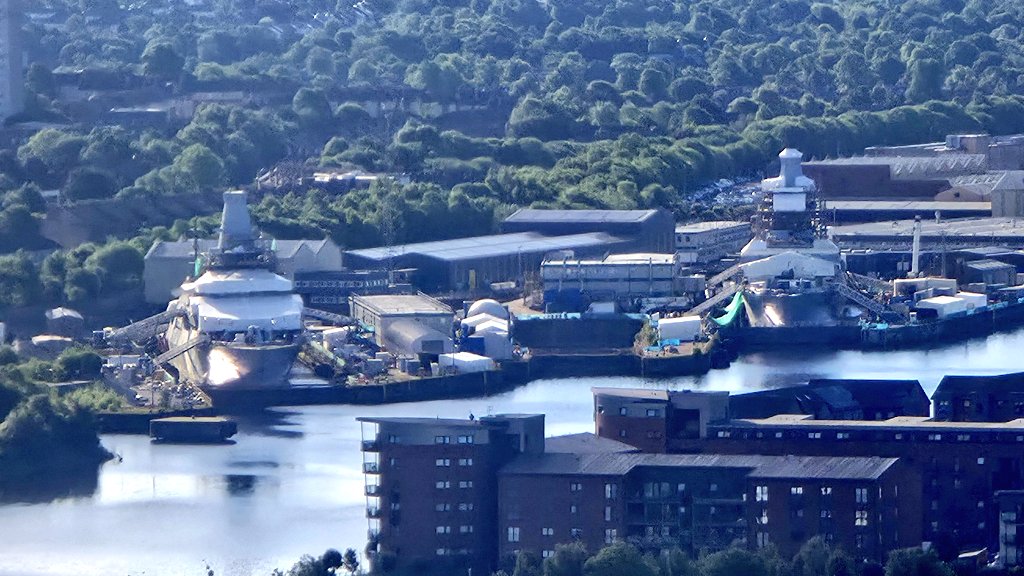
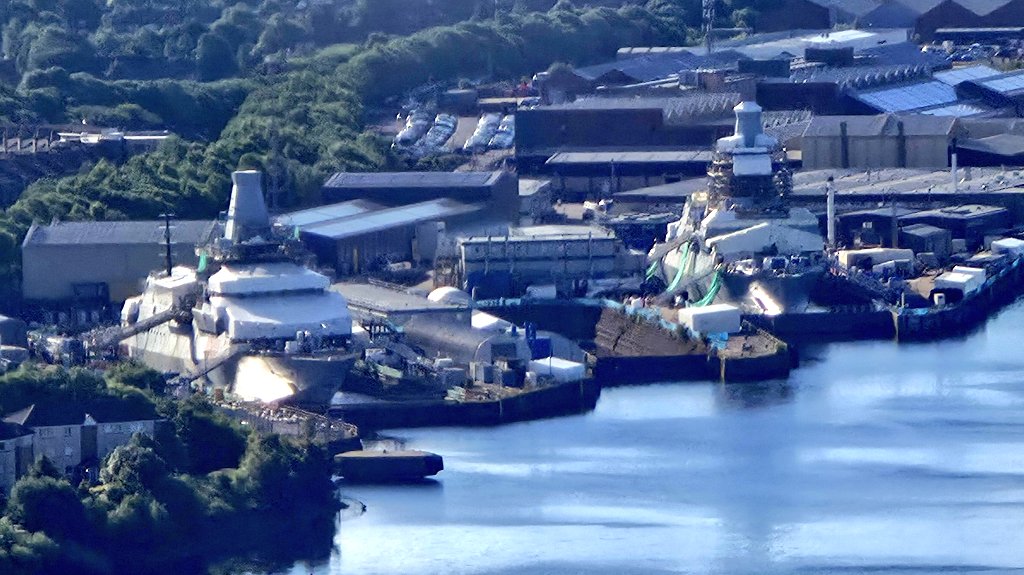
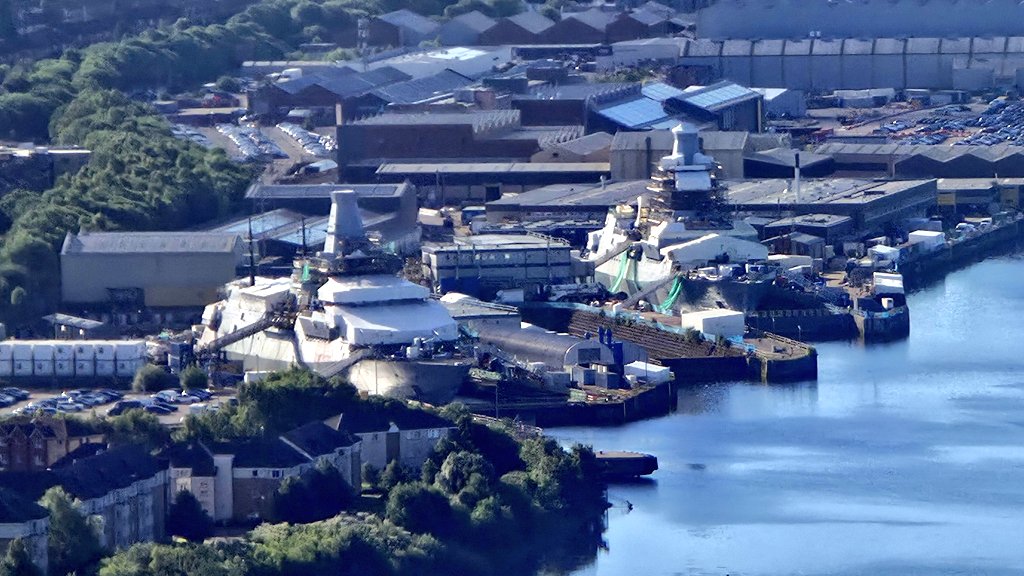
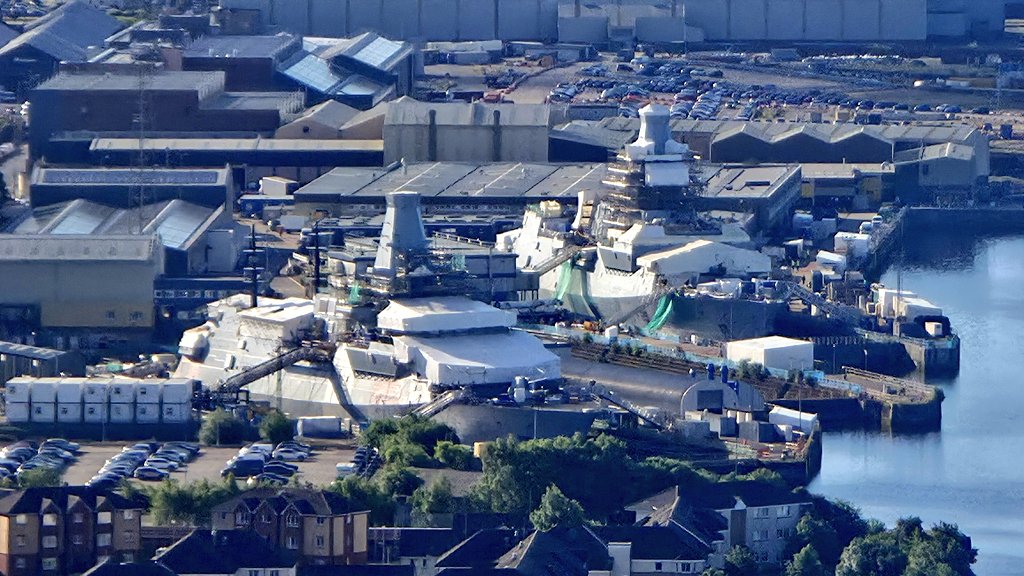
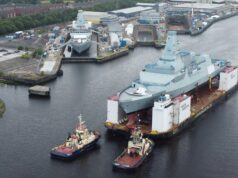
New images have provided a fresh view of HMS Glasgow and HMS Cardiff, the Royal Navy’s first two Type 26 anti-submarine warfare frigates, with both ships now progressing in parallel through the fitting-out phase ahead of trials.
HMS Glasgow, the lead ship of the eight-strong City class, has been at Scotstoun since being floated off at Glen Mallan in late 2022. The ship has spent the years since in a sustained programme of outfitting, with major equipment including the BAE Systems Mk 45 Mod 4A 127mm naval gun fitted forward, the foredeck prepared to receive the Sea Ceptor and Mk 41 vertical launch system modules, and the bow and towed array sonar systems installed. Internal cable termination, equipment commissioning and system integration work has dominated activity on board for the past year as the ship moves toward the start of sea trials.
HMS Cardiff, the second of class, joined HMS Glasgow at Scotstoun in late 2024 after her own float-off and tow up the Clyde, and the two have since been pictured together on numerous occasions. Cardiff completed her first flood-up in May 2026, transitioning into wet dock and into the afloat fitting-out phase. Her programme remains some way behind that of Glasgow, with major equipment installations and system integration work continuing.
The Type 26 build effort on the Clyde is a programme that has steadily expanded since first steel was cut for HMS Glasgow in July 2017. BAE Systems has invested heavily in the supporting infrastructure, including the Janet Harvey Hall at Govan that allows two Type 26 hulls to be constructed in parallel under cover. The investment is intended to reduce build duration from a first-of-class figure of around 96 months toward 60 months for the eighth ship of the class, with the interval between ships compressed from 18 months to 12.
HMS Glasgow is scheduled to begin contractor sea trials before the end of 2026, with reporting earlier this year indicating that the start of trials had slipped from earlier in the year toward December 2026 or early 2027. Following completion of trials and handover to the Royal Navy, the ship will undertake a period of Royal Navy-led work-up and live weapon trials, with full operational capability anticipated in 2028. The eight ships of the class are expected to enter service between 2028 and 2035, with each replacing one of the in-service Type 23 anti-submarine warfare frigates currently delivering the role.
The remaining six ships of the class, HMS Belfast, HMS Birmingham, HMS Sheffield, HMS Newcastle, HMS Edinburgh and HMS London, are at varying stages of construction at BAE Systems’ Govan and Scotstoun yards. HMS Belfast, HMS Birmingham and HMS Sheffield are at Govan, with long-lead procurement under way for HMS Newcastle.
Earlier this week, Minister for Defence Readiness and Industry Luke Pollard told Parliament that the programme remained on track to meet all user requirements and to deliver all eight ships, with vessels entering service from the late 2020s.
The Type 26 design has also become the platform of choice for a growing number of allied navies. Norway selected the British design last year under a £10 billion agreement covering at least five hulls, with Australia building six ships of the Hunter class variant and Canada planning fifteen of the River class destroyer variant. Combined with the eight Royal Navy ships, the international Type 26 user community now totals around 34 hulls planned or under construction, placing the design at the centre of allied surface combatant procurement for the coming decades.
The ships’ primary role is anti-submarine warfare, with a quiet hull form, advanced sonar suite and a low acoustic signature engineered around the demanding requirements of detecting modern submarines. The class will operate primarily in protection of the United Kingdom’s continuous at-sea nuclear deterrent and the carrier strike group, alongside contributions to NATO standing maritime task groups and to the joint UK-Norway force structure agreed under the new Lunna House Agreement. The mission bay located amidships will allow the ships to deploy uncrewed surface and undersea systems, embarked Royal Marines, and a wide range of other mission loads alongside their core anti-submarine equipment.
The images were taken by me onboard a flight coming into Glasgow Airport, not by a drone, as many will likely be curious about.









Canada needs to pressure Irving to accelerate production of the River Class. They are working on one hull at at a time and stringing along the Canadian taxpayer for the next 25 years.
The RCN needs these hulls in the next 10 years not 25-30.
Well that’s what happens when you don’t order anything much for decades, let you Naval shipbuilding collapse, build house all round the build hall and leave no room for expansion. You end up with a single hull Assembly Hall and no wiggle room (unless you reclaim land and narrow the access to the Bedford Basin).
IMHO Canada should seriously think about building and funding a new purpose yard at Halifax and operate it on the same model as Australia and USA. State owned but Contractor Operated, nice thing is you can stick the investment costs into the 1.5% of GDP that should be spent on “Defence Related expenditure”.
The 12 to 20 Continental Defence Corvettes could be built in the St. Catherines on Lake Ontario and Davie yards in Quebec City in 10 years if the project hits the road soon.
Irving yards is a huge political decision for the building of the Rivers. A very long political story how Irving holds the federal government hostage over Atlantic Canada economy.
The good news is the 12 subs will be built abroad in half the time as the River Class. Estimated completion date in 2040 with 5-6 subs built by 2035 according to Hanwha. the Germans claim the same although thy just made that commitment recently.
If the delivery rate stays as it is their ships will be technically obsolete by the time they get them
Yes, considering the rapid change of warfare with drones, they will be indeed.
The English Channel has become a primary flashpoint in the maritime shadow war between the UK and Russia. Following the aggressive implementation of Western sanctions, an estimated 184 unique UK-sanctioned Russian “shadow fleet” tankers have defied tracking to make at least 238 journeys through British waters, transporting crude oil. To protect these economic lifelines and deter Western interdictions, the Kremlin has deployed naval assets – primarily the Udaloy-class destroyer RFS Severomorsk and the guided-missile frigate RFS Admiral Grigorovich – as armed escorts.
The standoff escalated dramatically after Royal Marine Commandos forcefully boarded and seized the Cameroon-flagged shadow tanker Smyrtos off Portland, confiscating 98,000 tonnes of Russian oil, Days later, a severe propulsion failure and fuel crisis left the Grigorovich drifting in dense fog south of the Isle of Wight Incapable of manoeuvring, the paranoid Russian crew panicked when “Bright Future” a motorless British leisure yacht sailed near. The frigate fired warning small arms shots, sparking a major international incident
Today, the crippled Russian frigate remains heavily constrained, loitering in international waters roughly 20 miles south of the Isle of Wight. The Royal Navy has successfully paralyzed it’s escort mission; the River-class patrol vessel HMS Mersey maintains a continuous visual lock supported by Wildcat helicopter overflights. While Prime Minister, Sir Keir Starmer condemned this “reckless” display. The MoD concluded the shooting stemmed from mechanical incompetence rather than a deliberate act of war. Meanwhile, the UK legal system has fast-tracked the sanctions prosecution of Smyrtos captain Ajay Pant, remanding him in custody ahead of a July 16, 2026 trial hearing, signalling an unyielding British crackdown on Russia’s maritime evasion.
Why doesn’t the UK offer to tow this frigate into port and as a gesture of goodwill fix it up enough to send it on its way? Imagine the PR value of that? Might be bonkers and Ukraine obviously wouldn’t like it, but might diffuse some Russia v West tension.
Or just seize it and gift to Ukraine; imagine the PR on that!
Al Carns for SecDef!
Russia needs to be shown the high port and told to foxtrot oscar off the world stage and give their collective heads a wobble and enter the modern world the bunch of c**ts; although only a dead Russian is a good Russian.
With it being in international waters they would need to request our help. If she should happen to drift within the 12 mile limit then she could be declared a hazard to navigation and as such boarded and towed to a port where she could be ‘repaired’.
They really need to get a move on. All the Treasury has to do is to loosen the purse strings.
I wonder if the change in language regarding T31 in service dates has come about because funding has been switched from Babcock to BAe in an attempt to accelerate Cardiff and Glasgow. I would say 2 T26 in service are a higher RN priority than T31s.
Type 31 is irrelevant – it’s a fixed price Contract 🙄
But the scheduling of work or funding is not fixed. The govt could choose ( for a year ot two) to accelerate T26 work at the expense of the pace of T31 work while keeping the total, eventual total contract payments the same for both contracts in order to prioritise the delivery of one type over another.
Are BAE coordinating the final piece (Radar) on HMS Glasgow with the fitting of the festive star this year perhaps?
Talking of radars, will it they be the currect Artisan’s or the Artisan NG’s?
With the sluggish fitting out of Glasgow we might hope the Artisan NG could be a welcome option. One might argue that it would be the “Gold plated” version when there is a current, well known and tested system available.
I’d go for the NG, if available, reduce future upgrade delays and get RN use of the system now. It’ll not get onto the T45s now but will if there is to be a T83?
When they know they’re likely to be shadowed by a opv than a warship they’ll be happy to carry on what they’re doing. Disgraceful and embarrassing. How many , more years before Glasgow actually joins whatever is cheaper and quicker to get and fit the fleet?
Good to see these ships progressing, though it’s obvious that despite modern electrical wiring and systems, plus weapon installation, the fitting out still remains an issue in terms of being timely. Obviously Glasgow is the lead ship; hence, it will be subject to prototype problem-solving and mistakes, which should allow the rest of the fleet to benefit. Also, I do hope there is no Treasury interference in the budget management?
Along with others I thought that Computer design would lead to a much quicker fit out. In fact we haven’t built a ship so slowly since HMS Hermes or the Tiger class all of which were started in WW2 and then halted and restarted to modified designs. This slowness at a time when our Navy is literally rusting away is not good.
Well, it has to be said, Jonno, that the build rate needs to improve, and we may just see that with ship No. 3?
How on earth did Pompey dockyard build the first battleship Dreadnaught in under a calendar year and today’s computer an billion pound technology can’t build a frigate? THAT IS EHER the biggest issues need sorting out.
Wonder if BAE are worried about the lack of progress with the t83 …? Or do they lay off all their workers on the Clyde after t26..??
With Mr Pollard wanting a “1000 ship navy” and if T83 slips has any cost and usefulness study done on maybe getting a couple more T26s and a few less (100s of) LUSV/drones add ed to the run for the RN?
Has the T26 design been offered to the USN as an alternative to the Constellation class? Even the AH140/T31?
TI3? WE’LL STILL BE WAITING FOR GLASGOW BEFORE WE CAN AGREE ON THE DESIGN AND SPECS FOR IT.
Eleven years from steel being cut to in service (we hope). The latest Japanes destroyer took three.
So quick indeed that the Japanes decided to remove an e in celebration of the stunning efficiency of their speed typing.
You noticed that as well. 🙃
Because we have a. Badly run, unmotivated workforce at the Clyde yards
Impressive warships. Really wish they had MTLS and didn’t have to solely rely on a Merlin, which whilst fantastic aren’t ubiquitous.
Considering the development of XLUUVs and the likelihood that everyone and his brother will have a few its looking like a bit of an oversight.
You could sort of understand it if your only worried about SSNs.. your small ship flight is always the way to attack an SSN and if it all goes a bit wrong then a rocket assisted torpedo in a MK41 launcher will do the job…
But in a world with XLUUVs sneaking around everywhere and in numbers.. A magazine of organic light weight torpedos may be needed…
Or it may be that you go more to a depth bomb.. either rocket delivery or 5inch gun delivery.. as the quick snap attack brown trouser weapon of choice.
It’s sad that the RN has one of the most impressive escort building programs on planet earth with 6 Type 26s laid down or fitting out and 4 type 31s laid down or fitting out.
That’s 10 frigates being constructed concurrently.. that’s the same number of Burkes the US has in active construction..
It’s just a shame that construction did not start in the time frames it should have.. 2010-12 or at the speed it is now
The problem of course is that HMG is going to do what it always does and take the foot off the gas, instead of just keeping the building rates going.
Nearly 4 years fitting out now, when that should be more like 18 months -2 years
Poor project/resource management.
It’s probably the lack of practice issue.. it was literally an entire decade between the finishing of the fitting out of the last T45 and the start of the first T26. That’s essentially a generation of lost skills that needed re developing.
Practice makes perfect.. that’s why sticking with long runs, spiral development and not leaving production gaps work.
One word. Pathetic. Well, two or three. No excuses are there, except politicians with zero experience of the real world. No appreciation of anything other than their own little bubbles and egos. These are the clowns ( 40% ) lawyers who let terrorists off but pursue veterans. They allow an invasion. They tax decent people more than since WW2 to fund breeders, idleness and illegals. They have made our country a laughing stock, they allow Chicoms a free hand and Russian interference with our infrastructure. Hell you could write a book eh?
Think that will do. Dont want to be called a fascist/racist by the obvious leftards who haunt these fairly honest pages.
”The eight ships of the class are expected to enter service between 2028 and 2035, with each replacing one of the in-service Type 23 anti-submarine warfare frigates currently delivering the role.”
Ironic or just poor journalism?
The glacial build rate of these warships is appalling, however, as Johnathan notes, in part because of the fmr Govts failure to order on the back of the T45 production run cessation. Causing further delay and compounding the above ‘irony’ is the Norwegian order and again a failure of Govt to notify us how that order is going to be interwoven into the RN order.
Worrying? Sad? Or just plain pathetic?
10-11 years to build the lead ship, I wouldn’t say its much to get excited about.