

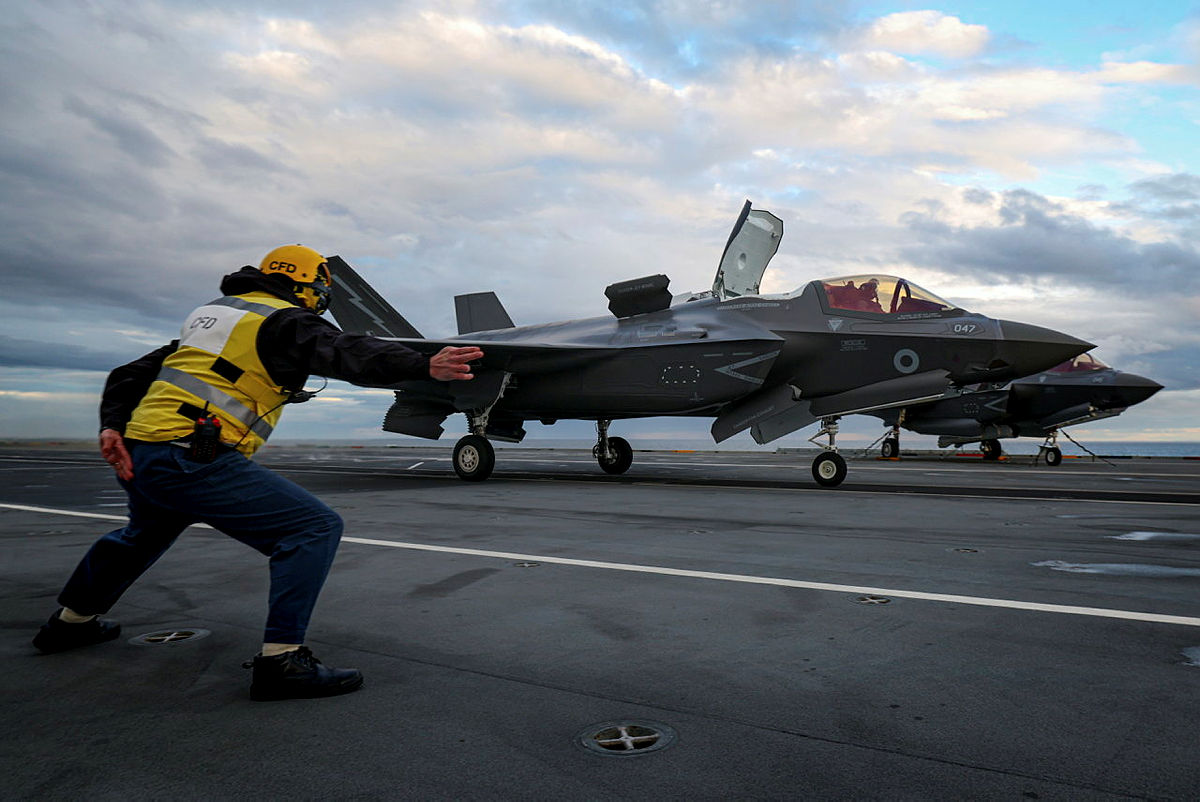
British F-35B stealth fighters have embarked on the aircraft carrier HMS Prince of Wales and are flying from her deck as the fleet flagship conducts heightened vigilance in the North Atlantic under NATO’s Arctic Sentry mission, the Royal Navy has said.
The Lightning jets, drawn from 617 Squadron and 809 Naval Air Squadron, embarked on the carrier from their home base at RAF Marham in Norfolk, and have been operating from her deck as she works alongside NATO allies in the High North. 617 Squadron, the Royal Air Force’s Dambusters, and 809 Naval Air Squadron, the Fleet Air Arm unit reformed to fly the jet, together provide the United Kingdom’s carrier-borne fifth-generation strike capability.
The F-35B is a fifth-generation, multirole stealth fighter capable of air-to-air and air-to-ground missions as well as intelligence gathering and electronic warfare, and its short take-off and vertical landing design allows it to operate from the Queen Elizabeth-class carriers, which have no catapults or arrestor wires. Embarking the jets turns the carrier into a mobile airbase able to project that capability across the region.
HMS Prince of Wales is conducting what the Royal Navy describes as extra vigilant activity, known as Arctic Sentry, in the North Atlantic, the NATO mission introduced earlier this year to step up watchfulness across the High North, the Norwegian Sea and the North Atlantic in response to increased Russian activity in the region. Operating in the High North and the wider Euro-Atlantic, the Royal Navy says, the United Kingdom is demonstrating its contribution to NATO’s deterrence and defence first hand.
The carrier has been joined by the destroyer HMS Duncan and the tanker RFA Tidespring on Operation Firecrest, the United Kingdom’s deployment for the first quarter of 2026, intended to demonstrate the country’s commitment to delivering advanced warfighting capability to both NATO and the Joint Expeditionary Force. Working with NATO allies and JEF partners, the Royal Navy says, is business as usual for the United Kingdom and its commitment to security in the region.





Fake news, I read in the daily mail and the independent this ship was broken down and I heard on X that we don’t have any planes. Munro assured me we can’t put a single credible warship to sea just this morning
Check your sources George 😀
I’ve gained $17,240 only within four weeks by comfortably working part-time from home. Immediately when I had lost my last business, I was very troubled and thankfully I’ve located this project now in this way I’m in a position to receive thousand USD directly from home. Each individual certainly can do this easy work & make more greenbacks online by visiting
following website—.,..,.,.,,,,..,,,.,.,.—>> LIVEJOB1.COM
I’ve gained $17,240 only within four weeks by comfortably working part-time from home. Immediately when I had lost my last business, I was very troubled and thankfully I’ve located this project now in this way I’m in a position to receive thousand USD directly from home. Each individual certainly can do this easy work & make more greenbacks online by visiting…
following website—.,….,,.,.,.,.,—>> PAYAtHOME1.COM
Even more shocking is that you read the “Daily Mail and Independent”.
Good to know the F35B aircraft are flying in the high north in a show of strength to potential aggressors. Any idea how many aircraft are on board?
It did say fighter Jets, so plural therefore at least 2 🤦♂️😜
Malcolm, How many F-35Bs do you need to conduct or train for ASW, which is the point of the exercise?
None, but as this is billed as An Aircraft Carrier specifically designed for Strike. I would expect some F35 to keep the deck teams up to speed on handling, launch and recovery. My biggest concern is the Treasury forcing the Navy to use this primarily as an LPH because it can and it will be cheaper.
In a North Atlantic ASW mission of the kind the navy was primarily configured around during the Cold War, the requirement would be for a mix of ASW helicopters and sufficient fighter aircraft to defend the surrounding airspace from the Russians.
totally agree with that assessment and the reason we have a much bigger ship compared to our through deck cruisers is the size of the aircraft.
No it’s not Malcolm, the reason we have much bigger ships was a design choice around sortie rate. The concept of the carriers was carrier strike.
The concept of the Invincible class was ASW with enough “air” for air defence. If it was just a size thing they would have built something like Cavour at about 40,000 tons
I’ve gained $17,240 only within four weeks by comfortably working part-time from home. Immediately when I had lost my last business, I was very troubled and thankfully I’ve located this project now in this way I’m in a position to receive thousand USD directly from home. Each individual certainly can do this easy work & make more greenbacks online by visiting
following website—.,.,.,.,.—>>> JobatHome1.Com
Three flights of 4 F-35B’s embarked over three days, so – to my amazement – a full squadron of 12 a/c, i.e. what is supposed to be the standard Lightening load when operationally deployed. There are some official photos on X. A couple of USMC F-35B’s may also embark soon!
More than 12 UK F-35B a/c is an exception that will be exercised only occasionally, with the general assumption that CSG29 will be the next occurrence. But the RN and USMC seem keen to keep integrating the latter’s F-35B’s in to QEC air groups.
It seems all but certain that POW will be the stand out attraction at the New York International Naval Review 250 on 4 July. And the RN desperately needs a bit of positive PR!
12 F35s as per Navy Lookout
Which is more than enough to do the ASW job that the Invincibles used to do.
12 F35 is more than enough to retake the Falkland’s
As long as they have enough spare parts 😜
A decent number then.
Not hardly dude. 12 is kinda pathetic.
It’s a full combat load for an old Invincible, if said Invincible didn’t have any significant ASW wing embarked.
So?? Was Invincible a strike carrier?
Yes.
Delusional
Maybe learn to defend your point instead of just throwing an insult and people will not think your a troll?
Literally the first use of the Invincibles was in the carrier strike role providing air cover to the fleet and attacking ground targets in support of troops. 12 Harriers was literally the *STRIKE* load out of an Invincible.
12 Harriers? What were they attacking, the Isle of Wight?
Maybe try reading a bit of history instead of just having temper tantrums?
HMS Invincible sailed with 8 SHAR FRS1, HMS Hermes with 12, both being augmented mid-May with SHAR FRS1/GR3s. Ex F126 myself.
12 are on board
4- Helicopters and a few F35Bs …?
On a unreliable 70000t Warship !!!!
12 F-35B are a reasonable size of force to exercise with. I’m not sure if PoW is particularly unreliable. Maybe that’s just new carriers generally. We know the USS Ford has had its teething problems. It would be interesting to know the reliability of the Chinese carriers, such as the Shandong (commissioned in the same year as the Prince of Wales). It has certainly needed some major overhauls in the last ten years.
If we sent 12 flying rubber ducks, it would be 12 more than Russia can put to sea. As for reliability it doesn’t need a tug to follow it round. The bogs work and it hasn’t burned to the ground. Her sister ship has done over 100k miles with few issues. Although we haven’t tried dropping a crane on it.
Nige, Just checked some stats. PoW has been in in dock for maintenance/repairs on 411 days since being commissioned in Dec 2019 ie averaging 63 days per year. About half of that was for unscheduled major maint/repairs (one especially causung flooding damage – 193 days) being a manufacturing defect) and the rest was routine maint/minor repairs.
Disregarding the 193 days caused by a build error, does that make her so unreliable?
Amazing how you saw people further up mocking this kind of post and then just tried to do it with a straight face.
I know it’s not that accurate but was watching the grim reaper battle of the active ships vs the russian ship that opened fire in the channel. It’s shocking when you think how we lack any real ground or air based anti ship missiles, considering we are a island nation.
The Russian ship was broken down and not under way.
So a dumb bomb or other missile could do the job.
I’ve said it before but I often think that the relegation of the carrier borne anti shipping role to Wildcat helicopters is akin to the carriers of early WWII being stuck with the Fairey Swordfish biplane; a platform that was well regarded and could perform its duties in the right circumstances, but was less than ideal when compared to some of the high performance monoplane options that flew off the carriers of other combatants. I hope one day our F-35s get an anti ship weapon.
The wildcats have found a nice niche against slow moving drones, which the RAF really struggled to get to in their fast jets noting risk of “controlled flight into terrain”. Based on everything, I think there is a case for a few more. Plus they are a nicely reliable platform especially when compared with NH90s.
Side note, it’s worth remembering that the Swordfish was a 1936 torpedo bomber, and when it gets compared to other monoplanes it’s usually ones from 1943-45 (when it was largely replaced in frontline RN service by more modern models too).
Side note: it was due to the RAF, that the obsolete Swordfish entered WW2 in Royal Navy front line service.
e.g. what happened to the Swordfish that attacked the German ships during their Channel dash?
Their only saving grace was an unexpected aptitude for ASW.
Not entirely. The Swordfish very much was not obsolete in 1939-41, it had some pretty comparable performance to other Carrier Torpedo Bombers in the early war. As said, the TBD’s that people tend to compare it too where introduced in 1942-43, at which point the Swordfish itself was being replaced by Barracuda and Avenger.
They gave good service in their TBD role not just at Taranto but also in the hunt for the Bismark and at Cap Mattapan (all 1941).
It’s funny you mention the channel Dash, because frankly, any TBD in service in early 42 doing that operation against ships with air support from fighters and no escort would have ended similarly. Look what happened to the American Devestator Squadrons that, 6 months later, attacked the Japanese at Midway without fighter escort.
Rubbish, the Swordfish was obsolete. Take off your rose tinted glasses.
Can you imagine Swordfish attacking Pearl Harbor? Jeesh.
Yes. It’s called Taranto. Except the RN used a single carrier to knock out three Battleships while facing an enemy on a wartime footing, and the IJN used 6 carriers to knock out 5 battleships when facing an enemy that was in an unsuspecting peacetime posture.
If your best response is to shout “Rubbish” I think this conversation is a bit beyond you.
Morning Dern.
Absolutely.
Swordfish and Taranto were the Inspiration behind Pear Harbor. Some people don’t understand basics It seems.
Brave men flying Stringbags, achieved great things.
spot on Mate – you may recall that brilliant piece of BBC TV from the ’70s – the World at War. In episode 6 . there is a short interview with Mitsuo Fuchida, (who lead the Pearl Harbour attack) . He states that Taranto taught Japan the lesson of shallow water torpedo launching.
No doubt Admiral Yamamoto wished he had a few squadrons of Swordfish. Midway would have been a walk over. Not.
Success at Taranto doesn’t mean the Swordfish wasn’t obsolete. Sopwith Cuckoo’s would have done as well.
Now who is getting spitty because they where proven wrong.
You asked if Swordfish could have done Pearl Harbour, I pointed out a similar scenario where they did a *better* job than the Japanese, and now you are goalpost shifting.
I’ve already listed multiple battles where the Swordfish preformed well in the early war so your little tantrum about Midway (which was already mentioned because the American torpedo attack aircraft did worse than the swordfish in the channel dash due to attacking without fighter cover) is a bit irrelevant here.
Being able to perform a subset of capability required does not stop the Swordfish from being obsolete. As it was.
GB entered WW2 with plenty of obsolete equipment that was pressed into use because of no alternatives.
That is profoundly ironic, in there the Japanese got their proof of concept for pearl harbour from the RN undertaking exactly that type of attack using the swordfish.
Yes at the time the japans Nakajima B5N, was a more advanced torpedo bomber than the swordfish.. but did not start to get replaced in service on the strike carriers until mid 1944 and stayed in service until 1945.. by which point is was utterly obsolete.. where as the swordfish was being replaced and removed from the strike carriers in 1941 by the Fairey albacore and then in 1943 the Barracuda took over..
So any pearl harbour type attack by in late 1941 or 1942 would not have been made by swordfish as by that time they were second line aircraft on escort carriers.
I was kind of talking more about the early war period. While the Royal Navy had Swordfish the Japanese had the Nakajima B5N and the US the TBD Devastator. Britain’s own homegrown successor program produced aircraft (Albacore & Barracuda) which were arguably still inferior to those aforementioned aircraft. Of course, afterwards we were operating the US Avenger, which I think illustrates slightly the point I was making.
Overall I’m drawing comparison with the lack of interest/enthusiasm for naval aviation then and today. It is resource management and, as I said in another post, I’m not necessarily dissing the decisions made in allocating scarce resources. We won WWII so it worked. Would having a few monoplane strike aircraft for the carriers be worth a trade off elsewhere, like fewer Hurricanes or Spitfires? I suspect not. Today, I think F35 should naturally have a suitable weapon for sea surface targets and having Wildcat, while an excellent platform, is not fully embracing the Carrier Strike role.
Cheers
Good comment again 👌
The Avenger would be the direct Swordfish replacement as a torpedo bomber, the Barracuda was designed as one but according to Bill Gunston never dropped a torpedo in anger.
There’s also the Albacore but let’s not mention that one.
TBF when the Barracuda entered service it was initially a direct Swordfish replacement, but the fact that the Italian Navy surrendered, the Kriegsmarine was largely on the bottom of the sea, and the fact that the FAA didn’t have a dive bomber, meant as you said, it didn’t do any torpedo runs. By the time the BPF sailed they’d all been re-rolled to dive bombing. But still, most Swordfish squadrons got Barracudas first and then Avengers.
Hi Dern. I didn’t realise that my wee comment would kick up such a storm and I’m on a ‘reply frenzy.’ I’ll avoid continually duplicating myself but just say that I would contend that Swordfish was absolutely outdated in 1939 when compared to similar craft of other major carrier operators at the same time. Putting aside that the Swordfish didn’t even have an enclosed cockpit, there are some specs I’ve looked up in my little Collins book of WWII aircraft.
Swordfish – Max Speed 139mph. Service Ceiling 3660m.
TBD1 Devastator – Max Speed 206mph. Service Ceiling 5900m.
Nakajima B5N – Max Speed 235mph. Service Ceiling 7640m.
Cheers
Hi mate;
A few corrections:
Your Collins Book is citing the performance stats of a Swordfish with a Torpedo on board, but not so for TBD1 Devastator. With a Torpedo TBD1’s top speed drops to 180mph, still faster than a Swordfish, but not in a different league. Same mixed stats for service ceiling; without a Torpedo a Swordfish’s service ceiling was 5,000m. Similar for the B5N, it’s top speed with a torpedo also dropped considerably.
Was the Swordfish the best Torpedo bomber of the early war period? Probably not. But obsolete? No.
Ah, I thought my book is wrong. It specifies 139 mph without torpedo. Checking what Wikipedia says, 143 mph with a torpedo. Actually, looking further at it, Collins is describing the Swordfish MkI which is the sea plane variant with giant floats instead of wheels! There’s even a picture of it that I didn’t clock, lol. My bad.
I do think it was outdated but I agree it was not obsolete and served well in its duties, including on the operations you highlighted in previous posts.
@caspain237, good comment 👍
Thanks, appreciated. I think the point I was making was that less effort was placed on the fleet air arm than other branches. Their aircraft development did not keep pace with their land based colleagues. The Swordfish was generations behind, say the Spitfire and Hurricane. in fact it was a generation behind their predecessor, the Gloster Gladiator. Resources could have been directed to develop a mono wing strike aircraft by 1939, they just didn’t. Not that I’m arguing with the thought process. Who am I to question the allocation of scarce resources 80 years ago? 😀
At any rate, nor was there an adequate domestic program for a successor. The direct replacement was the Albacore, still a biplane, although at least it had an enclosed cockpit to protect the crew from the elements! The all singing, all dancing Barracuda Torpedo/Dive bomber ended up being something of a disaster, distrusted and disliked by crews. A little tidbit that tickled my fancy; among its many flaws it had a vicious dip when the gears were raised, leading pilots to joke that the Barracuda didn’t raise its undercarriage, it went down to collect it. I chuckled over that one for a few days.
I guess we’re in a better position today. We have the F35, just not the weapon system.
👍
It’s worth remembering that the RN lynx and sea skua combination has been probably the most deadly combination in modern naval warfare, mission killing more surface combatants than any other capabilities, a total of 15 vessels.. if you look at harpoon it managed 5.
Yes, but would it not be a better overall solution to have a similar strike option with a fast jet rather than a helicopter? I don’t claim to be an expert on the issue but, my thought is that delivery can be done quicker and at a greater range from the carrier by the F35 compared to Wildcat which have some implications for fleet safety and durability. Obviously it’s target dependent but surely these are key factors in naval warfare?
Oops, which loops back to my original post regarding Swordfish versus a hypothetical higher performance ‘modern’ strike aircraft that could have been available to the RN Fleet air arm in 1939. 😀
Now compare tonnage sunk by each missile.
Umm and that’s pointless because any missile
That happens to have sunk a super tanker or two will win..
Umm because Sea Skua has just sunk iddy biddy patrol boats. Harpoon has sunk real warships.
I’ve gained $17,240 only within four weeks by comfortably working part-time from home. Immediately when I had lost my last business, I was very troubled and thankfully I’ve located this project now in this way I’m in a position to receive thousand USD directly from home. Each individual certainly can do this easy work & make more greenbacks online by visiting…,
following website—.,….,,.,.,.,.,.,.,.,.,.,..,—>> PayAtHome1.COM
Not yet for fast jets, but FAA Wildcats can carry up to four Sea Venom missiles. I think the Stormbreaker SDB IIs, being ordered to provide a stand-off capability for UK F-35s, have an anti-ship capability.
We use wildcat with sea venom which is probably the best anti ship helicopter combination in the world.
Fast jets launching ASM in congested water around the UK would be a disaster.
A small bit of JSM for F35 and LRASM for P8 makes sense but neither is yet available.
Sea venom is far too short range to take on anything with air defence missiles.
It can be launched from behind the horizon with only a short pop up to get targeting information or using a UAV instead.
As long as the enemy doesn’t have AEW in the air it can approach inside the maximum range of their SAMs, especially in coastal areas.
Just about, it’s max published range isn’t much beyong the horizon at any sensible flying height. During that pop up window they would also be subject to the ships radar identifying and firing. Agree UAV or f35b providing targeting info could be the solution .
|I hear the Americans are actively developing a Flat Earth Radar system, just In case the theories are proven to be true.
Fortunately radars can’t see over the horizon, that’s why the USA used Apache to take out long range surveillance radars ahead of SEAD campaigns. First shots fired in GW 1 were by Apache against Iraq radar.
I suspect there were radars designed to look up and not along as ground clutter gets in the way. Ship radars are designed to do both as need to do for sea skimming missiles. Not that the russian radars appear to be able to spot anything.
That was the issue with the rapier during the Falklands, they were put on hills but their radars were designed to look up and the Argentina bombers flew blow them.
Not strictly true. Most radars are sort of line of sight up to a point, but due to RF refraction through the atmosphere, a RF signal can and does bend over the horizon. The degree to how far it can see around the curvature of the Earth is determined by the frequency and the power of the signal. This is why when you do a how far is a radar horizon on Google, it is further than the visual horizon. Low frequency radar operating in the HF band, can see a long way beyond the horizon, by using the ionosphere as a “mirror” to bounce the signal over the horizon. For example the radars in Australia at Jindalee, can see objects up to 3000km away. Radars operating in the lower end of the VHF band, have a phenomena called ground wave, which is where the transmission hugs the ground, allowing the radar to see a fair bit beyond the horizon. Radars that see way beyond the horizon, generally cannot provide the height information of an object.
During Gulf War 1, the Iraqi’s relied heavily on Soviet/Russia air defence systems, particularly the radar. They had a lot of VHF volume search radars, which were used for long distance object awareness. These were the primary targets for the Apache’s. These radars could in theory detect the approaching Apaches. But they flew relatively slowly and flew nap of the earth. The radars the Iraqis had, did not have much in the way of signal processing. Where the moving target indication mode, filtered out most things below 80knots. Which was done as they could detect moving vehicles. So basically the Apaches were lost in the background clutter and due to the Soviet era filtering.
Interesting post 👍
A few points also to consider, although TorpedoJ also makes a fair point:
AD systems on vessels are not as common as people may think on non-NATO vessels, where they do a lot of them are essentially CIWS, with ranges of 5-8 km.
The Admiral Grigorovich does have longer-ranged missiles (sea-going equivalent of BUK) with a stated range of 50 km. But that’s stated range, and performance in Ukraine has suggested they’re not always as good as advertised.
Also, you have to assume that they’ve got the systems fired up and operating- which consumes large quantities of power and flags you on EW frequencies for all to see- beyond your own detection range. They can’t be running all the time. So there are plenty of opportunities to run at even a well defended ship without them knowing they’re being attacked- as long as you keep out of visual range.
True but you have to assume in the scenario we would be attacking it, it would be on maximum readiness. However as you say can’t maintain that indefinitely and that is what resulted in the sinking of the Sheffield
The sinking of the Sheffield is down to mind blowing incompetence by the captain and his staff.
“Fast jets launching ASM in congested water around the UK would be a disaster”
Utter bollox.
Hi mate, it ultimately will depend on the AShM’s seeker. In the main active radar equipped AshM carry a fairly basic radar, with very limited signal processing. Where they will hunt for and lock on to the most significant radar return, as per early era Exocet. However, as processing power has managed to increase in line with the circuit board shrinking. A missile like RBS15 has a much more expensive radar package. Which has the ability to discriminate between objects. But it still lags significantly behind what Spear-3 can do. Spear has a very high frequency radar that operates in the millimetre band, that was originally developed for Brimstone. This radar has the ability to produce a scanned image of an object. Which enough fidelity that you can pick out specific items to target. Something like Spear will be able to differentiate between a warship and a cargo ship pretty easily.
However, if the AshM carries an imaging infrared (IIR) seeker, as per NSM/JSM. The IIR seeker can produce fairly high definition images of the object. NSM/JSM has preloaded imagery of the target, which is then compared to what the seeker can see. If the image doesn’t match the library image, the object is ignored and the missile continues hunting. Additionally NSM/JSM carries a two way data-link allowing the operator to either update the target image or see what the missile sees.
Based upon peacetime rules of engagement (ROE) for the UK military, where a target has to be positively identified as a threat before being fired upon. Both Spear-3 and NSM/JSM have the ability to match this ROE requirement. As the missile’s seeker can produce high definition imagery of the target, plus they have two way data links. Thereby enabling them to be used in congested waters.
Harpoon is a poster child for that. One mode has it performing a race track pattern and hitting any target it comes across.
But such weapons are obsolete and are being rapidly replaced with missiles that can be used in crowded waters. Like NSM.
It does depend on the generation.. a modern generation ASM is a pretty clever thing indeed and launching in a congested seaway is probably not an issue.. launching a cold war generation harpoon would have been begging for a warcrime as it could quite frankly take out almost anything.. most famously when a Danish frigate once accidentally blew up 4 holiday cottage’s..
Ground less so. Air is lets be frank, the Americans fault at this point. Spear 3 should be on F35 by now.
Hard to know if it’s the US or the UK delaying things. We will never know but it’s entirely possible that either we didn’t negotiate properly with our deal to buy or just haven’t released the funds required for the integration.
LM have literally said they are prioritising US weapons.
But that doesn’t answer the question. Why are they prioritising.
You mean “Why is a US Company making a product for the US government prioritising US weapons over weapons of a third party that has only 70 aircraft?”
Maybe because they want to sell more of their own missiles, and by messing everyone who isn’t a US missile user around for long enough they’ll get just that.
I’m sure that is what they prefer to do, that’s not at question, but we have a contract with them. If it’s not tight enough to enforce delivery then it’s our fault. The fact that we aren’t enforcing contractual penalities tells me either the contract was poor, or we aren’t releasing the funds, either option is on the MOD.
Or American Company Lockhead Martin is just in a place where it can say “Having difficulty not our fault” and then make enough bank that even if the UK takes them to court it doesn’t matter.
Either that or we never actually had a contract for the integration and only now talking about it and they are saying we’ll you at the back of the queue behind all the ones that have one.
LM literally integrated UK’s ASRAAM & PW IV as two of the first weapons.
Meanwhile:
JDAM
SDM
Stormbreaker
JSW
BU61
AIM-9
AMRAAM
JASM
LRASM
AGM88
JSM
But yes, so nice of them to fit a bomb into their integration schedule.
In other words you were 100% wrong but too much of a jerk to admit it.
The UK could have had more weapons integration but didn’t want to pay.
11 US systems intigrated.
2 UK systems.
Sorry but if that’s not prioritising American systems I have a bridge to sell you. And just because I’m pointing out your wrong doesn’t make me a jerk. Grow up.
The UK originally had 6 candidates for F-35B integration. ASRAAM and PW IV had their integration costs paid and were there day 1.
Storm Shadow was dropped by the UK on the basis it would soon be out of service (in hindsight, a mistake).
Spear 3 and Stratos were decades away, so integration would wait until they were ready. They are still not. Mostly due to the penny pinching dribble of UK development money.
That left Meteor. A new missile (then) that would require development to fit the F-35B internal bay. The UK decided to stay with AMRAAM (it had existing stocks) on F-35, and integrate Meteor at a later date. One argument was that F-35 stealth meant the longer range of Meteor wasn’t a priority.
There’s been zero evidence that the UK has offered up the considerable cost of Meteor integration to have the missile before F-35 block IV, so block IV is when it will arrive.
There’s zero evidence of any LM or F-35 office discrimination against the UK. The UK is getting what it asked and paid for.
Interestingly, there are no plans to integrate Spear 3 or Stratos on the UK’s Typhoon. No doubt there’s a sneaky Eurofighter conspiracy against integrating UK weapons.
Facts not xenophobic rubbish.
Typhoon and Rafale, are the first aircraft to be integrated with Stratus LO and RS.
That’s all very cute, except of course that LM promised Block IV which made the MoD go with “we’ll integration onto Block IV.” LM has since delayed Block IV repeatedly to prioritise US weapons integration.
Oh and look, I managed to do all of that without accusing you of being a xenophobe or using silly words like Rubbish.
“LM has since delayed Block IV repeatedly to prioritise US weapons integration”
Prize for dumbest most xenophobic comment of the year goes to …
You’ve missed AIM-260. This is the AMRAAM replacement. The USAF in particular “made” LM and the joint program office skip the plan and bring forward its integration on the F35. This was based on the latest India/Pakistan spat, and the capabilities of the PL15E. Which significantly outranges the latest AMRAAM AIM-120D variant. PL15 is also one of the reasons why F18s are flying around with half a SM6 strapped under the wing in the guise of the AIM-174.
However, Meteor could easily have had its integration brought forward, as its range is comparable to the PL15. But for some reason the US chose the AIM-260 instead…..
Besides I think it is BS that the F35 needs Block 4 to operate Meteor. The AIM-120D system wise is comparable to Meteor. Which has been integrated with the F35 for a few years now.
I think you’ll find that AIM-260 is also waiting on Blk IV.
As for the US choosing US air to air missiles, and the UK buying European, there’s a bunch of history behind that. Nothing to do with the f-35.
Hi folks hope all is well.
Great to see, obviously not much mention in main stream media. If there was a problem like a bit of rust on the side of PoW, that would be a headline. Jokes aside, pleased to see this , and hope all are safe on this deployment. I gather there are 12 F35Bs on her. Cold be more? However, would we need more for this deployment ans exercise? Over to you experts here to advise.
Cheers
George
Sorry shoul could be deployed?
Give this website a whirl if you want to have a peak at more images. And if you can get the search to work (It’s not great) you can find some brilliant photos of old retired kit.
https://www.defenceimagery.mod.uk/Home/Search?Query=%3Fq%3D20052026hq&Type=HomepageAlbum&AlbumName=UK%20Carrier%20Strike%20Group%20back%20to%20sea
It seems there must be 70 F35 on our Carriers at all times, and if not, they’re shit.
12 was fine for the role of the vessel. If more were needed, they can be flown out.
36 actually.
I quoted 70 as I remember the row you had with Halfwit about 70 aircraft.
I could happily differentiate but no need, well aware that not all will be F35s.
Each carrier is designed for a complement of 36 fast jets. I don’t remember arguing with the half witted one.
Why do you want 36 F35 aircraft in the high north? You know something we don’t?
Grinch is pretty much just on a troll at that point.
Child, puleeze.
Thanks for proving my point.
Yes I clearly do. The QE’s are strike carriers that’s why they are 80k tonnes, carry a complement of a thousand plus, and cost billions each. Deploying them to do ASW is beyond insane.
Does any other country use their premiere carriers in such a stupid way?? United States, China, France???
I guess this exercise gives the UK carriers another useful role.
Not sure why that Is a bad thing 🤔🫡
It’s also not another useful role. ASW focused carrier ops has been RN bread and butter since the 60’s at least.
Yes, using through deck cruisers that were specifically designed for ASW.
Using the CVF’s for ASW, on the other hand, is utter madness.
But in the 70s, so the likes of Ark Royal, had a high north role, to hit targets on the Kola.
And they also had the ASW helicopters.
That they were replaced by the Invincible Class surely doesn’t make that mission obsolete.
They are flexible, that to me is the whole point. There’s still a Merlin Sqn dedicated to Carrier ASW and it needs a platform.
Hitting Kola is an excellent role for the carriers. But they won’t last long with only 12 jets on board.
Carrier ASW is for defending the carriers, the highest value targets in the Royal Navy. Not for swanning around hunting submarines. That would be stupid.
It does add another string to the bow though, by doing both an ASW and a strike role. The size of the carriers should allow it to do both roles concurrently. Bottling up Russian subs, whilst striking the airfields, ports and bunkers around the White Sea and Kola peninsular. With Finland less than 150 miles from Murmansk, Russia may be too busy fending off the Finns, if things did kick off. Which should allow one of carriers operating on the far north a much easier time to reach prospective targets.
Its been fixed, again then, well built class of ships, quality workmanship. Is it our ships are crap built or just we have no spares and money to maintain them?. After all the massive increse in defence spending under this Government where is the cash because there is none just very creative accounting.
Turns out they have been well built and designed. The shafts and seals have been problematic. Sourced from France I believe.
bloody French, never liked us,
Tru dat. They don’t like anybody, even themselves. De Gaulle was the first Trump.
the french even tried to shool De Gaulle, much like Trump.
It is interesting to see how the carriers develop, use and airwing wise.. in the end the they will probably be known for being the ships that allowed European NATO to dominate the North and restricted Russia in the north.
I Imagine that they will spend most of their time from now on as sea control ships, but with the constant threat to the Russian bastion that they turn from a sea control role to a strike role in one easy step..
In the end the versatility is profound and the ability to change the threat they present extreme.
So in a standard configuration as a sea control ship.. 12-24 F35, a squadron or 2 of long range ISTAR and strike drones, a squadron of ASW rotors, AEW aircraft.. essentially that quashes Russian air in the high north, leaves any Russian surface vessels at profound risk of detection and therefore destruction, it allows ENATO air and surface ASW assets to range without risk of air or ASuW attack and hunt Russian subs and it allows ENATO subs to range without risk from Russian surface vessels and airborne ASW..
Essentially the sea control ship allows surface and subsurface denial as well as control of the air.. and unless Russia gets a aircraft carrier there is very little it can do about it outside of its land based fighter air cover ( 600NM or so ) .. because its strategic naval strike aircraft would have no hope against a squadron of F35bs… so it can sit in the high north being a right pain in the arse.
But at any moment the RAF can surge all its f35s onto it and it suddenly becomes a strike carrier aim at the Barents Sea infrastructure.
I get annoyed when folks say “surge” to a designed capacity. To me “surge” implies over capacity.
But ignoring my HB, interesting comment 👌
Yes it’s probably less “surge” and more the flexibility to concentrate or distribute the F35b force at will.. and that’s a massive advantage and difficult for and enemy to manage..
A modest sea control ship is always that ( something like the Trieste in a sea control configuration).. a good ship but limited in strike capability.. where as an Elizabeth can be toddling along as a sea control ship.. then bam the RAF concentrate every one of its F35Bs as well as drones and you’re suddenly looking at major strike force somewhere off your coast.. then a day later it’s toddling around as a sea control ship again…
The chaotic or adaptable nature ( depending on your spin) makes planning around countering an Elizabeth quite hard…
I’ve gained $17,240 only within four weeks by comfortably working part-time from home. Immediately when I had lost my last business, I was very troubled and thankfully I’ve located this project now in this way I’m in a position to receive thousand USD directly from home. Each individual certainly can do this easy work & make more greenbacks online by visiting
following website—.,.,.,.,.—>>> JobatHome1.Com
I’ve gained $17,240 only within four weeks by comfortably working part-time from home. Immediately when I had lost my last business, I was very troubled and thankfully I’ve located this project now in this way I’m in a position to receive thousand USD directly from home. Each individual certainly can do this easy work & make more greenbacks online by visiting
following website—.,.,.,.,.—>>> Homeprofit1.site
great