

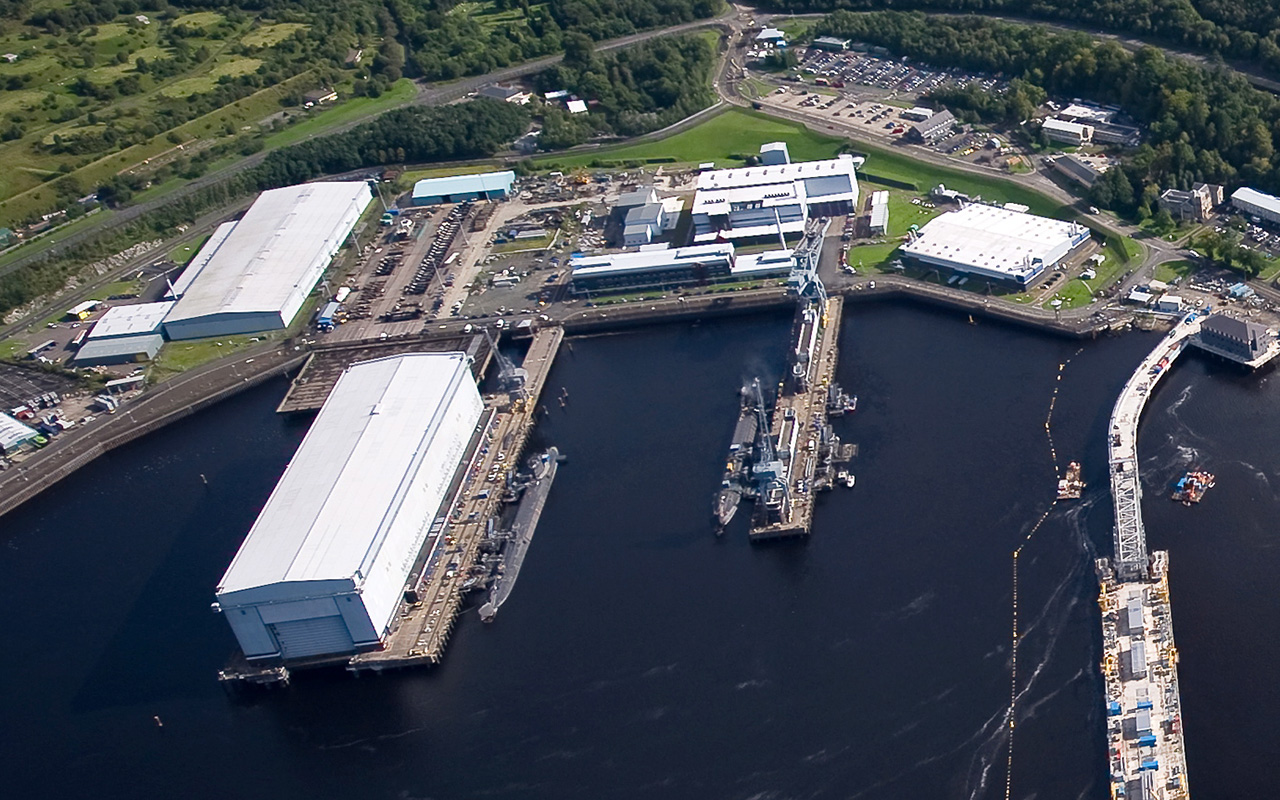
QinetiQ is to install an additive manufacturing facility at HM Naval Base Clyde capable of producing submarine components on demand at the dockside, in a development that is intended to reduce the time boats spend alongside between operational patrols.
The new capability has been delivered through two contracts with the Submarine Delivery Group’s Additive Manufacturing team, with the Additive Manufacturing All In One solution and its associated Market Access Cell together enabling submarine components to be manufactured to order on site by QinetiQ and Royal Navy submariners and delivered directly to the boats.
According to QinetiQ, the All In One solution constitutes what the company describes as a UK sovereign point-of-need capability designed to reduce dependence on complex external supply chains and accelerate repair timelines on the Royal Navy’s submarine fleet.

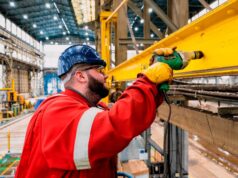
The arrangement combines two distinct strands, with the All In One containers handling routine on-site production while the Market Access Cell covers more complex components that fall outside what can be produced on site. The All In One containers were designed and manufactured by QinetiQ technicians and engineers at the company’s Cody Technology Park headquarters in Farnborough before being moved to Faslane, where one container will support reverse engineering tasks by scanning parts to produce a digital blueprint, with parts then re-engineered in the neighbouring workshop using polymer printing technology.
The Market Access Cell, meanwhile, sees parts reverse engineered by QinetiQ at specialist facilities across the United Kingdom, with digital blueprints then shared with an accredited network of UK and Australian small and medium enterprises drawn from sectors including Formula 1.
QinetiQ will operate the containers at Faslane with the support of Royal Navy submariners, before applying its engineering expertise and platform knowledge to support the Submarine Delivery Group in qualifying components produced through either route for reintroduction into the wider supply chain.
Will Blamey, Chief Executive of UK Defence at QinetiQ, said the combined capability would address one of the longstanding constraints on submarine availability. “Our proven expertise in additive manufacturing combined with the latest technology being installed at HM Naval Base Clyde will see us print, scan and reverse engineer submarine parts on demand, at pace and at dockside, helping to get submarines back on operations more quickly,” he said, as quoted in the company’s release.
First Sea Lord General Sir Gwyn Jenkins, who launched the Submarine Maintenance Recovery Plan in January, described the deployment as a meaningful step toward the plan’s goals. “The arrival of these deployable workshops marks a step forward in delivering the Submarine Maintenance Recovery Plan,” he said. “This new technology has the potential to change how we maintain our submarines, cutting time alongside and increasing availability. It represents the real, tangible, progress the Royal Navy is making to strengthen the underwater fleet.”
The Submarine Maintenance Recovery Plan was established in response to longstanding concerns about the availability of the Royal Navy’s nuclear-powered submarine fleet and about the lengthening time the boats spend alongside undergoing maintenance rather than at sea on operations. The Astute class attack submarine fleet and the Vanguard class ballistic missile submarine fleet have both been affected, with maintenance cycles for the latter in particular running considerably longer than originally planned, and Faslane, as the home of both fleets, sits at the centre of the recovery effort.
QinetiQ’s involvement in additive manufacturing for submarine maintenance has been building for some time, having most recently supported a routine maintenance period for HMS Anson, the fifth of class Astute submarine, when the boat visited Perth in Western Australia in March 2026. According to QinetiQ, the company rapidly designed and produced the required critical components and delivered replacements in around four weeks, well inside the lead times typical of the conventional submarine supply chain, with the experience having helped inform the design and operational concept of the All In One facility now being introduced at Faslane.
Paul Duff, Associate Materials Scientist at QinetiQ, said the project had moved from concept to fielded capability rapidly. “Working in the Additive Manufacturing All-in-One facility alongside Royal Navy personnel will provide us with an incredible opportunity to show how additive manufacturing can transform routine submarine maintenance,” he said. “It’s been very rewarding to see the facility come together in Farnborough and even more exciting to see it now deployed at HMNB Clyde.”
Commander Max, the SDG Additive Manufacturing Lead, said the on-site model offered direct benefits for the boats themselves, telling QinetiQ that “by enabling engineers to produce components on-site, we are reducing dependence on complex supply chains and accelerating repair timelines, ultimately improving the submarine’s material state and availability.”
Additive manufacturing has steadily moved from prototype and research applications into mainstream defence engineering use over the past decade, with allied navies including the United States, Australia and the Netherlands all running parallel initiatives to bring the technology into the supply chains supporting their fleets, and the technology is particularly well suited to the production of low-volume, high-specification components for legacy platforms where conventional supply chains can be slow or where original equipment manufacturers may no longer offer parts.






That’s nice and all, it all of the A boats are back alongside again, the question is for how long I guess.
Captain’s shower is broken …. they could be more radical and just go to screw fix.
the last trafalgar h.m.s triumph hasn’t been out of service for long. i think she should be recommissioned.
What kind of cretins have been in charge that this hasn’t been done years ago! Unbelievable. Do they have rooms of filing cabinets for the use of? Perhaps getting a few of those things called computers would help.
Because you have actually do risk assessments if a polymer part can safely replace the current part. Fires on submarines are significant risk The standard PLA will produce toxic fumes and is not fire rated. The UK operates a submarine safety system that’s based on the US SUBSAFE programme. You cant just bung something on, you have to show thats it’s safe. Theres a reason why there’s been only 2 people lost in accidents on board RN nuclear submarines.
If you were being asked to descend in a tin to the bottom of the sea you might tend to err on the side of caution when it comes to the manufactured parts that keep you alive from one second to the next.
Can it 3d print a dry dock? Asking for a sub currently languishing waiting for one…
Yeah but you would need to build a 3d printer twice the size of dry dock. Might as well just build 2 dry docks.
Perhaps we should build several dry docks around the country and fix all the subs. Plus build some more.
No I’m getting too sensible now. Ridiculous idea. I’ll shut up.
No no, you do that thing with the conveyor belt where it can print objects larger than the printer, so you only need a printer the cross-sectional area of a dry dock.
Put a concrete extruder on a robotic arm on a ship and reverse up to a coastline, with enough dynamic positioning by the end of the week you have a new dry dock!
Ah but yes but no but.
You just print Individual blocks just like LEGO.
What level of spares for Astutes does the RN hold? Since manufacturing is still underway with Achilles, one assumes the supply chain still exists. Obviously, it is easier to keep those chains going for equipment bought in large numbers that requires regular consumption of spares.
Anything that improves SSN availability from its current abysmal state is welcome.
Could we overcome some of the spares shortage affecting F35Bs by additive printing or has LM got a monopoly?
Given that they are using Ambush for spare parts for the others I’ll have to assume this is a classic case of the MOD forgetting that you need spare parts before something breaks and there’s not enough parts being produced.
One of the scandals that the uni party should face the music more, at a national level. Especially the Tories.
All the billions spent on a capability tied up alongside.
Ignoring the obvious operational impact of no assets for the GIUK, you have:
The knock on effect on crew experience, real sea time.
The knock on effect on lack of boats for Perisher.
The knock on effect on Chalfont, and SBS submarine training.
What else?
Could our SSN be maintained in US or French facilities to try and close the gap a bit? I guess not?
And still we will have to make cuts to the defence budget. We are not even standing still.
Piss poor planning by RN, MOD and the Conservative government. You have to wonder when will we have a credible number of boats at sea? Is by the end of the decade a reasonable ask?
People. We are banjaxed. And the blame lies with politicians.
This is a good solution to a difficult problem. We either order lots of spares which we may never use or we do this. Just in time spares does not work for platforms with a 30 year life. The original equipment manufacturer will not keep the same product in production for that time.
I do wonder how the UK can present itself as 1 of the 3 major players in Europe. OK we can deploy a carrier but probably not without assistance. We can deploy a Bde to Latvia but with ageing equipment. I surprised the Poles demand a spot at the top table at our expense.
Lots of this going on within MOD. Wonder if RN are only doing the polymer printing or if they are doing the metal printing as well. I know for a fact RE have been doing this kind of thing for ages, starting with the training side of things and spewing out training mines galore, recognition models et al. If you have an original its a quick 3D scan and almost plug and play.
Are these plastic or metal printers? If they are plastic printers, it’s basically guaranteed that the MoD massively overpaid.
Does that mean we can replace all the parts from storerobbed HMS Ambush now? the 1 billion pound machine we spent years carefully building to then unbuild in a curious Benjamin Button way.
The article does mention complex parts that a normal supply chain company could struggle to supply at short notice. I imagine an example of this would be a part for a weapons system.
With all conventional boats currently all out of service, this is surely a way of speeding things up and getting subs back at sea.