

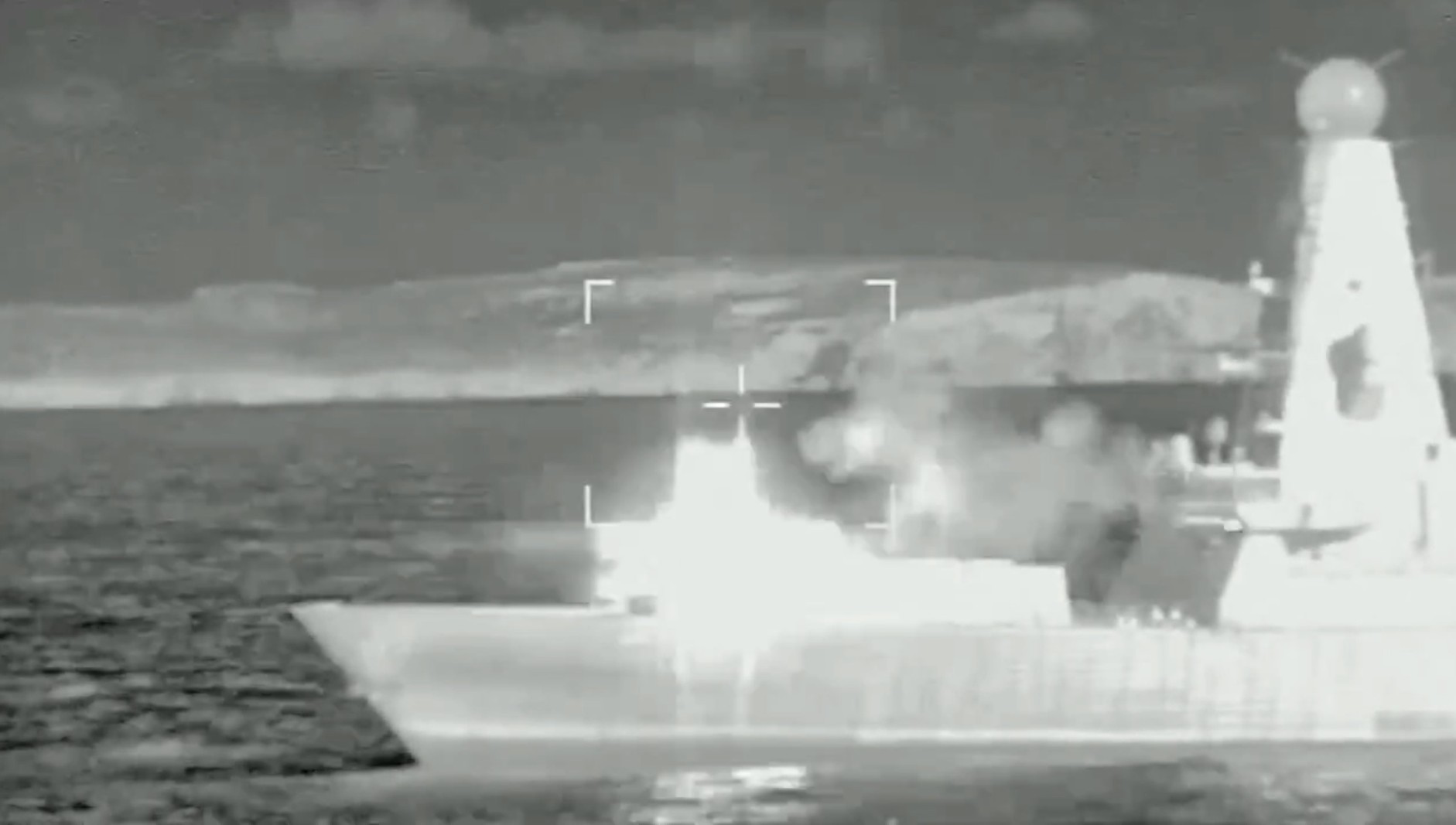
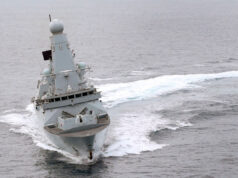
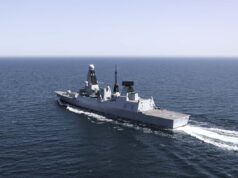
The Royal Navy will not extend the lives of its six Type 45 air-defence destroyers, which are due to begin retiring from 2035, as the service shifts towards a hybrid fleet of crewed and uncrewed vessels under the Defence Investment Plan, Ministry of Defence officials said.
Officials told a briefing on the plan, published on Tuesday and launched by the Prime Minister, the Chancellor and the Defence Secretary at a British drone manufacturer, that the department had decided against prolonging the Type 45s and would instead use the roughly ten years before the class leaves service to stand up the hybrid navy intended to take over the air-defence role, with an additional £1.3 billion going into that effort on top of the more than £7 billion already committed to the Type 26 and Type 31 frigate programmes.
Defence Secretary Dan Jarvis, opening the launch, said the plan put “more money for hybrid Royal Navy,” and one official, describing the change as “a genuinely do different moment” for the fleet, said the department wanted to see the first hybrid vessels appear before the end of the decade rather than waiting until the destroyers had gone.
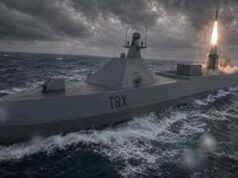
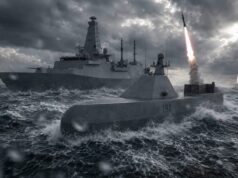
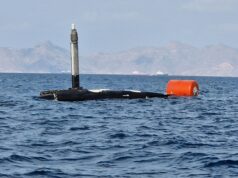
At the centre of the plan are at least six Common Combat Vessels, the hybrid warships trailed over the weekend that are to act as the hub of a networked air-defence system, supported by a family of uncrewed platforms designated Type 91 to 94 covering tasks that run from carrying missiles to hunting submarines and scanning for air threats, with the Common Combat Vessel taking the place of the planned Type 83 destroyer that has now been dropped. Sir Keir Starmer set out what that would mean in practice when he launched the plan, describing frigates moving to intercept a Russian ship in British waters accompanied by “outriders, uncrewed ships above and below the surface,” their artificial intelligence working in unison with the warships so that the whole group operated as a single integrated force.
The decision not to extend the Type 45s rests on a combination of their age and the cost of holding a small number of complex ships in service, weighed against a judgment that a fleet mixing crewed and uncrewed vessels is better suited to the pace of modern warfare, and although the six destroyers and their Sea Viper missile system have furnished the fleet’s high-end air defence for more than a decade, they have been dogged by propulsion problems and the class has at times struggled to keep enough hulls available for sea.
The obvious risk in the approach is one of timing, because the hybrid vessels meant to succeed them remain at an early stage, with the design and procurement work for the Common Combat Vessel only now beginning, which leaves a full decade across which the transition has to be managed if the Navy is to avoid any gap in its air-defence cover.




Cant dragon fire, be fitted to tge new frigates?
Cant dragon fire be fitted to the new frigates too? As i understand it, but could be wrong. . Are we onky buying 4 Destroyer fits?
Not enough power generation
Yes, Navy Lookout reported that they could.
My guess would be there planning on introducing them on the destroyers FIRST, then rolling them out.
They cutting the fleet defence and ABM role to play a PR game with ships numbers that can’t fulfill the requirements. The DIP actually represents 10 billion in cuts. All the armchair experts banging on about new technology were wrong.
Wrong how? Did you think this new tech was going to be in service next week? Its called a 10 year plan for a reason.
You balthered away nonsense. It’s a 10 billion cut and that’s end of fleet defences. No ABM radars, no ABM missiles, lower radar horizons so they can point at the number of hulls .
The first Type 45 (HMS Daring) was a little over 4 years from start of construction to Sea trials and commissioned 2 years later.
The first steel was cut for HMS Glasgow in 2017, 9 years ago and it has not even started Sea Trials.
Commissioning, by 2028, maybe.
The price you pay for slowing things down.
The follow-on ships will be quicker, one anticipates, subject to satisfying the Norwegians.
If the CCV is fitted with mk 41 launcher AND MBDA can adapt Aster to be launched from it, then a T31 based platform could provide long range air defence including ABM. But I don’t see where they plan to put a powerful enough, high mounted radar.
Quite. The only way they are going to save money is by cutting capability.
I all but guarantee that for the same capability, this new drone fleet will be more expensive than making large destroyers.
You still need to buy the same sensors, the same weapons, only you need to pay for 8 hulls, not 1, 8 sets of propulsion, I navigation systems, 8 communications systems, 8 CIWS, 8 weapons control systems etc.
I can’t but help this is jumping the gun on the whole drone thing. We don’t have drones yet, we don’t know how they will work or perform, yet we’re already planning on getting rid of the manned ships on the mere assumption that there the future.
I can understand how for the army, drones are going to be revolutionary, but for the navy I think they will only ever supplement manned ships.
Bet you a tenner they will
And pigs will fly….
This is what I was thinking, T45 absolutely will be when they change their mind in 5 years on T83 and can’t deliver it until the mid 2040s, they just won’t announce it now with them just starting to come out of major refits with PIP.
So does this mean that HMS Defender will be the only Type 45 to get upgraded with Sea Ceptor, NSM, etc.? If they are scrapping the Type 45s without replacement will the remaining 5 ships still be upgraded?
They will sell them to Brazil or India
Anything regarding T45 is up in the Air at the moment,Diamond follows Defender in the PIP/CAAM Upgrade,Duncan will be the last for PIP,will she even get that done now,will the other T45’s even go back into Refit for the CAAM Work ? So many questions ,not many answers.
Agreed Paul. Frankly, I think the Type 45s will soldier on well past their anticipated out of service date as I don’t see all this hybrid stuff being designed, built, tested, implemented, etc.,. in time for the Type 45s to retire.
I’m also assuming that the Type 45 upgrades for all six ships has been funded already so hopefully will still go ahead. It would be short-sighted to do otherwise but we’ve seen a lot of that already happening!
“I think the Type 45s will soldier on well past their anticipated out of service date” …. don’t count on it, capability gaps will continue, just to save costs. Unless we get another government with a harder line on other aspects of policy this thinking won’t change.
The only thing coming out about the DIP so far is a whole lot of getting rid of things either with no replacement at all or plans to “invest” in a replacement. Not a good omen.
What else did you expect? It’s another complete disaster weakening our already week armed forces even more! I pray to God that when Labour get kicked out at the next election that the incoming government trys tp put things right…..
There goes Js hope to keep the T45s!
I’d wager a tenner they will get extended at some point when the new systems need problems ironed out that causes delays.
Not in the budget they can’t. The new ships can’t do fleet defence or ABM because they are too small. They are junking the capability not replacing it
As in Type 45 can’t do ABM or this uncrewed 90 series?
A couple of CCVs and some drone ships is not how you escort a carrier.
Why dnt we just scrap the whole lot? We could save millions by not having a ministry of defence, army, navy and airforce, within a few days someone will have invaded to steal some of our resources but the civil servants can be happy the Russians are closest. We need ships, we should keep the ships, it’s not impossible, other navies keep hulls for longer periods and upgrade armaments and radar so can we, it’s cheaper, it has to be. This continual cutting of our defences is pathetic. Russia has a gdp a fraction of ours and half a dozen fleets bugger than our navy. France has a similar size geo and can build it’s own planes, Sweden is smaller and builds it’s iwnz Russia is smaller and builds it’s own. Why the fuck do we have a government and civil service so incompetent we can’t even make our own stuff but buy it in from everywhere else leaving us with no manufacturing, no jobs, no tax revenue, no defences that aren’t reliant on other people’s food will, nothing, naked with nothing
The Guardian had a piece suggesting just that once.
I 100% agree.
Tbh I’m starting to think any politician that can’t get behind British sovereign defence, or any civil servant who can’t deliver cost efficiency for the country should be at the very least sacked on the spot, but preferably tried for treason. Thy have been entirely responsible for this mess for the past 80 years. The constant excuse that it’s too expensive is a lie… Just look at what Sweden can do on a much smaller budget, or France can do on a slightly smaller budget.
Our entire defence industry has been sold of and is run for the interests of shareholders and politicians and civil servants support, defend and perpetuate that.
Thanks, the number of people on here that seem to think I am stupid for suggesting this is quite amazing, I wonder if they are civil servants.
Definitely civil servants.
Or Russian bots, who knows?
They will get extended, they just don’t want to have to plan for it now with them coming out of PIP, they have a while left until it will be needed, so why start committing funds that far away ?
But new programs never deliver on time and funding priorities change when services get desperate. T45 have plenty of life at the moment and their real replacement (T83) isn’t a priority right now but it’ll be back, SSN-A has a much longer more complex procurement process that needs to be pursued now so it gets priority.
Clearly they will be extended.
The Hybrid solution will not be operationally effective in the AD role by 2035.
Unless even that capability is to be ceded.
This is a ridiculous waste of money, the ships have spent the best part of the last decade in dry dock or refit. They’re basically unused. The money spent on them will be completely wasted and leave Britain with ZERO capability to shoot down ballistic missiles just after they’ve been upgraded to do so.
Hmm can anyone else see a cluster f..k coming. Lets start with carrier deployments I would bet heavily they don’t even know how a new carrier group would look like without T45 or similar. Will take years to work out things like refuelling and replenishment at sea for these new systems and how they operate with a carrier. They seem to have jumped on the highly conceptual drone and autonomous band wagon with little thought of how it will work in the real world. Anyone with an IQ above 2 would ensure overlap from old to new tech and only once proven phase out older tech. But political class has never been that bright.
Unfortunately, it is unrealistic to expect sound strategic and political decisions in the current UK political climate.
I can’t but help this is jumping the gun on the whole drone thing.
We don’t have drones yet, we don’t know how they will perform, we don’t even know how they will be structured or work at all.
The entire thing is at best, a concept, and we’re only 9 years away from having T45 from retiring (not to mention WASTING AN ENTIRE YEAR waiting for this DIP).
Despite the replacement being more of an aspiration than a plan, let alone a proven asset in service, despite nobody IN THE ENTIRE WORLD proving that drones can replace manned ships in blue water operations, we’re already planning on getting rid of the manned ships on the mere assumption that drones are the future.
Do they even have a detailed plan for how drones are expected to do AAW or ASW.
I can understand how for the army, drones are going to be revolutionary, but for the navy I think they will only supplement manned ships, certainly for the foreseeable future.
It’s insanity to get rid of manned ships before drones are proven. What if the don’t work how we expect? What if there are major unforseen problems with a highly experimental project… (That never happens with new things in the MoD…) They need at least 1 generation of overlap with fully manned ships working to integrate drones and see how they can be used IN PRACTICE, before committing to anything.
Considering the maintenance downtime for Power Improvement Programme these vessels planned service life hasn’t been used even if they were retired on the original plan date.
I can’t comment on their intensity of use which is another service life factor. How many have stayed in temperate waters or in more severe conditions would drive corrosion and wear.
Dragonfire installation will be more downtime but a solid reason to keep them in use for UAV defence.
Looking at AFU Sea Baby speed boats, that’s not a blue ocean Navy however effective in the Black Sea. North Atlantic would eat that for a snack.