

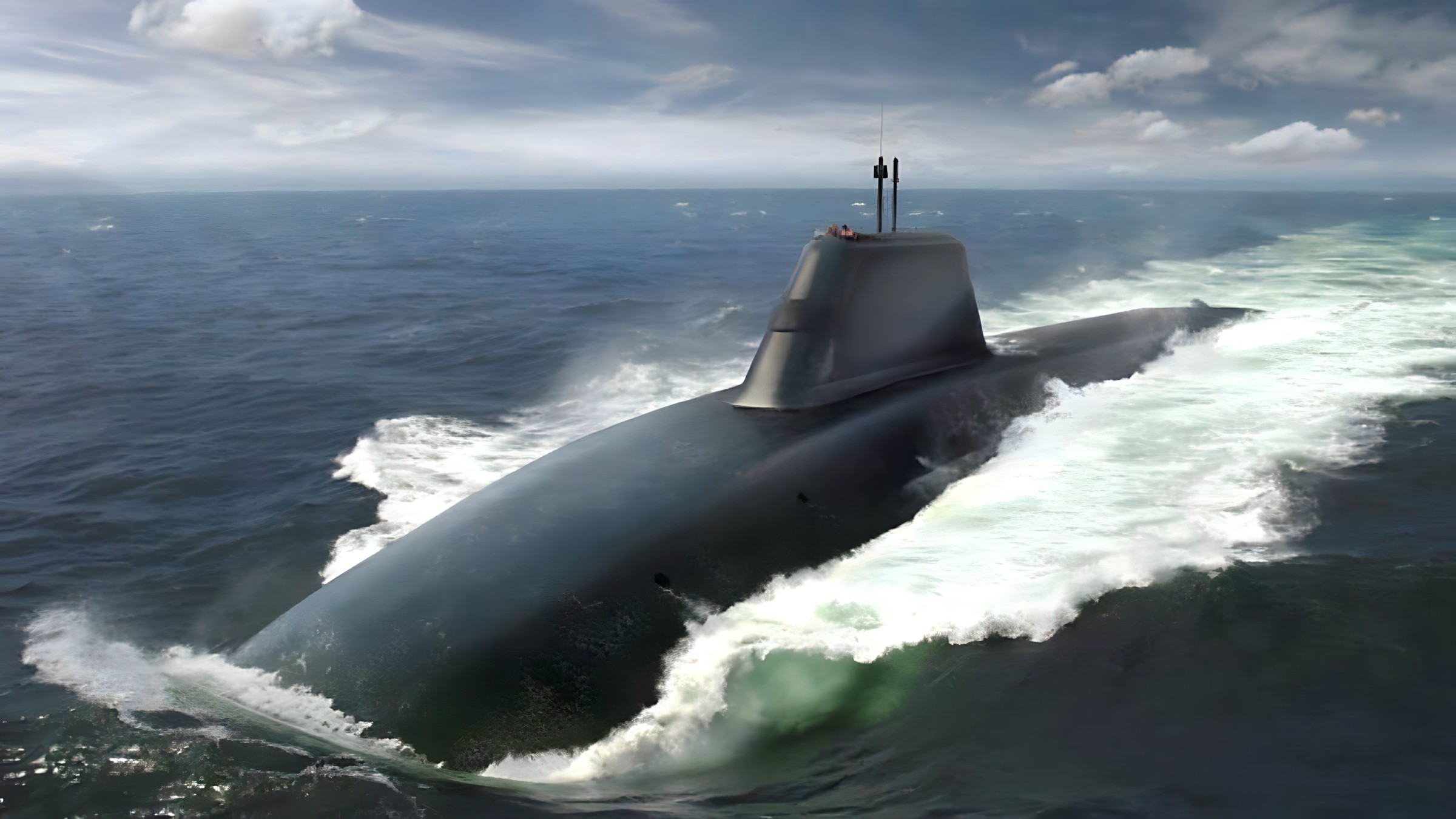
The UK will begin defining the requirement for the submarines that will one day replace the Dreadnought class, with the Defence Investment Plan committing to start work on the post-Dreadnought strategic deterrent within this Parliament.
The plan lists among its nuclear investments “starting to define the requirement for the post-Dreadnought strategic deterrent within this Parliament,” a commitment made while the four Dreadnought boats themselves remain under construction at Barrow-in-Furness, with the class not due to enter service until the early 2030s. Steel was cut on the fourth and final boat, HMS King George VI, last year, joining Dreadnought, Valiant and Warspite in build.
Beginning successor work this early reflects one of the hardest-learned lessons of the British submarine enterprise. The gap in orders that followed the Vanguard class contributed to the loss of skills and industrial capacity that the programmes of the past two decades have spent heavily to rebuild, and the Ministry of Defence signalled its intent to avoid repeating the cycle when it began early concept studies on post-Dreadnought submarines last year, work aligned with allied strategic planning.
The Dreadnought boats are designed for a service life of decades, meaning their replacements would not be needed until well past mid-century, but the design, industrial and warhead decisions that shape a deterrent platform run on timescales measured in decades rather than years.
The commitment is within a wider nuclear package in the plan. The Vanguard class will be maintained at Clyde and Devonport while it continues to carry the deterrent, and the warhead programme will sustain the current Mk4A while designing its replacement, Astraea, supported by £15 billion announced in the Strategic Defence Review for the warhead programme between 2025-26 and 2029-30. That includes strategic investment at AWE Aldermaston, Burghfield and RNAD Coulport, completion of the MENSA warhead assembly and disassembly facility, and construction of a Future Materials Campus to transform nuclear material manufacturing, storage and recovery. A £1.7 billion Nuclear Fuels Programme will explore re-establishing a defence nuclear fuel cycle, and £6 billion goes to expanding and transforming submarine manufacturing between 2025-26 and 2029-30.
The plan also describes the deterrent within the UK’s alliances, citing the 1958 Mutual Defense Agreement and 1963 Polaris Sales Agreement with the United States and a strengthening relationship with France on nuclear policy, capabilities and operations under the 2025 Northwood Declaration. Total deterrent spending across Dreadnought, SSN-AUKUS and the warhead runs to £63 billion over the next four years.
The plan gives no detail on what form the post-Dreadnought platform might take, its numbers, or when a design decision would be expected, with the commitment limited to beginning the requirement definition before the current Parliament ends.



Best plan for a different missile.
Yes, either that or an outright purchase and direct operation of trident II. Given the cost of making the boats and warheads the missile is easily the cheapest bit.
You can’t just build a new missile. Its a system that’s designed from the ground up to work together. The navigation system on the missile takes its initial fix from the submarines navigation system and its own navigation system gives the fix the warheads. Its not plug and play. The cost of building the maintenance facility is in the billions, the USN also had a nitrogen filled warehouse storing the chips that system runs on. All that is going at leat double the price.
You got the money to fund that? D5 cost ~ £20 billion to develop. That’s an effective doubling of cost
Why not a land based Medium ranged ballistic missile ( MRBM) in 27 Harded Silos in 3 bases in
N Scotland, Cumbria and N Wales..?
Because they can be targeted in a first strike and negated.
Also, the Nimbies in the area would have a pink fit.
The deterrent submarine will always be manned. I am certain that delegating the control and launch of British nuclear weapons to an artificial intelligence is simply a non-starter.
The consequence of this is that the UK must preserve its ability to design, construct, operate and maintain manned nuclear-powered submarines. Now, to do that, you need mass in your fleet. Unless you greatly increase the size of your deterrent submarine fleet (at least tripling it), you need a smaller nuclear-powered submarine to preserve those four requirements.
Therefore, the necessity of operating manned nuclear-powered deterrent submarines directly leads to a requirement for operating manned nuclear-powered attack submarines.
For this reason, the submarine fleet might actually be functionally immune to the movement towards massed autonomy. It provides one of many reasons that the British attack submarine fleet, against the run of play, is planned to be doubled in size.
As for what a future Dreadnought replacement might look like, it’s so hard to even begin to speculate. These are boats that will begin construction around 2060, and enter service around 2070, almost forty years after the planned Dreadnought enters service in the early 2030s.
Somethings that I can think of:
– A replacement warhead for the currently in-development Astraea.
– A new submarine-launched ballistic missile (with hypersonic glide vehicles containing the warhead) to replace Trident. Given the slow decline in Euro-American relations over the past decades, I think it’s up in the air as to whether, in 2070, Britain will continue to share deterrent missiles with America.
– Integrated uncrewed underwater vessel storage and operation facilities (e.g., a hangar) for observation, sensing, tracking and engagement of threats. H I Sutton described the torpedo room as potentially morphing into a ‘generic ocean interface’, with submarines using the space for a variety of functions, rather than simply torpedo launch.
– Large-scale reductions in crew requirements given AI-assisted operations and control. As I said above, it’s extremely, extremely unlikely deterrence will ever be entirely uncrewed, but we might see much smaller crews and subsequent improvements in crew comfort.
Whilst I would agree that the responsibility for firing nuclear weapons should not be left to AI I think I disagree with your suggestion that future boats would have to be manned. Why? The Trident missiles are not manned. At some point you have to release control to a computer of some sort.
The important point is that there needs to be human involvement in the decision making process.
There’s a legal requirement for ‘human responsibility’ according to various international statutes, that implicitly requires ‘human in the loop’ control of nuclear weaponry. This stems mostly from the requirement to be able to delegate responsibility for the act to a human operator; you can’t prosecute an AI or an automated system.
Now, the presence of ‘humans in the loop’ prevents the nightmare scenario of a massed launch due to a technical malfunction.
The other issue with unmanned British deterrent boats in particular is that British nuclear doctrine has to account for the eventuality of a successful first strike against the British government, and therefore requires sailors onboard the submarine to take responsibility if required.
A further problem is jeopardy due to normal malfunction. If your unmanned boat fails in any major manner whilst deployed, you lose deterrent value for that boat entirely.
A launched Trident missile is different to a proposed unmanned drone deterrent submarine, because a Trident missile is the effect of a human decision to launch. You’ve handed over control, but only after the decision is made to launch.
A drone submarine differs because you no longer retain certainty of human control over the deterrent itself. Removing the crew introduces jeopardy within the highest stakes system of all.
Until society loses the stigma around nuclear weapons, a condition of their use in the West will be human in the loop control.
Russia does things slightly differently, though their Dead Hand system and Poseidon LUUV are still technically ‘human in the loop’.
I’ll just expand on an early point to head-off a potential argument. Of course, manned systems still make repeated mistakes and have led in the past to near misses.
I think we are in broad agreement. The Nuclear Deterrent can only be deployed on the authority of the UK Government, currently the PM but delegated to others in case they are unable to make the decision. Additional automation in the mix should not make it impossible however it will need to be thought through and if changes are necessary they should be made. I am certainly not advocating we should leave decisions to AI.
Leh,
No “Flying Sub,” ala “Voyage to the Bottom of the Sea?” Actually probably conceivable by the 2060-2070 timeframe. 🤔😉
Maybe the submarine aircraft carrier could make an appearance 😉
‘Voyage to the bottom of the Sea’ ..
Now that does takes me back…
Perhaps a series before it’s time …
Personally I would think a slight delay might be in order.
We are changing the whole basis upon which the RN (drones etc. etc.) operates which will have consequences.
This does suggest the MOD and industry have learned the lessons from the Astute debacle! Positive stuff.
only a complete nutter would actually fire these missiles in attack, or defence, but then, we do regularly elect them to lead us
Britain maintains its strategic deterrent through CASD to ensure a survivable second strike capability (the ability to retaliate even after suffering a nuclear attack). The purpose isn’t to fight nuclear wars, it’s to make any nuclear attack, or existential threat to the UK or NATO, so costly that no rational adversary would choose to launch one in the first place.
The UK also maintains deliberate ambiguity over the exact circumstances in which nuclear weapons might be used, because uncertainty strengthens deterrence. If a Prime Minister ever authorised their use, it would mean deterrence had already failed and the UK’s survival, or the collective defence of NATO, was at stake.
You don’t have to support nuclear weapons, but dismissing any potential use as the act of ‘a nutter’ misunderstands what they’re for. Their entire purpose is to prevent nuclear war by making the consequences of starting one unacceptable.
except in trying to prevent nuclear war you might be:
1. making nuclear war more likely, and
2. making the whole thing worse
but one thing is more certain than anything else, sooner or later one of the nutters is bound to use them, the only sure way to prevent this is not to have nuclear weapons at all
I seriously doubt countries like..
North Korea, China, Russia, India.isreal. Pakistan,France or the United States
Will give up their Arsenal’s..
But you can dream…!
But Even if they did there are strangely Enough even more deadly forms of WMD … that don’t get anything like the same publicity. .. (covid experiments?)
so what’s the alternative, wait till a nutter does start using them, and then wait again and again until the planet is effectively destroyed for human civilisation and billions die !
there really is only one answer, it’s staring you in the face, if you have the courage to accept it, because accepting it implies you have to do something about it, no matter how small the effort ?
“because accepting it implies you have to do something about it, no matter how small the effort ?”
So, Unilateral Nuclear Disarmament.
It is staring us in the face, yes, and it involves the WESTERN DEMOCRATIC NATIONS DISARMING FIRST.
Correct?
No idea, you need to get away from thinking in black and white terms, you need to understand the current situation is untenable in the long term, and take it from there
Exactly the sort of reply I expected.
The west first, SOP for CND and the likes of.
If, when Russia and China offer to get rid of all theirs, then the West can join.
Till then, nukes stay.
As the West getting rid while the CRINK nations keep makes no sense.
I have to say, I expected no more from you, that’s what being conditioned to hate does to your reasoning ability, the two do not go together
Another truth you might ponder on, but I doubt your able to
Change the tone going forward.
For UK and France the core deterrent of CASD is both too much and too little. Too much in that its costs squeeze the budget for other conventional forces; too little in that a single submarine with 12 missiles may not be enough to achieve deterrence. MAD means we would have to be able to inflict equivalent harm on an adversary to the harm a pre emptive first strike would inflict on us. Does one SSN really achieve that?
I am guessing this will not be unmanned.
Whilst I understand the serious problems we had trying to restart Astute design and build after a long gap, the Dreadnought successor is so far in the future that technical advances between now and 2060/70 may make the whole idea of SSBNs obsolete.
There unlikely to get into any serious Design mode for quite some time….probably more an outline of concept as Powerplant, and other Types of hardware and software they might employ initially…perhaps methods of speeding up production and reducing maintenance time and costs..!
Suspect it will be what the Americans decide to do With Trident 2 missiles that Dictates what system we wil have as in the Thatcher era of the 80s with Trident 2.
If they go for a new missile we will have to follow .
Whatever missile choice they make will almost certainly be compatible with their Columbia Class boats and therfore our Dreadnought class..
Of Course we could choose to go our own way…
Or eben join the French..! But both those pose their own problems…!
Two things need to be done. Firstly, set things up so that as soon as the last vessel (I’m including frigates and destroyers) in a class is completed work should be started on making the first vessel of it’s replacement class, and secondly we need to develop and make delivery systems that don’t depend on the US.
That way we don’t have huge ‘gaps’ in capability as one class goes out of service and the replacement isn’t ready, and we don’t have issues with future US Presidents like Trump.
@george Allison: what’s the matter cherub, afraid your sheeple will start thinking for themselves
Ideally just thinking and figuring out that you’re not on Twitter and can’t tag people in would be a great start.
Your obviously monitoring independent thinkers so assumed you’d manage it somehow
Who of ever thought you military men would be such snowflakes