

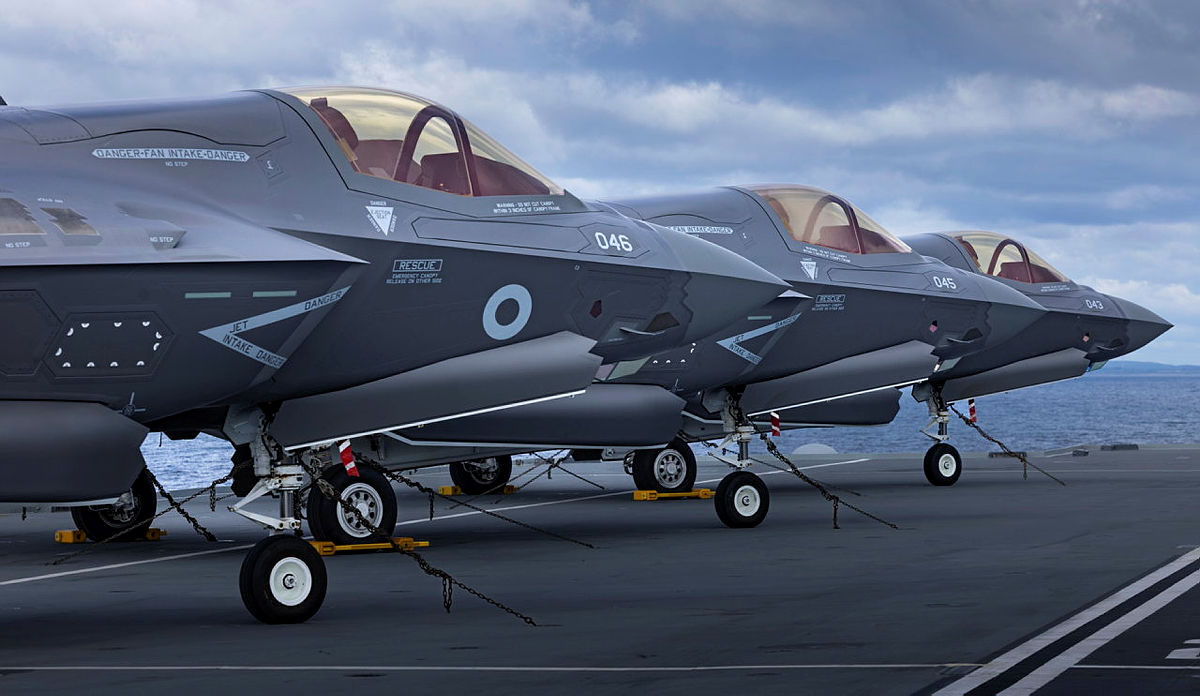
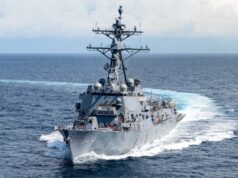
Somewhere in the waters of the High North, F-35B Lightnings are launching from the deck of HMS Prince of Wales, which sailed from Portsmouth in April at the head of a task group built around the Type 45 destroyer HMS Duncan and the tanker RFA Tidespring.
Her flying operations inside the Arctic are the centrepiece of Operation Firecrest, the deployment the Prime Minister announced at the Munich Security Conference in February, and they fall partly under Arctic Sentry, the vigilance activity NATO stood up that same month to pull allied operations across its northern flank into a single effort.
Rather than breaking new ground, the deployment takes the Royal Navy back to waters it once knew intimately, because for most of the Cold War the service’s main wartime job was to hold the line across the Greenland-Iceland-UK gap against the Soviet Northern Fleet, while the Royal Marines spent every winter from the early 1970s onwards training in northern Norway to defend NATO’s northern flank, a commitment that goes back further still to the wartime commando raids on the occupied Norwegian coast.
What changed after 1991 was not the geography but the threat, and as attention moved to the Gulf, the Balkans and Afghanistan, the cold weather skills and the standing presence were allowed to thin, a drift the past few years have sharply reversed.
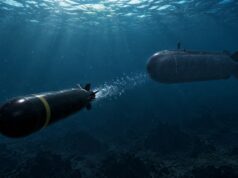
The reason the region matters so much comes down to a fact that hasn’t changed in eighty years. Russia’s Northern Fleet, home to the submarines carrying most of Moscow’s sea-based nuclear deterrent as well as its best attack boats, operates from bases on the Kola Peninsula, and any Russian vessel heading for the Atlantic must first pass through the Bear Gap between northern Norway and Svalbard and then through the wider Greenland-Iceland-UK gap to the south.
In a war, keeping Russian submarines north of those lines would be the price of protecting the sea lanes carrying North American reinforcements to Europe, and it is work that soaks up anti-submarine frigates, maritime patrol aircraft, hunter-killer submarines and air cover in numbers that only constant peacetime practice makes credible. The same waters now carry things Britain cannot do without, from the pipelines delivering the Norwegian gas that meets a large share of UK demand to the seabed cables moving the data on which the financial system runs.
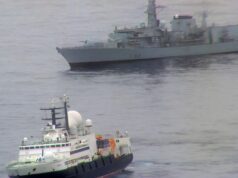
Russian interest in that infrastructure is no longer a theoretical worry, with the government pointing to a 30 per cent rise in Russian naval activity threatening British waters over the past two years, and the UK and its allies earlier this year tracking a Russian attack submarine and two spy ships loitering near critical undersea infrastructure in the High North. That episode prompted the then Defence Secretary John Healey to address Moscow directly, warning that any attempt at damage “will not be tolerated and will have serious consequences.”
NATO Secretary General Mark Rutte, announcing the alliance’s stepped-up posture, said “the Arctic and the High North are of growing strategic importance to our security,” pointing to Russian military activity and China’s growing interest in a region where, since Finland and Sweden joined the alliance, seven of the eight Arctic states are NATO members.
Away from the carrier group sits a year-round presence that most of the public never sees, with around 1,500 personnel of the UK Commando Force spending winter at Camp Viking, the operations hub south of Tromsø, while the Commando Helicopter Force flew from Bardufoss under Operation Clockwork, a training deployment now in its sixth decade.
March brought Exercise Cold Response, in which some 25,000 personnel from fourteen nations operated across northern Norway, Sweden and Finland, and during which Royal Marines rehearsed reconnaissance raids launched from a German submarine, while a smaller patrol codenamed Arctic Fox saw a team of Royal Marines and Army commandos cover more than 1,500 kilometres over 40 days in temperatures as low as minus 60, finding out what troops and kit can actually sustain rather than what the doctrine assumes.
First Sea Lord General Sir Gwyn Jenkins said afterwards that “the High North is not a peripheral concern” but a strategically vital theatre for national security and collective defence, and the Lunna House agreement with Norway has since tied the two navies into still closer cooperation, while this week’s Defence Investment Plan added money for undersea infrastructure protection, commando force transformation and the hybrid fleet.
What the Royal Navy is buying with all of this activity is something no amount of money can produce quickly, because the ability to fly jets from a pitching deck in freezing spray, to hunt submarines through Arctic acoustic conditions that behave unlike anywhere else on earth, and to keep commandos fighting fit at minus 60 comes only from years of doing it, and the nations that let those skills lapse do not get them back in the timescale of a crisis.
Britain sits at the southern end of the very gap through which any Russian move into the Atlantic must come, its energy and its data arrive across the seabed of these waters, and the navy training in them now is the same navy that would be asked to defend all of it if deterrence ever failed, which is why the deployments keep coming and why, on any serious reading of the map, they have to.




One of the key reason to opt for STOVL carriers instead of CATOBAR is for operations in the high north. The ability to operate in heavy sea states, deploy large numbers of helicopters and troops if needed. They have the ability to carry out land interdiction, fleet air cover, amphibious assault and anti submarine warfare on a large scale. All roles that the previous invincible class carried out just on a much larger scale.
Fortunately with the Navy and RAF on the same page we have been spare the carrier vs fast jets debate on the 1970’s this time.
Interesting and informative.
I didn’t see reference to the high north trade route though.
Global.warming is increasingly expected to make the icy sea route from china along Russia’s northern coast less icy and more navigable
(It is much faster than alternative china to Europes seaborne routes) But does pass through russian territorial waters.
Prior to Russia’s current shenanigans this emerging trade route was frequently given as the main reason for high north build up.
so trump was right again !
Royal Navy exists to protect the interests of rich capitalists…..it ain’t right but it is consistent.
Greenland reference??
Even if Trump is right he can never be right!
Greenland is him playing games and fantasy exploitation scenarios.
The USA is highly welcomed by all of NATO and if Trump wants a vast military presence in Greenland it’s almost certain that Denmark would agree to allow such….
Trump used a qualified argument as an excuse to exploit. That’s what capitalists do.
Trump was very, very wrong whilst speaking some truth.