

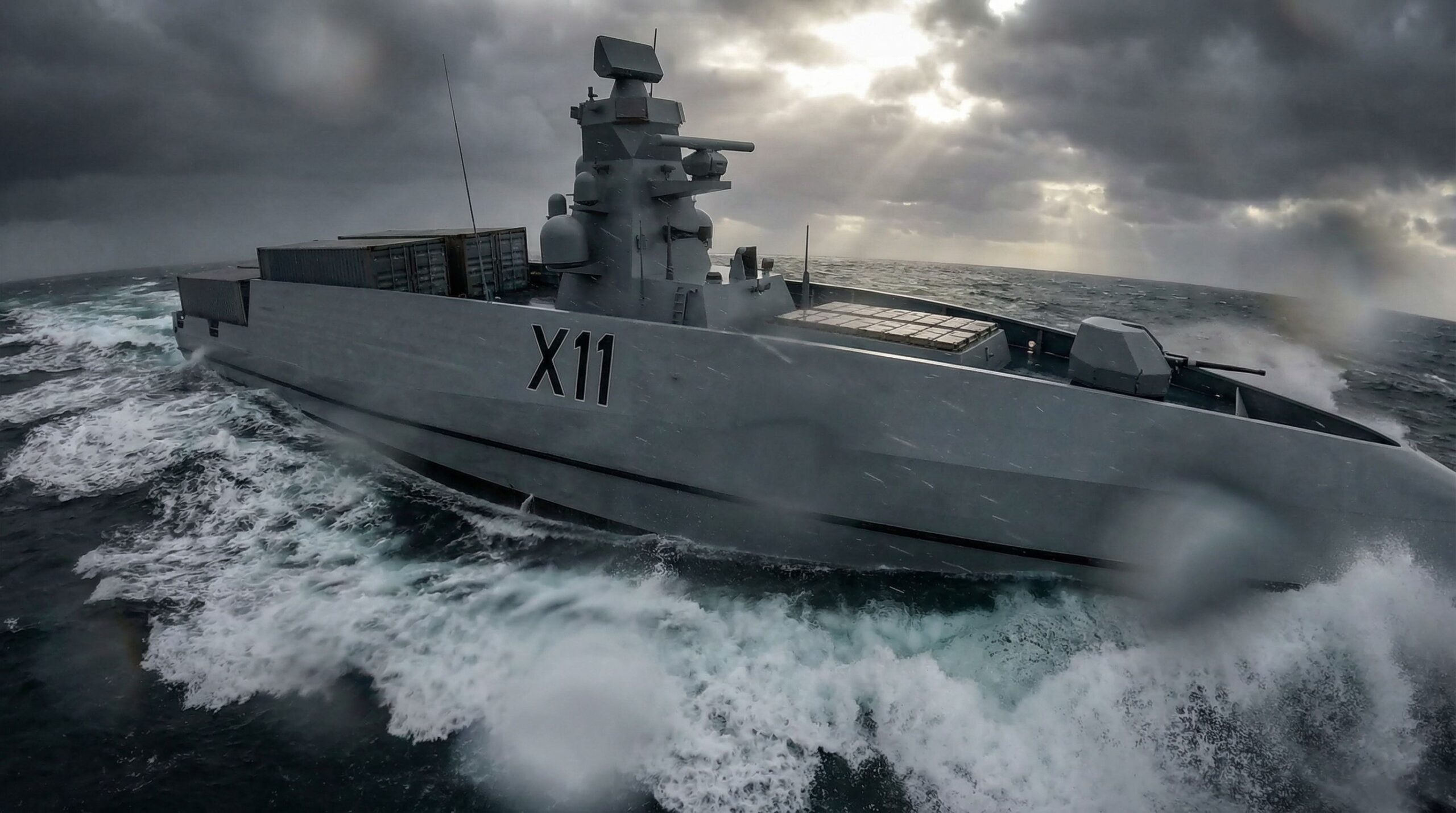
The Defence Investment Plan swaps a planned generation of crewed destroyers and frigates for six Common Combat Vessels and a fleet of uncrewed platforms it says will grow through the 2030s. On an optimistic reading, the sheer number of simpler hulls, spread across more yards, could do more for British shipbuilding than the warships they replace, but will they?
The Royal Navy’s shift to a hybrid fleet leaves one figure wide open, the number of ships it will actually build, because the Defence Investment Plan commits to at least six Common Combat Vessels and a new family of uncrewed platforms, the Type 91, 92, 93 and 94, a mix of missile carriers, submarine hunters and sensor ships, without ever putting a firm number on the uncrewed fleet.
The plan drops two crewed programmes the Navy had been counting on, the Type 83 destroyer meant to replace the six Type 45s from the late 2030s and the never-numbered Type 32 frigate planned on top of the eight Type 26 and five Type 31 already under construction. In their place come six Common Combat Vessels acting as crewed command hubs for the uncrewed platforms, plus however many of those platforms the Navy can eventually fund, so that on paper a generation of perhaps eleven large and complex warships gives way to six command ships and a far larger number of small ones.
Fewer warships, but many more hulls
For British shipyards, that trade looks very different depending on how it is counted, since eleven frigates and destroyers would have meant a great deal of steel and thousands of skilled jobs concentrated at the big yards on the Clyde and at Rosyth, whereas the uncrewed vessels are smaller, cheaper and far simpler, each carrying only a fraction of the tonnage and labour of a frigate. Measured by tonnage and man-hours, six command ships and a swarm of drones would likely not match the programme they replace, though the sum looks different once the measure is hull count and the number of yards able to take part.
Simplicity is what makes that plausible, because when industry was competing to shape the cancelled destroyer requirement, one British shipbuilder’s concept, shown publicly in 2025, paired a large air-warfare command ship with smaller, lean-crewed or autonomous sensor and effector vessels it argued could be built at a wide range of yards, well beyond the two that build the Navy’s frigates today.
If that holds, a fleet of uncrewed platforms could spread work to the commercial and second-tier yards that rarely see a warship order, sustaining a broader industrial base and a steadier drumbeat of construction than a handful of complex hulls ever could.
How many drone ships would it take?
As for how many that might be, the plan gives no total, yet the Navy has offered a template, because the First Sea Lord has described the hybrid model as a Type 26 frigate operating in company with two uncrewed escorts while a submarine drone hunts beneath, and has said he wants the first uncrewed escort ships sailing alongside Royal Navy warships “within the next two years”.
Taking that flotilla as the unit, the Navy will have nineteen crewed surface combatants once the command vessels arrive, the eight Type 26, the five Type 31 and the six Common Combat Vessels, and on the usual planning assumption that only about one hull in three is at sea at any moment, roughly six of them would be on deployment at once. Screen each with the two escorts the First Sea Lord describes and that is a dozen uncrewed vessels at sea, or eighteen at the higher figure of three apiece, and applying the same one-in-three rule to the escorts themselves points to a standing force of something like around thirty to sixty surface hulls.
That one-in-three assumption is doing most of the work here, and it could move either way, because uncrewed vessels are meant to stay at sea longer than crewed ones, which would pull the total down, while unproven early designs may spend more time under repair, which would push it back up.
The template only carries the count so far, though, because the four uncrewed types are not one interchangeable escort. Three of them are surface ships, the Type 91 carrying missiles as a dispersed magazine, the Type 94 carrying a radar to watch the skies, and the Type 92, listed in the plan as an underwater sensing platform but in practice a surface sloop that hunts submarines with towed sonar arrays in support of the frigates, and it is these three that the flotilla screen above is really counting.
Only the fourth, the Type 93, works beneath the surface, an extra-large uncrewed submarine drawn from the Excalibur programme that ranges alongside the crewed attack boats, and it scales not with the number of frigates put to sea but with the length of the North Atlantic barrier the Navy wants to hold, so it sits on top of the surface figure rather than inside it. Once it and the sensor gliders already entering the water are added, a total comfortably into the sixties is easy to reach.
The government says as much itself, listing the Type 91 to 94 and committing that “in the 2030s, we will expand the numbers of the above platforms and bring at least six Common Combat Vessels into service as the brain of a networked Maritime Air Defence system.” The upper end of the ambition is larger still, because the minister responsible has spoken of a Royal Navy numbered in the hundreds, most of it uncrewed, a figure that drew open scepticism given the service’s struggle to order even a modest number of autonomous minehunters.
There is evidence behind the direction, too, because a Navy-wide wargame late last year was reported to show the hybrid force roughly trebling the missile capacity of a task group, and even the lower, flotilla-driven figure, were it built in the UK, would be one of the larger runs of naval hulls this country has ordered in a generation.
Where the hulls get built
The optimism rests on conditions that are not yet in place in my view, the most important being where the hulls are to be built, because one of the competing industrial concepts would base its uncrewed vessels on designs from an overseas shipbuilder, sending much of the metalwork abroad and leaving the British share in the systems and the integration, while much of the value in these platforms may lie in the combat systems and the autonomy in any case, where the yards that weld the hulls would capture only part of it.
There is a question, too, of how simple these hulls really are, since the larger surface types are assessed as potentially eighty to a hundred metres and a couple of thousand tonnes, closer to a small warship than to the cheap drone the word suggests, even if the sonar sloops prove smaller. Only one of the four, the Type 93 underwater vehicle, would flow not to commercial yards at all but to the specialist submarine supply base, so three of the four types are surface hulls that more yards could in principle take on, which is the part of the case that most helps British shipbuilding, provided the orders come and the metal is cut here. All of it depends, too, on orders that do not yet exist, since the plan describes its figures as indicative, commits only to at least six command ships, and leaves the uncrewed numbers to future budgets, against a recent record of ambitions announced and then quietly trimmed.
None of that cancels the opportunity, and if the Navy builds the flotillas it is describing, and builds them in Britain, the hybrid fleet could put more hulls into more yards than the crewed ships it has given up, even if each one is smaller and cheaper than the warships now being set aside. Whether the Navy takes that opportunity will show in the order book over the coming years, as the numbers the plan leaves open are either turned into contracts with British yards or allowed to slip.





Just imagine the personnel savings that can be realised by using remote hulls and the possibility the RN could have around thirty surface combatants crewed and uncrewed by 2040.
It should be significant however with an unmanned fleet there will have to be substantial dockside prescience either of RN or civilian personnel as maintenance will still have to be done. But certainly less days at sea for most.
Absolutely Jim, and the RN will lose some personnel due to the fact only 30% will ever go to sea by the end of the 2030s. For many who enlist in the senior service, the allure of the sea is the prime mover for joining up. Interesting times ahead.
Hi Maurice10, agree the sea is a great allure for those that want to sign up but it’s also often the biggest reasons for people wanting to leave the RN. Deployments beyond a week are killers for anyone with families and young kids.
I hate to point this out however it seems likely that just as the ships become autonomous so will the building and dockside activities. Most of the car industry relies on robots even now. It seems likely that the robots might need to increase in size and I think that will be where you will see the humans – designing a whole new era of tech to make all this happen. Just as in the 1980’s and 1990’s there was a boom in IT jobs which outweighed the loss in jobs caused by IT systems so this might be the boom in Robotics which is virtually free which will outweigh the Chinese who need to at least feed their workers.
One issue the Chinese enjoy is widespread employment, but the minute that status changes, resulting in manual jobs being lost to technology, the social problems could begin. Cohesion is one major factor behind China’s meteoric rise in the last ten years, and redundancy is something alien to them. It will be interesting to see how its government handles robotics and AI and retains the work balance.
China’s youth unemployment is already high. Social unrest could cause the CCP to do the classic move of starting a war, in an attempt to galvanize the population and stay in control (but hopefully Putin’s experience will give them pause) Or there could be some sort of popular uprising or a military coup, in which case all bets are off for what comes next.
I would put the chances of any form of uprising or coup in china as very very low indeed.. this is the most controlled society ever to exist, its social control is extreme with 1 networked CCTV cameras for every 2 individuals, it’s got a 100 million strong communist party that oversees everyone and everything, it has about 5 million international security troops but it’s also highly cohesive culturally is focused on the need of the nation not the individual and that is something indoctrination from childhood and is part of every living generations beliefs. this is nation that lost 10s millions to starvation in a failed social experiment and essentially collectively shrugged its shoulders and went “ shit happens”… yes there may be a few people who disagree but they will be picked up and re educated… xi himself ended up in a Labour camp for re-education in his youth.
I did hear that many Chinese were fascinated by the Prigozhin mutiny. It blew all records for online searches and the CCP were somewhat spooked, the interest being at such a universal level it can’t even be used as a marker for identifying dissidents because pretty much everyone in China followed it.
If we can do it, then so can the Chinese or Russians. The dozens of unmanned ships will face off possibly thousands of Chinese. So I don’t see any savings will be made as we will need to build, maintain and deploy a huge mass to help counter our adversaries.
At the end of the day robotics will build ships, resupply them etc. This beats workers however cheap because a robot is effectively free.
Oddly Kier might have accidentally done the right thing. The Chinese, in being hostile, have forced the rest of the world to produce something to beat cheap labour. A bod move really.
I think the point I was making is that the Chinese and any other adversary will also be able to do this, and China in particular will be able to build thousands of unmanned small ships. So the collective West will also need to build on that scale. So will there be any financial savings overall? Probably not.
I suspect this will develop into an arms race. The west (especially the UK) are great at designing things and if they are built in the UK as well I suspect we will benefit from clever, well designed kit in quantity. Sure China will be able to build cheaply but will suffer because the west will stop buying from China. It seems likely that China do not actually want conflict with the rest of the world and will moderate their message when they realise the message they are currently sending.
Bear in mind China has arguably even worse demographic decline than Russia, and they are acutely aware of this. OTOH I wouldn’t make any assumption that any unilateral trade war with China will succeed; Trump has amply demonstrated the limits of such an approach.
Unlike Putin (who’s crappy empire is founded on unearned resource wealth) the Chinese have built their enormous economic & technological success on rational long term strategy and extremely hard work, so they are unlikely to squander their strength (as both Putin & Trump are doing) on rash delusions of glory.
OTOH China are catching us up fast on automation (ask Germany how this is going) and we need to keep up. But I’d say that at least in the naval domain, the UK and many European countries have some early mover advantage, because our own demographic decline started earlier, pushing us to pursue things like leaner crewing, HMWHS on the QE class, and more recently, autonomous mine clearance.
China (and even to a degree the USA) are at a structural disadvantage here, because they already capitalized a massive fleet based on the old model of endless labour. Ukraine is showing how autonomy, efficiency and ingenuity consistently wins vs Russia’s massed manpower, which is now hitting demographic limits. The CCP are no doubt watching this and taking notes, so I think your prediction of a new ‘automation arms race’ is spot on.
I agree we will never beat their industrial capacity but we really don’t need to. They’re not heading to the Atlantic any time soon.
A big difference between the yanks and the Chinese is the Chinese concentrate on their backyard militarily and the rest of the world economically
I doubt it will be thousands of remote warships in the Chinese navy, as they will face the same issues of control and reliability as the West. If the UK can achieve a naval mix of ships of around thirty and Germany and France match this, plus contributions from other NATO members, there should be enough surface combatants to face off against Chinese ambitions.
“Just imagine the personnel savings that can be realised by using remote hulls and the possibility the RN could have around thirty surface combatants crewed and uncrewed by 2040.”
There will not be any personnel savings. You are moving from sailors to an huge hiring of software/mech engineers and trades workforce.
AlexS, you are correct, but I was referring to personnel at sea and its associated costs. Of course, there will be an increase in land based technitions however, AI and robotics will no doubt replace a percentage of these functions over time.
Id believe it if they ran a competition in 2 years time. Spec that industry demonstrate a prototype able to work maintenance free for 60 days , in winter and rough seas and do 15-20 knots transit to operational areas and have the range to provide the screen for the carriers. Demonstrate robust data links that can deal with disruption. Until then a 2035 date seems fantasy.
They might get some slow plodding smaller ships at that time ( which will be targeted / shadowed by persistent enemy drones) but if this concept has legs, why are better funded Navies not doing it.
That’s the crunch. It’s cost pressure.
Also , with the lack of RFA vessels , how will this large flotilla be refuelled at sea?
US and China are already ahead of UK. Sea Hunter class are operational. They are small- 135 t and expected to operate for up to 70 days without refuelling.
I can just about see this size of USV being an effective and cheap force enhancer. The larger the USV the more doubtful I become. Are we really going to put £100m of missiles on a wholly unmanned vessel that would have to be at least OPV size to cope with the load?
Obviously we need genuine proof of concept, building and testing a prototype in all conditions. That should include evaluation of a lightly manned variant.
I am very sceptical about the whole idea.
What happens when they break down at sea, you will very often need a manned vessel to go to them as helicoptered personnel (will we have any?) can only do so much. This looks great on paper but I really don’t know that they are factoring in all manner of problems and added requirements operating such a fleet will inevitably entail. We will see but sounds very optimistic with so few manned vessels to cope with this plus their own responsibilities.
The apparent idea they outlined is multiple redundancy’s onboard to ensure sufficient capability to at least return the vessel to port.
Multiple redundancies, aka duplication taje up volume – suddenly your ‘small’ drone ship is as big as a manned warship
Without extra capacity, you can do a 50/50 configuration e.g. limp home using only one of two engines, but normally use both engines for design performance. Most warships are built on variations of this principal already.
Limping home its on its own if the AS version will it have the defences to cope.
I say ‘limp’ metaphorically; marine propulsion power increases exponentially, so loosing half your engines (or one of three or four) isn’t that big a deal, you can maintain a decent if slightly reduced speed.
It’s more a question of deciding when to return to port/rendezvous with a crewed ship, or taking a punt that you continue with the mission at a higher risk of loosing the vessel.
I remember that. HMS Hood used 2/5 Power for 25kn and the other 3/5 to get over 30kn. Ships from that era were amazingly thirsty. Like many tens of tons per hour at full speed.
They’ve proven that before changing entire naval strategy I would hope:)
This stuff is very well understood and we have plenty expertise in the UK/Europe from thing like telecom networks, data centres and nuclear power stations. All of these are engineered with multiple redundancies that keep things going through multiple failures without human intervention.
We somehow manage to maintain thousands of wind turbines in the north sea.
They’re bolted down to the sea bed and if they fail will simply stay put until someone comes to service them.
A broken drone if a rough sea with £100m of missiles on it that your relying on to defend you against an impending attack is a completely different proposition.
Some principals are still the same – turbines must autonomously make themselves safe and wait for intervention, and UK industry has world class experience in deploying personnel to offshore assets in many challenging conditions.
Civil aviation is perhaps a better example of how redundancy is effectively used in a non-fixed application to recover to base in the event of faults. It’s much easier to engineer robust redundancies into a ship, without the tight weight restrictions of an aircraft.
You’d give me some confidence if you could show me a blue water crewless ship that does what you say before placing armed personel lives on it and the defence of the nation. It shouldnt be hard to demonstrate a crewless cargo ship for example if building in the redundancies are as simple as your example of a wind turbine shutting down in an orderly manner.
My solar panels shut down in the event of a grid failure, has very little significance to an automous AAW barge going offline during an aerial attack.
Wind turbines are easily damaged by weather. If the blades are not feathered & locked correctly the tower can fold. So they need a bunch of quite complex automated protection systems in case of faults.
The idea will be to make them more resilient as there will be nobody to look after them. To some extent perhaps they should be able to fix themselves. They should definitely have an auto-destruct.
The rules here have completely changed. Need to think outside the box. Besides I thought helicopters were to be autonomous as well.
All of the tech will need to be developed in parallel. Different companies will focusing on their area of expertise. Prototypes will be made from what is available at the time however the design will constantly evolve. The prototypes thrown together in weeks / months will look nothing like what is being produced in a year or two.
For the AAW sensor version, how large would it be to operate “up threat” in the winter just of northern Norway?
This is folly.
Correct These things could easily become unstable due to icing. By the time you’ve added on inflatable rubber or heaters the thing cost a whole lot more.
You don’t dabble in new technology by staking the most critical part of the Royal Navy on its success.
A far more prudent approach would have been to build a scaled down Type 83, think Type 45.5. Then alongside it build semi-autonomous Corvette’s to act as a picket against exactly the type of emerging threats forcing this change. They should be armed not with Aster, but up to and including CAMM, specifically to force multiply the lower layers of the fleets’ defence, which is where the saturation risk lies. An autonomous Visby-like (perhaps slightly larger) corvette designed to combat cheaper mass threats would provide a cost-effective defence against emerging threats WITHOUT risking the integrity of the RN’s most critical assets. A Visby-like approach would also provide additional hulls to investigate / hunt SeaBaby-like threats, which have so decisively deterred the Russia Black Sea fleet.
These USV’s must exist in addition to proven philosophy, not instead of it. The fleet should be designed such that if all USV’s are destroyed, that it’s fighting capacity is merely degraded, not fundamentally undermined or worse.
I fear the RN is going in too hard on this, at a time when the consequences of getting it wrong are unacceptably high. A shortage/forced retirement of T23 during tense times is one thing, but the same for T45 at a time of war/critical moment of deterrence is an all-together different affair. We cannot repeat the fiasco of the T26 timeline, and this proposition is currently riddled with risk.
We will not repeat the same issue with the T23, the T45s are very much better built hulls with a lot thicker hull plating.. so they can actually manage 30-35 years without literally losing 40%+ of their hull plate thickness.
Hi J, That’s all very well and good, but HMG have confirmed they will not LIFEX the T45s, despite the current investment, and that they will start leaving service from 2035, with all six gone by 2038.
What they say and what they done.. in the end they will not need a lifex.. just a 6 year refit, which is cheap and does not take a huge amount of planning…. After all the last full upgrade refit ends in 2032.. running that ship for only six years will be pissing hull life away..
If it’s all looking a bit sticky come 2032 I’m betting you they will be all in for a 6 year refit in the mid 2030s…
The problem here is you’re talking about an orderly transfer of capabilities, whereas HMG won’t see it that way. They will no doubt accept a capability gap and then try to prove an unproven concept.
Probably true, but I live in hope.
HMG of all colours say lots of things and do different things.
As in, will we have this capability up and running by 2035? I don’t think so. We will have a capability gap with the ‘promise’ of something far better and more lethal.
I agree. A scaled down T83 or type 45.5 would work.
I’m sure some kind of plan for that already exists somewhere on the shelf.
I think there would be a lot of problems with a CCV based on a T31 design if it is to replace the T45s.
There is a real opportunity here for UK industry to swap something that we are not particularly good at ( making big metal boxes) for something we are excellent at, small boats and high end autonomy.
If we get this right then there is no reason why we can’t see multiple yards in the UK like AP Tyne, Cammel Laird and Falmouth reopened. Countries will probably be far more open to buying foreign made drones than they ever were for full warships. If the Command Ship does end up being based on the Type 31 then Babcock has a strong foundation of assisting with foreign completion of the ship aspect and we can tap on our own domestically produced drones.
Hi Jim Mmm actually that’s probably going to not be the Big problem with these ! We are pretty good at building Big Metal Boxes that Float the bit that’s holding everything up is we are lousy at outfitting these days ! That’s partly down to the mass loss of skilled workforce post T45 build, partly down to the fact that workers with those skills are highly paid and poachable but mainly due to just how complex modern warships are.
So daft thing is these little blighters may have cheaper and smaller hulls but have by their nature be fully automated so even more complex.
Time will tell.
Hi ABC, good point on the slow fitting as part of building the big metal boxes. I suppose much will depend on scale and size of the drones . The UK does particularly well in very small craft like yachts and power boats. So far this seems to have transferred very well into systems like Kraken K3 Scout USVs and RNMB Ariadne from L3 Harris in Portsmouth. We appear to have the autonomy software side down from want we are seeing in Ukraine as well.
Whether we can scale that up to drones in the 1,000(t) range is hard to say, I think we can but I have doubts over BAE being able to operate in that environment. But if we look at project breakstop where we have one traditional legacy manufacturer in MBDA competing against two new players that are virtually start ups using F1 technology you can see how the UK can play this game given it’s technology base. I think small yards on the Tyne or Methill or Falmouth could knock those out at reasonable prices that would be good enough to attract exports.
How this pans out in the next few decades is anyones guess, but its a facinating time. Seems like a watershed moment for sure. I bloody hope it works
My opinion is this dash to drones is a modern day “ Dash to Drones” is a modern day Duncan Sandy moment.
How will a small cheap drone ship survive a North Atlantic Winter and remain operational. How does it survive attempted jamming or electronic warfare. How does it protect itself from suicide drones. This has not been thought through. It is fortunate the type 45 hulls still have a lot of life and alot of room for growth .
I am expecting some realism to start creeping into defence.
As for Trump bullying Starmer at the next NATO summit. He has made this bed he can sit in it, by encouraging others to spend more than not leading by example. See Meloni or Zelensky for advice on how to handle the bloated one.
Replacing 11 manned ships with 6 means less resilience! If say two are lost from the 11 it leaves 9, but if two are lost from 6 that only leaves 4. Each of those command ships will be a primary target and therefore need upgraded and substantial defences themselves. Having lots of uncrewed ships certainly saves on manpower, but they are only the effectors, the actual weapons or weapon platforms. Going after the ‘command’ ships will obviously be a primary goal of any enemy. Lose the command and then lose the weapons associated with them. At least manned ships are able to operate independently and take advantage of opportunities otherwise not seen. While there is some logic, it is really done to save money and staff costs. The whole point of using uncrewed weapon systems is to have lots more of them, but they all need control and it is all very well having lots of weapons, if they can’t be ‘manned’ or controlled then what is the point? Aside from a single point of failure they are still going to be vulnerable to communications disruption as well.
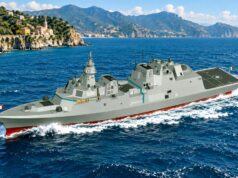
I may be stating the bloody obvious but when I look at that image I just can’t help my self ! Why do we think this is a good idea ?
If someone at MOD thinks this is a good idea in the North Atlantic in winter then they have never been there, and up in the Arctic it gets even worse so who’s going to get rid of the Ice, clean lubricate guns and carry out RAS 🤷🏻 And thats before we get to the small issue of reasons why modern state of the art warships keep getting pranged more often than there predecessors did, lack of experienced / competently trained watch keeping personnel.
TBH why is it that no other Naval power is seriously thinking of building a large Drone Frigate / Corvette ? Yes many are looking at Small / Medium Drones with containerised weapons as off boarded Arsenal ships or remote sensor carriers but not full on like this image.
Just think about this for a second but Japan, Australia, Norway, Sweden, Singapore aren’t going down this route in fact they are all going for a more hybrid approach of a Highly Automated / Lean Crewed concept there is a reason even the USN are looking at the Mogami FFG concept and going Mmm.
The other bit I don’t get is why is it so art attractive to MOD ? It has to come down to a cost / benefit analysis based on zero crew costs and removing crew spaces and facilities. But surely we will be replacing them with shore based highly trained, very expensive Tech Warriors with very transferable skills ?
IMHO this whole DIP stinks ! It reminds me of another Defence Review carried out years before I was born, look it up and see how that went !
Sandy’s Review MK2 😏
We have taken the Soviet lesson from Ukraine: quantity has a quality all its own. And Soviet meatgrinder tactics too, except we’ve chosen a meatless, vegetarian option. However, when it comes to ships we can’t use tiny dirt-cheap boats like the IRGC or the Ukrainians because we want to operate in blue water. So we have alighted on this halfway hybrid that may end up with neither quantity nor quality. Let’s hope we can evolve it into something effective before we find out the hard way that there’s no fully vegetarian option in a war.
They are still planning to build six large command vessels as well to sit alongside them on top of the 13 frigates under construction right now. Despite the hype the plan is not necessarily that unconventional. I believe the USN would be following the exact same doctrine right now but they have been side tracked by a president who wants battleships and a Fox News host willing to give him them.
Can you put a radar sensor on an autonomous drone and send it twenty miles down threat (yes so type 94 is doable)
Can you drag a towed array behind an USV in the North Atlantic in most sea states and get useful data from it to hunt a submarine (probably) so type 92 is likely achievable
Can you put a mk41 and a couple of 40mm cannons on an unmanned 1000 tone drone (maybe), admittedly difficult in the North Atlantic, probably much simpler in the Mediterranean or Red Sea. Realistically such a vessel is probably not that useful in the North Atlantic and it’s also why we are seeing optionally manned concepts too.
Do we need 100 sailors to make sure a mk41 and a 40mm don’t jam might be the bigger question or can we do it with 5.
But realistically the big news form the DIP is not that drones are the future, it is that submarines are the future. Surface ships probably won’t survive in a future fight and that’s what we are spending everything on building the world’s third most powerful SSN force as well as the worlds most powerful anti submarine system in the North Atlantic.
The ccv wont be large current info is it will be less than 3000tn with a budget for each ship less than a t31 and a dozen or 2 vls thats it. Whole thing is a bastardised fads + t32 scrapping the t83 and making the t9 totally unmanned and moving the radar to a new t94 it will be a money pit give it 2yrs of studies saying they cant do it either the physics, survivability or protection of the t94 from boarding or gray zone attack, the t91 and t94 will come in at 200mn a pop each so not attritabile and we will end up with a few ccv frigates rebranded back to t32 and t83 started back up again especially when jenkins leaves as 1sl
If it’s two years of design studies and delays the T83 I’m ok with that. Lots of work to keep the design teams going without getting them on a 10,000(t) cruiser
T45 has plenty of life in it especially if supplemented by a T91 with 16mk41 VLS onboard.
In my mind the big question on viability for the new design is radar that can target ballistic targets. I suspect that will end up on the Command Ship and it’s probably much easier to just use an existing T26 or T31 hull for that both of which come with larger radar options.
However if you have a sensor platform like the T94 down threat then the radar on the Command ship for detection of ballistic threats does not need to be highly mounted.
This can probably produce significant savings in the size of the command ship as there is no need to go larger to have lots of top weight.
It can be more like a sea based THAAD battery.
From what I understand for the budget given for the ccv it cant even be a t31 deriverative might aswell get a river batch 3. I dont see how they can sort the gray zone threat to an unarmed unmanned sensor platform that needs to operate for you to do abd and frannkly i dont see how this is cheaper have 2 or 3 100m usv each costing 200mn plus the ccv for 300mn a more fragile and less flexible than the original fads concepts. To keep costs down the t83 was likely to be a t31 deriverative anyway. This all feels like history repeating itself bad politically and treasury desicions forcing us down a path to keep to an annual budget thats a money pit. We are loosing time and and could see skilled staff get poached by the aussies or yanks if the yards dont get guaranteed long term work.
Until someone wacks your T94 radar picket drone.
If the T94 drone is too small then the radar will be mounted too low resulting in a short radar horizon from the T94 itself. If I was the attacking commander I would exploit the hell out of that and target the radar picket with as many high speed sea skimming missiles and one way UAV’s as I could. Once I have put a hole in the radar cover I would target the Command Ship in a similar way.
There are three ways to counter such tactics. Airborne Early Warning drones (needs an aircraft carrier and possibly weather limited), more T94 effectively drifting towards attritable radar pickets (not the best idea obviously) and or a big radar mast on the command ship driving the size of the command ship up significantly.
I have little faith in the T94 radar picket drone as physics rather gets in the way. Perhaps if it was a passive stealthy sensor platform capable of avoiding detection but able to generate useful intelligence then pushing it out towards the threat might make more sense, but to have it actively transmit a relatively powerful radar signal that basically says ‘hello, I’m over here’, when defending it would be a tough proposition makes no sense at all that I can see.
For me AAW is the most challenging role for small vessels to undertake and is the area where big hulls are likely the best solution for the foreseeable, even if they are eventually replaced with some other system of systems.
Cheers CR
Am expecting Type 93 to get an initial batch to sea as a step up from Excalibur tech demonstrator to prove the concept on operations, then a further batch based on learnings.
Makes sense Type 92 be the first of the surface drones – likely to be the smallest and will complement Type 26s entering the fleet. Might see Cammell Laird (or whatever it’s called this week) and Appledore get some of this work?
As a lower risk affordable alternative –
Build enhanced T31 to replace T45, increasing numbers to at least 8. MBDA can adapt Mk41 to fire Aster. Overall crew numbers won’t increase.
Separately, design, build and test a USV that could deliver one of the FADS variants. If it works, fine. If not, an AAW platform will still be ready to replace T45.
BAE are suggesting a CCV derivative of T26. But this is a much more expensive option, even if the ASW elements of the design could be dispensed with.
It could. But by the time the civil service finally gets to order them from a foreign shipyard another chance to helpful to the British economy they will have found an excuse
It’s exciting, but I remain deeply sceptical.
1. We’ve spent billions and years getting a handful of small MCM USV into service, so how much will T91 and T94 cost with all the missiles sensors and all the rest?
2. I’ll have what 1SL is on, thank you, with Chips. We’ve taken over a decade so far ro build a single T26!! In that time Italy has knocked out several ships, admittedly a bit simpler but still warships, sold some, and laid down more.
3. Surely a skeleton crew to help with maintenance, RAS, pilot complex manoeuvres into port and a host of other things.
Hopeful, as always.
Hi M8 If you think the Italians are impressive go take a look at the Japanese Mogami Class they are churning them out at a hell if a rate. They are a bit bigger than a T23, very heavily armed ASW Frigates with a crew of just 90 and powered by the same engines as a T26 (RR MT30 & RR MTU). The RAN were so impressed they cancelled 3 of their Hunter class versions of the T26 and plumped for the 11 of the “New FFM” improved version.
By comparison.
In 2010 BAe got the contract to design the C1 of the FSC commonly known as the T26, first steel in 2017 and non yet even on trials.
Vs
In 2015 MHI showed their FFM concept, in 2017 they got the contract to develop it, 2019 first steel cut, and by early next year all 12 will be in service.
Then they start churning out the improved version.
No wonder the US is looking at asking Japan and Korea to maybe take over some of their shipyards and run them !
Yes I don’t understand why they don’t us autonomous systems to essentially slash the crew requirements, but essentially keep a command, deck crew and maintenance crew…get the crew to 20 and your golden.. there is no need to try and go all the way to zero crew with all the lost capabilities of a crew and extra risk.
Russian drone meets US drone in the N.Atlantic. Good morning Tovarich, take me to your leader.
Does anyone know if the flaw in sat communication that allowed Argentina to track the task force, has been solved?
Yes, The UK effectively scrapped the Task Force. 😊
If it’s not solved then autonomous vessels would be in trouble.
Farcical and 1 SL was probably on something not very legal…
– Software, where it is?
– where are the designs and subsequent orders?
– A River class 1700-2000t is the minimum to be capable for the North Atlantic, what shipyards can build something like that?
As much as I like the idea and can see possibilities there is one issue that I see as a problem communications. Let me take a simple situation a CCV and a single drone sensor ship over the horizon vs manned warship over the horizon. Manned warship picks up a target over the horizon on radar, man decides to shoot not shoot and gives broadcast to other ships in the fleet. Drone sensor ship over the horizon radar signal picks up target, converts signal to data package for transmit, package transmitted via an in sky relay point that could be a UAV, tropospheric, ionospheric or satellite. CCV receives signal converts signal so it can be seen on a screen or computer, man decides what to do, transmits back to drone ship using the same path. This all causes delay. LEO time delay is 40ms whilst GEO is 600ms, double those for Tx/Rx-Tx/Rx. Plus the delays in the equipment for reading and converting one type of input for a different type of output and you have a overall delay between 1-2 seconds on a Tx/Rx-Tx/Rx path on a satillite network. This does not sound much however, a Russian Kh-47M2 Kinzhal will cover between 3,400-6,800meters in that time period. This is using a star type network with the CVV being a single point of failure. If we use a ring network with spur then not only does the CVV need a large communication/data suite but also the drone warships. This eliminates the single point of failure, reduces the cost of a mesh network but still increases the size and complexities of the drones. No matter what type of network is used the signal and commands must come to and originate from the CVV or a RN HQ for man in the loop operations.
It also does not take into account signal jamming, drone unavailable, satellite or weather interference or the situation where you have two CCVs with 6-8 drone warships all bouncing around signals at the same time. Also you need to think it is not just looking at what the drone warship is seeing, you need to command the drones speed, direction, state of engines, radar, communications, weapons control, damage control, air con, fire fighting, fuel state, and the myriad of things that humans see and take care of on board a ship without even thinking will need to be monitored in real time. A manned warship has two hundred moving sensors on a ship they are called eyes. You will also need to design the moving network so that it does not broadcast out of your CVV/drone group ring otherwise a potential enemy could pick up your signal. So its back to direct line point to multi point transmission/receive.
I suspect that the CCV will be larger than what many people think they will be. As you do not want to have a broadcast signal it will have to be point to multi point communications. This for the CCV would mean different types of antenna arrays and multiples thereof as they will need to face different directions, That means a large clear deck area. Also the CCV herself will need its own radar which will probably be AESA so separation between between the AESA radar and the communication arrays will be critical. The CCV will need a large communication and computer room with cooling and dedicated power supply with back up. Possibly a micro nuclear reactor for this. Not to forget a large command-control-combat information room. This is even before we get to the CCVs weapon systems, ships crew which would need more techies than currently onboard a warship etc as they will still be the air defence ships of the carrier group.
These CVVs would be in concept quite close to the US navy’s Blue Ridge class and they are almost 20,000 tons without any real weapon systems apart from point defence.
Several years ago I suggested that we use HMS Albion/Bulwark and convert these into command and control ships as a test bed as they had the surface deck area for the arrays and space for the communication suite and computer data banks. Although they were not ideal as they could not keep up with a carrier group they would have been useful in the GIUK gap and as a test bed. They could have also carried their own ROVs, UUVs, RUAVs with on board workshops
Could.
😂 LMAO
This ‘concept’ of drone replacements for manned warships is idiotic and should be criminal.
.
.
hmg and the mod should be forced to resign.
.
.
There are so many technical reasons why this fail it isn’t funny, let alone there isn’t any momentum (even with the Ukraine war and the likelihood of state on state conflict with the russians, chinese and dump and co, from a military stand point, so why are these idiot politicians [I class the mod in the same cloth] allowed to make such ‘decisions’
*All lower case lack of respect intentional.
What is needed is 💩 loads more funding and leadership in the RN, without that the UK in any future conflict may not be on the side that writes the history books
I think you need two fleets and trial this thing gradually. I’d be happy if we built 5 uparmed T27s. The enemy only has to sink the 6 Command ships and we have lost. Simples. Its all about leaving our history of a Global Navy. This is not what I’d do.
At the risk of receiving a really rude reply, it simply smacks of defence on the cheap. The drone ships will likely be neither plentiful or well armed given the track record of any government.
The drawbacks are numerous, the time frame is short. No vessels exist, no full scale trials have been carried out.
What we do have is not armed properly.
A couple of River B2’s with sea giraffe radar and camm missiles ( containerised perhaps) could have provided defence for Cyprus recently…I know many here don’t want to see up-armed B2’s but with the navy the size it is.
Would a drone missile carrier have been adequate in this instance, or would it gave needed a command ship and several drone vessels to do the task. What about the terrorist in a rubber dingy armed with a machine gun…could a drone deal with that?
Sorry. Shoot me down now.
AA
Everyone is missing out on the infrastructure requirements – large parts of either the Devonport or Portsmouth naval base is going to have to be rebuilt at significant cost, including the construction of dedicated covered docking, maintenance and refit facilities for the sloops. Imagine a lean crewed CCV and her accompanying gaggle of three unmanned sloops returning home after six weeks patrolling Bastion Atlantic in mid-winter. I.e. six weeks of no maintenance and brutal wear and tear – particularly on the smaller sloops. Hundreds of dockworkers – many highly qualified technical specialist probably employed as contractors will – will need to swarm on board in order to maintain, repair, test and recertify the many sophisticated and complex systems. And this work will need to be completed on all four vessels within a month with 100% reliability if just two CCV’s plus accompanying sloops are to patrol Atlantic Bastion on a back-to-back basis. Even more worrying is how the sloops will be maintained on long duration CSG deployments, an accompanying purpose built depot ship is the best option, is that affordable and budgeted? Or from the late 2030’s will we rely on allied navies to provide destroyers to escort the UK CSG?