

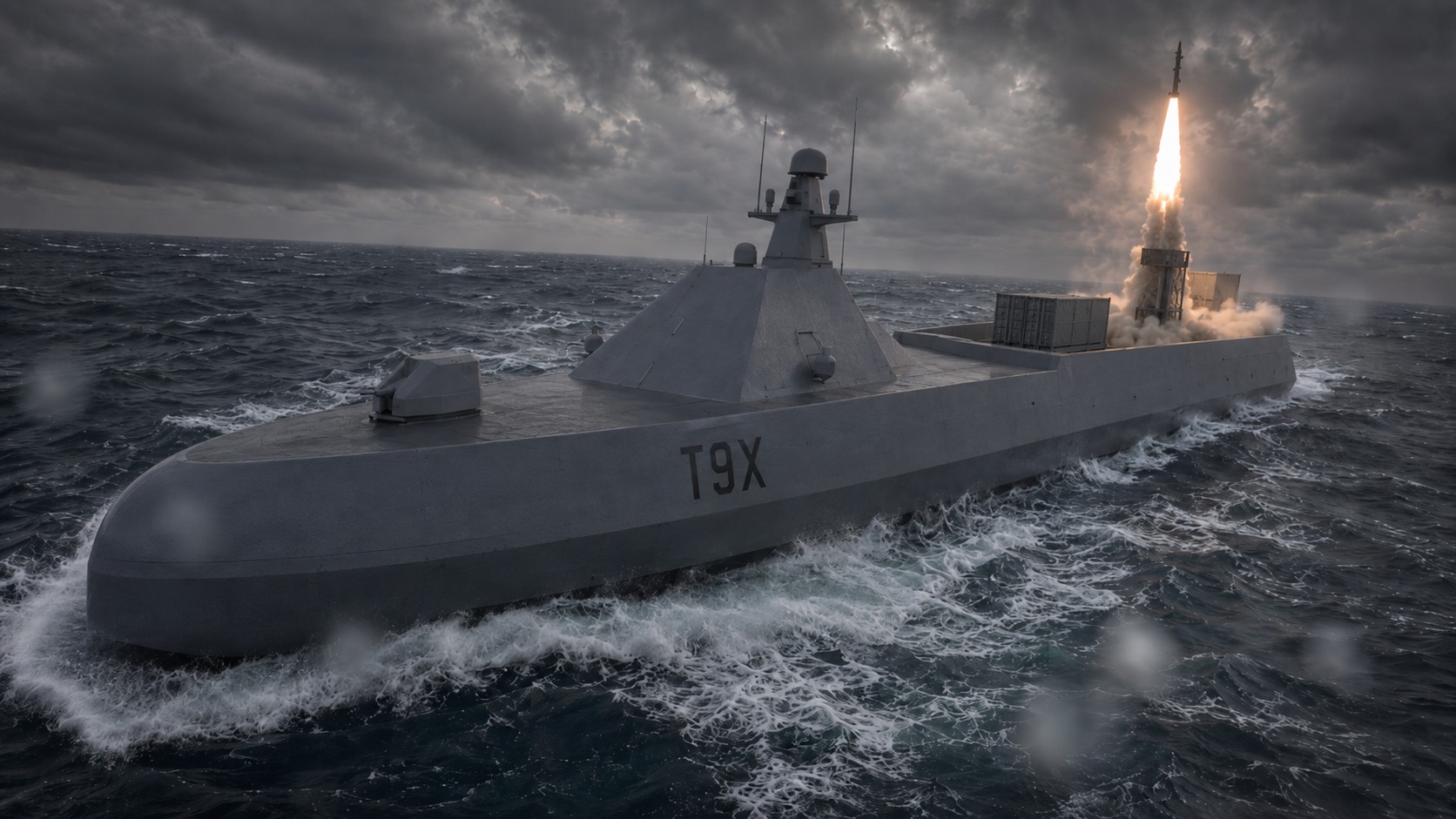
The Ministry of Defence is asking industry for missile silos capable of operating aboard uncrewed vessels and remaining ready to fire for at least 30 days without any physical human interaction, according to a request for information issued to suppliers.
The RFI, titled Future Integrated Air and Missile Defence Silos and published on the Defence Sourcing Portal on 27 May with responses now due by 13 July, states that current and planned maritime missile launcher and silo systems “carry substantial platform design and integration work, require high levels of maintenance and operator interaction, and are not optimised for remote operations in the Hybrid Navy onboard Uncrewed Surface Vessels.”
The department is seeking information on developed and conceptual high-performance launchers with low maintenance demands, capable of operating on both crewed platforms and USVs, able to fire current effectors such as the CAMM and Aster families or similar while remaining compatible with future weapons.
An update issued on 30 June widens the ambition beyond air defence. The clarification tells suppliers still preparing responses that “a pillar of IAMD is a Strike capability” and that the department “would value responses which include Strike in the capability of future silo,” indicating that the launchers under consideration are intended to fire offensive weapons as well as air defence interceptors. As secondary learning, the RFI also seeks containerisation options to minimise platform integration complexity, and solutions achieving 90 per cent component commonality between maritime and land domain variants, pointing towards a common launcher family serving ships, uncrewed vessels and ground-based air defence alike.
The requirement reflects how existing systems work. The Royal Navy’s current silos, the Sylver launchers firing Aster from the Type 45 destroyers and the vertical launch cells carrying Sea Ceptor on the frigate fleet, are integrated deeply into their host ships and depend on embarked crews for maintenance, checks and firing, an arrangement incompatible with vessels that have no one aboard.
A silo able to hold weapons at readiness for a month unattended is the enabling technology for the missile-carrying uncrewed platforms envisaged in the Defence Investment Plan, which ministers have described as including missile barges and sensor platforms sailing alongside crewed warships. The RFI documentation is issued under the FADS Hybrid Navy title, understood to refer to the Future Air Defence System, the effort to define the air defence architecture that will follow the Type 45s, which a senior defence official confirmed this week will retire from 2035 without life extension.
The document is explicit that the exercise is market analysis rather than the start of a procurement, stating the activity “is not intended to prepare industry for any specific future procurement” and that information gathered will inform Hybrid Navy and joint force IAMD development within the MOD.







Remote systems have advanced at a rapid rate, and I’m sure they are about to go stratospheric. The notion of firing weapons remotely will require extraordinary engineering backed up with AI, but it will be done as both China and Russia double their efforts in this field. We are about to witness seismic naval developments quickly matched by remote land systems.
How secure will communicating orders to drone ships be?
Any one who can accurately answer your question will not be posting here.
Too true sir ^.^
Wanted…Anyone with ..
An highly advanced knowledge of Quantum AI Computing with similar knowledge of Encripted Communication..!.
An advanced knowledge of Drone technologies would be of great Advantage….
Please apply to ukdj…!
Nah. Anyone with any kind of computer security background could quite confidently say that this is a solved problem, and any defence company that screws that up would be grossly incompetent. There’s nothing uniquely different about this being used in a military context compared to, say, the bank transactions that the entire global economy depends upon.
Wellllll there was the debacle with WEP, not a military application for sure but still unbelievably poor planning, implementation and deployment.
Indeed better go to Twitter I guess.
CEC (cooperative engagement capability) from the US. Its a mature system and very effective. Allows E2s, F-35s or other ships etc to launch and control SM-6 missiles launched from arleigh burkes or drone boats beyond the horizon. So the answer already exists and the US Navy already operates these drone boats fitted with that and MK-41. That would be the simplest solution. The system was supposed to be fitted to Type 45, but much to the chagrin of the RN the decision was made not to fit it to save a few million.
It’s not about buying an overpriced communication system from the US. It’s about operating reliable, maintenance-free systems in a corrosive environment. If Mk41 and Sylver aren’t up to that job without human intervention, the ability to send the instructions to fire is meaningless.
Drone technology is by no means a cheap alternative that Some including politicians belive…!
The work on anti Drone technology barely gets a nod in the Media but huge sums of money are secretly being spent on it Globally every year..!
Even the likes of ukdj know little about the work undertaken in the counter Drone world…. wonder if this subject will receive an Article in the future..?
😂
If it is being “secretly” spent, honest question, how do you know about it? If you do know and areannouncing it it here it can’t be much of a secret can it?
Seems your the type who would tell the world that you’ve come up with anti -Drone technology…?
Clearly no one therefore has read you into this secret…!
What a very odd response.
I quote
“but huge sums of money are secretly being spent on it Globally every year..!”
If it is being secretly spent how do you know?
Do you think countries are standing on the side lines? Will they tell us ..? Therefore it’s secret privileged info…Need to Know..!
OMG and that means that you do not know whether it even exists or not, never mind how much money is being spent on it.
Let me try.
Developing and keeping nukes is a complete waste of time and money because huge amounts of money, all around the world, is secretly being spent on force fields to protect targets.
So I pick a weapon
I speculate on just how much money is being spent defending against the.
I say that it is secret
I draw conclusion just like you did ……. Well I won’t bother as it seems that you fail to understand that just saying that someone is happening in secret is enough evidence that it is actually a happening AND if it is then it will be successful …
Then I’m sure it’s not happening as you’re convinced me it ain’t..!!
I have no idea if it’s happening, neither have you, I’m not trying to convince you of anything other than the need not to just make stuff up in your own head and then proceed to argue as though your own unfounded belief must be the absolute truth, quoting “it’s a secret ….” And than proceeding to draw conclusions from the secret that you cannot buy definition know anything about …….
As Hal (almost) said, “I’m sorry, Colin, I’m afraid I can’t tell you that.”
Not very. With quantum computing just around the corner any current encryption is going to be at risk. Combined with jamming and anti jamming tech being a constant arms race. Any Comms on them need to be constantly updated to remain secure and as we know upgrades are constantly cut /put off to save money.
Which is why quantum encryption is being developed.
Yep, the challenge is we will never know if the encryption has been broken by the other side until it’s too late.
China already claims to be able to penetrate any known encryption, fine it doesn’t mean it can or can do so as and when it wants, outside of lab conditions but it’s something that is going to be a growing concern especially by the time this fleet takes to the water. Trump cutting us all off from the latest ai models could seriously affect our sustainable encryption technology/techniques in this back and forth war of measure and counter measure. It’s why we need our own protected ai companies like Cosine to at least give us a fighting chance. Sadly others have already been absorbed into US control at one level or another. We must start seeing this sector as vital nationally vital sources of IP (more so indeed) than our physical defence companies.
We are still in the early period of AI and i suspect there is a major stock crash coming caused by the big AI companies. If that happens they will be seriously short of cash and that will allow startup companies to develop without instantly being brought off and kills. So in theory a UK or European companies could appear.
The world already uses quantum resistant encryption.
The world’s banking system, and thus the entire global economy, already uses encrypted communications that cannot be broken by any nation state. Hell, the protocol your browser used to load this comment section uses quantum-resistant encryption both to secure the contents of the message and to verify that someone else isn’t pretending to be ukdj. The tech is so ubiquitous that we just throw it on stuff by default.
Quantum computer technology is very much in its infancy… just how far Quantum technology will go and how reliable encryption resistance is must be pure guess work…. The massive amounts of resources America and China are currently pouring into this area simply dwarfs what Britains efforts…
Companies such as Google, IBM and Microsoft with their recent majorana 2 chip are pushing the boundaries daily..
No it doesn’t. The banking industry is working on encryption to beat quantum computing but the regulators have been warning that the industry isn’t ready and needs to be by 2030.
I could have told you about this three weeks ago, George 😁
The expansion to include Strike is interesting but not unexpected, a repeat of single-role Sylver style air defence silos isn’t sensible.
Hi mate, sorry, not following, told me about what?
I discovered the new RFI for low-maintenance air defence silos in early June on one of my sporadic sweeps of the Defence Opportunities Portal where they are published, and we had discussions about it on UKDF. There was also a discussion about it in one of the comments sections here, a couple of weeks ago I think?
I looked back at the RFI yesterday after the X post by James Fennel but didn’t notice the addition about strike, it’s a good thing you published the article.
Yep, you told me about it at the time.
A real scoop for you!
Mate, seriously… you need a girlfriend !!! 😁
I’ve trained him well…..taking after me with depth of research! 😁 😉
Young padawan, his training is almost complete…..😆
Even I wasn’t perusing the MoD contracts portal, but only because I wasn’t aware of it!
I do now.
And yes, I have a wife, thank you.
Young Padawan briefing Sunray up! Love it!
I’ve read Torpedoes and Lehs’ comments about how young they are, and they are both clued up.
Imagine, in 40 years, when they are the ‘old heads’ on this page and the knowledge they will have 👀
Defo mate. I remember when he came on here as Toby.
Place on the board of the CUKDJS?
‘Place on the board of the CUKDJS?’ 🤣 deffo pal 👍
CUKDJs?
Ha! JJs idea when we were joking about a month ago.
Sunray is George.
Also known as CUKDJ.
CUKDJ is a play on the CDS, CAS, CGS, CNS ( 1SL )
Chief of the UK Defence Journal – Staff.
I’ve finally found the origin of this.
@George.
😁 👍 You’re the boss.
Ha in 40 years they won’t remember where they put their cup of tea, let allow be able to focus enough to drink it while it’s still hot…
🤣
Already there 😉
Leh is quite a lot cleverer than me, reading between the lines of his comments. I think I just put more work in.
Very different backgrounds and interests too, apart from UKDJ.
You’re far too kind, and it’s the effort that you put into your commentary that makes it as good as it is. I’m more political/strategic leaning than technical with my thinking, but it’s all purely amateur from me.
I mean, you got into Cambridge and I didn’t so there’s a direct comparison there 🙂 that’s why I need a job for the next year!
I do hope I put more effort into original research and finding info than most do, that and enthusiasm disguises how little I often know on a subject before entering some debates.
He got in Cambridge? that is suspicious…
Many thanks, though at some point I think I’ll have to leave my amateur defence-watcher hovel and re-enter regular society. 🙂
This whole thing fills me with dread.
We are making a mistake, the consequences of which could be dire.
Just think of all the cash they’ll save not having to buy even more mk41s!
As an aside like to get an update ob the CAMM silos on the T45s ans if anyone else is pushing for more CAMM than the 24? A repeat comment but all the CAMM silos on the retired T23s – could they have not been in part recycled, cut the silo in half and put down the side of the T45 Aster silo walls? All non-deck piercing. Or, put them into 20/40′ containers/ pallets/flat racks for pod deployment on other ships when rigged up to fire control? What a waste going to the knackers yard. And the T23s 2x30mm? Four ships x2, can’t they be refurbished for the carriers?
Absolute madness
I think this is the problem. The sea is not the land, the sea dumps a vast amount of energy From dynamic forces into a ship and its systems…it’s also a one of the most corrosive environments as well.. finally it has the worst weather.. dynamic forces, environmental corrosion and weather are always trying to Destroy ships and their systems… that’s why you need a crew..
Then finally you have the human factor.. someone is going to do nasty things to an uncrewed vessel..
I can see an autonomous ship working, but I still think it needs a CO, deck officers and engineers… even just 10 or so.
The US has been testing the concept with some already deployed large unmanned vessels fitted with MK 41 in the pacific, I’m curious how it works too. I think they have skeleton crews (possibly civilian contractors) to do maintenance and security. Im not sure if that is just because they are still in the testing phase or how they plan to do it long term.
Yep even the Chinese are still putting bridges and some crew space on the autonomous vessels they have been operating and experimenting with.. I suspect in the end everyone will decide trying to have a large complex ocean going autonomous ship, with powerful expensive sensors ( you don’t want random nations grabbing) and expensive effectors you don’t want anyone looking at is basically a stupid idea ans they will use the autonomous systems to essentially cull the crew requirements.. but still have a small command crew ( so it’s a commissioned warship) as well as some engineering..,..
I suspect the fully autonomous uncrewed systems will essentially be small mass produced long range low power slow speed sensor platforms.. such as the gliders the RN are getting or essentially platforms that are launching from a mother ship for littoral combat.
How many deep water unmanned merchant ships in service?
The CEO of Mearsk, the worlds largest shipping company thinks it won’t happen.
Just a question out of curiosity, and i have no knowledge on the subject. What is the likelihood of hostile states being able to take control of these armed, drone warships?
I can disable your drone ship with a trawler and some nylon rope
Well the Iranians haven’t managed to capture any of the USN reconnaissance drones that have been sailing up and down their coast for months now.
Just out of curiosity, whats happened to all the Iranian mini subs? Haven’t heard any news on them being used or hunted down? Are they hiding or being held back?
I’d imagine either
(a) destroyed
(b) saved for if US warships came within Iranian littoral waters
Do not scrap what you have already got before designing something that does not exist yet.
You would think that would be obvious but It needed saying.
They’re not.🤦🏻♂️
The type 45 8 years to decompression, no sign of the type 26. Dhen do you predict these missile tugs will be in service?
Get real.
We’re not scrapping anything tomorrow.
If you do t think there’s no sign of the Type 26 I suggest you travel up to Glasgow and see for yourself if you’re too paranoid to believe news articles on here or the BBC. There you’ll see 2 being fitted out and 3 under construction, or do you believe there’s some sinister conspiracy and they are actually holograms? 😆
The Type 45s don’t submerge, so don’t need to “decompress”. The current Type 45s were planned to be decommissioned between 2035 and 2038, being replaced by Type 83 initially and now the CCV.
8d bet money they are still surviving I to the 2040s given their condition and planned upgrades. The drones will be built first (not “missile tugs”) with the Type 45 fulfilling the CCV role while the RN decides what the CCV actually needs to be. We’ll easily have the drones within 10 years given the automation technology that already exists.
Pipe down will you. We will see, I can guarantee you it’s going to be a mess a very dangerous mess.
These wonderful cheap as chips drones, ai don’t exist yet, therefore have NOT been trialled and remain to be funded.
Your assumption that we have the kit in 10 years, 10 years too late is for the birds.
“I can guarantee you it’s going to be a mess”
Says the bloke who didn’t even know the Type 26s were under construction and want to “decompress” the Type 45s 😂
Have you been living under a rock these last 10 years?
“ai don’t exist yet”
Well apparently you have been living under a rock 😂🤣😂🤣😂
they should do it like in the star trek episode, both participants share a digitised strike platform, where attacks are simulated and casulaties recorded, people then have to report to ‘humane’ termination centre’s
the valuable real estate isn’t actually damaged, that programme was so ahead of it’s time !
The move to drone warships could be the end of the Royal Navy. Maybe not now but in a decade otr two.
It would only take one of these presumably Expensive vessels to be lost by Accident or Whatever and the S××t will hit the fan…
Unmanned british warship with missiles washed up on a beach or hit by speedboat…. Yes unfortunately we lost contact….. What a lot of tosh… Make ships get crews…
when are we going to hear about land based air and missile defences? With the way the MOD has been asset stripping the defence estate (the same as they did with the NHS) and hell bent on placing all assets in few locations, it wouldn’t take much to wipe out our military capabilities.
It was only recently this came into the news when Akrotiri was attacked.
Being this is an enabling technology, shouldn’t this have been developed and proven out before committing to building a fleet of drone ships?
Agreed, I remain unconvinced this will happen. To suggest multiple un-crewed platforms, new launchers and Command Vessels will appear quicker than the Type 83 with its System of Systems, none of which were positively identified, suggests some are living in ‘Cloud Cuckoo Land’.
Tin hat and flak jacket on.
A lot of people asking good questions on here, but then some/many using those questions as an excuse not to bother. Basically how this Labour government has operated when it comes to defence, surprised you don’t relate to them more!
Joking aside: the US, the Dutch, and the Chinese are all going this way. It’s an arm race now, you have to be in it to win it. All aboard. The difficulties answer for themselves.
The question then is are we all ‘lemmings’ heading for the cliff edge or are we all heading in the right direction….far from clear the jury’s out..!
“is not intended to prepare industry for any specific future procurement”
So this whole unmanned thing is a joke?
To develop standalone systems that work reliably without human intervention will be far from cheap, it will require numerous back up systems to operate reliably, have to be more than likely designd from the ground up and not adapted from an existing system.
Repeat that across a wide variety of necessary propulsion, weapons and sensor systems and your unmanned T9XX becomes far from a cheap option.
Minimally manned with say a 12 man crew and they could potentially use a good number of existing systems and be a good deal more flexible regarding tasking, I.e, sending to the Gulf etc.
Looking at the picture I’m seeing quite a multi-function large ship.
How big does it have to be carry a few missiles, maybe some sensors fire and retreat.
Clearly these autonomous ships will be of various sizes but personally I would think quantity is more important – then if the enemy hit a few less is lost.