

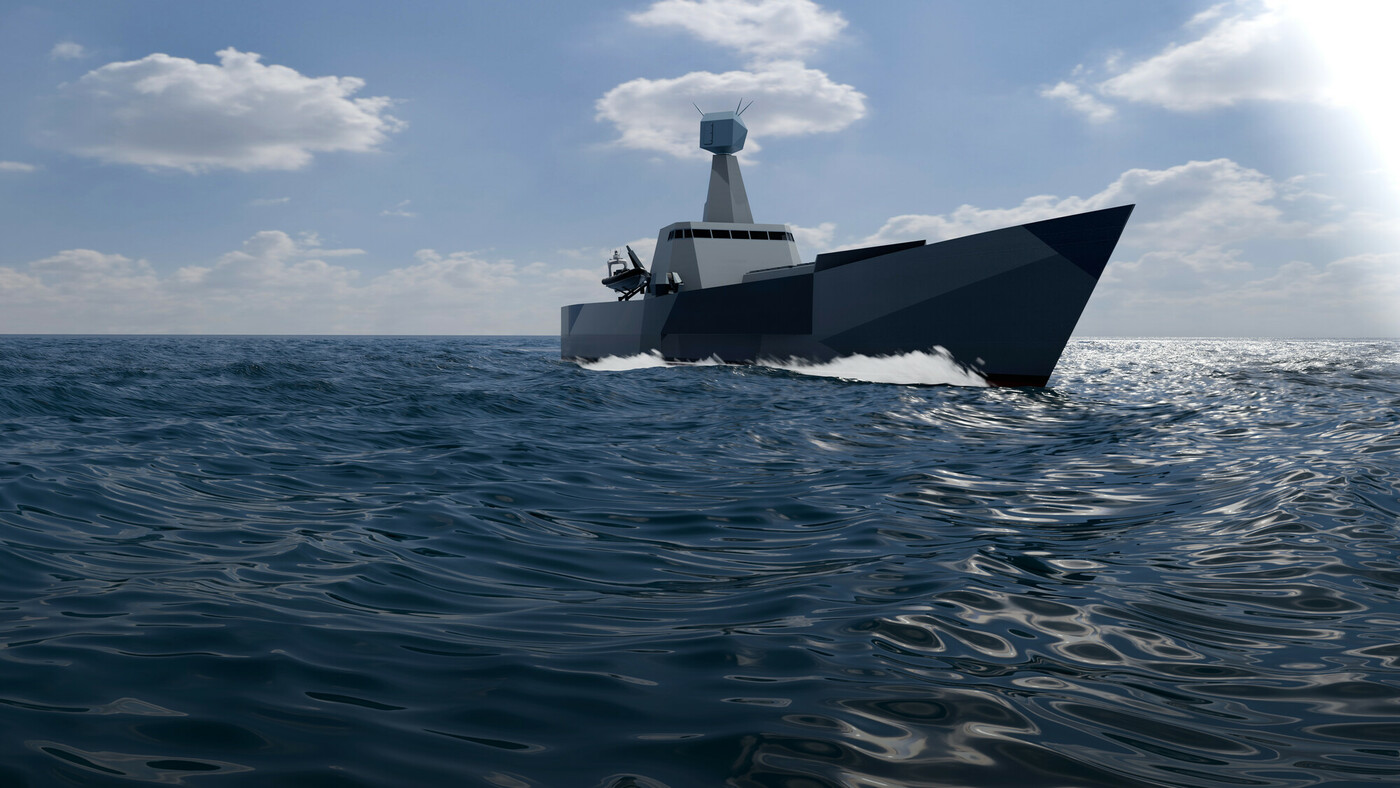
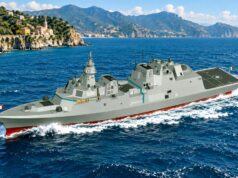
Britain is to build a fleet of hybrid warships designed to command uncrewed systems across the air, surface and subsurface, ordering at least six new Common Combat Vessels to replace the Royal Navy’s Type 45 destroyers and the planned Type 83, the Ministry of Defence said.
The Common Combat Vessel is described as the Royal Navy’s first hybrid warship, acting as a control hub that coordinates drones in all three domains to deliver air defence, with the first ships expected from the early 2030s.
They will form the crewed core of a far larger mixed force. Once in service, the department said, the vessels will operate alongside eight Type 26 and five Type 31 frigates and a new family of uncrewed platforms: the Type 91 missile platform, the Type 92 underwater sensing platform, the Type 93 extra-large uncrewed underwater vehicle and the Type 94 sensor platform, an arrangement it called a once in a generation investment in maritime capability. Funding in the Defence Investment Plan allows the National Armaments Director Group to begin the design work that underpins the change.
Defence Secretary Dan Jarvis cast the new class as built for a harder operating environment, saying the vessels would give sailors “hybrid ships that are designed and built for the increasing threats we face.” The ships would be “British-built, supporting jobs across the nation,” he added, with programmes funded through the plan expected to sustain tens of thousands of jobs. The department said the shift away from concentrating capability in a few large, expensive hulls would extend the Navy’s “reach, resilience and firepower without a proportional increase in crew or cost.”
The programme is also intended to anchor three new Atlantic efforts, named Atlantic Bastion, Atlantic Shield and Atlantic Strike, which the Ministry of Defence said are designed to counter Russian activity in the North Atlantic and High North, protect undersea infrastructure and strengthen NATO deterrence. Ministers pointed to export potential in the adaptable design, noting that the Type 26 frigate has already been selected by Australia, Canada and Norway.
The Type 83 had long been identified as the successor to the six Type 45 air defence destroyers, which are due to leave service by the end of 2038, but it never advanced beyond an early concept within the Future Air Dominance System. Defence minister Luke Pollard told Parliament earlier this year that around £1 million had been spent on platform-specific design over three financial years, part of roughly £6.9 million of wider work, and that the concept had been inherited in an underdeveloped state. The existing destroyers have been troubled by propulsion faults traced to a design flaw in their gas turbines, with one ship, HMS Daring, having not put to sea for more than 3,000 days.
Industry has been circling the requirement for some time. At DSEI 2025, UK Defence Journal reported, BAE Systems set out a system-of-systems vision built around a large Air Warfare Command Ship carrying sensors, missile batteries, guns and directed-energy weapons, paired with smaller, adaptable combatants.
One concept, based on the Triton trimaran demonstrator, was shown as a lean-crewed sensor and effector platform with full autonomy under study, while design lead Gavin Rudgley said reduced crewing would come through “automation, autonomy and the embodiment of artificial intelligence.” Geoff Searle said the firm was modernising its combat management system under the Re-Code contract to build the “foundation of the sovereign core” capability, and BAE representatives confirmed that evolving the future ship from the Type 26 frigate was one option under review, with one official calling the proven design “an obvious thing to build on.”
A rival approach has come from Babcock, which previously pitched its Type 31 frigate for the role. Under a concept it calls ARMOR Force, the company would turn the Type 31 into a controlling node for a fleet of large autonomous surface vessels built by the United States shipbuilder HII, dispersing anti-submarine, air defence and strike capability across wide stretches of ocean using swappable containerised payloads handled at its Rosyth yard.
Babcock described the proposal as the industrial answer to the First Sea Lord’s call for a hybrid navy and a direct enabler of the same Atlantic Bastion, Atlantic Shield and Atlantic Strike programmes, with chief executive Sir Nick Hine describing ARMOR Force as “our response to the First Sea Lord’s call for a re-imagined Hybrid Navy.”



To me this looks like a win big or lose big strategy by RN & HMG I’m just not decided on which.
I’m excited by it.
We need more mass.
I want to see a better quality quantity balance and if hybrid csn give that, fine.
As long as the T45 capability can be distributed successfully.
I also look overall at Defence, if losing T83 prevents numerous cuts elsewhere and it offers the same capability, then why not.
Questions:
Height. I thought Sampson had to be as high as possible, is that still possible with a smaller CCA?
Jamming. What if? We cannot assume in warfare.
Assume each pair of T91 92 94 will always be close to a manned escort?
I think that’s the idea though, that they aren’t close to a command vessel. They could be 70-100+nm away covering a huge area of airspace and surface and subsurface. I don’t know how that will work exactly, but that seems to be the Jist of it.
Which then brings me to the other issue raised by many.
Peacetime grey zone. Your asset is beyond visual range and someone decides to take a close look at it. How does it prevent it? A few cctv and GPMG?
I see the advantages and I see the pitfalls.
The same way they do close protection now. With all that networked coverage, they going to know about everything that moves in the area.
Hmmm.
I recall that CEC which the RN was after was cancelled due to cost.
So how does this differ?
I don’t know, but its going to have a pretty impressive system behind it all.
I think you missed the comment about ‘grey zone’. If the thing is 100 nm away, a rogue power can board it an disable it in situations just shy of open warfare. It’s no different than ‘anchor-dragging’. Surveillance will let you point the finger but won’t stop the hostile action in the first place.
I’m not aware of any RN vessels being boarded or disabled. Just because it autonomous, doesn’t mean they are any more vulnerable. They will be part of a task group. Nothing moves without us knowing about it
The Iranians literally attempted to steal a US Navy Drone near the Persian gulf. They had almost succeeded in pulling the thing into their boat when the USN got there. They could have been much more successful simply in smashing the thing/putting a few holes in it and letting it sink. If they had, they would’ve been long gone before ‘help’ arrived. This thing was ‘part of a task group’ too, working with USN vessels at the time.
I’ve heard the ‘we know about it’ fallacy before. 1.) Knowing something is happening is meaningless if you cannot stop it from happening. 2.) We DON’T see or know everything. E.g. enemies of the collective west have been having a good time smashing ocean infrastructure.
You expect it’ll just sit stationary, allowing itself to be boarded?
Or do you think it’ll be so busy looking for aircraft/ submarines/ etc that it won’t notice some RIBs approaching?
The USN drone wasn’t stationary. It was moving. In a ‘greyzone’ environment, you won’t be able to simply leave the thing ‘weapons free’ to shoot anybody approaching it on its own. And reacting to threats seen/glimpsed through a camera on a boat a hundred miles away isn’t as simple/easy as you think.
Your comparison of drones is as ridiculous as comparing a glider to an F35. The only maritime drones captured have been hydrographic craft, like the Saildrone that are wind/solar powered.
All Iranian attempts to capture reconnaissance drones, like the Devil Ray, have failed completely
Cameras, how quaint. You realise there are other sensors these days to detect approaching vessels? The AI aboard these drones will identify approaching hostiles and take evasive measures long before any sailor on the control ship squints at a video feed.
Assume this is being fed by the trials with the Rattler RHIBs that were controlled ftom hundreds of miles away.
Yes but people happy shot down drones.. remember the footage of the Russian jet essentially playing airplane rugby with a US predator.
I wouldn’t be surprised if it was fitted with RWS that can be controlled from the mothership, but I have to admit I’m a bit worried about jamming and spoofing, especially in an increasingly contested electromagnetic environment.
Thank you for that too rare of things on here, a sensible comment.
I expect they’ll be both capable of both remote control and autonomous action.
Spoofing should only be an issue where GPS is concerned as the comms will be encrypted. (Though what happens after ‘Q Day’ is anyone’s guess, but we’ll all possibly be worrying about lots of other things – like our savings!)
Jamming would be my concern. In theory the vessels could operate completely autonomously. However in the Democratic West we’re still committed to having a human in the loop when it comes to using weapons to kill people. We’d rather not rush towards T1000s autonomously hunting humans – regardless of whether they look like Schwarzenegger or not.
So jamming could prevent the use of any weapons aboard a drone.
I suppose they could be connected via fibre-optic cables linking the drones to the CCV. After all, these are used to control submarine launched torpedoes like Spearfish. But it would severely limit the range the drones can operate from the CCV…
How is jamming or worse still foreign break in control to be prevented? The US has announced that it will withhold the latest Ai models from any foreign Govt or indeed any foreign born researcher even operating in the US, a bit ironic considering how much of their own efforts originates from such figures. So as things stand this would mean only the US and China would have access to these most advanced ai technologies, and it is known (Anthropic one of the main businesses targeted by these new rules has already removed a model it fears is expressing signs of independence from control) that already to a degree these ai models are beginning to be able to penetrate and potentially hack any security measures defending valuable assets. The Chinese already claim that they can do so. So how do we, without at least catching up to these players, expect to protect our assets, especially autonomous ones from being infiltrated? British and European companies (and Govts) are now after this US decision (and events more generally) being taken more seriously and moves are afoot to create sovereign capabilities but we are a long way behind while companies like DeepMind who have been allowed to slip into US hands will ironically be used against us to all intent and purposes. Europe and others really have to work together if we have any chance of remaining in the real World independent nations with control over our own future because fact is it’s now US policy (and no doubt Chinese) to dictate our choices, and behaviour through digital means at every level.
Digital Services interference is but the opening gambit of this process, maybe we have been lucky to see a Trump doing so so blatantly to spur us into action at last, because it was all happening surreptitiously anyway and attempts to lock us out would probably eased in over time rather than the overt unsophisticated ‘America Only’ tactics we see now. Even Burnham appears to have some semblance of the dangers if his speech today meant anything. Sadly Brexit is going to make our ability to fight this growing war without re aligning with Europe a very difficult affair to balance. We need cards and quick.
DeepMind is a British company, registered and headquartered in the UK. While it has offices worldwide, it’s London where most research is done. As such it’s subject to English law.
Personally I suspect that the large drone ships will have small crew areas to allow for a command crew, maintainer crew or constabulary crew.. having the ability to put say 10 people on it is a bit of of game changer in regards to none hot war usage ( 99% of the time) for the T9x brigade..
Oil and gas industry in remote offshore locations uses a variety of tools to monitor and deter the curious ( and the criminal) from boarding their unmanned platforms. Sound, light, water, chemical, physical design, rapid response etc.
So the Sampson is put on a T94. Then it in itself will be of some size to accommodate that.
I’d be surprised if Sampson is used on these. Its very capable, but its a 20 year old design. Could probably design a newer ASEA radar that’s much smaller but just as powerful and capable. More ECRS MK2 E scan tech than Captor M.
Ok. Still needs height though? So quite a sizable vessel.
The thing is if sensors are diffused you don’t need hight. Hight is a requirement of a single sensor platform as your radar horizon limits detection of sea skimmers.. if you can throw sensors platorms even 20 km down the threat access you don’t need hight
Yes….silly me. The T94 picket.
Lets hope it can defend itself.
I hope the CCA also has a radar at a decent height anyway, surely they’re not putting all the sensors elsewhere.
This is where it all gets interesting.. if the RN plays it well then these arsenal, picket and ASW ships all become interesting and useful.
I think this is where CAMM will come into its own, the fact it’s essentially an all up round in a maintenance free module will make it perfect as the general missile for your jobbing picket ship add in a 57mm and the Job is done.
The interesting one will be the arsenal ship how will that be used.. how much independence will it have and how large will it be.
I imagine the T92 sloop will be the most basic of the three.. after all if what you want is a towed sonar platform hunting subs in the mid Atlantic.. you want it to be doggo and not doing much of anything.
I image the T92 will be the most common, smallest and least rounded, the T92 the largest and least in numbers and essentially bound to a major combatant and the new T94 picket a bit more general purpose… for all of them the big question for me around usefulness is will they have crew quarters for optional crews… because that’s what will make them well rounded naval assets or break glass in time of war money sinks.
Am pretty sure that long before the first new CCVs are built, the Type 45s will be fulfilling the role of CCV with drones.
Who pickets for the pickets?
A missile aimed at the outer radar USV will still only come over the horizon 20km from it, and if the missiles are on another vessel the reaction times will be increased too.
The enemy could whittle down the unmanned vessels one by one.
I suppose this is where the wider game comes into play. In the end Russia only has limited number of strategic strike platforms that can attack the RN with missiles. You’re not just passively sitting around getting hit, when they attack, you can and will be attempting to kill their strike platforms, exposing your strike platform to kill a major AAW warship then enemy has only 2 of available is worth the risk.. the risk of losing your SSN or backfire squadron to knock out a 1000-2000 ton unmanned picket ship the RN has 10 of before you even get to the main escort.. that’s a different issue.
If you look at it passively then lots of less good mass becomes a stupid ideas.. your just waiting for the big bad Wolf to destroy all your ships in detail at its own pace, if you look at the fact in war attack is the best form of defence then lots and lots of mass even if it’s a bit shit is better and as soon as your enemy attacks that mass your opportunity arrives to do harm.
That thought occurred to me as well.
Sitting duck. Assume they have some sort of self defence.
That depends on how many drone ships the Treasury will let the RN have…. they will be an easy target for number reductions….
In the end I think it’s a good goer because the RN have time on their side with the T45s.. in the end the update program ( the final Aster 30 NT) will not end till the mid 2030s and the hulls are well built enough to last as long as a US destroyer and the burkes will each do 40+ years.. so the RN can really keep the last T45s running till the mid latter 2040s.. that essentially gives them 20 years to get the AAW drones and wider FADs stuff working.
And if they get 6 new all purpose escorts/ drone mother ship starting from 2032 as well 6 10,000 ton MRSS for littoral assault/patrol and control it’s going to be in a very very much better place than I thought it would be.
I like the idea as it’s presented but I am concerned that all it takes is for one of the drones, such as the sensor platform, to be cancelled and suddenly the whole thing is pointless.
For me the real question is how much cheaper can a drone ship really be?
The cost of a combatant isn’t the hull. It’s the combat systems. Optionally crewed (they’ll have to be optionally crewed) will save a little on hull size, and crew quaters. But they’ll still need engines, sensors, vls…
No. Unmanned (or minimally manned) warships are not direct replacements for properly crewed warships classes of cruisers, destroyers and so on.
.
.
Anyone saying otherwise is just sea-blind with zero understanding of the maritime domain in any respect, plain and simple.
.
.
From the government angle, this proposal is just another way to promise to fund defence while not actually funding and equipping defence – Here’s an idea government do your job and provide for defence first and foremost, everything else is secondary – If you don’t grasp that quit and don’t stand any more elections; while voters do your job and hold your member accountable if you cannot do that, then learn russian or chinese.
.
.
This is not to say the proposed ‘warhsips’ do not have a role in augmenting forces; but that is just it, you need forces, mass, people in the first place to augment, this proposal (it is not a plan or programme or project yet) does nothing to address that. 5-8 T26 and 5 T31 will not defend the UK or her interests in war, that is also plain and simple.
I doubt the ‘Drone command ships’ will ever be built. They will probably end up being slightly modified T26 / T31 hulls and commanding very few actual drone vessels. I suspect that the ‘tethered drone’ concept (a wild guess here) is a dead end and that highly mission focused autonomous drones are the future.
This is true but then manned ships have all that, too.
What they won’t need are life-support systems, food and water etc. The biggest operational cost long-term is probably the crew. I’d imagine the cost in salary alone of a destroyer crew would run a few million per year, plus factor in crew training (both initial and ongoing) and then add on the aforementioned costs such as food, water, medical aid etc.
It’ll still be expensive, but cheaper long-term than increasing the number of hulls by the same amount but with manned ships. The upfront costs will likely still be a lot, but operational costs once they’re built should be cheaper.
To me this looks like a win big or lose big strategy by RN & HMG I’m just not decided on which.
The British have always been great naval innovators, and this must be the right decision. The concept of a fleet of loitering surface vessels with extended tours of duty without the impediment of hundreds of personnel means smaller and lighter ships.
The concept is fine, the reality is that large ships need regular, ongoing maintenance and for that you need people. The only way this works is a little bit like Nelson’s navy where the officers’ valuables were put in small boats that were towed behind the ship and there was a gentleman’s agreement not to fire on them. In this case I suspect the maintenance crew will have to live aboard and there will need to be a helicopter evacuation when they are expecting to go into combat.
There will be a need to house a skeleton crew either permanently or from the mothership as and when required. The lost rate will probably be higher than for manned warships, but the build time and cost should allow for a possible fleet of some 15 vessels, accompanied by six conventional motherships.
Except it doesn’t really mean smaller and lighter ships. The driver for ship size has long been the size of the weapon/radar system, the generators to feed that weapon system, and the propulsion plant to move it around. A Burke isn’t 9800 tonnes because of the crew.
This ‘solution’ means either an ineffective sensor system or an expensive/large ‘drone’ that will basically get smoked or disabled by commandos in a real war.
Jomo, your observations are interesting. However, accommodating a normal-size crew does take up a considerable amount of space plus the stores required for an operational deployment. With a restricted crew there has to be a size and weight dividend.
The sensors and weapons are also what drives a lot of the cost…
But running cost wise a huge amount is related to crew.. just the energy consumption of the hotel services on a T45 is essentially up to 4MW.. that’s 35% of the entire ships diesel generator capacity.. that burns up to £48,000 of fuel a day for hotel services, that equates to about 35% of the daily cost of running the ship… removing or limiting crews is massively cost effective.. in running costs, but as you say less so in capital costs… because capital costs are massively focused on systems.
But running cost wise your moves to a different order lower on the costs.
Will these warships be able to protect from all the various types of stealth, ballistic and hypersonic threats? If not this will be a disaster.
Why do you think it will be a disaster if you don’t know how it will work.
‘Disaster’ is likely too strong a word. It is simply hard too see how this will come to pass in the manner described, at least in the timescales (early 2030s). The Weapons Systems (Sensor(s), C&C and Effectors (missiles) still need to be designed, built and installed. To date those have all needed a ‘man in the loop’, much will need to change if long range missiles are to be left wholly unattended, but available, for long periods.
I think it holds a lot of promise and capability for the RN. But yes, its a lot of technology and process to refine. And we certainly aren’t the only Navy going down this path. If we don’t embrace this doctrine, then we will be left behind. And the same doubters in the comments section today will be back saying we have been to slow and we are useless and blah blah blah.
WHO will build T91 92 93 94 CCA?!
I keep reading here that the yards are maxed out. Assumed Rosyth takes amphibious next.
And by the earky 30s.
Pie in the sky surely.
the article mentions US shipbuilder HII ->
“A rival approach has come from Babcock, which previously pitched its Type 31 frigate for the role. Under a concept it calls ARMOR Force, the company would turn the Type 31 into a controlling node for a fleet of large autonomous surface vessels built by the United States shipbuilder HII, dispersing anti-submarine, air defence and strike capability across wide stretches of ocean using swappable containerised payloads handled at its Rosyth yard.”
We are certainly not quick. It all has to be designed, built and ultimately paid for, there is the rub. I do not want to sound like the cavalry officer facing the tank and machine gun but still cannot see the unmanned solution helping with cost aor timescales.
It will be expensive to develop and bring into service. But once it is, it should save through life costs compared to additional manned assets into service. And if we did lose an autonomous vessel in a shooting war, you’ve only lost money and equipment. Not people.
The closer a radar is to the threat and down the threat axis the better.. you don’t need it to be as high up, as high powered or have has large an aperture if it’s 50 miles closer to the threat down the axis.. also if you have 3 you still have an AAW screen if 2 of the radars get knocked out.
Physics is still physics on the demands and limitations on a single platform..lots more slightly less good platforms always beat 1 very good in naval conflict.
There is a lot of risk with comms being hacked or jammed. Also the sea keeping ability of small vessels in the North Atlantic is concerning. My fear is billions and years is invested and then it decided it’s not feasible. It not like that’s not happened before.
I’m hoping this is the culmination of a lengthy process of design and not a desperate play by our outgoing PM. I guess only time will tell, but on paper it’s a common sense approach to addressing the challenges of scaling up the fleet without increasing costs.
Don’t forget this is the supposed plan that caused two ministers to resign,doesn’t bode well does it?
To be fair mate, I’m not convinced this was the cause, but the overall funding gap.
If Defence gets a range of goodies elsewhere and assets are saved from the chop if we go 6 smaller rather than gargantuan T83 I can see the appeal?
As long as the capability works.
Does it?
Have any of these T91 92 93 actually been put in the Atlantic weather yet?
At least six will become ‘up to six’ and then four with options for 2 more, that’s then cancelled . That’s my fear.
Carns did say it was the focus of the DIP on legacy platforms that Jared him off,now all of a sudden lots of drone talk appears🤔 perhaps I’m too cynical in my dotage😀
Yes, fair, I’d read that.
He’s gone and got Drone itis as well, to me he was writing off conventional capabilities far too easily.
I’ve spent enough time in the high North and i can attest the weather is shockingly unpredictable even on a big Nuclear boat. These will need to be either very large or have impressive seakeeping capabilities.
Interestingly AC resigned because he stated that the DIP was planning to build equipment for the last war.. and a direct but better replacement for the T45 would definitely hit that..
Look what we have seen in a few days.. the RN saying it’s going to build 6 small amphibious/ littoral ships for distribution of risk and drone warfare instead of great big 30,000 ton monsters.. and it’s no longer building an all singing AAW destroyer but instead a drone command and common combatant..
Essentially two programmes that have moved from building for the last war.. to building for the future drone war and learning from Ukraine.. just as AC asked in he’s resignation letter.
A hybrid navy made of crewed and uncrewed vessels is a meaningful use of the word hybrid, whatever you think of the concept. A hybrid warship would have to be a mix of at least two other concepts: both electric and diesel powered, perhaps. In this case it means nothing. The word hybrid has become meaningless marketing slop.
I agree, it’s just that the possible and the technology don’t always live up to the theory and the desirable. If that is the case here then in a decade or more we are going to be in one hell of a mess again.
I would agree IF the T45s had no life in them.. but they have just had major refits.. they will be refitted again in 2032 onwards to take aster 30 NT.. we know their hull plating is about 20% thicker than a T23 and are build with a 30% longer life expectancy than a T23.. we managed to keep the T23s tick in till they were all about 33-35..so there is no problem really in running the 45s for 35 years..that gives the RN until about 2048 before the shit it’s the fan if it does not work.. so 22 years to sort the concept and make it work..
If those T45s had been built like a T23 or were a decade older it may have been higher risk.. as is they can play around for 15 years and if it all goes wrong still build a new AAW destroyer in time.
The main worry for me is where is the large air defence radar going to go, especially when T45’s are retired? Unless there’s some technological way around it?
That’s a very good point. Compared to smaller ships, destroyers bring superior radar and sensor capacity covering and protecting a much larger area, as well as higher speed and multi-mission abilities.
Crowsnest 🤣🏴☠️
Madness to rely on just this given the defence situation for the UK.
Six of anything ‘aint going to work. Realistic availability, given Astute/T45 issues will be 2 ships at best – or more likely ZEREO availability.
What about air defence of the UK against long-range cruise missile, or exo-atmosphere ballistic and manoeuvring re-entry missiles? Let alone at-sea defence of the carriers and overseas assets?
Madness.
Have you forgotten we only have 6 Destroyers today?
Given where we are today, that’s not a strong counter-argument.
EH? That’s exactly my point Robert. Six of anything has been proven not to be viable.
Yeah I was thinking there is a blatant weakness in that argument. Have to say that being in a total mess today isn’t a great argument for planning it as the basis to be in a similar one in a decade and more as your starting point, unless you include further evidence as to why this just might not be the case.
Surely to maintain or increase the detection capabilities of a T45 the CCV’s will need be a large hull to support a tall mast and whatever equipment is needed for controlling an armada of underwater & surfaced ships along with its air wing. Not sure the T26 or T31 could do this. T45 batch 2 maybe or something that resembles a T83 might be needed to put this vision into practice.
It will also need to be heavily defended as they will make very juicy targets – and not just by uncrewed escorts as I can well imagine electronic warfare interrupting or cutting communication between the mothership and drones; it should have its own defensive suit.
It’s still a warship, so no reason why it won’t.
The height of the radar is also a question, but for all our moans and questions, surely all this has long been worked out by the designers, the RN, DSTL, whoever.
I’m afraid you have more confidence than I do! It seems the CCV’s will need to be something similar to a T83 to be effective anyway, perhaps with fewer VLS slots as the drone ships will do this, but otherwise quite similar. Or maybe radar technology has moved on to a degree that tall, strong masts are not necessary anymore.
I do, mate.
I have confidence in our professional armed forces and the cutting edge science behind them.
I don’t have confidence in the politicians ( as the site knows by now!!!) and their budget.
If you put it like that then I’m inclined to agree. I’m just worried this is being driven by politicians and the treasury rather than the miltary professionals. Perhaps a fully funded DiP would have had destroyers and CCV’s.
We still are getting Destroyers of a kind. Just not 12000 tonne HMS Massive ones that cost 1bn+ each.
Maybe I missed it, has tonnage been indicated? Some are suggesting the T31 hull.
Know idea. Everyone is just guessing.
If the UK government really wants to save money while keeping up our military commitments to Nato I would have thought that if we just keep building T26’s and T31’s.There is plenty of room in both hull types for future developments, we then keep down the development costs the logistical support costs and we keep 2 of the UK’s best ship building yards at full capacity. Once we have got the number of vessels for the RN up to a sustainable level (18/20 vessels) then we can put the older hulls up for sale their by keeping production going and incorporating the latest tech in the new hulls so the RN keeps an up to date relivent surface fleet. By keeping a steady flow the Frigate production in Scotland this would allow some of the smaller yards in England to produce the small hull for the Drones that will be needed, and allowing Belfast to produce the RFA’s and Amphibious vessels.
I think for anything other than ballistic air threats this is clearly the best solution, a squadron of drones surrounding a mother ship offering extra sensors ,magazine depth and and out defensive layer of 40mm cannons to stop air or sea drones.
I’m just not sure how it stacks up on ballistic threats. For that you’re going to need a big radar, probably. That being said neither the MoD, RN, BAE or Babcock are daft and there will be a solution that they probably already have.
A T45 Sampson radar plate is quite small and it uses the last generation of radar technology and its plates are not pointed up yet it can track and engage ballistic targets in a near space environment so I’m sure this is no an unsolvable issue.
This sounds like the dream project of a Joe 90 type in MOD that will eventually be cancelled due to cost over-runs and then we will be left with nothing.
Just bear in mind, any subsequent, non-Labour government will want to do its own Defense Review, so the end solution may well end up changing.
No big deal, if it doesn’t work out, we just copy Canada and stick a big radar on T26/river class hull. BAE will be developing the radar anyway and the plate size can be altered to fit any required size.
At all costs we need to avoid BAE spending ten years designing a super cruiser with brand new hull form just to keep a design department in business with some new form of massively complicated propulsion system because we think maybe one day we might stick phasers or rail guns on it.
T26 is working, it’s being ordered in massive numbers (30) plus. Just keep knocking them out and have an AAW variant for drone control and job done. If the drones don’t work out then just order more T26 AAW.
None of this stuff needs to be complicated.
Replacing 6 Type 83 Destroyers with 6 Common Combat Vessels of a unspecified design and capability is in reality a cost cutting measure. Six ships replaced by six different ships plus un specified drone ships does not add mass to the Royal Navy. Most importantly the CCV is unlikely to have an Anti Ballistic Missile capability so when the Type 45s leave service the UK will be wide open to a conventional ABM or fast missile attack. The ABM gap makes the UK hugely vulnerable. What amazes me is that it seems likely that the DIP will continue the nonsense of acquiring F35As for the NATO tactical nuclear missile role.
Of course ditching the Type 83 budget line has benefits since the lack of dedicated air defence ships means that it will be harder and harder to justify the RN’s vanity project the Carrier strike group. I support a phased transformation to new technologies but I am far from being convinced this a good move.
The solution is simple: sell the two aircraft carriers and that’s it. No need for fleet air defense for those ships. A typical British Ministry of Defence solution. What they could do is lease the services of France or the USA if someone attacks the UK; the Treasury would surely be delighted with this arrangement.
Hi Nelson, where did you get your information that it’s unlikely to have anti ballistic missile capability? Could you share because this is news to me.
Thanks for asking the question. First of all I should really have said that as it stands the Type 45 (and only one of them) has a limited IRBM capability it does not have an anti ICBM capability. I also agree I did not present evidence that the new CCV would not have a anti IRBM capability. However as has been made clear by the MOD the Type 83 Destroyer programme has ceased to exist. For CCV to have an Anti IRBM capability it needs to fund a SAMPSON Radar replacement and for the new warship to in effect be built around a serious radar system. Secondly the new CCV would need to be equipped with an ASTER missile replacement or the new UK equivalent of the US SM missile. I dont see any of these two capabilities funded so far and the news this morning seems to confirm their absence. I don’t by the way count the T45 enhancement upgrade cited today as anything like a future proofed IRBM /strike missile equivalent. The Type 83 concept was about addressing threats in 15 -20 years time not now. I have long since supported a move to dispersed lethality in the RN this is about cost cutting.
Cannot wait for the DIP.
So far, looks like a few “juicy carrots” that might well actually be cuts take the headlines.
Amphibs with Dutch? How many? Are they shared assets?
If so, a cut, 6 MRSS of our own were planned.
Reading that RMs budget for new stuff was 700 million, now it’s grandstanded. 500 million. So, a cut, whats that money gone to instead, and what are the RM not now getting?
6 CCV, I’m excited,hopeful, concerned all at once there, but it’ll be seen as another cut regardless by many as cheaper ships “replace” proper Air Defence Destroyers.
Who else is downsizing their main AD assets?
It’s important to remember that the budget is actually going up by a lot, not as much as the MoD wanted but it’s no cutting program like 2010 or 2015.
So far what I see seems reasonable, fingers crossed it stays that way.
Hi mate.
If the 6 CCV can effectively replicate the output of 6 T45 by distributing the effect onto the LUSVs then fine.
I remain curious how this will work when CEC was previously discarded on cost grounds.
The 200 million reduction is public record, an answer to Healey himself when he was in opposition. What it has gone on instead we’ll never know.
Yes, budgets going up. So is inflation and god knows what HMG have placed in that budget that isn’t military, which I highlight here all the time, so lets keep that in mind as well.
What is actually new money which isn’t committed to the DNE and cost overruns?
I believe nothing what spin doctor politicians say. The resignations a few weeks ago says everything really.
Main thing, we just cannot take any more cuts to force levels without the services institutionally starting to unravel.
We’ll see.
Hi mate remember CEC being cancelled in 2010 or 2015 for a saving of £500 million. This was the USN version, nowadays CEC is much more common and probably essential. Fingers crossed.
It can be said that France is showing a trend for downsizing its AD assets from Horizon to FREDA to FDI. The US is replacing it’s 122 Cell Ticos with 96 cell AB Flight III while DDG(X) and CG(X) are dead in the water. Germany just cancelled its 10k ton frigate though that’s probably not related to its AD role. It’s interesting that Asia are supersizing while Europe are going the other way.
Italy’s DDX programme is still on. Turkey has a destroyer programme too.
Mea culpa, I’d forgotten Italy’s DDX.
Design follows Function,it has nothing to do with Downsizing,Horizon,FREMM,FREDA and FDI were each designed to do a specific Job,that dictates the size.
Horizon is an air defence destroyer that was big and too expensive so they only built 2. FREDA was the next attempt at an air defence vessel built on a FREMM hull to lower costs but they only built 2. FDI is an air defence frigate deliberately designed to be smaller to attract the export market and add numbers to the navy. All designed primarily for air defence and each smaller than the previous design hence ‘downsizing’. I’m not meaning it in a negative way since I can definitely see there’s a lot of utility in producing more of a smaller less complex design.
Germany are still going for upto 8 f127 which is a 10000tn 100vls aaw “frigate”. Its the f126 they cancelled
Could be out tomorrow or Thursday. Get the popcorn ready pal. The comments section will be on steroids 😆
😬😳🥺
For about a year now when the MSM are interested in defence, and of course pages like this, we have been fixated on the DIP and rightly so. Once the DIP is released and we have had a few days arguing over everything in here the dust will settle on that front and then I think the focus will shift to how we plan to get up to 3.5% of GDP.
NATO members are expected to set out credible plans for how they reach that level of spending and share those at the upcoming NATO summit on 7–8 July. Obviously we are in a transitional period politically so we will have to wait a bit longer, but hopefully Burnham can clear that up sooner rather than later.
The DIP is clearly extremely important but if we 🚨really are🚨 to move to 3.5%, the around £30bn extra annually is going to massively change the shape of future capability planning.
Welp, I predicted this would be the outcome. The RN would get its Type 26s and Type 31s and really nothing more. This ‘idea’ strikes me as an innovative way of kicking the can down the road until the future, when those who came up with it will be long gone. The Ukrainians have to tether their drones to the operator station using fiber-optics because of saturation RF jamming. You can’t tether a warship to another warship with fiber-optic wire.
Welp, I predicted this would be the outcome. The RN would get its Type 26s and Type 31s and really nothing more. This ‘idea’ strikes me as an innovative way of kicking the can down the road until the future, when those who came up with it will be long gone. The Ukrainians have to tether their drones to the operator station using fiber-optics because of saturation RF jamming. You can’t tether a warship to another warship with fiber-optic wire.
Except the 12 SSN’s it’s getting too 😀
Correct me if I’m wrong – and I’m sure a few of you would love to do that – but while I’ve heard of most of these drone types mentioned before, this seems to be the first time we’ve heard of the ‘T94 sensor platform’.
Which makes me think this, plus its control ship, is what is replacing the Type 83.
My guess is that there will be several of these for each control ship, acting like radar pickets. While that proved costly in the Falklands War, the difference is these will be unmanned, so not as disastrous if lost in combat.
T83 is only in early stages of design. It will be years until even the design is ready, add another x years on top of that for actually building and we are looking at T83s on the long term rather than short to medium.
Just recently the MoD have invested in a fleet of drone capabilities. By the time the T45s become redundant, the treasury should have enough funds to buy whatever is after T45. So probably this new drone fleet is in-addition to long term T83s (or whatever else replaces the T45s) providing the economics are good x years down the line.
There is no point in buying T83 now when it is in such an early stage and we have working T45s still.
The money (for now) was better spend on autonomy and drone capability.
What part of the Type 83 cancellation didn’t you understand 🤷🏻♂️
You asked
“Which makes me think this, plus its control ship, is what is replacing the Type 83.”
You didn’t like the answer.
You answer answer was to twatt on about the Type 23 which had already been cancelled. Maybe you should read an article before commenting?
The answer is apparently “Common Combat Vessels” … whatever those are.
Wrong.
Even when they still planned on building the Type 83, they also planned on other manned vessels to control the Type 91s, 92s and possibly the Type 93s too.
Now they’ve added the Type 94 “sensor platform” and scrapped the Type 83. They obviously belief that several 94s will give the CCV the same capability as the 83.
Try and keep up.
Agreed, I’d not heard of it either.
But is the Type 94 the CCA itself, or another LUSV that acts as its arsenal picket.
And if so, I thought that was what the T91 was for??
No the Type 9x indicates autonomous vessel, like Type 2x for ASW, Type 3x for GP, and Type 4x for AAW, with:
Type 91 missile platform,
Type 92 underwater sensing platform, the Type 93 extra-large uncrewed underwater vehicle
Type 94 sensor platform
It’ll be interesting to see what Type designation they give the CCV. If a Type 4x then that would suggest AAW focus.
I suspect that the CCV will be given the designation Type 32…
Yes, that makes sense.
So basically shit canning the Type 83’s and replacing them and the Type 45’s with Type 32’s. Brilliant.
Rather than the T32 acting as a multiplier to the Frigate force by expanding hull numbers even modestly?
Nicely spun by HMG if so, but I’d expect little else.
Interesting journey we’re on here folks and one that will no doubt evolve very quickly.
So the question out there which spikes my curiosity is what will stop a remote drone ship being boarded, taken over and disabled?
It seems that the era of drone warfare means that you don’t need to be a strong wealthy country to cause the most carnage on the battlefield – what will the long term era of counter drone look like and what comes next?
Rules of Engagement in the British military are not something individual commanders just make up on the spot, they come from a political, legal and military chain.
The UK government sets the political aim and ensures there is a legal basis for the operation. The MoD then works with military lawyers to turn that into a lawful ROE framework. Commanders in theatre are then given specific rules that define when force can be used, what counts as hostile intent, and what level of force is allowed.
Some actions are delegated down to unit level, like immediate self defence if something is attacking you. Other actions, especially anything involving escalation, are controlled higher up.
A good way to understand ROE is that the same action can be treated very differently depending on context. A boarding attempt by Greenpeace would be dealt with under law enforcement powers, minimum force, and arrest procedures. The IRGC attempting to board in the Persian Gulf would be treated as hostile intent and dealt with under military ROE, with self defence responses already pre authorised.
So even with uncrewed or autonomous vessels, they would still sit inside that system. The key point is that ROE always govern the use of force in advance.
This seems to me like sneaky cuts , the UK is a sea fairing nation , I cant see how drown ships will protect against air threats and protect supply
routes , could this be another TRS2 predicament from Labour , something the UK has never recovered from.
Guess you didn’t read about the Ukrainian drone boat that recently shot down two SU-30s in a 24 hour period.
Yes I did here that but I don’t know the location on which they fired, the Black Sea is small , my criticism with RN using drones instead of
ships is their effective range and lethalness in the big oceans.
These will be drone-ships, not drone-boats as used in the Black Sea. They will be ocean-going and carrying the similar weaponry as manned warships.
The drone boat comes with an AESA radar, 16 mk 41 VLS and twin 40mm cannons.
Shooting down aircraft won’t be an issue.
Shooting down Iran Air Flight 655 wasn’t ‘an issue’ either…except it was really, wasn’t it…
The “all eggs in one basket” approach is highly risky, as it is largely theoretical from both a combat-tactical and a technological standpoint.
It might be better to proceed in stages, using a mix of manned platforms and drones as a force multiplier over time, since technology is constantly evolving and tactics will adapt gradually.
as in Tropic Thundet -> “never go full retard”
my 2 cents
It’s not really one bast it’s 7 baskets
T26
T31
6X command ships
T91
T92
T94
T45
Kill the command ship and all you have left is targets
So if the timescale is delivery of the first by 2032 then this looks like the only way is going to have to come from Babcock and in reality it’s going to be an arrowhead 140. Because that’s the only thing that can be delivered from 2032.
Infact it’s essentially exactly the thing you would do to maximise your industrial output as well as cost effective use of capital.
It’s likely bulldog will be launched mid to late 2028, this would allow the first new common combat ship to be laid down in late 2028 early 2029.
The reality is arrowhead 140 is probably not a bad baseline.. it’s cheap, well put together, and it can take 2 radar as well as MK41 cells…
6 common combat ships and 6 MRSS built as the Dutch want them ( under 12,000 tons and well armed) with the T45 extended to the mid 2040s until the FADs autonomous vessels are in place would see a very strong navy by the mid 2030s…
By 2032, the Hunts and the RB1s will be gone. We are on course to have 7 patrol vessels to cover the world, with one of those expected to retire the following year. For a strong navy, we can’t tie up all our premium ships doing scut work. We also need more small ships to patrol UK and Northern waters, freeing the RB2s to continue their current job and to allow more frigates to go where the danger is. I doubt 10,000 ton Dutch amphibs will be cheap enough to act as patrol ships in the Channel for preference, nor light-enough crewed. It’s not a difficult or expensive problem. We should immediately order half-a-dozen 70m ice-tolerant OPVs, built to a coastguard spec for fit out in the UK, and I doubt we’d have to pay more than £50m-£60m a pop. Cheaper than a large uncrewed ship, even the Treasury wouldn’t have a heart attack.
Well the RN will be able to bring back the 5 rivers 2 OPVs and through the new agreement are buying into Norway’s programme to develop innovative offshore support vessels.. and will have at least 3 of these.. Denmark want the MRSS to also function as a patrol vessel with warfighting capabilities.
So the RN should be getting a lot of decent patrol capabilities.
Bringing the RB2 to the UK (hardly “back” as they were aligned globally from the get go) is exactly what we need to avoid. I’ve made the point before but it’s worth repeating, replacing a £50m ship with a £120m ship, and the £120m ship with a £400m ship, is the same as replacing a £50m ship with a £400m one. How does that make sense? We don’t have enough frigates to have them doing constabulary or flag waving missions.
I’m trying to “sit on the wall” pending more details, but my initial reaction is that distributing a system of high-end AAW/BMD weapons and sensors across multiple smallish “sloops” that will be tossed around in the North Atlantic, rather than one big destroyer seems unlikely to save money, and will create more problems than it solves. Other mid-to-large navies are going in exactly the opposite direction, with super sized destroyers (aka cruisers) of over 10,000 tonnes becoming the norm. I wouldn’t be be surprised if after 2 or 4 years of studies, we end up with the CCV having grown to at least T26/T45 size!
I don’t think there is any indication they are considering the new ships being smaller than the T31 or T26…. Infact I would suggest it’s very likely that one of these hulls will be the new common combat ship… my money is on an arrowhead 140 variant built by Babcock..
Considering how often the RN has been able to put 2 Darings to sea at the same time, I think more than 6 will be needed.
But, the concept, on a whole, is putting out a lot of Thunderbirds vibes.
These autonomous wunderwaffe can de disabled by nothing more warlike than a Russian trawler
Let’s be honest, it’s a whole ton of bs. There are so many unresolved issues with this, it’s unreal. A whole set of new platforms, never tested, no one has used them. Quick we need to send a warship to do X. Oh, how do we refuel it? How do we stop smugglers/pirates/anyone or converse with them with no crew. How do we render first aid or give assistance to people who need it. Oh we will send a manned ship that will just happen to be in the right place at the right time, one of many we haven’t got. A destroyer fulfills many more functions than just a missile platform. This plan is a mistake a really epic one.
This is definitely revolutionary thinking
A force of just 6 command ships deploying sensors and effectors across all three domains- sub surface warfare, surface warfare and air warfare is very ambitious.
Whether this is viable or not remains to be seen. the concept seems to make sense
the command ship will obviously be well guarded by its drones.
I’d imagine the command ship will have defensive weaponry and sensors itself and hopefully be lean manned and survivable.
I guess the key point will be the investment in the optionally manned/ unmanned sloops of war- so the type 91+92 platforms- not sure what sensor platform the type 94 will be- doesnt say- maybe aerial sensor?
regardless- if the RN can get a survivable command ship in the 4000-5000 ton class, minimally crewed but with a robust self defence arsenal as well as a screen of upto 18 of the types 91 through to 94 drones then I can see this would deliver persistent presence, a wide area of sea dominance and control and a potentially potent fighting force equivalent to a squadron of destroyers or frigates potentially for a fraction of the cost.
Indeed. If if and if……except a playstation controller and a small box of tricks don’t require a specialised command vessel just a corner and a couple of operators and a couple of extra failsafes within existing warships….
The efficiency is surely maximised by having the fast large missile magazine usv controlled (for example) from aboard the aircraft carrier or any commissioned naval vessel (I imagine with some not insignificant tule changes command and control could even better mounted aboard lpds and other rfa vessels)…..
I’m also thinking that heavy high sensors (Sampson) are a potential inhibitor that could be wished away in favour of airborne drone sensors and whatever standard is otherwise to be used on t26 or t31…..
My best guess is that the extra large and extra high ship borne radar will be found to be not worth the inconvenience and cost…..in which case large usvs won’t have to be extra large….just moderately so (ie more like the APX 50m that Ingels and damen are building)…..
The largest autonomous vessel in service is theUSNS Apalachicola an expeditionary fast transport Diesel powered, @ 2500t displacement.
Has a core crew of 24 and claimed endurance of 30 days.
Total cost @$240m including the autonomous tech.
All the other autonomous platforms the USN has trialled are much smaller.
I think it is foolish to believe that the CCV plus its drone companions will cost less than a traditional AAW destroyer.
As a first stage, we ought to test the idea with a light manned demonstrator, operating in all weather and sea states. With luck, that will show the whole idea is nonsense.
Dutch are building 2 50metre aaw missile carrying ships using Damen fast crew support ship hull (unmodified). ….minimal crew (APX 8-20 [..due to be commissioned by 2027]….
Containerised aaw missiles and drone effectors and electronic warfare suites to be activated/launched from off ship (by a command vessel) ….pretty interesting stuff.