

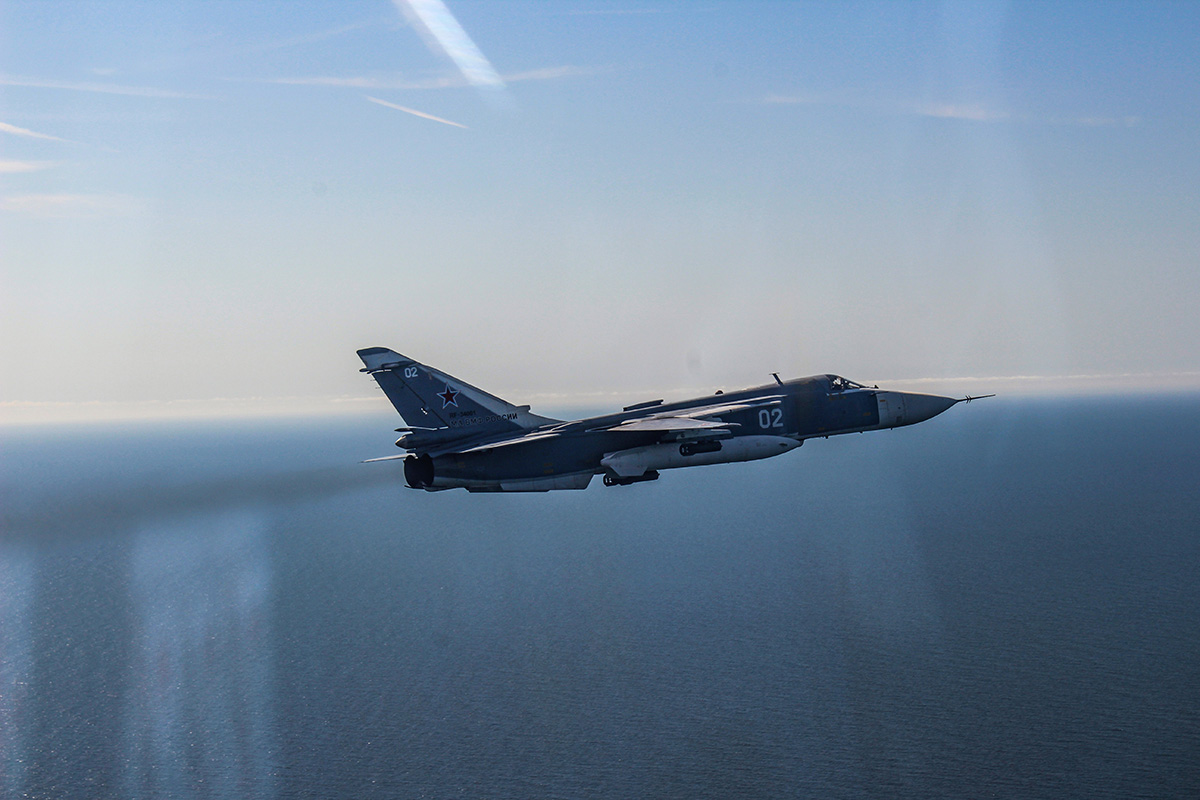
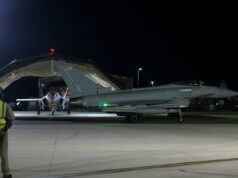
Italian Eurofighters have scrambled from Šiauliai Air Base in Lithuania to intercept two Russian military aircraft over the Baltic Sea, in the first such launch since Italy took over from France as part of a rotation that marks a shift from NATO’s Air Policing mission to a broader air defence role, according to Allied Air Command.
The Russian aircraft were flying in international airspace and the intercept was the Italian detachment’s first since the French Air and Space Force concluded its deployment, and comes as Italian, Spanish and Turkish detachments replace French, Portuguese and Romanian jets along the alliance’s eastern flank.
Announcing the rotation from its headquarters at Ramstein, Allied Air Command said the change “marks a shift from NATO’s Air Policing mission to a broader air defence role, aimed at providing a more flexible approach across the alliance’s Integrated Air and Missile Defence (IAMD) framework within NATO’s area of responsibility.”
Air policing was oriented primarily towards protection against manned and unmanned aircraft in the air, while the air defence framework, according to Allied Air Command, “protects NATO territory against the whole range of threats across all domains, including those posed by manned and unmanned aerial systems and cruise missiles, as well as ballistic missiles.” The command said this provides greater flexibility to respond to changes in the security environment, drawing on a multi-layered, 360-degree approach that includes Quick Reaction Alert aircraft, sea and surface-based air and missile defence systems, and counter-drone capabilities.
The Italian Air Force has deployed four Eurofighter Typhoons and more than 100 personnel to Šiauliai, succeeding the French Air and Space Force, which had been lead nation in Lithuania alongside the Romanian Air Force since March 2026.
Türkiye is deploying to the mission for the first time in two decades, sending around 80 personnel and five F-16 fighters to Ämari Air Base in Estonia. Its last Baltic Air Policing deployment was 20 years ago at Šiauliai. The Turkish contingent takes over from the Portuguese Air Force, which has been in Estonia since March.
Spain is deploying to Mihail Kogălniceanu Air Base in Romania with seven F-18 fighters and around 200 personnel, together with an A400M providing air-to-air refuelling and, in the final phase of the deployment, three NH-90 helicopters assigned to counter-unmanned aerial systems tasks.
Lieutenant Colonel Alberto Calvo, the Spanish detachment commander, said: “Our purpose is clear: to contribute to Allied deterrence, protect NATO airspace and reinforce the Alliance’s posture on the eastern flank.”
He added: “Spain comes to this mission as a committed, reliable and capable Ally. We understand that collective defence is not an abstract principle, but a daily responsibility that demands presence, readiness and credibility.”
Allied Air Command linked the broadened mission to the activation of the enhanced vigilance activity Eastern Sentry last September, saying the air defence mission continues to strengthen integrated air and missile defences across the alliance to address emerging and future threats.
Baltic Air Policing has run continuously since 2004, when the three Baltic states joined NATO without fighter forces of their own, with allied detachments rotating through Šiauliai and later Ämari on roughly four-month tours. Intercepts of Russian military aircraft transiting between mainland Russia and Kaliningrad are a routine feature of the mission, typically involving aircraft flying without transponders or filed flight plans.





Might want to fix the typo in the title
Might want to tell them.
Its so nice they keep these museum pieces flying.