

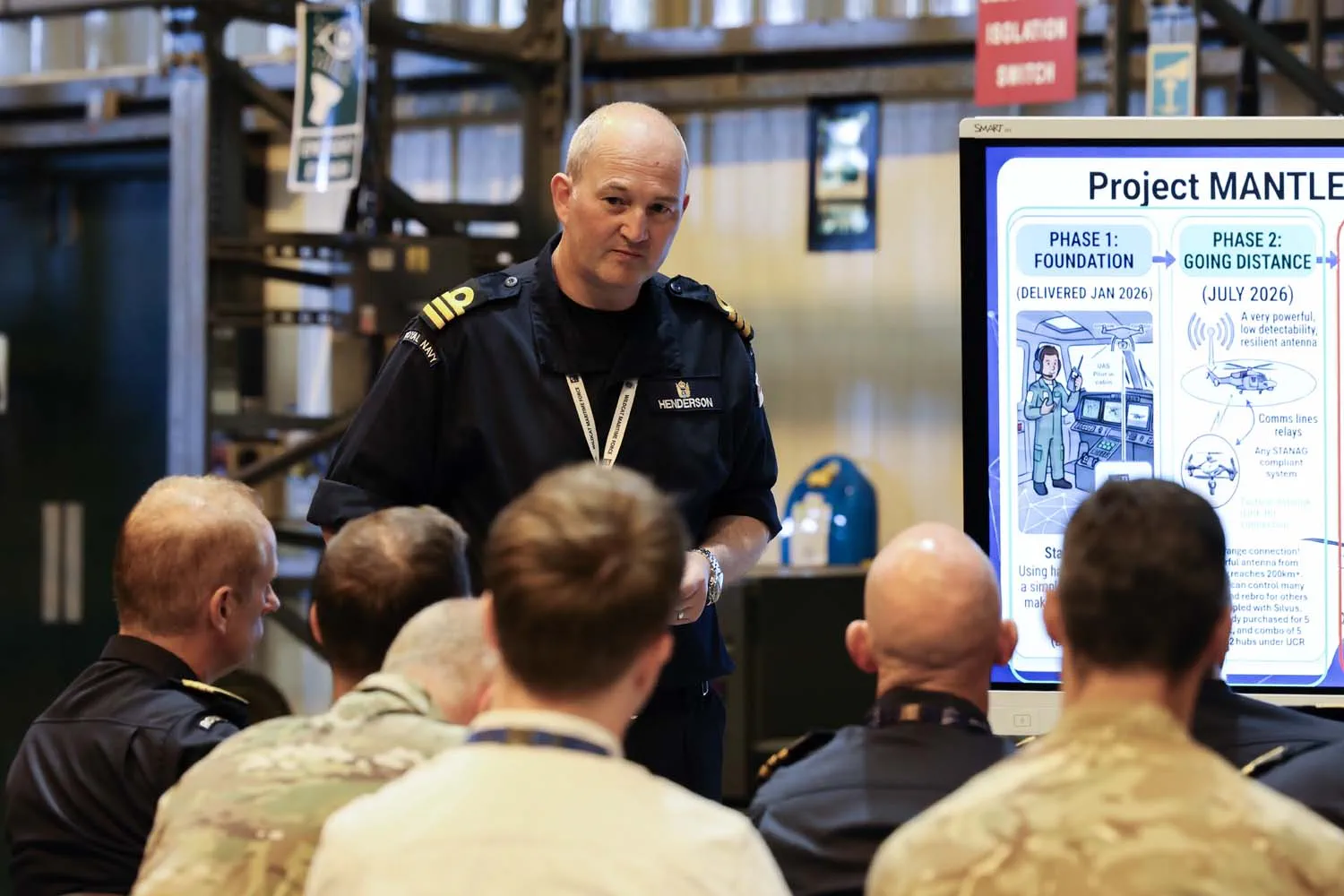
The Royal Navy has demonstrated a system that allowed personnel to receive data from and remotely control several uncrewed aircraft across more than 200 miles of southern England, the UK Defence Journal understands.
The week-long activity, known as Exercise Dragon Rider, involved a specially modified Wildcat maritime strike helicopter, drone operators, Royal Marines and personnel working from a control hub at Royal Naval Air Station Yeovilton in Somerset.
According to the Royal Navy, the trial was intended to examine how crewed aircraft, ships and land forces could exchange information with aerial drones operating beyond the normal range of their radio links.
Activity was spread between the Lizard peninsula in Cornwall, Somerset and Salisbury Plain. A Wildcat fitted with additional sensors acted as a communications relay, passing data from multiple drones to personnel at Yeovilton. Operators viewed live video feeds, exchanged secure messages and practised identifying targets across the network. They also assumed control of the drones remotely, allowing aircraft operating in one part of southern England to be directed from the central hub.
The work was conducted by the Maritime Aviation Strike Operational Advantage Group, formerly known as the Wildcat Maritime Force. The unit operates the Royal Navy’s Wildcat HMA2 helicopters from Yeovilton and is responsible for developing tactics and technology associated with maritime aviation. Dragon Rider followed the Eagles Eye trial conducted in Cornwall in January. During that activity, drones transmitted live data to Wildcat crews, which used the information to locate and track a moving vehicle. Elements of the system were later tested in Norway during Exercise Tamber Shield.
The latest trial expanded the number of systems involved and the distances over which they could operate. By using the Wildcat as an airborne relay, the Navy sought to move beyond the line-of-sight radio limitations that ordinarily restrict how far operators can control smaller uncrewed aircraft. Communications were supported by a mobile ad hoc network, commonly known as a MANET. Such networks allow individual radios and transmitters to act as nodes, passing information between users without relying on a single fixed communications point.
The Royal Navy said the network used during Dragon Rider could reroute data if one part of the system became unavailable. The service also said the communications technology had previously been used in Ukraine and was designed to continue operating in environments affected by electronic interference.
Lieutenant Commander Rhydian Edwards, who has led work to integrate uncrewed systems with the Wildcat force, said in the press release: “The trial proved that this low-cost system is ready for the Royal Navy to use right now.”
He added: “This successful test is a major step forward in keeping human crews safer by letting drones handle dangerous tasks further ahead of the main military force, whilst also greatly increasing the number of units we can field at the same time.”
The trial involved several small and medium-sized companies from the United Kingdom, United States and Norway working in drone technology and networked communications.
The Royal Navy is developing what it describes as a Hybrid Navy, combining conventional ships, submarines and aircraft with autonomous and remotely operated systems. Under the concept, uncrewed aircraft and surface vessels could scout ahead of a naval formation, extend sensor coverage or carry out tasks in areas considered too hazardous for crewed platforms.
Wildcat helicopters already perform surveillance, targeting and anti-surface warfare duties from Royal Navy frigates and destroyers. Connecting those aircraft to distributed groups of drones could allow information gathered by smaller systems to be shared with ships and command centres over greater distances.
The next phase of the programme is expected to introduce satellite communications into the network. According to the Royal Navy, that could eventually allow commanders to direct uncrewed systems deployed overseas from control locations in the United Kingdom.






Jesus H Christ……yet another utterly pointless name change.
These MANET networks are great for ad-hoc testing, but unless ships have compatible systems, we’ll end up with a mirror of the RAF.