

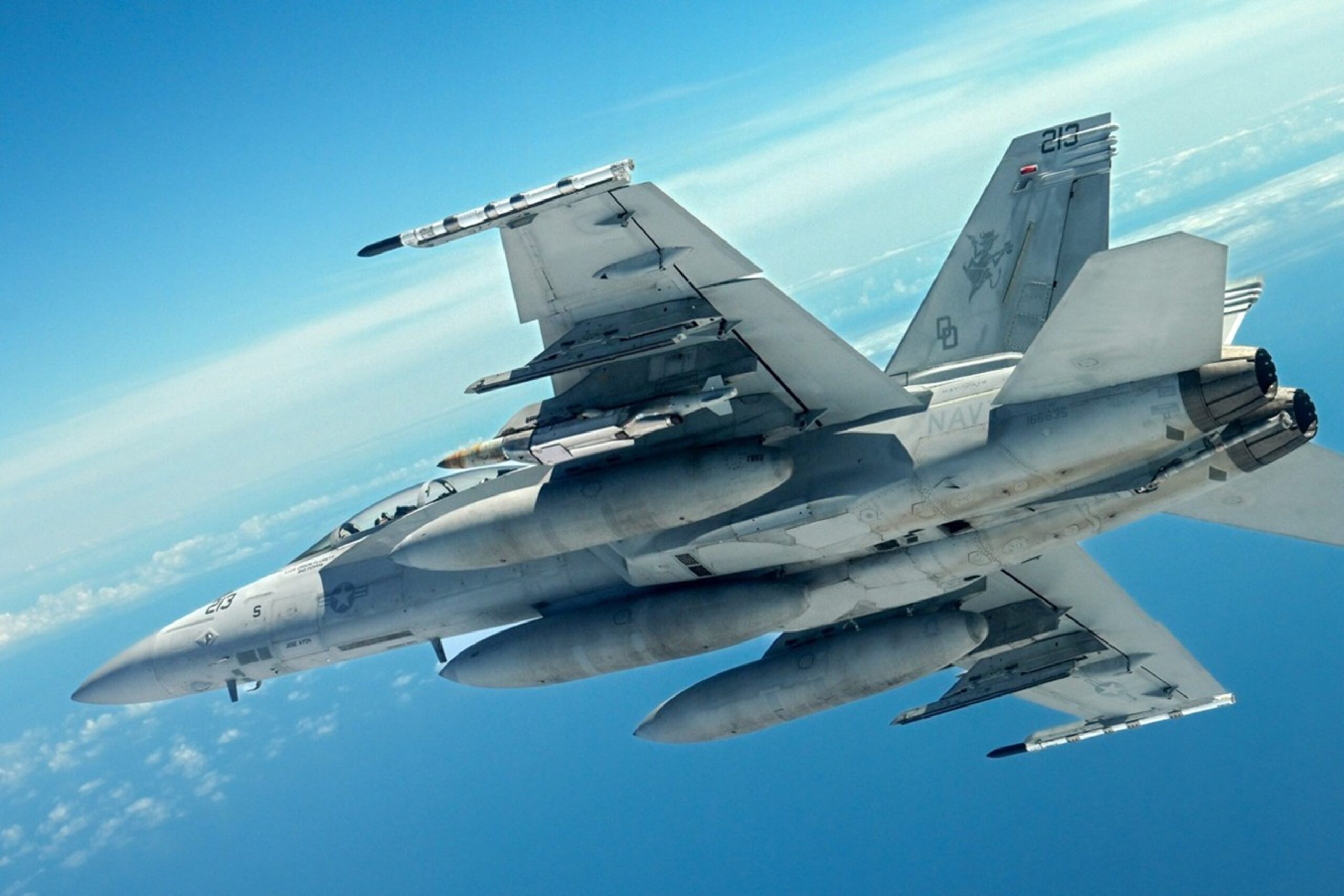
Boeing has been awarded a $75 million contract by the United States Air Force covering initial production of a powered, long-range version of the Joint Direct Attack Munition able to travel more than 300 nautical miles, the company stated.
The award follows what Boeing describes as nearly $100 million of its own investment in the programme, and clears the way for initial production of units for the US Navy.
The weapon, designated GBU-75, takes the existing JDAM guidance tail kit and aircraft interface and adds a wing kit and a compact turbojet engine, carrying a 500-pound class payload. Boeing says it is intended for precision land strike, naval strike and maritime aerial mining.
Bob Ciesla, vice president of Boeing Precision Engagement Systems, said: “This first production contract is a major milestone for the JDAM LR program, demonstrating our ability to deliver long-range precision-strike capability at a significantly lower cost. Scaling production of the GBU-75 will provide the fleet with an affordable, sustainable solution designed to eliminate long-range land and sea-based threats to U.S. and international forces and enable them to safely and effectively operate in a contested battlespace.”
He said: “JDAM LR gives operators an affordable, mass-producible option for striking targets from beyond the effective range of enemy defenses.”
The system completed its first flight test off the coast of California recently, which according to Boeing met its objectives of sustaining powered flight along a predefined profile while navigating on military-code GPS and guiding to its target.
JDAM began in the 1990s as a tail kit that bolted onto existing unguided bombs and turned them into satellite-guided weapons at a few tens of thousands of dollars apiece, and it has been produced in the hundreds of thousands since. Boeing says building the long-range version on that foundation allows it to use existing JDAM infrastructure, enabling high-volume production and integration with any aircraft already cleared to carry a conventional JDAM.
Cruise missiles capable of comparable range typically cost well over a million dollars each and are built in limited numbers, and Western stockpiles have been drawn down faster than they can be replaced during recent operations in the Red Sea and against targets in Yemen and Iran.
Russia has pursued a version of the same approach with its UMPK kits, which add wings and guidance to standard high-explosive bombs. Those weapons have been used extensively against Ukrainian positions and cities, launched from aircraft standing off outside the range of Ukrainian air defences, and have proved difficult to intercept in quantity.
The GBU-75 carries a guided bomb unit designation rather than an air-to-surface missile one, following the convention that a weapon without its own propulsion at release remains classed as a bomb.







$250k per unit for the initial production run sounds like pretty good value for a 300+ mile ranged weapon.
Would be nice for us to do something similar with Paveway. The quicksink version is devastating to shipping as well
Back in the day, there was a wing kit developed for Paveway, but for some unknown reason wasn’t further developed or purchased. The guidance kit (rear mounted wings) Paveway currently uses does give it a degree of gliding. But nowhere near as significant as the JDAM wing kits.
There was also the rather cheap & cheerful AGM-123 for A-6. 25km only but cheap to do.