

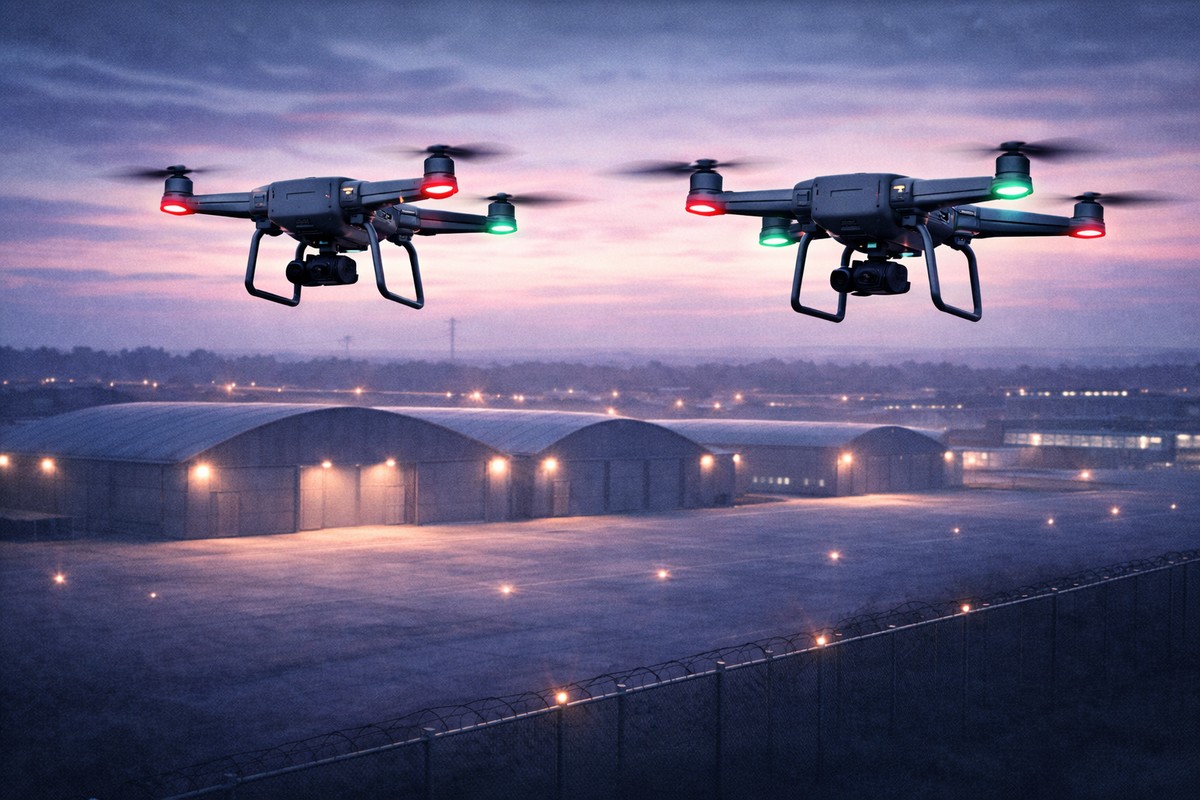
The Ministry of Defence is investing £240 million in Project PRESAGIUM, an enhanced counter-drone system intended to detect and defeat emerging drone threats, alongside a further £470 million to improve the security of military sites in the United Kingdom.
Louise Sandher-Jones, Parliamentary Under-Secretary and Minister for the Armed Forces, was responding to Stuart Anderson, the Conservative MP for South Shropshire, who had asked what steps have been taken to provide additional capabilities for the protection of bases and critical national infrastructure in crisis and in conflict.
She said the Strategic Defence Review committed the department to strengthening that protection, and that “Defence is investing an additional £470 million to improve the security of military sites in the UK”, work she described as supporting broader home defence planning to ensure the resilience of the country’s most important infrastructure.
On the counter-drone element specifically, she said: “Defence is investing £240 million in Project PRESAGIUM, an enhanced counter-drone system, providing effective detection and defeat of emerging drone threats.”
Alongside it, the department is growing and equipping the Reserves to support homeland defence tasks and enhancing capabilities to protect critical underwater infrastructure, with integrated air and missile defence capabilities to be prioritised against the assessed threat as part of the future Integrated Force.
The approach described rests on working out which infrastructure would matter most in a conflict before deciding what to defend. By contributing defence data to the Cabinet Office’s critical national infrastructure knowledge base, the minister said, the department is fulfilling commitments in the Resilience Action Plan and improving understanding of “the infrastructure, dependencies and vulnerabilities that would be most critical in a conflict scenario”.
That analysis is informing home defence planning by aligning defence resources against the most important infrastructure across a spectrum running from hybrid activity through to conventional conflict, and will also help identify what defence could contribute to protecting other priority infrastructure essential to the functioning of the country.
Britain has invested in counter-drone capability at bases before, including the deployment of systems at RAF Lakenheath and RAF Mildenhall, and the Royal Air Force Regiment holds responsibility for ground-based air defence of airfields.
Defence Secretary Wes Streeting was asked in the Commons this week what is being done to secure British manufacturing facilities, following a case in which a man was charged with offering to sabotage drone factories, and said he would not comment on operational details while confirming that threats to British assets are taken seriously.





All sounds good, and it seems to be progress.
But I’d be interested in the nitty gritty details of how many assets and who will operate them with no manpower uplift, or what is lost to divert posts.
And I’d also beware of “double hatting ” as well as HMG include Field Army assets in the list which will be deployed elsewhere in war. As if they’re not, the Field Army is bare. They cannot be in two places at once. I say that as HMG have been seen to do this previously, regards announcements for GBAD for “Homeland Defence” which included assets not bought for that task
There is virtually none beyond the ORCUS, Rapid Sentry, and Giraffe systems of 2 CAUS Wing. With the new Skyhammer Drones, just how many of those were bought? It’s never been revealed.
“Growing and equipping the Reserves.” Where? With what? How? Where are the details?
Hard to judge, I remain sceptical at the reality behind the words, sorry.
Well other than the cost. Ukraine is massive producing counter drones drones at a very cost efficient approach. Why can’t we buy that tech and utilise it.
Too simple. It would never occur to the MOD.
I’d agree with that. Cost effective.
Does it support the UK MIC, though? HMG main priority. My own priority would be the right kit in the right amounts for HM forces, the two don’t mix well.
Hello Mate,
Hope you are well.
Double hatting is a serious game of self delusion by the politicians, but I also think that the military are not exactly doing themselves any favours. There seems to be a complete institutional block on being able to recruit enough people to be able to maintain the current force levels and yet I saw a report recently that the Army turned down more than 30,000 people on medical grounds.
Whilst I am well aware that the nation has put on rather more weight than is good for us over the last 2 or 3 decades and is no where near as fit as we should be I get the sense that the military are clinging to entry fitness standards from decades ago. These standards simply do not match realty and they need to accept that if they are to recruit enough people to defend the country they need to adapt. After all, isn’t adaptability one of the key capabilities of our military that we are so proud of. Over all everything I have read recently points to a situation where there is no shortage of volunteers, rather it seems there may well be a distinct lack of realism towards recruitment and training with in our armed forces. There is also a tendency to blame the ‘yuff’ of today. Well whose fault is it that they turned out the way they are..? Ours. Our generation created the world they were borne into after all. So we own it to them to help get them fit and trained to able to defend the country!
I am reminded of a story a very dear friend of mine told me about one of his relatives in WW1. This chap volunteered repeatedly but was turned down on the ground that is glasses were the thinkness of milk bottle bottoms and he was still as blind as a bat! However, by 1917 the army was so short of troops they took in on anyway, taught him to carry shells from the ready to use stack to the gun and hand it to the loader. It was about all he could do. Then the Germans launched the 1918 spring offensive and he found himself in the frontline as everyone else had buggered off. A passing sergeant gave him a Lee Enfield and told him to shoot at the Germans when they cam into view. He saw some vague grey shapes coming down the hill in front of him figured they were German so fired at them from behind a wall until the magazine was empty. As no one had ever bothered to showed him how to use a Leed Enfield he didn’t know how to reload. So the rifle went over the wall and he legged it after the rest of the army..!
Reason I recount this story is not to suggest that the army start recruiting half blind soldiers, that would be daft, rather to point out that the standards really are flexible and can be very flexible when our backs are against the wall. Also bravery has nothing to do with physical fitness as I think the actions of the chap I describe are truly courageous under the circumstances.
I think we need to modify our recruitment and training to make up for the loss of Physical Education and school playing fields or we will never be able to build up our military to the level we need. Double Hatting is not the answer and giving the politicians the excuse that it is not possible to recruit enough people in the modern era is a foolish form self defeatism.
Now I’ll go and put me tin hat..! 🙂
Cheers CR
Hello mate.
What a post! You usually contribute some fine examples and this is another.
All sounds sensible, but I’m not a serving soldier so whether they’d agree to a drop in fitness standards? Don’t know.
I’d certainly not agree with diluting standards in UKSF, for example, or the Parachute Regiment, Royal Marines, or Ranger Regiment.
We’ve read that the MoD have relaxed, how many was it, dozens, hundreds, of exemptions to increase recruitment. There are also initiatives in the Cyber Domain to recruit the skills despite not having the usual fitness standards. A balancing act may be best?
I wasn’t really thinking of ‘dropping’ the standards rather taking more time to bring recruits up to the standard for basic training. As Airborne points points out the RM have a more flexible approach to the fitness and injury in training issues. We need fit service people coming out of the process not broken and injured rejects, but my main point is the recruits will always only be as good as the society from which they are drawn and we ain’t what we used to be fitness wise. The armed forces need to come to terms with that and adapt.
I think the ‘standards’ should be applied rigorously at the output point, especially for peace time regular armed forces as they are there to deter. However we need greater flexibility at the input to the process and the training process needs to be far more flexible as well as the armed forces, as well trained as and capable as they are, are far too small to provide an effective deterrence. Of course, in the (hopefully) unlikely event of WW3 breaking we will likely be forced into a whole different ball game..! So perhaps some ‘Prior Preparation and Planning will Prevent a serious spanking in the future’.
I think that so long as Ukraine can hold out Russia will continue to be bled dry and the West will remain relatively safe so there is little immediate threat but that could change quickly and with little warning given how stretched the Ukrainian’s are. I note that the populations of the fortress towns in the Donbas have been told to get out so we may be heading towards a crunch point. So should Ukraine succumb then I can see Putin rearming and looking for his next target and he certainly seems to have the UK high on his hate list.
We should be safe given the likely limitations of even a rearmed Russian military over the short to medium term and our geographic position with many NATO countries between us and the threat, but that assumes a reasonable level of home defence capability. We have next to nothing. Our home defences have more holes than a kitchen colander which means Russia could carry out surprise irregular attack with limited or no warning before weapons go hot.
To fill those gaps we we people. Some will need to be fit, others could sit in an office block at a desk with three standard screens and keyboard and direct drones – as Airborne says and Ukraine has demonstrated. In fact, Ukraine really does have people in offices flying drones, many as part of the air defences I believe and these people are not even in the military!
My view is that these days, if you are breathing and can interface with the technology then you can probably do something useful..!
Cheers CR
Agreed! Double hatting is an easy peacetime bit of spinning! Ref the fitness levels, agree again! Like it or not fitness across the board has reduced (mostly) in day to day life! There has to be a basic fitness standard but once people are in the training cycle (the fitness side) should be constructive not destructive! Keep the youngsters you have, even if injured in training (the RM have always been the best at understanding this) and take a little more time if needed.
Agree once again, do most soldiers need to be such a high level of fitness, nope, obviously PARA Reg, then line Battalions need good and expected fitness, but the 20 year old operating a drone, from an ISO/fixed location not so! I could go back to having the biggest airborne tash, porn star pork chops, allyist kit, big cigar, 3 x weapons, all the gear, trained to the hilt just for the speccy geek sat at a remote station to wipe me and my team out with one hand while drinking a very high sugar content caramel latte!!!!!
Get the right people in the right jobs and let’s get our shit sorted as we are running out of time! 👍
PS the RAF Reg fitness levels can stay at cadet levels, apart from shoulder raise exercises to ensure when checking hundreds of ID cards they don’t get worn out!!!!
Thanks Airborne,
Nice to hear from you mate, long time since!
Your point about an elite combat unit being taken out by a geek in an office is a real issue and one I don’t think anyone has a definitive answer to. Russia’s response has been to recruit cannon fodder from the older generations, some in their 60’s, but that approach has generated a huge casualty list for a slow and grinding advance.
The real value of our professional armed forces is indeed in their elite capabilities but in a major WW3 style of conflict their true value is as a store of knowledge that will need to be passed on to the volunteers and conscripts who will be need to rapidly expand the forces should deterrence fail. However, waiting until the conflict starts will be too late. Even if the anti war era running up to WW2 the government undertook a major rearmament and expansion program that was just enough. But only just…
As for time I couldn’t agree more with you, we could be running out of time quicker than many seem to assume. If Ukraine does succumb to the relentless Russian pressure we will find ourselves in a race with Russia to rearm or risk deterrence failing, and I read recently that citizens of the fortress towns in the Donbas have been told to get out by the Ukrainian Government! Mass will be a key part of that race and that means far more people under arms. We need more barracks, training grounds, uniforms and basic kit let alone all the Gucci techie stuff that we simply can’t build fast enough. It is people where the real problem and risk lies. Until we get this idea that recruitment is too difficult out of our heads we will be unable to recruit the people needed to create the genuine mass we need to adequately defend our home land and hence generate the deterrence effect we need to maintain the peace. Worse, without an expansion in people numbers with will be no point in ordering more kit, so the manufacturing base will not expand and look how long it has taken to regenerate the SSN lines, for example!
So drones, yes. Drones to create mass without people, I don’t think so. More drones will need more people to maintain, launch, control and direct them. What drones really do is make people far more effective, but even in a war dominated by drones boots on the ground still count. Even if it is only one pair of boots as in one example in Ukraine that I read about recently..!
Our forces are too small, we all agree on that point, even many of our backbench politicians seem to agree these days..! Unfortunately, that hasn’t as yet led to any commitment, let alone serious plan, to increase the size of our forces. Plenty of talk about money and high end kit, but I am not aware of any statements that the army will grow from 73,000 to 90,000 or any other number!
All of the forces need to grow and significantly, and we will need the professionals to teach the new recruits so the expansion needs to happen before we get caught up in any fighting.
Time may be shorter than we think.
Cheers CR
PS. You really like to stick it to the RAF Regiment 🙂
Mmm isn’t there a country with combat proven drone defence systems capable of rapid upgrades when/if needed already in partnership with British companies? Ignore that and spend £m,s reinventing the wheel sounds like a plan👍
MIC. Money. Jobs.
Who cares about the military?
Kit wise it will go the the RAF Regiment and the reserves. That seems pretty clear to me. Thats over 700M of new funds for this.
Is that new funds mate? Or just previously announced funding being spun?
Makes sense if it’s for Home Defence. The Army is primarily expeditionary. To a degree, so is the RAF Regiment, with it’s Squadrons grouped into FPWs Force Protection Wings allocated to differing RAF force elements.
The RAuXAF Regiment Sqns are committed to those Wings, and RAF Reserve Sqns are I believe a mix of trades used as IR.
So what gives? It’s all fine for politicians to announce stuff, where’s the announcement of a 1k increase in staff to man this stuff, for example?
I’d assume the new kit and drones will go to existing units responsible for Force Protection. And I think some of the money is for improving station infrastructure.
Hi Daniele.. I thought it was interesting that the RAF personnel numbers had gone up by 800 plus personnel – Basically that was July 2025 through to July 2026. Positive, hope the RAF can keep that trend going over the coming years.
Amazing isn’t it we are constantly told what we can’t have because of ‘lessons learned’ from Ukraine but never what we can do!
At the risk of being moaned at😂 just watched BFBS journo’s having a go with Sig Sauers MX8 a contender for the new rifle but believe it or not MOD still haven’t released the actual requirements for the new weapon!L85 is slated to serve on well into the 2040s apparently🙄
At the glacial pace our procurement goes, and the total lack of updates, it makes you wonder where all these millions are being spent, doesn’t it?
It wouldn’t be the British government or the MOD if they didn’t see the vast hordes of cheap drones causing carnage and thought “hmm, we really must build three or four of those, as long as we make them REALLY EXPENSIVE so we can’t afford them, and we’d better also make them so bespoke to our own needs, no-one else will want any”
Sensible, essential requirement however as ever with this Government, probably mostly spin, half truths and deception with kit already stated as coming into service! Hope I’m wrong but more than likely a few more systems, on the books, not manned (in the store) unable to actually be used as not enough people!
This is the crazy of the matter.
My own belief is to delouse and believe nothing until you’ve seen the small print.
Crazy! Lol phone autocorrect. “Crux”
And was for Airborne.
I’m still wondering if you meant “delouse”.
If you meant going through things with a fine tooth comb to resole problems and streamline processes, amen.
These are fairly small sums in the grand scheme of things. The reality is that, whatever extra money HMG puts into defence is cancelled out by the mega increase in the cost of the Defence Nuclear Enterprise (DNE),, which is now gobbling up about 40% of the entire procurement budget. No argument that DNE doesn’t need the money, every aspect of it has been run down and neglected over the last two decades. But it means there is nowhere near enough money for the conventional equipment we need to order, such as a robust GBAD set-up to defend the UK or low-level air defence/C-UAV to cover critical national and military infrastructure. No amount of wuffle from the MOD, delivered verbatim by the Minister, can disguise the reality of the situation.
The RAF regiment will get some counter-drone systems to protect some RAF bases. There is no budget or plan to increase the size of the volunteer reserve in order to protect critical national infrastructure or to create a GBAD system for the UK. The few air defence assets the army has, two regiments, are there to provide defence in the field, not the air defence of the UK.
The MOD is just paying lip service to the need, but in fairness, they just don’t have the budget to do very much about it. The snails-pace procurement of Sky Sabre for the army underlines how far behind we are on air defence.
Be good if it actually worked.
Throwing money we haven’t got at a problem we cannot fix
Only four years and some change after Russia invaded Ukraine; four years in which drones have totally changed the face of modern warfare (come on, they have).
Russia can produce thousands per month while we’ve produced some paperwork and a few scheduled committee meetings.
I also don’t understand why military bases haven’t been able to blow unidentified drones out of the sky for years. Surely these dodgy drones have reported everything we’ve got by now; it’s not like there’s been much added, upgraded or amended over this time.
The ‘blowing drones out of the sky’ bit apparently needs some changes in civil aviation rules, which.are being debated. Problem.about shooting drones our of the sky, or unresponsive choppers and light aircraft, is possible loss of innocent civilian lives l plus impact of falling debris on homes, motorways rail lines and the base itself. We are not at war, as Ukraine is, so there will inevitably be very strict peacetime rules about shooting down anything.
The ideal defence base or critical national infrastructure would ideally have a say 3-mile radius of uninhabited land around it and be at least that far from main road and rail lines. None of which is really feasible in built-up Britain without a lot of resiting and rebuilding of much of the critical national infrastructure.