

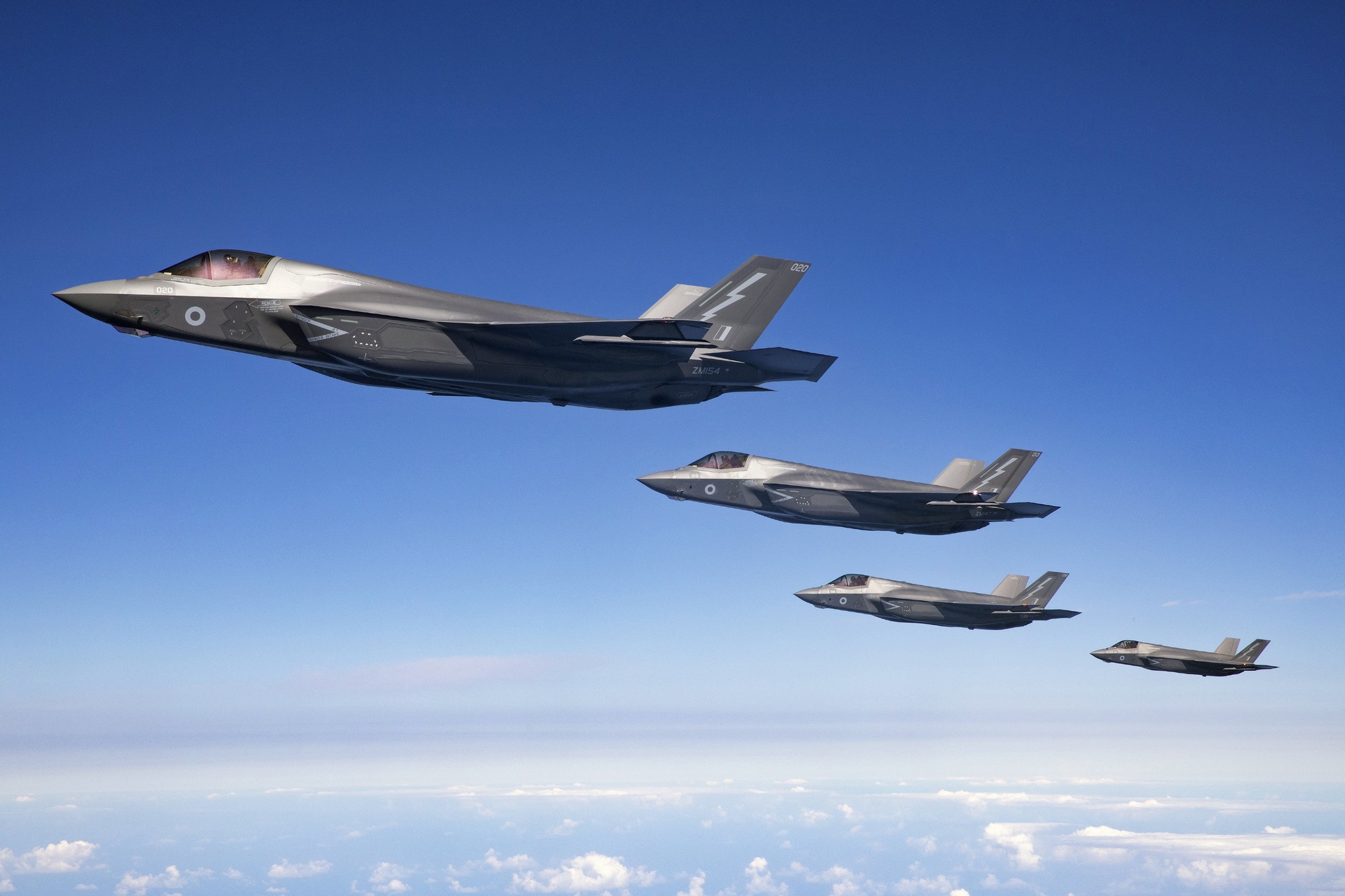
The Ministry of Defence has not had sight of the 2026 edition of the United States Government Accountability Office’s annual report on F-35 production and modernisation, a document the Pentagon has blocked from publication for the first time in more than two decades, according to a written answer published on Friday.
Luke Pollard, Minister of State for Defence Readiness and Industry, was responding to Ben Obese-Jecty, the Conservative MP for Huntingdon, who had asked whether the department had been given access to it. Mr Pollard said: “The Department has not had sight of the 2026 edition of the US Government Accountability Office report entitled F-35 Joint Strike Fighter: Update on Production and Modernization Efforts.”
The report exists and has been completed, but a GAO spokesperson told The Hill in July that it had been reviewed by the U.S. Department of War and marked as containing “Controlled Unclassified Information with no current plan to be released to the public”. The Pentagon declined to comment.
Congress mandated the annual review in statute, and the GAO has reviewed the programme every year for more than two decades, delivering a public verdict each time on cost, schedule, production and readiness. This is the first occasion on which the entire report has been kept from publication.
Controlled Unclassified Information is a handling designation, not a security classification, of course. Material marked that way is not secret in the ordinary sense, but its distribution is restricted, and in this case the restriction extends to a document whose public title has been published while its contents have not.
The 2025 report, the most recent to reach the public, gives a sense of what the withheld edition would have covered. It found that Lockheed Martin delivered 110 aircraft in 2024 and that every one of them was late, by an average of 238 days. Technology Refresh 3, the $1.9 billion suite of hardware and software upgrades on which the Block 4 modernisation depends, was running around three years behind schedule.
On Block 4, the GAO reported previously that the Department of War was redefining the subprogramme and expected it to comprise fewer capabilities than the original plan, deferring development of some to a future effort. The programme had told the GAO in 2018 that it planned to deliver 66 Block 4 capabilities by 2026, and by May 2024 the content had been revised and the completion date extended to 2029. Reporting on the same document put the cost growth at more than $6 billion above original estimates.
The same report carried a Department of War estimate putting the cost of Block 4, engine and power thermal management modernisation, and maintaining and operating the 2,470 planned aircraft across a 77-year life cycle, at more than $2 trillion. The GAO has separately reported that power and cooling shortfalls force the engine to work harder than its contractors intended, reducing its life expectancy, with programme officials estimating that the resulting wear has added $38 billion to the life cycle cost estimate.
What it means for Britain
Britain has been an F-35 partner since the earliest stages, at Level 1 alongside the United States, with British industry holding roughly 15 per cent of the workshare on every aircraft built, on paper at least. BAE Systems manufactures the rear fuselage at Samlesbury, Rolls-Royce produces the lift system for the short take-off and vertical landing variant, and Martin-Baker supplies the ejection seat.
Mr Pollard confirmed on the same day that discussions with the F-35 Joint Program Office are ongoing on procurement profiles and the delivery schedule for Britain’s next batch of aircraft, with delivery anticipated from the early 2030s. The Strategic Defence Review confirmed an intention to buy a further 27 aircraft, of which 12 are to be the F-35A conventional take-off variant to support Britain joining NATO’s dual capable aircraft nuclear mission.
A partner nation committing to further purchases while unable to see the most recent independent audit of the programme’s production performance is an unusual position.










The F-35 is not exactly the most reliable aircraft, is it?
What are they hiding this time?
We may not hav blocked it, but why have the Americans? All so good they don’t want to publish?
The statement that some capabilities to be dropped from block 4 is concerning. Isn’t it block 4 that is meant to include most of Uk missiles that are still due for integration.
This has always been a case that the original 80+ upgrades for hardware, software and weapons integration would be scaled back to 66-75. The UK and Italy have finally paid the $100 million integration fee for Meteor and Spear3, but is likely to be at the back of the Queue for Test Aircraft. So there’s no issue of them not being integrated. It’s always been a thing by the UK to say that it’s delayed but it would of helped if they had paid for it early.
Time will tell. Agreed should have been paid for from the start. Currently the f35b has limited capability if the carriers were really needed.
Why do you think the F-35B has limited capabilities? What are these limitations? The F-35B beats the aircraft it was planned to replace on all metrics and gives greater capabilities than we have ever had in the UK on all mission sets.
It’s not the jet itself it’s the available missiles/bombs currently. No real standoff capability and AMRAAM is no where near the capabiltiy of meteor
Tell the US that Mildenhall may no longer be available for USAF use, that will soon see the report in UK hands.
We kinda need to keep that card in case trump really pushes things with the Falklands
Completely honest unless they give free equipment to Argentina or join in the war with Argentina it does not make a difference what the US position is.
Same but if they do sell equipment to them then it makes the islands far harder to defend. Realistically the typhoons there are it’s only serious defence. Everything else is just there to buy time. If Argentina got it hands on some more f16s and potentially some air to air refueling options then the equation would change significantly.
…and yet the Telegraph said we should cancel GCAP and abandon the Typhoon to go all in on F-35 claiming it’s cheaper. Latest US assessment I saw would beg to differ.
Yep. Latest GAO report shows flyaway cost of F35B with radar and engine has risen to>$121m.
And you think the cost of the Eurofighter Typhoon haven’t increased because of inflation and labour costs. It’s a 10% rise in costs so sounds pretty much in line with everything that’s been happening around the world.
Also the oft quoted 15% workshare on each f35 is unlikely to be that high. Francis Tusa, who knows his onions, did a breakdown of UK content, and reckons its more in the 8 to 10% range. Yet another reminder that we need to get behind gcap and get it right….
It is cheaper but the extra costs for engine maintenance have spiralled. Originally they wanted 15Kw of cooling air and they rammed so much kit in that it need 32Kw of cooling air. So the engines have to run hotter for producing double the bleed air this in effect have increased the mean time before failure by 100% think it was 4000 hours and now it’s about 2000hrs before the hot part of the engine needs overhaul. But with TR3 upgrades with AN/APG-81 it again goes to about 47 Kw and with the AN/APG-85 it needs about 62Kw+ of bleed air. Problem being with stealth aircraft you have to put everything inside that creates heat, they’d really didn’t have issues with the F-22 as it doesn’t have Thermals/laser and its computing requirements where smaller. Not to mention it was a 40,000lb plane with smaller area to keep costs down but needed to be able to carry 1000/2000lb bombs in a bomb bay. They really where creating something they’d never done before.
The F-22 also has two engines to power its electronics. The F-35 would have benefitted from the continuation of the GE/RR engine, it had a 13% margin of power electronic delivery over initial deliveries whereas the the PW unit had 5%. But nooooo, don’t pick the best engine for the job, pick the best for US employment.
Instead GCAP will benefit from the technology carry over from the F136.
The idea of the F35 being cheaper than the Typhoon has always seemed hilarious to me, but so many people seem to have swallowed it. That’s like saying the latest Ferrari will be cheaper than one from the 80s; yeah right.
A lot of trousers seem to have been pulled down over this. Being a tier 1 partner only seems to mean ours were taken down more gently, and butter has been applied.
The modern US is embarrassing. It can’t seem to get anything right. Blundering around on the world stage alienating, frustrating and letting everyone down, while loudly yelling about how great it is.
You have to ask, where the mandate or context is coming from with the Telegraph? For example where did they get the information to say the F35 would be better than GCAP and in what way? I suspect that this would be somebody with a vested interest in Lockheed Martin.
That recent report on F-35 costs tells us a lot. The flyaway price of all three versions has risen considerably and now stands at, in GBP:
F-35A: £69m
F-35C: £83 m
F-35B: £91m
So we are buying the most expensive version, with the shortest range, most limited weapon capacity, least effective capability and by far the lowest serviceability rate, due to the complexity of the lift fan, in order to equip one operational carrier.
Sounds like we got something wrong somewhere. In part, it was building two carriers that we couldn’t really begin to afford. In part, it was designing the carrier around a Harrier replacement, which was BAES’ VTOL ticket to nudge its way to being a tier 1 partner.
It is no surprise that the number of F-35Bs has been capped at 62 and the RAF is more interested in acquiring the more capable F-35A, which is now 31% cheaper than the B.
Instead of rehashing the same old argument, just go and read the various articles that explain why we went for STOVL. The gist is that it’s the only way to have an operationally independent carrier force; CATOBAR required more expensive carriers, and either more carriers or sending pilots off to the US or France to keep them current.
Your cost analysis is meaningless; the A variant isn’t carrier-capable, and the ~£8m difference between the B and C conveniently ignores the expensive and complex refit to fit EMALS to the carriers.
The RAF were more than happy with the B, until it also had to replace the Tornado. It’s nothing to do with the B being a good or bad aircraft, and everything to do with needing to cover a completely different mission profile to the original plan.
thankyou you Callum, EMALS was not fully proven during QE carrier construction. people may have buyers remorse but F35b + carrier remains a good capability
Additionally, it gave us a carrier capability significantly quicker than if we waited for EMALS.
Carriers with a 50 plus year lifespan futureproofed id say, a great many things the UK first used on it’s aircraft carriers othe countries adopted, angled decks. steel decks, the list goes on.
As pilots are increasingly taken out off aircraft, not requiring, all the heavy space and power using systems a pilot needs, not to mention limits on launching thus not to break a fragile human pilot, far smaller, lighter. faster air craft will be taking off from aircraft carriers.
You don’t need CATOBAR for that, which is pretty archaic, steam to launch, and some steel cables to land,in what on land would be considered a controlled crash landing 😀
No the British have got it right again with the carriers, other will likely follow
F35 is just another tornado type failure of an aircraft.
The sooner we ditch it and move on the better.
Spend the money on the navy where it is needed
Didn’t Tornado worked as intended?
Yes European combat aircraft from 70’s are mostly out service while F15s and F16s still soldier on. So from that perspective all Euro combat aircraft from that period failed the longevity test. No more Mirage F1, 2000(retiring), Viggen, Tornado.
One iffy feeling is that GCAP seems to be an attack aircraft of F111/bigger Tornado type. Will the enormous rocket and missile, space industry boost, and AI and robotics make it obsolete soon?
To be fair, usa able to update and keep legacy aircraft, they have the budget and legacy aircraft would operate only once there is American control of airspace.
America is having a terrible time keeping these legacy aircraft flying, so much so that large numbers of pilots are unable to fly sufficient hours for combat readiness.
Both F15 and F16 have still a production line working.
Google AI
The Lockheed Martin active production line for new F-16 Block 70 jets includes recent major orders from countries like Bahrain, Slovakia, Bulgaria, Taiwan, and Jordan, with ongoing deliveries continuing through 2026.
U.S. Air Force (USAF): The Pentagon boosted its total acquisition objective for the advanced F-15EX Eagle II to 129 fighters.
Israel: The Israeli Air Force finalized a contract for 25 advanced F-15IA fighters (derived from the F-15EX standard) with an option for 25 more.
Sadly for Tornado, the low level attack requirement died off. The Tornado GR version’s RB199 engines were designed for low level operations, rather than high level. For the time, the engine and aircraft was designed, the RB199’s low by-pass ratio turbofans, used a higher than normal bypass ratio. Meaning that at higher altitudes, it didn’t have the outright performance. The version used in the ADV version only mitigated the issue, it really needed a redesigned engine. However, saying that although Tornado didn’t have that great an acceleration, it could easily surpass Mach 2.2. If I remember correctly the ADV version was limited to Mach 2.4. The RAF’s GR4 version had its variable intake ramps fixed in position (inhibited), so it was limited to around Mach 1.4ish. This was due to the fitting of the fixed FLIR pod. The wake from the pod, disturbed the air going in to the intakes.
At low level, there was nothing that could keep up with the Tornado. However, like all other aircraft of the period, it had a massive radar cross section. Which meant it could be easily detected and tracked, unless flying in the weeds. Flying at really low level is still a valid tactic against radar. However, today we can use a stand-off weapon that accomplished the same task, thereby placing less risk on the aircraft or crew.
We must have tempest.
Quite concerned by the suppression of annual GAO assessment of F-35 Program. Patently obvious some aspect of program is headed South, perhaps at alarming rate, or perhaps a new issue has surfaced. True dilemma, program success is an essential, even an existential, requirement for US and Allied tactical airpower. Uncertain re possible remedy, other than investing more in (and possibly restructuring) the spiral development/modernization plan. Behind the scene, is US accelerating F-47 as a fallback option, and UK MoD being counseled to double down on GCAP/Tempest? May simply be unwarranted paranoia, but the existing historical record of program invites scepticism … 🤔 Dunno, honest Abe Lincoln (an important historical POTUS) once stated that all of the people could be fooled some of the time, and some all of the time, but all of the people cannot be fooled all of the time. Partners, take heed.
USAF still need to have 1090+ fighters only the F-35 can fullfill this requirement. But the USAF and to some extent all of the Services in the USA don’t want the Gold Standard they want the Gold with Diamonds encrusted Standard. They pushed the limits for Block 3F and now they are again pushing the F-35 Airframe and F-135 even further 15Kw of bleed air to 60-80+ Kw of bleed air. I’d be doubtful even a new Adaptive Engine would manage those requirements. The F-35 only has an intake and bypass ratio that’s so big, but you do not hear people talking about it!
Ruth2483,
Possibly, although there are so damn many alligators in the swamp that the JPO may not know which should be slain first. LM secured a $100Mn contract for 1450+ brake assembly heat sinks in May. Problem is that this is a baby gator. Meanwhile, Honeywell promises 40 kW of cooling in 3 yrs, w/ solely software upgrades to PTMS, and a further 40 kW, utilizing 95% of existing hardware and 80% of the software, by the early 30s (w/ the fate/success of a $2+Tn program hanging in the balance upon this and similar decisions). Having at least traveled through the great state of Missouri, if I’m in the JPO, my inclination is to make the contractor “show me” then provide hard data re the proposed solution. The overarching problem is that there is already a large existing fleet, w/ multiple governments already thoroughly p****d off by operational compromises, and the damned fleet increasing yearly. And, of course, this issue has interdependencies w/ the TR-3/Blk 4 mega-gator. Finally, w/ a suppressed report, no independent, credible data source to determine number and ferocity of additional gators that may be entering the swamp! Not certain which rocket scientist(s) proposed spiral development, and which enlightened managers believed them. A helluva way to run a railroad, let alone multiple AFs. Someone, sometime, is going to publish an exhaustive account of the post-mortem exam of this venture. Should prove to be a fascinating read for a certain audience. Rant temporarily suspended … 🤔🙄
It is certainly time that we gradually move away from the US as an exclusive partner. They are and always have been unreliable and scheming. We have plenty of actual trustworthy friends we can work with who also want to move away from the US.
We must have tempest.
I have never been the biggest fan of the F35B in particular the B variant.. There is obviously more bad news in this report. A lot of the bad news has been out there from the start. Unlike us the USA publish annual availability rates for every aircraft. The 35 across the board has been low. USMC are not happy about the B variant needing much more facilities when they go expeditionary. Where the AV8 could operate from austere sites the B can’t. We should note the USMC operate the B as close support. So they want the FOB up near the front. Cutting down flight time in missions.
In short it’s not doing what it was supposed to. After the midterms Congress may put a different gloss on the whole programme.
This may not be the case now with how the USMC operate in the Pacific. It’s all about pre-deploying troops to defend islands in the 1st and 2nd island chain. Not having to take an island after it has been captured but rather defend it. At the same time the increased range of the F-35B and extra speed removes this persistence issue of being close the beach head. On top of this the increased range of the F-35B does help the large Assualt ships surviveability, when the F-35B was being designed and produced there wasn’t long range hypersonic anti-ship cruise missiles around from China. Not saying China can target them if the kill chain is taken out. Plus Harriers wouldn’t survive first day of war with the huge Engine face reflect radars back to S-400 class GBADs. We all look to knock the F-35 but not what it actually brings to the fight.
The USMC have no intention to stay aboard the assault ships. Flying from shops far out to sea is their worst nightmare. By getting ashore they can reduce their flight time and increase missions rates. As they did in the gulf. AV8 outperformed every fixed wing airframe in the close support role.Flight times for carrier borne aircraft were multiples for the AV8. Ground based aircraft faired no better flying to friendly country airfields. Each MEU will have 8 B variant for dedicated ground support. Long trips to sea is not in their battle plan. USMC is now Expeditionary and and part of that means getting the Cobras and the Bs ashore ASAP. It’s now part of their DNA. The exercise just that regularly. Each MEU as part of their workup practice just that at either Pendleton or LeJeune. They don’t practice long range ground support.
So much for being the only tier 1 partner. The UK paid $2B for that title and got little in return.
Lots of fuss over the incompetent F35 and no chatter for old Donnie pouting and what threatening the Falklands. Now lots of silence for Ireland union. What would PM Carney do?
Lots of fuss over the incompetent F35 and no chatter for old Donnie pouting and what threatening the Falklands. Now lots of silence for Ireland union. What would PM Carney do? ,
Between Trump rants and LM under performance, Carney’s ability to reduce the F-35 buy is getting easier by each passing day. A shame GCAP is so far away.
This page blocked me on Facebook for no apparent reason
This page blocked me on Facebook for no apparent reason gggggggggg
Scrap F35 procurement and put the money into making a modernised P.1154 for the carriers.. 😁
Or buy a few hundred used AV8Bs off the USMC and turn them into sacrificable missile carrying drones? Lots of different ways to deploy them to improve the surface fleet’s effective reach out and touch bubble.
We only charged them £1m per plane when we sold ours to them..