

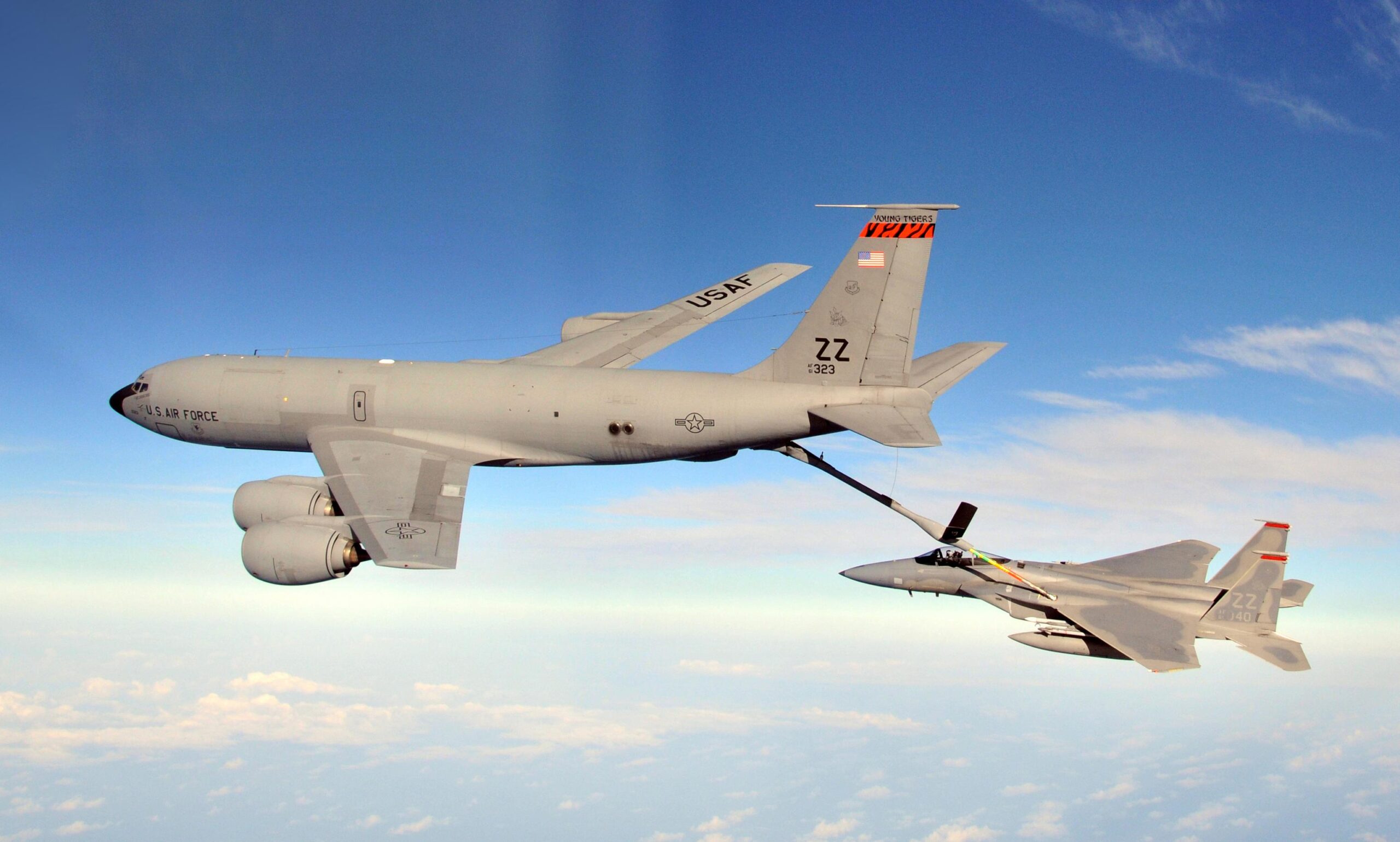
More than 200 US aerial refuelling aircraft and upwards of 230 combat jets have been tracked across the Middle East and the wider network supporting American air operations in the region, according to open-source analysis compiled by UK Defence Journal Senior Editor Jon, known as DefenceGeek on X, alongside the Military Air Tracking Alliance.
The assessment draws together aircraft movements, unit deployments and other publicly available information to provide a snapshot of the scale and geographical spread of US air power positioned across the US Central Command area and supporting locations in Europe and the Atlantic.
A fast-jet order of battle published on 10 August placed the deployed force at around 237 aircraft, covering F-15E Strike Eagles, F-35A and F-35C Lightning IIs, F-16 Fighting Falcons, A-10C Thunderbolt IIs, EA-18G Growlers and F/A-18C/D Hornets.
US ORBAT – Fast-Jets – 10/AUG/2026 #IranWar
So as promised, here’s the slightly more detailed US Orders of Battle for fast-jets in CENTCOM available in case of further conflict with Iran. Due to the fact my list of airframes is over 250, I am not going to list individual… pic.twitter.com/59enR8x6m1
— DefenceGeek 🇬🇧 (@DefenceGeek) August 10, 2026
The largest individual contingent listed is the F-15E force, with 64 aircraft associated with deployments from the 4th Fighter Wing, 366th Fighter Wing and the RAF Lakenheath-based 494th Fighter Squadron. The figure includes two aircraft recorded as unidentified combat losses.
A further 55 F-35As are listed, including aircraft from the Vermont Air National Guard’s 158th Fighter Wing, Hill Air Force Base and RAF Lakenheath. Fifteen F-35As from Lakenheath’s 495th Fighter Squadron were recorded as deploying in July.
The F-16C/CM force is placed at 61 aircraft, with deployments involving units associated with South Carolina, Shaw Air Force Base, Spangdahlem, Aviano and Misawa. Eleven additional aircraft were recorded at Spangdahlem but excluded from the forward total because they had not deployed into the CENTCOM area.
Thirty A-10C Thunderbolt IIs are also listed across deployments involving the 107th Fighter Squadron, 124th Fighter Wing and units from Moody Air Force Base. The figure includes one aircraft recorded as an unidentified loss.
Naval and Marine Corps aircraft add another layer to the force. Twelve F/A-18C/D Hornets from VMFA-312 and ten F-35Cs from VMFA-311 are included, alongside six EA-18G Growlers from VAQ-135.
Another six EA-18Gs from VAQ-138 had previously been tracked at Lajes in the Azores and were initially excluded from the forward total. US imagery dated 3 August subsequently showed a VAQ-138 Growler operating in the CENTCOM area carrying an AN/ALQ-249(V)1 Next Generation Jammer Mid-Band pod, indicating continued movement through the wider deployment network.
The scale of that network becomes clearer when the tanker force is considered. A separate assessment dated 13 August records 209 US aerial refuelling aircraft across locations stretching from the United Kingdom and continental Europe to the Gulf and Indian Ocean. The total consists of 33 KC-46A Pegasus aircraft, 152 KC-135Rs, 23 KC-135Ts and a single KC-135RT.
Of the 209 tankers, 107 were placed in the assessment’s red zone closest to the principal area of operations. Another 48 were in the orange zone and 37 in the green zone farther west. Sixteen were recorded as having returned to the United States during the previous two weeks, with one aircraft listed as being at another or unidentified location.
The accompanying map shows tanker locations across a broad chain of bases. RAF Mildenhall is marked in the United Kingdom, with Lajes in the Azores, Avord and Istres in France, Stuttgart in Germany, Bucharest and Mihail Kogălniceanu in Romania, Bezmer in Bulgaria, Sigonella in Sicily and Souda Bay in Crete also forming part of the tracked network.
Farther east, tankers are shown at locations including Ben Gurion, Ovda and Ramon in Israel, Prince Sultan Air Base in Saudi Arabia, Al Udeid Air Base in Qatar and Al Dhafra Air Base in the United Arab Emirates.
Al Udeid and Al Dhafra had both returned to use by the tracked tanker force by 13 August after previously dropping out of the observed deployment pattern. Diego Garcia is also marked on the map as part of the wider support architecture. The British Indian Ocean Territory facility has long been used by the United States to support military operations across the Middle East and Indo-Pacific.
Aerial refuelling is central to sustaining combat air operations over the distances involved. Tankers allow fighters, electronic warfare aircraft, surveillance platforms and other assets to remain airborne for longer, while also supporting the movement of aircraft from bases in the United States and Europe to forward locations.
The numbers are based on open-source tracking rather than an official US military order of battle, and individual aircraft can move between locations without appearing on publicly accessible tracking systems. They therefore represent a snapshot of observable deployments rather than a definitive real-time inventory. The data shows a US combat-air presence numbering well above 200 fast jets backed by a tanker network of more than 200 aircraft distributed from Britain and the Atlantic through Europe and into the Middle East.




If it kicks off again, I hope the US goes after regional revolutionary guard leaders, rather than bridges & power stations. However the global economy needs this to turn to peace as soon as possible.
Its an impressive force. But as the last 35 years have proven. You can’t win wars with air power alone. And certainly without a well thought out political strategy. Its been the Americans weak link, not the combat power, but the politicians.
The Orange Emperor was babbling about the Straits of Hormuz becoming American overnight, no doubt renamed the Straits of Donald next. This force will be in the area for the rest of Trump’s reign at the least. God knows when the Navy will rotate some of its carriers out if the stories about half rations and suicides attempts are even half true. Yet nothing seems to dent his MAGA base. I doubt this will be his last military misadventure, just a matter of trying to guess where next?
This must be excluding carrier air wings? No Super Hornets listed. Legacy Hornets from the USMC no longer deploy on carriers I believe, and the USN retired all their legacy Hornets quite a few years ago.
yes its not including the 2 carrier air wings. That would add around 100 f18s/f-35s and i think there are a couple of amphibs there each with at least 6 f-35bs.