

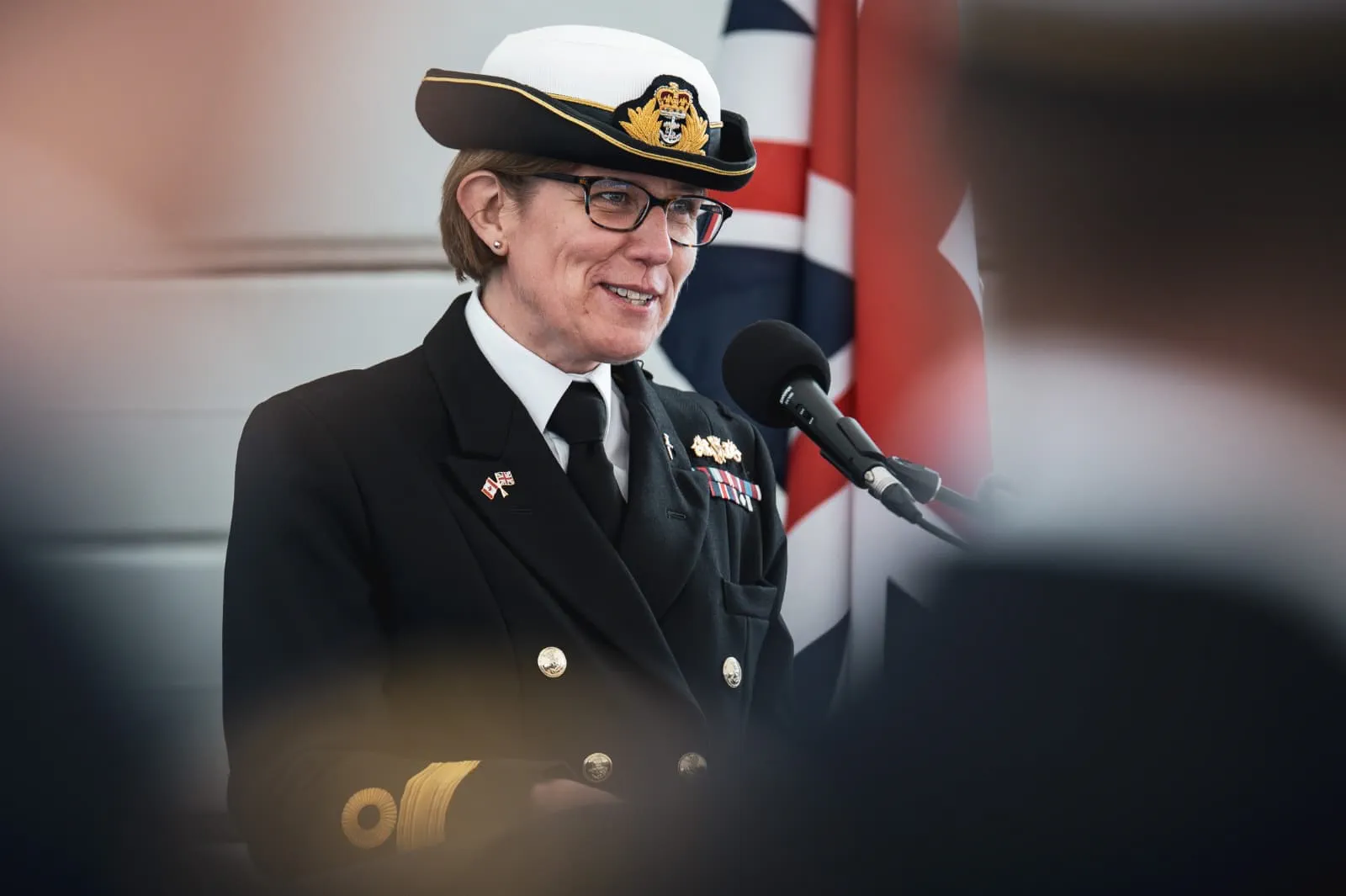
Commodore Maryla Ingham has handed command of Standing NATO Maritime Group One to French Rear Admiral Nicolas Molitor after four months spanning Baltic Sentry, Arctic operations, major anti-submarine exercises and a deployment across the Atlantic.
The Royal Navy has completed four months in command of Standing NATO Maritime Group One, handing leadership of the alliance task group to France after operations stretching from the Baltic and High North to the eastern seaboard of the United States, the UK Defence Journal understands.
Commodore Maryla Ingham formally handed command to French Rear Admiral Nicolas Molitor in Reykjavik, Iceland, bringing to an end a tenure that began in April and included Baltic Sentry, Arctic Sentry, Exercise Dynamic Mongoose and the US-led FLEETEX 250. According to a Royal Navy news update, the task group also supported protection of critical national infrastructure, anti-submarine warfare, boarding operations, gunnery, casualty evacuation and multinational integration across several maritime theatres.
The handover follows an interview with UK Defence Journal last month in which Ingham described the pace and breadth of the deployment while speaking from her flagship at sea in the middle of a gunnery shoot. She said the group had moved almost immediately into Baltic Sentry after taking command, spending around a month on the operation before heading north for Dynamic Mongoose 26 off Norway, a major anti-submarine exercise involving three live submarines, five maritime patrol aircraft and a multinational surface force.
Ingham told UK Defence Journal: “We started off in April. We went straight into enhanced vigilance activity, Baltic Sentry, which is to protect critical underwater infrastructure, and we were there for about a month.” She continued: “Then we went up off Norway, and we were the lead for Exercise Dynamic Mongoose 26, which was a major ASW exercise, multinational, three live submarines, five MPAs. Goodness, I can’t even remember how many ships we had.”
From there, the group crossed the Atlantic for FLEETEX 250, a US Second Fleet-led exercise which at one point expanded to ten ships, before taking part in the International Naval Review marking the 250th anniversary of the United States Navy in New York. The Royal Navy said the wider exercise involved 30 warships operating off Virginia and North Carolina. Ingham subsequently described the group’s integration into the Commander Task Force Atlantic activation as particularly important because it demonstrated multinational command and control across the surface, air and underwater domains.
She told UK Defence Journal that the activity was “all about demonstrating command and control of multinational forces on the sea, in the air, and underwater, and that’s the first time that’s been practised.” After returning across the Atlantic, the group called at Glasgow before heading back to sea for gunnery and operations in the High North ahead of the eventual handover in Iceland.
One of the most tangible operational changes during Ingham’s command came through Baltic Sentry, where NATO has increased its focus on protecting subsea cables, pipelines and other critical infrastructure. Ingham said the operation had reduced NATO’s reaction time to incidents involving critical underwater infrastructure from around 17 hours to approximately one hour. She also described a Baltic operating picture in which almost all activity could now be observed or tracked by the alliance.
“It’s also reduced our reaction time to critical underwater incidents from around 17 hours to an hour,” she said. “And it’s really enhanced our situational awareness.” She added: “I’m really confident that there is very little that happens in the Baltic without us being aware of it.”
The group encountered Russian naval forces during the deployment, although Ingham characterised those interactions as routine and professional rather than confrontational. “Did we have interactions with the Russian Navy? Yes, we did. But they were all safe and professional,” she said. “At the end of the day, a lot of those areas are international waters, and we all patrol them together, because that’s the nature of the sea.”
She repeatedly spoke on the protection of seabed infrastructure as one of the group’s central missions, arguing that the Baltic operation had improved not just the quantity of forces available but the way they were coordinated. British, French, Spanish and Turkish ships were among those contributing to Baltic Sentry, alongside aircraft and other NATO capabilities. Ingham said the alliance now had considerably more maritime assets available for such tasks than Russia and was using them in a more structured way.
Another distinctive feature of the deployment was the way the British command staff operated from allied warships. Ingham and her Royal Navy battle staff initially commanded from the German frigate FGS Sachsen before transferring to the Canadian frigate HMCS Ville de Québec, the first time a Royal Navy-led task group had commanded operations successively from ships belonging to two different allied navies. The Royal Navy said this reflected the level of trust and integration within the group.
Ingham made the same point more practically during her interview with UK Defence Journal, describing NATO naval interoperability as something embedded in everyday procedures rather than simply an aspiration. “Out of the 32 nations in NATO, over 25 of them are maritime nations, and we all operate using the same tactics, techniques and procedures,” she said. “So it’s actually really, really seamless to be able to operate in another ship, and we’ve proven that.”
She used replenishment at sea as one example. NATO ships use common fittings and procedures, allowing vessels from different nations to refuel from one another without lengthy adaptation. “Any NATO ship can fuel off any NATO tanker,” Ingham said. “Everybody knows what to expect. Everybody knows how to do it. Everybody practises it. And so when you need to fuel, you’re literally in, fuel, gone.”
The Royal Navy also contributed a Wildcat helicopter from 815 Naval Air Squadron while the staff was embarked in FGS Sachsen, adding surveillance, reconnaissance and force-protection capability. Ships from France, Germany, Belgium, Denmark, the Netherlands, Portugal, Turkey, Spain, Norway, Canada and the United States served with the group at different points during the deployment.
Ingham said, as quoted in the Royal Navy update: “Leading Standing NATO Maritime Group One has been a great privilege. I am incredibly proud of my Battle Staff and the ships from across the Alliance that have served alongside us, demonstrating NATO’s unwavering commitment to collective defence and deterrence.”
She added: “Throughout my tenure, we have shown that our strength at sea comes not from any one Nation, but from the unity, trust and professionalism that bind us together as Allies. In an increasingly complex security environment, that solidarity remains our greatest strategic advantage.”
That reflected the argument she made to UK Defence Journal when asked what the standing maritime group ultimately exists to achieve. “The first one is deterrence, and we mustn’t ever forget that this is a deterrent alliance,” she said, before pointing to Britain’s dependence on maritime trade and undersea communications. She cited 95% of UK imports arriving by sea, around half of its food and 97% of internet data travelling through subsea cables.
For Ingham, the deployment also demonstrated the less visible value of a standing multinational force. “We’re specialist mariners. We are professional, calm, getting on with our jobs. We are not looking for trouble,” she said. “We’re a defensive alliance here to defend over a billion people.”
The handover in Reykjavik brings Ingham’s fifth command at sea to an end and her first commanding a multinational battle staff. Her own description of command remained notably simple despite the scale of the task group: “Execute the mission. Two, keep the ship safe. Three, look after your people.”
Rear Admiral Nicolas Molitor now assumes responsibility for SNMG1 as the standing force continues NATO’s maritime deterrence and defence mission across northern European and Atlantic waters.





During the 2026 Iran war (codenamed Operation Epic Fury), Iran launched extensive retaliatory missile and drone strikes that damaged at least 20 U.S. military bases/sites across eight countries in the region
The primary IRGC missile and drone attacks on U.S. installations occurred across two highly volatile escalatory periods: the opening salvos late February into March and the maritime/gulf escalation in July
On 1 March the Port of Shuaiba, Kuwait was attacked by a drone which eluded air defences, directly striking a makeshift U.S. tactical operations centre. A triple operations trailer complex was completely incinerated. Six U.S. service members were killed (Reservists from the 103rd Sustainment Command), and dozens of others seriously wounded
On March 27 and again on July 1 Prince Sultan Air Base, Saudi Arabia was hit multiple times with precision strikes. The March 27 attack severely damaged a U.S. Air Force E-3 Sentry AWACS command and control aircraft, splitting it in two and leaving it beyond repair. A KC-135 refuelling tanker was entirely destroyed and “up to” three others were severely damaged, 12 U.S. personnel were wounded in the March 27 attack (two seriously), and an additional 12 U.S. troops wounded during the July 18 follow-up strike
On June 23, with secondary follow-up volleys in mid-July the al-Udeid Air Base, Qatar was seriously damaged. Iran launched 14 ballistic missiles. While 13 were intercepted, one slipped through, destroying a vital geodesic communication dome containing forward-deployed CENTCOM satellite tracking and communication hardware. The July volleys targeted nearby tracking sites
Bahrain – the 5th Fleet HQ – sustained barrages on July 12 and July 24. The primary command headquarters suffered structural damage, an unmanned vessel storage depot was compromised, and two critical satellite communications (SATCOM) terminals were totalled. No confirmed active-duty KIA. However, the structural damage to the port forced U.S. aircraft carriers to temporarily reroute and look for alternative docking ports
The Muwaffaq Salti Air Base, Jordan was hit by an initial 10-missile wave during the week of July 12, followed by a second lethal attack on July 17. There was significant precision damage to a state-of-the-art Terminal High Altitude Area Défense (THAAD) radar system node and an adjacent administrative operations building. Casualties included two U.S. service members killed during the July 17 engagement, with one service member initially listed as missing in action.
Erbil Military Base / Erbil International Airport in Iraq was struck with three successive drone and missile waves mid July.. The IRGC heavily targeted forward logistical nodes. Multi-spectral imagery confirmed direct hits to U.S. munitions warehouses, an active tactical logistics hub, and localized vehicle storage hangars. Secondary explosions were observed and the munitions warehouses were still on fire three days later
On March 3 and March 4 Al Ruwais & Al Sader Air Bases in United Arab Emirates were struck by coordinated low-altitude drone and ballistic missile packages. These IRGC precision strikes successfully scored direct hits on Terminal High Altitude Area Défense (THAAD) anti-ballistic missile batteries and radar components. The strikes also ignited localized fuel storage bunkers and caused extensive cratering across the tarmac
Many have suggested that the Russians provided precision targeting information, but the real damage was done by Chinese military electronic warfare specialists.
Rather than attempting to match the U.S. military’s superior space and air-based capabilities, they implemented a highly coordinated, cost-effective strategy designed to blind, confuse, and deplete U.S. defensive infrastructure. The IRGC structured its EW doctrine to prioritize physical “hard-kills” on the sensors that fuelled American electronic warfare networks. The IRGC exploited a fundamental flaw in layered air defence: resource exhaustion
U.S. Patriot (MIM-104) and THAAD systems rely on highly sophisticated tracking radars (such as the AN/TPY-2). The IRGC used pre-programmed, low-altitude loitering munitions to map radar emission frequencies. Then they launched massive, tightly synchronized opening waves of dirt-cheap Shahed-136 attack drones ($20,000 unit cost) alongside low-altitude cruise missiles
By sending sacrificial drone swarms ahead of their main ballistic inventory, they forced U.S. battery operators to leave tracking radars continuously active. This allowed specialized anti-radiation loitering drones to trace the radar waves directly back to their source, leading to the destruction of critical radar nodes, such as the multi-billion dollar early-warning radar arrays at Al-Udeid Air Base in Qatar.
These swarms created a massive density of active targets on U.S. command screens. U.S. automated defence networks were forced to engage, expending highly limited, multi-million dollar Patriot PAC-3 interceptors ($4.5 million per launch) on low-value decoys. Once the missile magazines were depleted and the tracking systems overwhelmed by the sheer volume of clutter, the IRGC fired their high-speed precision ballistic missiles to strike the defenceless infrastructure
Within hours of kinetic escalations, the IRGC mobilized more than 60 affiliated cyber units and external hacker fronts (such as Handala and CyberAv3ngers) These groups launched massive Distributed Denial of Service (DDoS) and data-wiping campaigns targeting digital military infrastructure, regional food supply tracking, and regional civil portal networks (including airport portals in Kuwait and interior networks in Qatar). This digital chaos was intentionally timed to delay U.S. battle damage assessments and scramble command-and-control communications during active missile barrages
While the Ayatollahs pulled the trigger, Russia and China provided the indispensable intelligence, technology, and materials that made the precision strikes possible. Chinese commercial firms (like MizarVision) provided high-resolution satellite mapping of U.S. THAAD batteries in Jordan right before they were hit. China also supplied Iran with advanced YLC-8B radar systems to map incoming U.S. aircraft while covertly transferring hundreds of QW-12 and FN-16 air defence missile launchers to rebuild Iran’s heavily damaged military infrastructure
Russia provided Iran with real-time military satellite imagery and space-based reconnaissance. This Russian data gave the IRGC the exact coordinates of forward-deployed American warships, air defence positions, and mobile taxiway assets (enabling the precise targeting of the E-3 AWACS, refuelling assets and THAAD components)
Russia also shipped advanced 9K333 Verba MANPADS across the Caspian Sea during ceasefire windows to help Iran protect its own launch sites from U.S. counter-strikes.
Geopolitical analysts highlight that while the Ayatollahs sought regional dominance, Russia and China viewed the orchestration of these attacks as an ideal cost-imposition strategy. By backing Iran, Beijing and Moscow successfully forced the Pentagon to rapidly deplete its finite stockpiles of multi-million dollar Patriot and THAAD interceptors. This forced Washington to redeploy vital troops and air defence assets away from Europe and the Indo-Pacific, effectively making those borders more vulnerable to Russian and Chinese ambitions
The man responsible for this military disaster was Secretary of Defence Hegseth, who proved to be completely outclassed by his equivalent opponents in Iran, Russia and China. The Pentagon was unable to prepare a workable plan to defeat Iran because Hegseth fired all the American specialists in his anti-wokery and anti-female campaigns last year.
Pathetic. Explain to me why no ship was hit?