

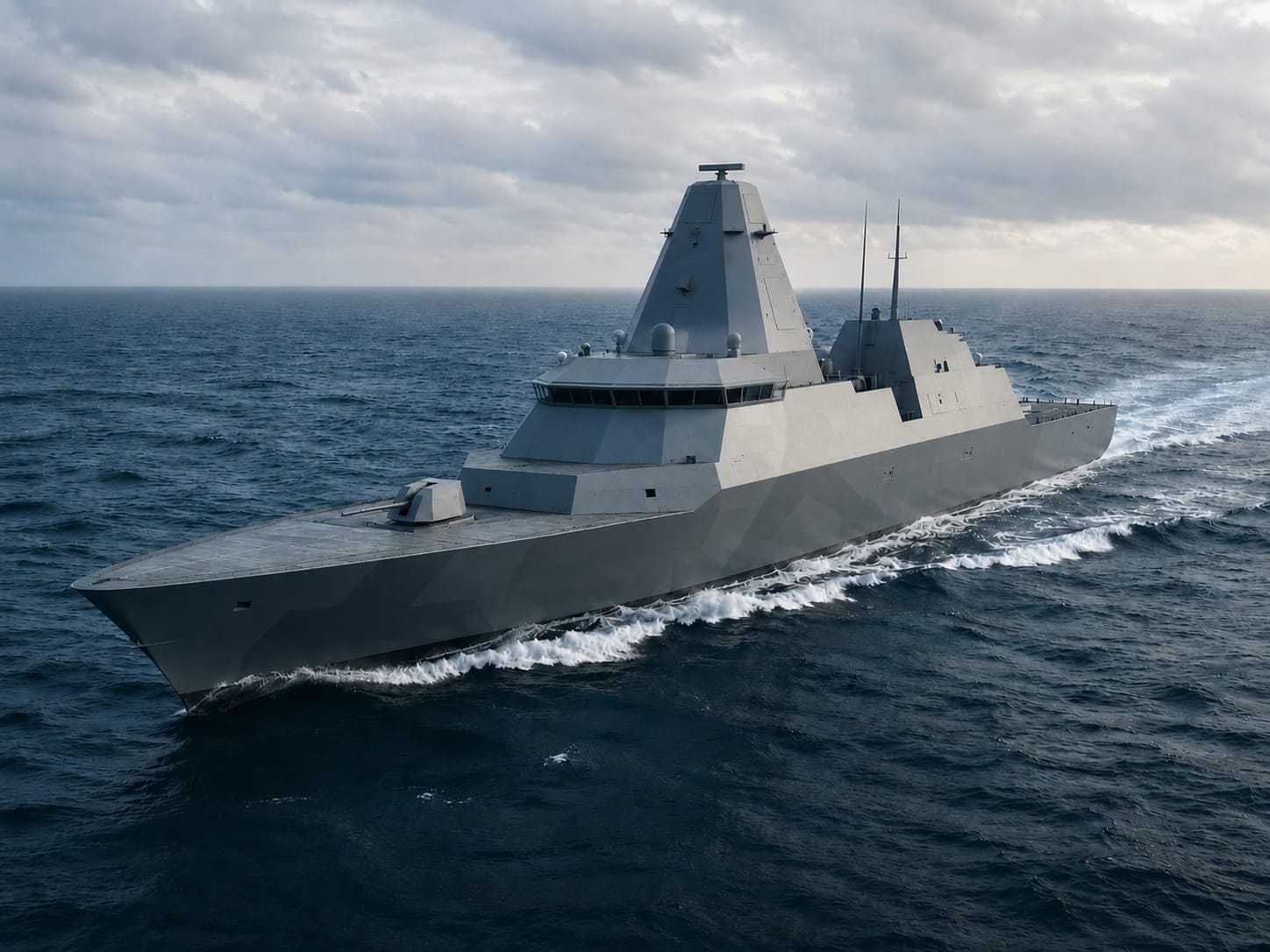
No specific service entry dates have been set for the Common Combat Vessel or the four classes of uncrewed platform that make up the Hybrid Navy, and planning assumptions support progressive introduction from the early 2030s, according to answers given in Parliament.
James MacCleary, the Liberal Democrat member for Lewes, asked when the Common Combat Vessels will enter service. Luke Pollard, the Minister of State for Defence, referred him to an answer given on 20 July to Stuart Anderson, the member for South Shropshire.
In that answer Pollard said: “The Defence Investment Plan announced at least £1.3 billion of investment in the Hybrid Navy Fleet, comprising uncrewed missile platforms (Type 91), uncrewed underwater sensing platforms (Type 92), extra-large uncrewed underwater vessels (Type 93), uncrewed radar platforms (Type 94) and a future class of Common Combat Vessel (CCV). Detailed requirements and delivery timelines remain subject to ongoing concept and assessment work. Current planning assumptions support the progressive introduction of Hybrid Navy capabilities from the early 2030s, but no specific service entry dates have yet been set for these platforms.”
Type 91 is an uncrewed missile platform, Type 92 an uncrewed underwater sensing platform, Type 93 an extra-large uncrewed underwater vessel and Type 94 an uncrewed radar platform, with the Common Combat Vessel the crewed element alongside them. The designations were announced earlier this year, and the department has since told Parliament that construction dates remain undetermined.
A prototype uncrewed missile ship is expected to join the fleet by 2030.



That’s because they have not figured out how these uncrewed fleets are going to work yet.
a few concerns I have (and by no means an exhaustive list):
Communication links data reliability and Latency Bottlenecks
Command signal latency in battle conditions.
Communication links signal attenuation (especially on high seas)
Seaworthiness and sailing as a large flotilla
Maintenance, fault detection, and mitigation at sea.
Battle damage detection and control
Rearming refueling at sea
Risk of Boarding and Sabotage or electronic hijacking
Yes but as the CDS just pointed out there are also great risks in not pursing autonomous distributed platforms.
If we rock in with one £3 billion Type 83 cruiser against an enemy that’s operating a dozen automated platforms for every one manned platform we have then we are highly likely to loose.
How you can get a dozen automated platforms for 1 T83? You need at least 2000t – so a total of 24000t – to be minimal oceanic and are even incapable of fitting ABM radars
The problem is UK is taking this autonomous approach with a smaller CCV whereas other nations ltaly, S.Korea etc are building large destroyers with huge electric power to power highly capable radars while specifying usage of autonomous systems as an extension of them. The layered type 91 – type 94 vessels approach makes sense but it doesn’t lighten the worries Bringer of facts has raised.
A manned T83 is much less of a risk.
Technologies for manned ships are proven.
The command signal latency you will get with communication between drones and CCV will be non-existent on a manned ship because comms between sub-systems are wired.
Crews will be trained in fault detection and damage control and will be active in mitigation.
Rearming refueling in one stop.
Very little risk of boarding or electronic hijacking.
I wish they’d give up on this smokescreen…T45 is going to be extended into the late 2030s/early 2040s, and that’s no bad thing.
It’d have been more respectable for them just to announce that in the DIP, rather than the opaque mess we received instead.
For clarity, the CCV/T9X idea could work, and could work really well. There’s nothing inherently flawed in the concept, despite what some pretend.
But to deliver it, timelines would need to be stringent, goals clear, and plans well-understood and defined. Instead, we’ve got quite literally none of that, and the only T9X that seems to be moving forward at anything like pace is the T93 – the only one not directly relevant to the CCV/T9X concept.
I don’t think that kind of detail is going fo be released into the public relm just yet. And also wouldn’t expect accurate in service dates yet.
“For clarity, the CCV/T9X idea could work, and could work really well. There’s nothing inherently flawed in the concept, despite what some pretend.”
There is something flawed in concept: no comms it fails, and can be just 5 seconds of comms failure at crucial time.
So it do not even respect the basic swiss cheese failure model.
That’s not a flaw, in the same that going ‘no power it fails’ isn’t a flaw.
There will be communications redundancies, and even in the event of total communication blackout, the individual units retain a core self-defence capability.
No it is not, a T26 power is contained in its hull, it is not dependent on other ship and no other ship is dependent on it.
“the individual units retain a core self-defence capability.”
How so when a human is needed to accept the fire order?
Humans haven’t been needed to accept fire orders for ship self-defence for a while, Phalanx’s automatic mode for example. There’s no reason why CAMM couldn’t operate on the same principle.
Phalanx have 2km range and usually engagement rules vary a lot depending on circumstances, helicopter approach turned off etc etc.. . Do not compare with a 25km system.
The idea is that that particular factor is phased out, as automated systems become more trustworthy. Again, not a flaw.
As TorpedoJ says above, automated self-defence systems exists, and as you then reply, they’re dependent on variable RoE. A total blanket communications blackout during an engagement would likely have some impact on RoE.
Cancel the T83 (Starmer on Cost Grounds.with Hybrid Navy Excuses) but No Replacment in Sight for T45… Politically. Shameful and Deplorable…!
A fantasy fleet from a fantasy government. Never going to happen.
What gives you to think that? The budget has been awarded, a couple of T9X are in trials and development, various companies are offering capable options. Certainlyt it will all be dependent on overcoming the many technical and operating challenges, which Bringer of Facts examples above. But I can’t see why we should start from such a gloomy dismissal of the whole programme, unless it is to make some party-political point?
“a couple of T9X are in trials and development”
What??? there is not even a requirement!
What budget, what trials, what timescale?
I can’t help but think this idea is smoke and mirrors, a political stance to make it look as if we are tackling the ‘lack of hulls’ problem.
A sensible option would be to start with a prototype CCV (possibly a T31 hull with no weapons fitted) and develop the coms hub from there.
The M25 syndrome. Once the politicians get inside it everything becomes smokey and the only mirrow they use is the one that they look into to please their ego. All these reports are meaningless. Cancellations, cuts and delays. That’s all they know.
One thing you can guarantee is that by the time they’ve figured it all out and used up the committee expenses budget, it will be too late and most of the T45’s will be retired before the first one is ready.
Defence Secretary in Parliament rowing back on 3% by 2030.
What a surprise.
These Charlatans are all the same.
They can row back, but the Americans get a vote.
Its not as simple as that though is it mate. High inflation alone from Trumps Iran war massively eats into the governments spending power. And if they don’t borrow more money, then they need to find an extra 17-20 billion for defence to get to 3%. 30+ billion for 3.5%. They are firmly committed to 3.5% for 2035, and a road map will be released on how we get there in next years spending round. So 3% could come in 2031/32. The debt interest alone is massive. Big cost of living pressures, high tax burden and sluggish growth. Just look what’s happening in France. I know it’s not what people want to hear, but that’s the reality of the situation. We all know the government needs to spend more on defence, the government knows it does too, ,but its going to mean every single government department is going to face big cuts. And that will affect all of us one way or the other. And the public didn’t vote for more austerity. So I can understand why it’s difficult for the Chancellor. There is no magic wand.
My guess is a lot of FFBNW followed by a couple of Capability Insertion Periods (CIP). It all comes down to having a solid concept of operations, which might be the problem.
Too early in the development phase to have any timelines and an upgraded T45 escorted with some drones is a viable interim option with a modified T26 also being a very suitable plan B.
‘To early’ for timelines? Come on, that’s just not supported by the scheduling of our other ship-building programmes.
T26 and T31 had schedules long before their estimated in-service dates.
I think the real problem is what the Type-9Xs look like and how long it will take to have a sufficient number of them in the fleet.
Will the Cocept Hyprid Navy actually Work and at what Cost are some of the Many Questions unanswered… OR is the Goverment using the Hybrid Navy idea as a money Saving ploy.. to Not investing in Proper Ships..?