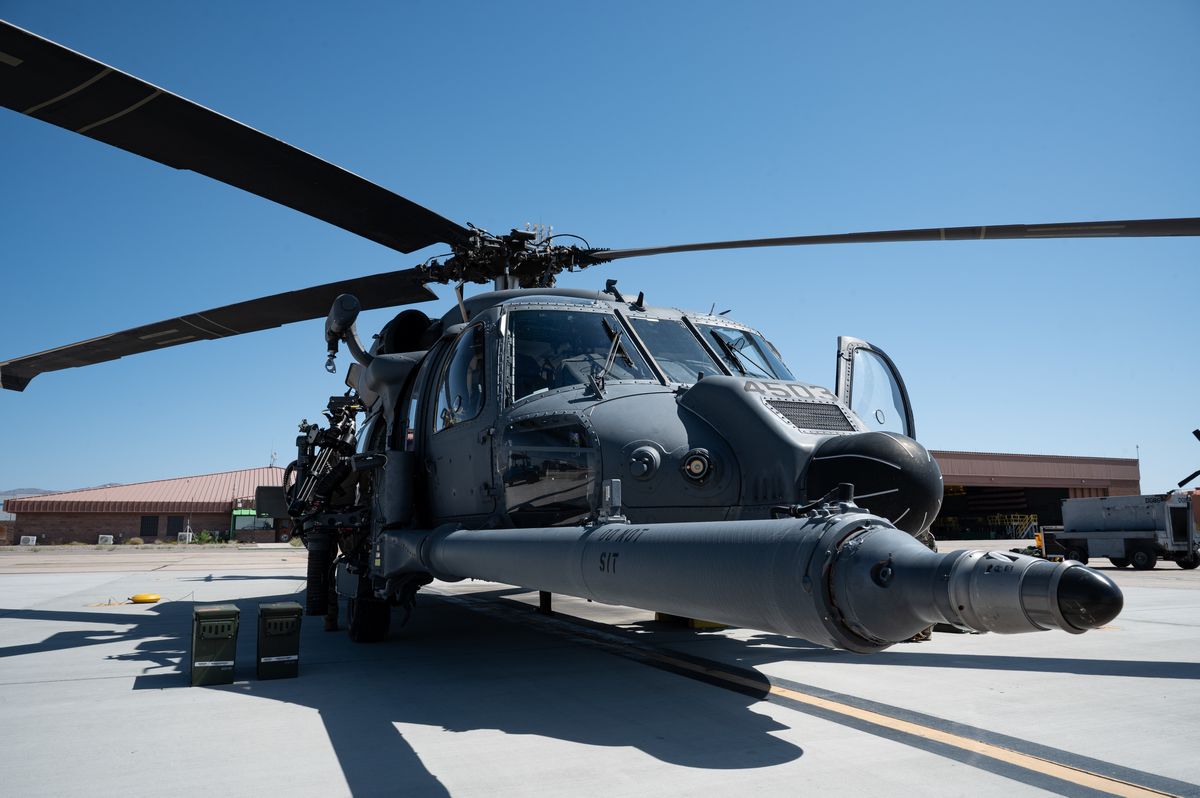
Two HH-60W Jolly Green II helicopters were launched from Nellis Air Force Base to recover five US Navy personnel after an MH-60S Seahawk made a hard landing in mountainous terrain near China Lake.
US Air Force rescue crews have recovered five Navy personnel after their MH-60S Seahawk made a hard landing during a high-altitude training flight in mountainous terrain near Naval Air Weapons Station China Lake, California, the UK Defence Journal understands.
The incident occurred on 10 August, prompting the Air Force Rescue Coordination Center to notify the 88th Test and Evaluation Squadron at approximately 11:30am. According to a US Air Force account of the rescue, the squadron immediately recalled personnel and coordinated with the Navy unit involved while the 355th Aircraft Maintenance Squadron prepared two HH-60W Jolly Green II combat rescue helicopters for the mission.
Despite the alert arriving on what had been scheduled as a training day, maintenance personnel generated both HH-60Ws in less than 30 minutes. The rapid preparation included troubleshooting an electrical problem on one of the helicopters after a circuit breaker issue threatened to prevent it from launching and no replacement component was immediately available.
Staff Sergeant Lucas Seney, an aerospace propulsion craftsman with the 355th Aircraft Maintenance Squadron, said, as quoted in the news update: “When production gave us the word for a real-world mission, I gathered the Airmen I had on the line and started directing traffic. The crew worked well together, and I was proud to see just how efficiently everyone was able to get the job done.”
Staff Sergeant Cody Adams, an avionics craftsman, helped identify the fault affecting one of the aircraft. He said: “We diagnosed the master caution warning press-to-reset button as what was causing the circuit breaker to pop and provided aircrew with a workaround to keep the system operational and allow on-time takeoff.”
The two HH-60Ws departed Nellis Air Force Base at 1pm. By 3pm, their crews had established two-way radio communications with the stranded Navy personnel and visually identified their position. Captain John Howe, a combat rescue officer with the 88th Test and Evaluation Squadron, then led the pararescue element into the landing zone to assess the five survivors.
The team confirmed that none of the Navy personnel had been injured. After evaluating the terrain and the condition of the survivors, the rescuers elected to move the helicopters to a closer landing area rather than requiring the group to make a more demanding movement through mountainous terrain.
Lieutenant Colonel Kenneth “Buddy” Wilkins, commander of the 88th Test and Evaluation Squadron and flight lead for the mission, said the crews had to carefully consider aircraft performance in the high-altitude environment. He said: “It was a good call by the team getting on the ground, making a good patient assessment, and then solid planning on the aircrew side of the house to determine what our ragged-edge power margins were that we needed to get into the zone and get out.”
The HH-60W is the US Air Force’s current-generation combat rescue helicopter and is designed for personnel recovery in demanding environments. High-altitude operations can be particularly challenging for helicopters because thinner air reduces rotor and engine performance, making aircraft weight, temperature and available power important considerations when selecting landing sites and extraction profiles.
All five sailors were aboard the rescue helicopters by 3:50pm. They were subsequently returned to their unit’s ramp at Naval Air Weapons Station China Lake before the Air Force helicopters flew back to Nellis.
Howe said preparation before an emergency was central to the speed of the response: “The preparation is what makes the execution smooth. It’s the combination of preestablished operating procedures, keeping equipment staged and ready for use, and hasty mission planning prior to departure, that makes this process effective, and expeditious.”
The Air Force said the operation drew directly on repeated training between the 88th Test and Evaluation Squadron and the 355th Aircraft Maintenance Squadron. Wilkins said: “This mission was a really good example of us taking the lessons learned from those previous events and executing as quickly and efficiently as possible. Within five minutes, I knew we had tails. Within 30 minutes, they were ready for us to go out.”