

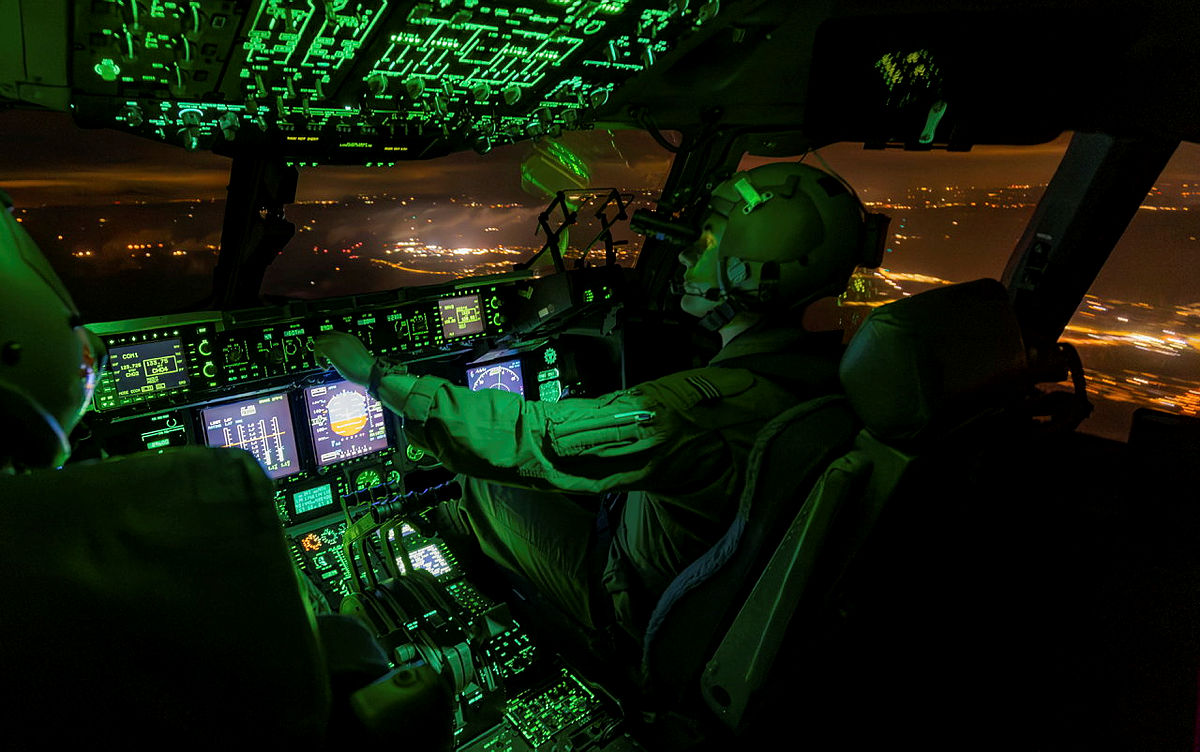
We now know why a US Air Force C-17 made an unusual flight from Riga to Moscow: CIA Director John Ratcliffe was aboard the aircraft for meetings in the Russian capital.
The reason behind an unusual US Air Force C-17 Globemaster III flight into Moscow has now emerged, with CBS News reporting that CIA Director John Ratcliffe travelled aboard the aircraft for meetings in the Russian capital, the UK Defence Journal understands.
The development answers the central question raised when the aircraft appeared on civilian flight-tracking services earlier on 25 August. What initially looked like a highly unusual American military transport movement into Russia was, according to CBS News senior White House reporter Jennifer Jacobs, carrying the CIA Director on a visit to Moscow. Jacobs reported, citing sources, that Ratcliffe travelled to Russia aboard a C-17 for meetings in the city and said it appeared to be his first known trip to the country since becoming CIA Director, although he has maintained contact with Russian intelligence counterparts.
It appears to be Ratcliffe’s first known trip to Russia as CIA director, though he has maintained contact with Russian intelligence counterparts. https://t.co/J9ugJvGnSj
— Jennifer Jacobs (@JenniferJJacobs) August 25, 2026
The aircraft was identified through open-source flight data as US Air Force C-17A Globemaster III serial 07-7191, using the callsign REACH 4555. It had first been tracked leaving the Washington area for Riga on 23 August, before departing the Latvian capital two days later and heading east towards Moscow, a routing that immediately drew attention because direct movements by identifiable US military aircraft into Russia have become extremely uncommon amid the deterioration in relations between Washington and Moscow.
UK Defence Journal Senior Editor Jon, known as DefenceGeek on X, followed the movement as it developed, first noting the aircraft’s arrival in Riga and then its subsequent flight into Russia. Tracking data showed REACH 4555 approaching Moscow before video and photographs from the city showed a C-17 descending towards the Russian capital, confirming that the aircraft had completed the unusual journey.
At that stage, however, the aircraft itself offered little indication of what the mission involved. The C-17 is the US Air Force’s principal heavy strategic transport aircraft and is routinely used to move personnel, vehicles and outsized cargo over intercontinental distances, while REACH callsigns are commonly associated with US Air Mobility Command missions, meaning the route could be followed in public without revealing who was aboard or why the aircraft had been sent to Moscow.
The CBS reporting changes that picture considerably, placing the flight in the context of a senior US intelligence visit rather than an unexplained logistics movement. Ratcliffe’s reported presence also helps explain why a conspicuous military aircraft was being used on a route that would otherwise have appeared highly unusual, although the precise purpose of his meetings, the Russian officials he met and the subjects discussed have not been made public.
Separate activity around the flight had already suggested that the movement involved more than a routine cargo mission. Imagery circulating after the C-17 arrived appeared to show US government vehicles travelling in convoy through Moscow, with open-source observers pointing to registration plates that appeared consistent with Latvia-issued diplomatic plates. The timing now makes a connection with Ratcliffe’s visit more plausible, although the available imagery does not establish whether those vehicles carried the CIA Director, formed part of his security detail or had any direct connection with the delegation.
There was also additional US government aviation activity at Riga before REACH 4555 continued to Moscow. A Boeing C-40, serial 02-0042 and using the callsign REACH 790, was tracked arriving at Riga International Airport from Joint Base Andrews on 23 August, with open-source imagery suggesting that it was parked close to the C-17. That movement can now be viewed alongside Ratcliffe’s reported journey, but there is still no confirmation that the C-40 continued to Russia or that it played a direct role in the CIA Director’s visit.
Jacobs’ reporting that Ratcliffe has maintained contact with Russian intelligence counterparts is also significant because it indicates that direct intelligence channels between Washington and Moscow have continued despite the wider breakdown in political and military relations. What those contacts have covered remains unknown, and there is no public information establishing whether the Moscow meetings concerned Ukraine, detainees, strategic stability, intelligence liaison or another issue.
The known sequence is now considerably clearer than it was when REACH 4555 first appeared over Russia: the aircraft travelled from the United States to Riga, later flew onward to Moscow, and was subsequently identified by CBS News sources as carrying the CIA Director for meetings in the Russian capital. The reason for the flight is therefore no longer the mystery it was when the movement was first detected, even if the substance of Ratcliffe’s discussions remains undisclosed.
The US Air Force declined to comment when approached about the flight, while no detailed public account of Ratcliffe’s meetings has yet been issued by the CIA or Russian authorities. What remains unanswered is not why an American C-17 was in Moscow, but what brought the CIA Director there and what was discussed once he arrived.




CBS eh? Difficult to say nowadays how supportive they are of Government policy.
Interesting network to distribute this information.
CIA Director is a political appointee isn’t he/she. Best person to go to Moscow then?
Yes he is a political appointee, apparently he was sent to Russian to get all the copies of the Pee Pee Tape in exchange for the Donbas 🫡🇺🇸
He is there to get the new set of orders for Trump newly signed by his mentor Mr Putin.
Interesting. Zelensky submitted a peace plan recently and Vatican representative Archbishop Paul Gallagher has told Russian Foreign Minister Sergey Lavrov that the war in Ukraine “must end”, insisting that the conflict cannot be resolved by military means. I wonder if peace is about to break out.
No chance unfortunately, Putin will go through a new mobilisation first.
More targets?
Well then, Putin is worried about the Ukrainian drone strikes. Maybe he’s asking for US satellite targetting and terrain data to be switched off. And/ or Patriots to be withheld. In any event he is having to ask for US help…a crack opening up?
Could be a new peace initiative but more likely a summons from Vlad so new instructions could be delivered to his bitch Donald.
Could be a crack opening Paul however with the Trump administration involved it’s more likely he is there to offer NATO’s unconditional surrender than a just and lasting peace for Ukraine. Putin is clearly starting to break but he is more likely to double down than negotiate peace without something that looks like a win for him. He has not yet tried a mobilisation and I don’t think he will give up until he does. I suspect another year until the Russian’s are ready to come to the table and hopefully after Putin is hanging from a lamp post in Red Square.
We’re creeping ever closer to armed conflict with Russia and we’re down to what 5 frigates and just 7 Typhoon Squadrons! I hope the fitting out of Glasgow and Venturer are speeding up. And when it does kick off can someone please give a special big shout out to Cameron and Osborne for leaving us in the state we’re in today.
Just add the lack of active subs and next to no GBAD/MRAD to your list.
Well, we do need the new frigates. But I think the most likely threat is the grey-zone: expect cyber attacks on control hubs for transport, power and the NHS and sabotage on logistics hubs as retaliation for the drone attacks on the Russian Wildberries warehouses.
Totally agree 👍
Knowing the Yanks it was either a navigation error or some money making scam. Maybe begging Poooootin to reign in the Iranians because they wont play fair.
I’m just wondering if he has gone there to dissuade Putin from a mass mobilisation as that is a massive Red Flag to NATO ! I just cannot see most NATO members just sitting back as Russia mobilises, the risk is just too great ! Many of the Eastern members maintain far larger reserves that can be mobilised than we do.
TBH I’d be Bloody fuming if someone didn’t point out to Putin that Mobilisation will trigger a similar reaction !
Or
He has gone to tell Putin that the US is withdrawing from NATO ASAP and he can do whatever he wants in Europe as its TACO time.
At least there’s some face to face talking going on. Got to be some talking on oil, fertliser, Iran as well as Ukraine and all their undersea snooping activity on communications cables or, maybe that’s for another meeting?
With the UK-Ukraine publicly sharing Storm Shadow technology that has got to have upped the ante a bit. Has the bell rung to finish this war or is there another 12 rounds to go? The list of casualties military and civilian is horrendous as is all the destruction and the potential for more. Strength to Ukraine and its people.
Agree; face to face talking is good. Russia is hurting – 1.2M losses, queues for petrol, Wilberries in financial trouble, people emptying their current accounts. I don’t think it is certain that Putin is confident about his future if he orders a 300k mass mobilisation, especially if pressure is brought to bear by making it clear that NATO will respond in kind; and especially if there is a deal on the table e.g. settle at the current front lines and cease bombardment of Ukrainian cities and the Ukrainian drone attacks will stop and sanctions on Russian oil will be removed.
Hmmm … mission doesn’t exactly have the same level of intrigue as exchanges/meetings on the Glienicke Bridge (“Bridge of Spies”) connecting Potsdam to Berlin during CWI. 🤔😉
Now that we’ve given in the Ukrainians the blue prints for storm shadow Missiles and letting them use British drones hitting Russia .I believe this is why Putin pull out its Ambassador to the UK .When moves are made like this Relations have gone lower than low .This is in my opinion why the US flight took place to see what Russian government intentions are . Worrying times sadly.
Pure speculation but either:
1) like in 2021 the CIA knows that the Russians are up to something nasty, and hopefully telling them not to do it.
OR
2) Trump and his crew have raided the US Gold Reserves and arrangements are being made with Moscow for when Trump has to flee America. 🙂
Eh?
What have Russia, China and North Korea all got in common, no extradition treaty with US and a History of giving Asylum to ex Dictators as long as they have funds.
…but I think (1) is more likely for now.
So Tin hats for everybody here. The Rooskies see the UK as “evil no. 1,” and therefore shame on all UK politicians for lack of defence preparedness/deterrence over the years. Even now they don’t get it. Deborah Haines at Sky News has run an excellent likely scenario article for this several months ago.
Who knows but I suspect it’s a deal around Iran and Ukraine.. Russia pulls support for Iran and the US pulls some support in Europe or gives an unofficial green light.