

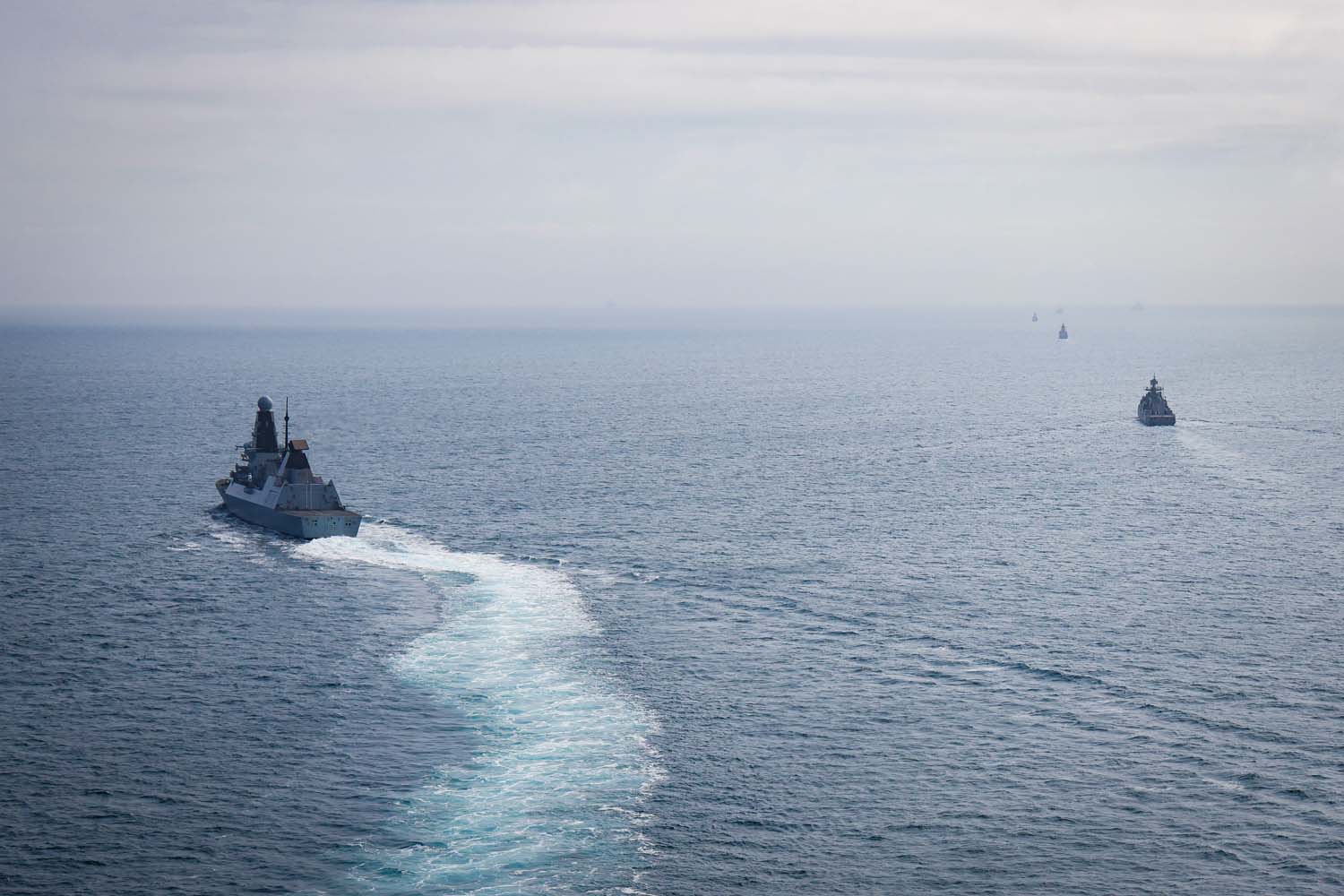
Earlier this year a claim began spreading online that a British warship had been struck by a Hezbollah missile in the eastern Mediterranean, initially appearing as speculation around an attack Hezbollah said it had carried out against an Israeli vessel, before changing fairly quickly into a much more specific story that the missile had actually hit a British ship.
HMS Dragon was the name that appeared most often online relating to this supposed incident. The Type 45 destroyer had been sent to the eastern Mediterranean as part of the British military presence protecting UK bases and interests around Cyprus, so to somebody seeing the claim without much other context it probably sounded plausible enough, and once screenshots began circulating the story started to acquire extra details as it went.
RFA Lyme Bay was mentioned too in some of the material being passed around. Within a fairl short period of time we were getting messages about it from readers and other people asking the obvious question: had a British warship actually just been hit by a missile?
We didn’t know immediately, and there was a period during which the only responsible answer was that we could not verify what was being claimed. Saying “we don’t know” isn’t a bad thing. So that is what we said publicly while we started checking it.
There is always pressure with stories like these moving at that speed to get something out quickly because everybody else is talking about it, particularly when screenshots are appearing from accounts which themselves appear to be quoting other sources, though at that point all we really had was a claim which had been repeated a lot, and repetition does not make something more reliable.
What we were doing behind the scenes
Several things were being checked at roughly the same time.
We were looking at the available open-source information to get a picture of where ships were, checking AIS information and other vessel tracking where it was available, and trying to work out whether anything we could see actually supported the claimed location of the incident.
A colleague was also watching aircraft movements around Cyprus and the eastern Mediterranean, because if a Royal Navy ship had genuinely suffered a serious missile strike then there was a reasonable chance that something else would start happening around it, perhaps helicopter movements, search and rescue activity, casualty evacuation or some other unusual pattern which might be visible through open-source tracking.
Military activity is not all visible on public tracking systems and warships quite routinely disappear from AIS, so the tracking could only ever form one part of the wider picture and we kept checking elsewhere.
We contacted the Ministry of Defence, UK Maritime Trade Operations and other sources as well, while continuing to look at what was circulating and, importantly, where some of the claims were actually coming from because by then people were quoting screenshots of screenshots and it was becoming difficult to tell which details belonged to the original allegation and which had simply been added afterwards.
That happens remarkably quickly with stories like this on social media.
One account says a British vessel may have been involved, another names HMS Dragon, somebody else adds that the ship has been damaged and within a few rounds of reposting the final version can look much more detailed and much more certain than the information it originally came from. People repeated it as fact because someone else repeated it.
Our checks weren’t producing anything that supported it, thankfully.
We couldn’t find evidence of the reported strike on a British vessel, we were seeing no activity that looked like the aftermath of a serious attack and the people we were speaking to weren’t corroborating the story either.
Then the MOD came back and confirmed that the claims were false. That answer came quickly, and in this particular case the speed mattered because the story was still moving online. We could go from saying that we had seen the reports and couldn’t verify them to telling people that the British government had directly denied that a Royal Navy vessel had been struck. We could shut the story down and answer the people reaching out to us.
The correction was therefore now travelling while the original story was still being shared, rather than arriving the following morning when thousands of accounts had already accepted the thing as established fact.
Why saying “we don’t know yet” matters
There is a wider lesson here about defence reporting, there is an extraordinary amount of defence information online now. Some of it is excellent, some of it comes from people with genuine expertise and some of it is anonymous material being repeated by accounts which have no obvious way of knowing whether the thing they have just posted is true.
For an outlet operating under normal editorial standards, there is a responsibility attached to putting something out under your own name. UK Defence Journal is regulated by IPSO, our journalists are named and we work under the Editors’ Code, and if we publish something significant which turns out to be wrong then we have to account for it.
At one stage the most useful thing we could tell people was that we knew about the story and were checking it, but we could not verify it. It is a fairly limited update, though it gives readers something solid to work with while the rumour is moving around them.
People were already sending the claim to us because they wanted somebody to check it. Once the MOD responded we could put an authoritative answer into the same information space, through an audience which was already paying attention to the story, and that meant the denial had a chance of catching up with the rumour before the rumour became accepted simply because everybody had seen it.
The MOD deserves some credit for the speed of the response here as well, that was really helpful here. Press offices quite reasonably cannot chase down every strange thing somebody posts online, and there are plenty of occasions where the government will either have no immediate answer or will be unable to provide one for operational reasons, but a claim that a deployed British destroyer has just been struck by a Hezbollah missile is obviously significant and in this case the answer came while it could still make a difference.
If it had taken until the next day, we’d still have done the same checking and we could still have reported that none of the available evidence supported the claim, though there would have been a much longer period where the information vacuum remained. That is the main thing myself and our team took from the whole episode.
The relationship between journalists and defence press offices gets built through loads of much less exciting exchanges, questions about deployments, equipment, exercises, timings, things which sometimes result in a story and sometimes don’t, and most of that work is fairly mundane. Then something like this happens and having people who know who to call, and somebody at the other end who understands why an answer is needed quickly, suddenly becomes much more important.
The Dragon claim was false.
For a few hours, though, the episode became a useful example of how this sort of thing now develops. A dramatic claim appeared, it was repeated internationally and picked up extra details, readers wanted to know whether it was true and we had to work through several different ways of checking it before we could give them a firm answer.
Open-source checks gave us part of the picture, sources filled in more of it and the MOD’s quick response allowed us to publish a firm denial while the claim was still circulating.
That is why the everyday relationship between defence organisations and the journalists covering them still matters.








The level of political warfare happening at present is insane.. the Russian troll farms must be on overtime and the Tankies are going ape shite.. the Uk is evil beyond belief, Russia is an innocent Nation defending against UK backed Nazis, Burnham is more dangerous than Putin.. Russia is right to strike the UK.. and the Tankies are lapping it up..
Its about the only thing the Russians are good at… Lying.
Are they good at that?
I ask for information only.
I was totally convinced by the Salisbury duos desire to see the cathedral clock….it didn’t sound at all like a terrible cover story….oh, no 🙂
‘…trusted outlets amplify it to people who are already listening.’
There are no ‘trusted outlets’. Each outlet is only as good as its last story.
The general public have critical faculties. They are quite capable of exercising them.
Trust is a two way thing.
> “There are no ‘trusted outlets’. Each outlet is only as good as its last story.” …….what a stupid way to think about anything. News outlets are as good as the sum total of their work, and the attitude towards factualness that that corpus reveals.
How many hours a week do you spend sleuthing for “the truth”? Too many I fear..
UKDJ is, and has for some time, been doing great work. I for one applaud George and Co for their efforts, and certainly trust this news outlet. If, on the rare occasion they make an error, a correction is swiftly issued and hi-lighted. That’s why they’re trustworthy, because they care about their work, and consistently act with integrity.
This is not about the splendid Defence Journal, on which I agree with you, except the ‘stupid’ bit which rather undermines your post. However 100% objectivity is impossible to attain so ‘trusted sources’ can never be 100% trusted. Consequently critical faculties must always be applied. We trust our fellow citizens in the matter of democracy to use their critical faculties. We should do the same over a free press.
In general terms, I am always suspicious of anything that smacks of censorship.
You talk about 100% objectivity being impossible, which is a trivially true statement, but then rely on every individual to “use their critical faculties” in order for the free press to work. Looking at the state of our free press (which publishes material that people *like to buy* remember), and you’ll see that truth is massively less valuable than titillation.
Your initial comment called for unrealistic expectations on the reader-at-large. If you want to “apply critical faculties” in your own life, then that’s genuinely a great thing, but to demand that the free press rely on readers to do half, or “50-50” of the critical work, is fanciful.
As ‘The woman from Delmonte’ says, below:
‘…yes more individualistic critical thinking and less just because a person in a suit says something is the absolute truth it must be true group think and we could avoid this decent into idiocracy…’
If democracy is the least worst form of government, then press freedom is the least worst form of censorship…
The thing about the human critical faculty is that it’s a bit shite.. it’s just as good at insulating you from the truth as from lies.. it does not matter how much evidence you show a flat earther it will still bounce of their critical faculty.
It also tends to..
1) believe the first thing said to it even a lye and then reject later truths even when there is evidence supporting the later truth..
2) believe the thing that then reenforced the most.. the single lie that is said first and then repeated 100 times is more powerful than the later true repeated 10 times.
Unfortunately exactly the same is true of ‘trusted outlets’…for example, from the BBC: ‘The science is settled’. Science is, of course, never settled. That is the whole point of the scientific method.
‘Trusted outlets’ abuse that trust, are not to be trusted.
We live in a democracy that puts its faith in the critical faculties of the general public, freely applied.
We must do the same for the free press, aware of its shortcomings as we are; as with democracy.
‘Democracy: the least worst system of government.’
No, disagree on the first point, very much.
In fact I see you are referring to my comment that there are no trusted outlets. For clarification, certainly with regard to scholarship, 100% objectivity is impossible to attain so ‘trusted sources’ can never be 100% trusted. Consequently critical faculties must always be applied. The Defence Journal, of course, sets itself high standards so please accept my admiration and thanks for the splendid efforts of yourself and your entire team.
Wow someone with a different opinion in here! I must say I wholeheartedly agree with your points especially on the science is never settled point. For if according to the on record proven to previously having put out misinformation BBC “science “ is settled then it’ would mean the science stops which would be the most ridiculously unscientific thing to do. There’s always more to learn and understand.
Unfortunately people seem to bizarrely believe “ consensus” equals “truth” which clearly is ridiculous. It’s like the idea of critical thinking is an anathema to people. I agree no outlet can ever be considered 100% trustworthy indefinitely.Just because an outlet is reputable historically does not mean it’s a gimme for the rest of time . Those who operate and control these outlets over time leave and new faces take over faces who may not hold the values and honesty of their predecessors. This isn’t a challenging concept to grasp.
So yes more individualistic critical thinking and less just because a person in a suit says something is the absolute truth it must be true group think and we could avoid this decent into idiocracy ( great movie btw how Mike Judge could forsee today is spooky) . But here we are debating whether thinking for oneself is crazy…………..if the Del Monte corporation hadn’t thought about my suggestion for The Man to wear a panama hat with his linen suit then it would never have gone public on the NYSE …..think about it
‘He say yes!’
That ‘science is never settled’?
‘Is it unavoidable that most research findings are false, or can we improve the situation? A major problem is that it is impossible to know with 100% certainty what the truth is in any research question. In this regard, the pure “gold” standard is unattainable…prejudice may prevail in a hot scientific field, further undermining the predictive value of its research findings. Highly prejudiced stakeholders may even create a barrier that aborts efforts at obtaining and disseminating opposing results.’ etc etc
‘Why Most Published Research Findings Are False’ John Ioannidis
As a consequence of this and its other prejudices, the BBC has, at least in my view, long since ceased to be a ‘trusted source’.