

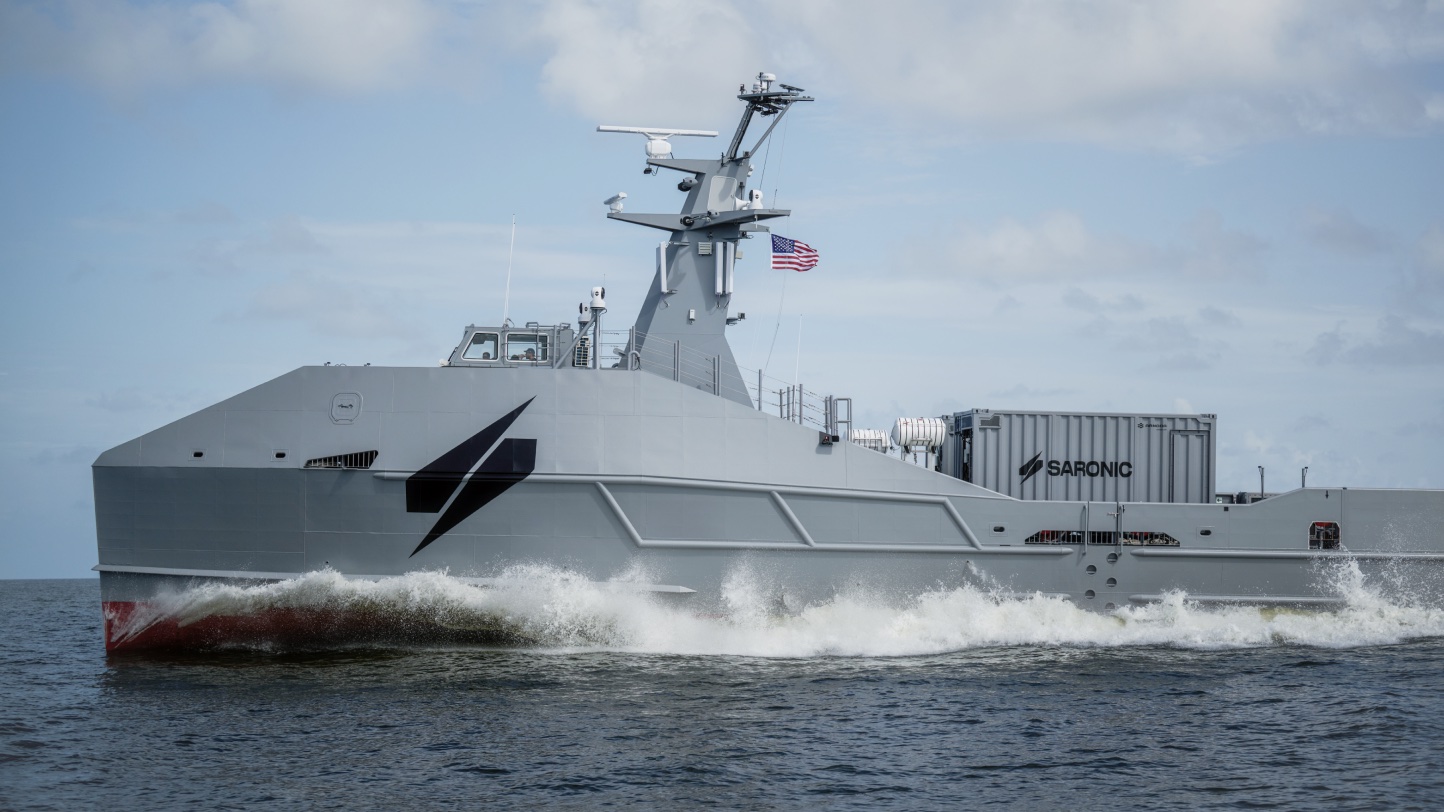
The US Navy plans to buy 30 Medium Unmanned Surface Vessels (MUSVs) from Galliano Marine Services, HII and Saronic Technologies after completing the first phase of at-sea testing, with the first vessels due for delivery before the end of fiscal year 2027, according to the service.
Each of the three companies has been awarded a production Other Transaction Authority agreement covering 10 vessels, at an average procurement cost of $40 million per boat. Across the three agreements, that amounts to roughly $1.2 billion. Three other firms that took part in the prototype phase, Leidos, PAC MAR and Sea Machines, were judged to have completed the work set out in their prototype agreements and will each receive a $15 million award under the terms previously agreed.
All six companies will be accepted onto the Maritime Marketplace hosted by Drones.mil, the Navy said, making them eligible for follow-on production agreements from acquisition authorities across the Department of War. On 23 September the service also released a Phase II Integration and Testing Call for Solutions, which it says is intended to widen the pool of offerings and meet future MUSV mission sets.
According to the Navy, Phase I testing assessed the vessels’ ability to perceive and understand the surrounding maritime environment, their autonomous navigation in line with the International Regulations for Preventing Collisions at Sea, and their capacity to carry out long-duration missions.
Acting Secretary of the Navy Hung Cao said in the release: “Our warfighters don’t have time to wait on bureaucracy while our adversaries pace forward.” He added: “Our message to the defense industrial base is simple: build fast, deliver on time, and match the urgency of the threat. This MUSV award is a prime example of how we are streamlining acquisitions to ensure our Sailors and Marines have the capabilities they need to fight, win, and come home safe.”
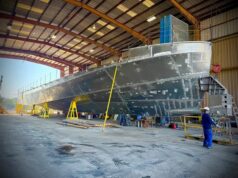
The Navy’s interest in medium-sized uncrewed surface vessels dates back several years, with earlier efforts including DARPA’s Sea Hunter, the Overlord programme and a 2020 MUSV prototype contract awarded to L3Harris. The three production awardees take different approaches. HII has developed its ROMULUS family of autonomous vessels, Saronic has expanded from small autonomous boats towards larger designs, and Galliano Marine Services comes from the Gulf Coast offshore vessel sector.
The Chief of Naval Operations was quoted in the release as describing MUSVs as part of the hedge strategy set out in the service’s Fighting Instructions. “They give commanders a Tailored Offset — additional capacity and capability that can be rapidly adapted to the threat, distributed across the battlespace, and placed at risk without placing Sailors at unnecessary risk,” the CNO said. “Just as importantly, MUSVs give us a platform for rapidly integrating new sensors, weapons, and other mission payloads as technology and operational requirements change. This is about moving beyond experimentation and putting reliable, combat-relevant capability into the hands of our Sailors at the speed the Fleet requires.”
Fielding will be led by the Direct Reporting Program Manager for Robotic and Autonomous Systems, working alongside the Robotic and Autonomous Systems Warfighting Development Center, which is responsible for developing tactics, training and operational experience for the vessels. Under the Navy’s Containerized Capability Campaign, the service intends to use modular payloads so commanders can fit sensors, weapons and other mission equipment to the boats according to the task at hand.


Arm the ship like a light corvette and price shots to 150M$ with SAM’s, SSM’s, guns at least…
Weapons in a box are cheap. No guns, no combat level radar.
Are we not planning to build this sort of stuff ourselves?
Not saying we shouldn’t do this initially however the long term plan should be to build this soft of thing ourselves in quantity.
The first to be delivered by 2027. The MOD will still be just talking about ours.
Hopefully MOD will be looking closely at this. Not so much imho to order a lot of stuff but more to see what the USN experience is. What are they for, do they actually work and are they cost effective etc. Yes it will use up time but if it can help inform the UK and lead to better outcomes its likely worth it given how short money is at moment.
Hung Cao is moving very fast for the bureaucracies, very unusual. And $40 million each is an absolute bargain. At this rate, US could keep up with China.
Unmanned vessels should have basic cabins for a small crew to be rotated in and out, crew not to exceed 4 sailors. Keep it manned in peacetime if it is deployed near China or Iran, for example, to reduce the risk of it being boarded and taken.
Take the crew off during wartime so there is no risk to the crew in action.
Command of a small vessel would get on a petty officer’s record, and the crew as a whole would be out on their own, so it would not be hard to find volunteers.