

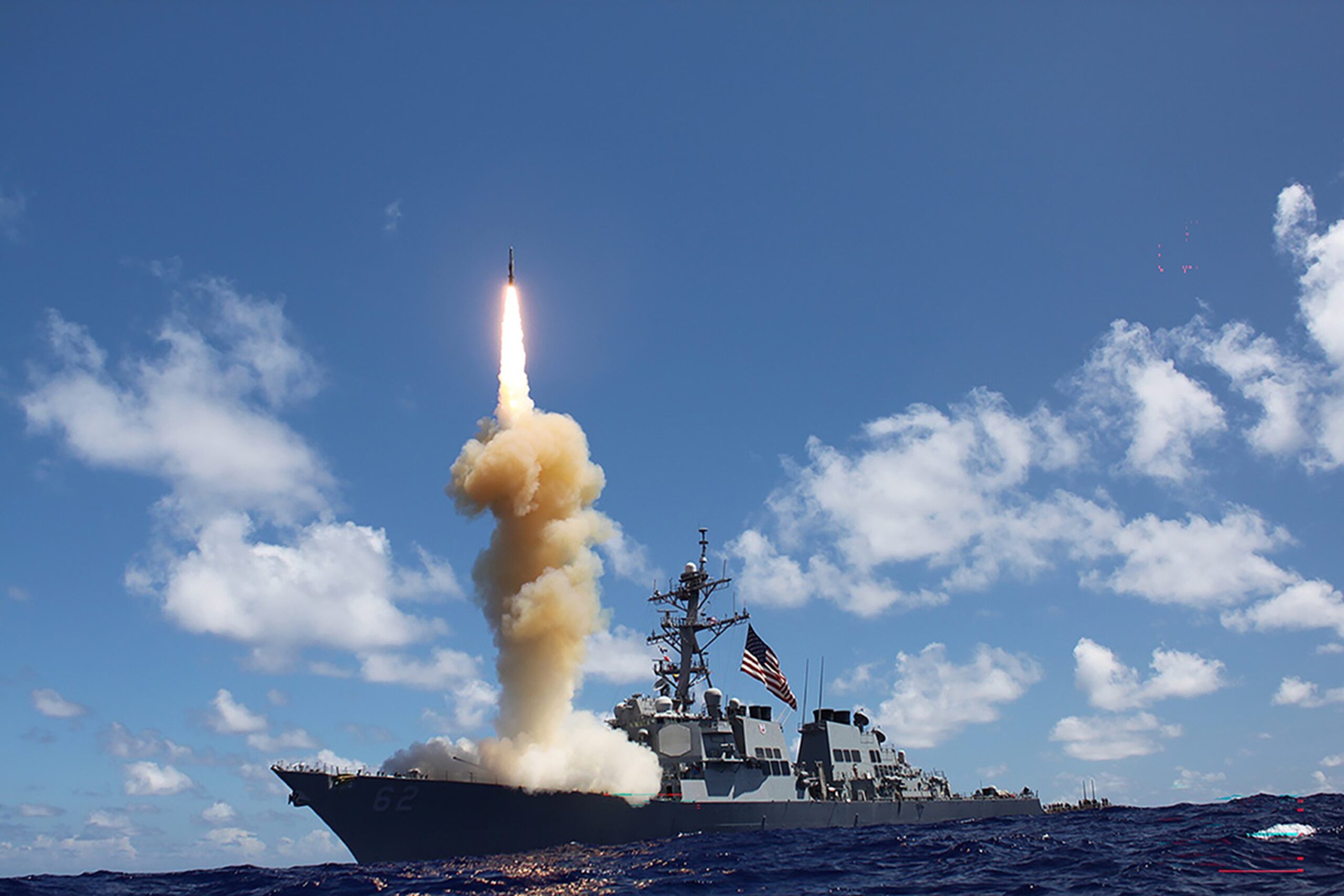
The U.S. Navy has awarded Raytheon a five-year contract worth up to $24.4 billion to accelerate production of the Standard Missile-6, its principal long-range anti-air and anti-surface weapon.
Announced on 1 October by Acting Secretary of the Navy Hung Cao, the multi-year procurement agreement includes two additional option years. The U.S. Navy says the long-term commitment is intended to give the RTX business the stability and predictability needed to expand production capacity, while delivering cost savings through a negotiated deal rather than year-by-year buys.
“Maritime strength demands weapons at speed and scale,” Cao said in the release. “This investment expands production and delivers the firepower our warfighters need to fight, win, and come home safe.”
The SM-6 has become one of the most versatile weapons in the surface fleet’s inventory. Fired from the Mk 41 Vertical Launch System aboard Arleigh Burke-class destroyers and Ticonderoga-class cruisers, it can engage aircraft, cruise missiles and ballistic missiles in their terminal phase, and can also be used against surface ships. Its active radar seeker allows it to engage targets beyond the horizon of the launching ship when cued by other sensors, a key element of the U.S. Navy’s Cooperative Engagement Capability. U.S. warships have fired SM-6s in combat during operations in the Red Sea and Middle East since late 2023, including against Houthi anti-ship missiles, drawing down stocks of a weapon that costs several million dollars per round.
Adm. Daryl Caudle, Chief of Naval Operations, linked the contract directly to the size of the fleet’s magazines. “Combat credibility depends on having enough weapons, produced at the speed and scale the Fleet requires,” he said. “This SM-6 award gives industry the demand signal and stability to expand production, strengthen the munitions industrial base, and build the magazine depth our Fleet needs. That is the Foundry delivering for the Fleet – and ensuring our Sailors have the combat power to fight and win.”
The award is being managed by the U.S. Navy’s Portfolio Acquisition Executive (PAE) Munitions, an organisation responsible for the development, procurement and delivery of naval munitions and strike capabilities. It follows a recent Tomahawk contract, which the service describes as part of the same effort to speed up weapons production across the portfolio.
“This award demonstrates what is possible when the Department leverages innovative acquisition approaches to deliver capability at the speed of relevance,” said Van Hendrey, Portfolio Acquisition Executive for Munitions. “Through PAE Munitions, we are bringing together the authorities, resources, and partnerships needed to accelerate production, reduce costs, and strengthen the industrial base that supports our warfighters.”
Raytheon produces the SM-6 at its facilities in Tucson, Arizona, with final assembly at Redstone Arsenal in Huntsville, Alabama. The missile has also been cleared for export to a number of U.S. allies, with Japan and Australia among the nations to have pursued it for their own air defence destroyers.
According to the U.S. Navy, the agreement will support a larger workforce, higher manufacturing throughput and stronger supply chains for the missile, as part of a wider push to rebuild the defence industrial base and keep Navy and Marine Corps forces supplied with advanced weapons.



If announcements were missiles then the USA wouldn’t be having to withdraw all its forces from the Middle East. I suspect despite the never ending announcements and dumper trucks of cash being levied at us defence contractors I doubt we will see much of an increase in missiles.
Despite the obvious animus, it appears like the Americans are at least trying to address some of the frailties exposed by the current conflicts. Instead of sticking their heads in the sand and hoping it goes away. The UK announcements, without the dumper trucks of cash I hasten to add, tend to be about things that don’t even exist yet.
This might be part of a growing pattern: the US has also spent a ton of cash on trying to bolster its shipyards in recent years – both for construction and for maintenance – but there aren’t many signs of that having made a difference.
Perhaps the mainstream opinion will be provided wrong and that regular testosterone injections WILL turn out to be the magic bullet that gets the US military firms up the US military again. Lol.
I agree Tim, clearly it’s low testosterone levels that stop companies like Boeing, Raytheon and LM delivering.
The speed in which you can build ships and planes isn’t something that you can turnaround overnight. Most missiles though, probably at a faster pace. More importantly, as has been ably pointed out on many occasions on this site, commitment allows companies to plan for the future and are more likely to invest in new infrastructure and development than if the Govt sits on its arse and dithers about it. There have been MANY a comment about how the Russians are going to do something before 2030 and our Govt does nothing about it, especially in terms of investment. What’s it going to be? Can’t have it both ways.
Yeah but we are not talking over night here. The US has been trying to boost submarine and surface ship production for over ten years and it’s pumped vast amounts of money in and gone backwards.
The US first started trying to boost Patriot production numbers in 2018. Nearly a decade ago and it’s got little to show for it and now it has a new mega announcement with the same company.
I’m just not holding my breath on it, US legacy defence contractors appear to be no longer able to do even the basic jobs no matter how much money is pumped in.
Fair enough. Maybe Mr. Testosterone is the guy to kick some ass and get the ball rolling. I think he’s proved, rightly or wrongly that he is not afraid to upset the cattle cart. I hope so, because I think someone needs to.
Certainly Ukraine and the ongoing nonsense in Iran has proven how thin the west was in relation to stores, supplies and ammunition of all natures! However all this needs time, as we are all aware (at least this who are interested) just how long the manufacture of platforms and assets now takes!
I agree Airborne, remember that time when we went to war and had everything we needed and there was no national scandal about ammunition shortages. 🤦♂️
People are fond of saying that the BEF of 1914 was perhaps the best trained and equipped army ever fielded by Britain. The main headlines of 1915 were about ammunition shortages that Lloyd George staked his career on fixing and failed.
Yes and remember knocking up a Royal Aircraft Factory B.E2 was a little bit easier and quicker than a Typhoon etc, and the ammunition factories were in place but the consumption was far beyond expectations, thanks for confirming my point Jim, it’s all about time and the will to act, both which is lacking at the current time.
The current shortage of SM6…is this due to using them to shoot down ” worthy” or difficult targets…ballistic types etc…of have a lot of them been used on ” non worthy” targets…Shaheads and so on? If so then perhaps essm2 should be ramped up and more widely fitted.
Ditto with camm or camm/er really…although the world’s best air defence platform ( go on..say it…you know you want to) is going to be refitted with camm in order not to waste valuable longer range stuff.
I know everyone has said it, but camm/mr when or if it eventually sees the light of day would be a valuable money saver in the longer range department against most things.
AA