

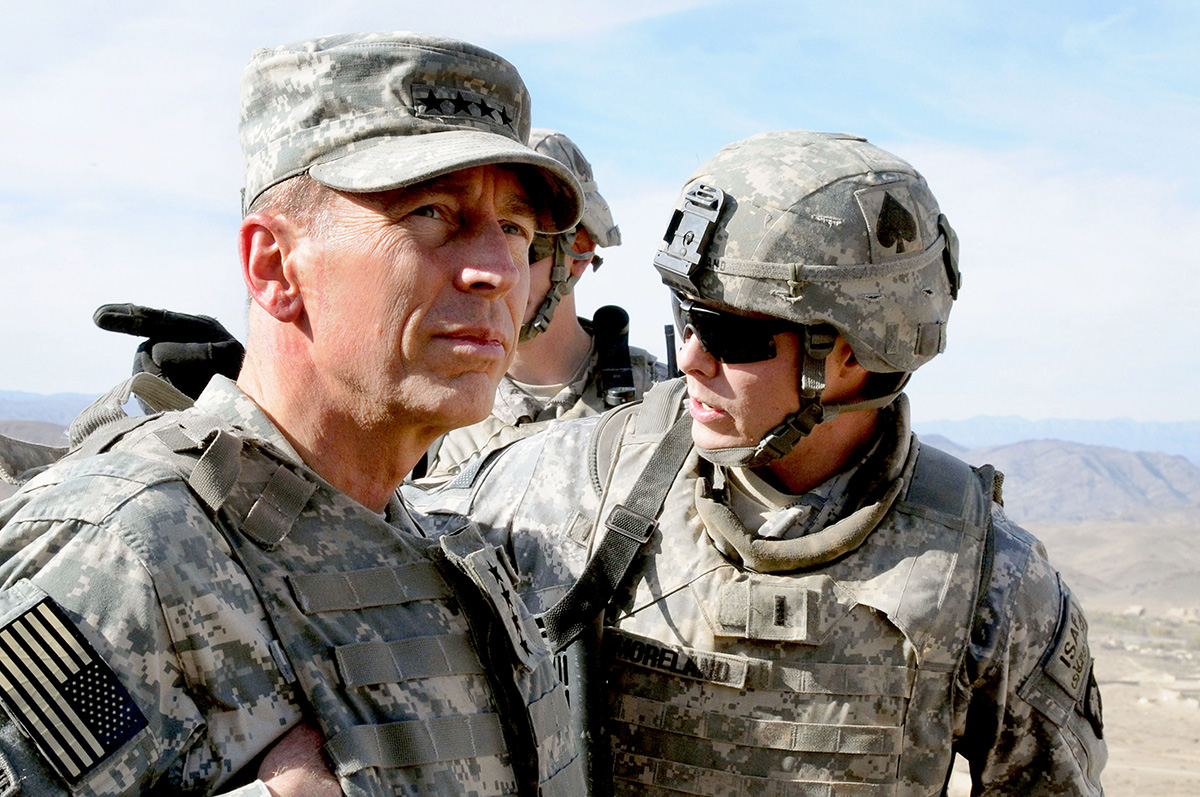
Britain should become the first major Western country to reorganise its defence institutions around lessons emerging from the war in Ukraine and use that experience to help drive a wider transformation of NATO, General David Petraeus has told the House of Lords.
Delivering the Lord Speaker’s Lecture on 1 September, the retired four-star US Army general argued that the nature of warfare is changing quickly enough to require more than conventional modernisation programmes. Petraeus said Britain’s early recognition of the threat posed by Russia and its sustained support for Ukraine had demonstrated what he described as strategic clarity, giving the UK an opportunity to take a leading role in reshaping how Western militaries organise, train and equip themselves.
Petraeus said: “Britain now has an opportunity to demonstrate that same quality once again. Just as it helped lead the Alliance in recognizing the strategic implications of Russia’s aggression, it can now help lead the Alliance in recognizing the revolutionary implications that Ukraine holds for the future of warfare itself.”
He described Ukraine as “the defining military laboratory of the twenty-first century”, arguing that its importance lies not simply in individual technologies but in the way sensors, software, unmanned systems, electronic warfare, precision weapons and industrial adaptation are being combined. Petraeus said information is being collected, analysed and acted upon at unprecedented speed, while commercial innovation is moving directly onto the battlefield and software, hardware and operational methods are being adapted while fighting is underway.
He told peers: “Much of the discussion has understandably focused on individual technologies—unmanned systems, artificial intelligence, electronic warfare, cyber capabilities, precision strike, battle management systems, and others. Each matters. But the principal lesson is larger: the very concept of warfare is changing.”
Petraeus said Britain’s Strategic Defence Review and Defence Investment Plan showed an appreciation of the changes taking place, pointing to their focus on unmanned and autonomous systems, artificial intelligence, electronic warfare, industrial resilience, procurement reform and accelerated innovation. He cautioned, however, that those measures should be regarded as the beginning of a larger transformation rather than its completion.
He said: “The most consequential military transformations seldom begin with new equipment. They begin with new ideas. Additional resources will clearly be required in important areas, but the greatest obstacle to transformation is rarely money alone. More often, it is the difficulty of questioning long-established assumptions and overcoming institutional inertia.”
Petraeus continued: “And I believe the United Kingdom is unusually well positioned to do precisely that. Not because Britain is free of serious economic, fiscal, or political constraints—it plainly is not—but because, as we have seen in Ukraine, Britain has demonstrated the capacity to recognize strategic reality early and act decisively.”
He added: “That now presents Britain with another opportunity: to become the first major Western nation to organize its defence institutions around the new concept of warfare that Ukraine has been pioneering—and, in doing so, to help lead the transformation of NATO itself.”
Petraeus said NATO itself would also have to change, including the operational headquarters responsible for commanding Alliance forces. He argued that NATO needs a common understanding of the emerging concept of warfare before individual nations can reorganise their forces effectively around it.
He said: “NATO must now summon that spirit again, with far greater urgency, by developing a common understanding of the new concept of warfare and the institutional transformation that must follow.” Referring to NATO’s operational headquarters, he added: “Those headquarters will have to think, organize, and operate differently if they are to lead this transformation successfully.”
Petraeus said the process could not be limited to another incremental modernisation programme, calling instead for changes to force structure, professional military education, training, procurement, personnel policy, industrial engagement and the way battlefield lessons are identified and incorporated.
He said: “The question is not whether this transformation will occur. It is already underway—most visibly in Ukraine, but also in Russia, the Middle East, and elsewhere. The question is whether we will lead it—or be forced to catch up to those who do.”










He gives us a lot of credibility, that is rather bold.
Or because it’s true and correct.
I agree with the General
However we are hitting off an entrenched media complex propped up by very very ex generals and talking heads far too keen to promote the capabilities that were developed for the later part of the Cold War or the global war on terror to support US operations.
Our military still continues to invest in such capabilities while shunning ABM, sub strategic nuclear weapons and conventional ballistic missiles which are the main offensive and defensive capabilities Russia is fielding.
There is still far too much of an attitude in the MoD and especially the army to leave it to someone else (the Americans) to provide all the strategic enablers, while concentrating on the capabilities they want to like Special Forces and Armoured Recce despite the mounting evidence that if we fight Russia their won’t be anyone (the Americans) their to provide capabilities.
If an Army cannot defend itself against ballistic missiles it has no place on a modern battlefield, it’s nearly useless and yet we are spending £10 billion on armoured vehicles and £2 billion on helicopters for special forces and just £750 million earmarked for ballistic missile defence which will probably be just a radar and no missiles.
No idea why you are having a pop at the Army here🤔the Army will fight nowhere near Americans as they have there own areas to defend and work in(if they are still in the game)as for ballistics again the Army hopefully will be mobile or spread out that they would be less of a target for such missiles,unlike fixed RN & RAF bases! The Army also still need armoured vehicles for attack,defending and protecting soldiers it can’t all be done by drones! Ukraine is a different kettle of fish as basically it is a WW1 battleground using modern weapons although of course there are things to be learned and adapted for our needs!
Budget realities show a different picture though – another billion on the obsolete & unusable Ajax. A vehicle described by GD at the Bid stage as ‘verified to 42 T’ and ‘Low risk’ apparently now after 16 years now needs automatic track tensioners to make it usable?
Additionally after being in storage for a few months most of the vehicles are non functional – I have been told only 30% are functional – or to put it another way 70% of the fleet isn’t available. This apparently mirrors reliability in the field which is horrific to. Users have to get out every time the vehicle stops to carry out checks. Surely we are not wasting more taxpayer cash on this poorly built Spanish vehicle? Word on the street is the troops have lost confidence in the CofC now on Ajax too – obviously this is a dangerous situation for the army. If no one believes in it surely it’s time to cancel it