

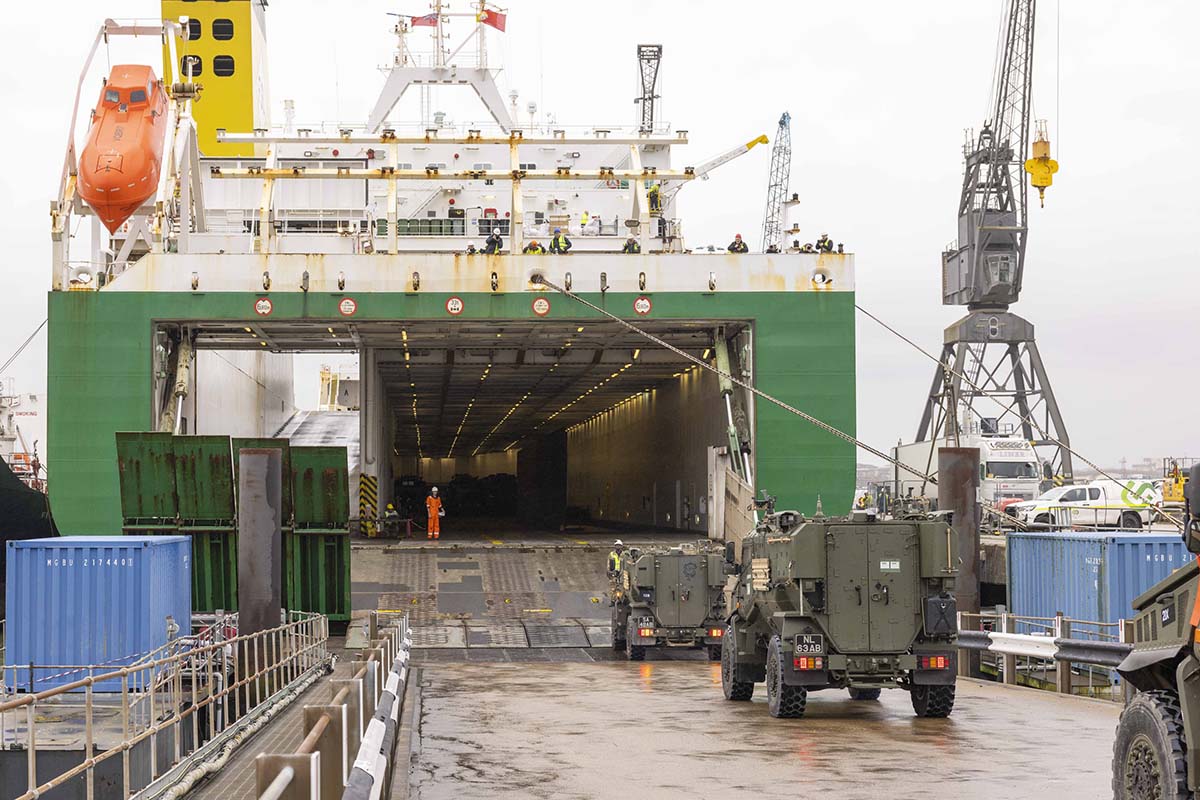
Britain’s existing system for requisitioning civilian merchant vessels cannot guarantee that suitable ships and crews will actually be available during a military crisis, with the pool of militarily useful British shipping having nearly halved since 2009, according to the Council on Geostrategy.
The warning appears in the Council’s new study of strategic sealift and maritime resilience, which examines the reliance of NATO militaries on commercial shipping. The report cites UK Defence Journal figures showing that the number of militarily useful British vessels fell from 841 in 2009 to 495 in 2023, while noting that Britain has relatively few options between requisitioning commercial vessels and its dedicated fleet of four roll-on, roll-off ships.
Under the Ships Taken Up From Trade system, commonly known as STUFT, the government can compel owners to provide vessels for military use. The mechanism was used extensively during the Falklands War, when 45 commercial vessels were chartered or requisitioned to augment government-controlled shipping. More than 60 merchant vessels were also required to move military equipment at the beginning of Operation TELIC in 2003.
The report argues that the modern international shipping industry makes reliance on the same mechanism more difficult. British authorities can legally requisition only vessels registered under the British flag, while a ship acquired through those powers would not necessarily arrive with an appropriate crew, the required specialist competence or equipment needed for military operations.
Freer and Kleberg write: “While requisitioning or utilising STUFT is legally possible to enforce, the maritime industry is international by design. Despite HM Government being able to access the required ship type, the requisitioned vessels could still end up without crew, necessary competence, or the operational organisation supporting them – potentially including the need for emergency refits to enable handling military cargo or taking onboard defences for contested environments.”
They add: “What this means is that STUFT, while a useful tool, cannot guarantee practical access.”
Crew availability forms a separate problem. The report notes a long-term decline in the maritime workforce combined with increased dependence on multinational crews. Across the European Union, only 38% of seafarers are EU nationals, according to figures cited by the authors. Nationality restrictions, security requirements and the willingness of crews to sail into contested waters could therefore further reduce the number of vessels practically available for military use.
Britain’s dependence on shipping extends beyond defence requirements, with around 95% of UK trade transported by sea. The report says British-flagged militarily useful capacity has continued to decline as companies registered ships elsewhere, while taxation, liabilities and other commercial pressures have contributed to the erosion of nationally affiliated fleets.
The authors argue that framework agreements negotiated with shipping companies before a crisis would provide greater certainty than relying on requisition powers once demand for suitable vessels has already increased. They warn that ships could otherwise be unavailable because of competing commercial commitments, sanctions, insurance restrictions or rapidly rising charter prices.
They write: “In the absence of such agreements established in peacetime, ships may be unavailable in a crisis due to competitive pricing, sanctions, or insurance withdrawal. Assumed capacity disappears quickly in such scenarios.”
The report recommends greater use of long-term agreements with commercial operators alongside measures intended to increase British flagging and improve the availability of trained mariners. It also proposes exploring reserve mariner arrangements and greater participation by commercial operators in military planning and exercises so that access to ships, crews and supporting infrastructure can be tested before they are required during a conflict.



Another weak spot in our defenses. Sadly, we could be weeks away from an expanding conflict with Russia, and still we commit to welfare with more urgency than defence. However, all that will change when the drones arrive.
Well some sort of tax break is needed for British owned, flagged & crewed merchant ships that have a wartime role.
Doesn’t help that companies like P&O ferries can illegally mass fire all their British crew and officers to replace them with cheaper workers without even a slap on the wrist by the government
Hopefully the strategic sealift future program will actually gain and retain all 6 ships, and be as much of a success as the current pfi
Who would have thought that not pursuing policies encouraging UK-flagged vessels through a system of cheaper loans for ship procurement and British-crewed vessels would never bite us in the rear end? Even the US let its ReForger capability die out. It’s as if politicians have forgotten we live on an island, one that’s relatively easy to isolate.
We are STUFT.
Unfortunately another report pointing out that the “Emperor has no clothes”. One option is to subside some UK flagged merchant ships to incorporate military features (e.g. for enhanced comms, structural strengthening, flight deck and fittings for self defence systems and a RAS rig) and have predominately British crews. Standard practice for Chinese ships, but undoubtedly not something the MOD will want to fund over other priorities.
So hardly any RN or RFA ships and now ship’s for trade are hard to come by .Oh dear me is they any good news on defence for the UK. 🤔
Will anything in the MOD work if the Balloon goes up..Doubt it…!