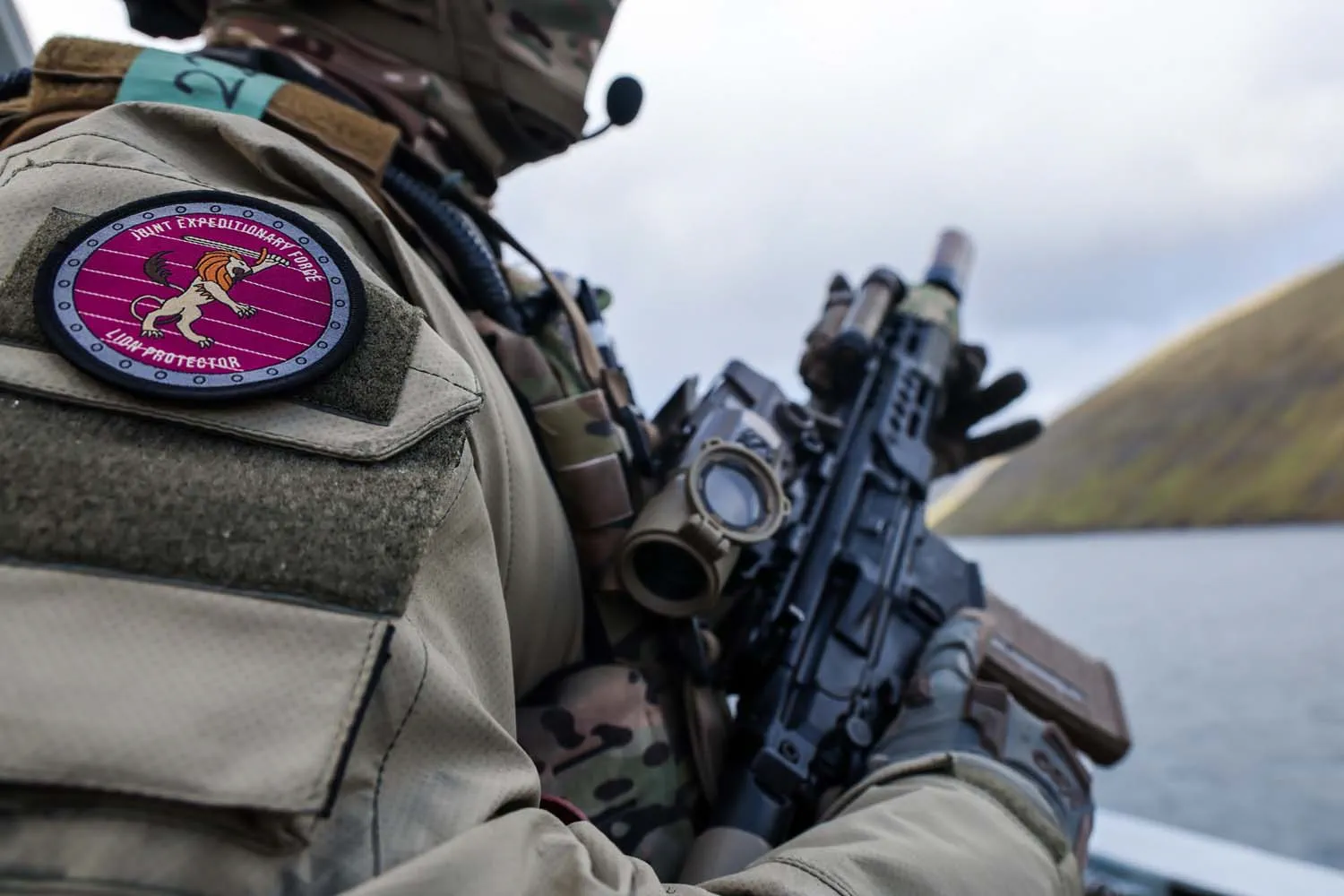
Royal Marines have deployed to the Faroe Islands for the first time since the Second World War, training with Danish and Faroese forces around the strategically important Greenland-Iceland-UK Gap, according to the Royal Navy.
The deployment formed part of Exercise Lion Protector 2026, a Joint Expeditionary Force activity intended to test how quickly participating nations can respond to events across the High North and the approaches linking the North Atlantic with the Baltic Sea.
Commandos from the UK Commando Force deployed as part of the Allied Reaction Force Special Operations Maritime Task Group, or SOMTG, working with Danish forces and maritime agencies from the Faroe Islands.
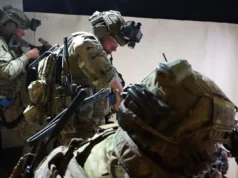
Training included maritime interdiction operations, with personnel practising the boarding, inspection and seizure of vessels, as well as small boat operations and coastal landings on steep and difficult terrain.
The Faroe Islands sit between Iceland and Scotland in the Greenland-Iceland-UK Gap, an important maritime route connecting the North Atlantic and Arctic. The area has long been closely watched by NATO because Russian naval vessels operating from bases in the north use routes through the wider region to reach the Atlantic.
According to a Royal Navy news update, First Sea Lord and Commandant General Royal Marines General Sir Gwyn Jenkins said: “Defending the Atlantic is fundamental to our economy, national security and way of life. In troubling times, we cannot be complacent.
“The return of the Royal Marines to the Faroe Islands should send an unequivocal message: the UK, alongside Denmark and our other allies in the Joint Expeditionary Force, stand ready to protect the waters, islands and vital routes that keep our nations secure.”
The exercise is the principal 2026 deployment for the UK Commando Force’s Allied Reaction Force Special Operations Maritime Task Group. The formation is designed to provide NATO with forces able to deploy at short notice for missions including recapturing vessels or offshore infrastructure and conducting reconnaissance or raids along coastlines ahead of larger amphibious operations.
The task group includes specialist personnel from across the Royal Navy and UK Commando Force, including boarding teams, pilots, engineers and small boat crews.
During Lion Protector, personnel practised approaching target vessels, using boarding ladders and climbing aboard before carrying out searches and simulated seizures.
Training later moved ashore across the Faroes’ 18-island archipelago, where Royal Marines operated around steep volcanic terrain, established observation posts above maritime routes and conducted cliff ascents. The deployment also has a historical connection. Royal Marines last operated in the Faroe Islands during the Second World War after Germany invaded Denmark in April 1940.
Britain subsequently launched Operation Valentine, with Royal Navy destroyers sent to Tórshavn before around 250 Royal Marines landed from HMS Suffolk. British forces remained on the islands until 1945, when control was returned to Denmark. The Joint Expeditionary Force brings together the United Kingdom, Denmark, Estonia, Finland, Iceland, Latvia, Lithuania, the Netherlands, Norway and Sweden, with its activities focused primarily on Northern Europe, the North Atlantic, Baltic Sea and High North.
Exercise Lion Protector ran between August and October and was designed to rehearse military response options across the High North and through the Danish Straits into the Baltic Sea. The Royal Navy said the activity was intended to improve the ability of JEF forces to deploy and operate together across the region.
The training takes place ahead of the Atlantic Future Forum and International Sea Power Conference aboard HMS Prince of Wales later this autumn, which will bring together defence leaders, industry representatives and policymakers to discuss Euro-Atlantic security.