

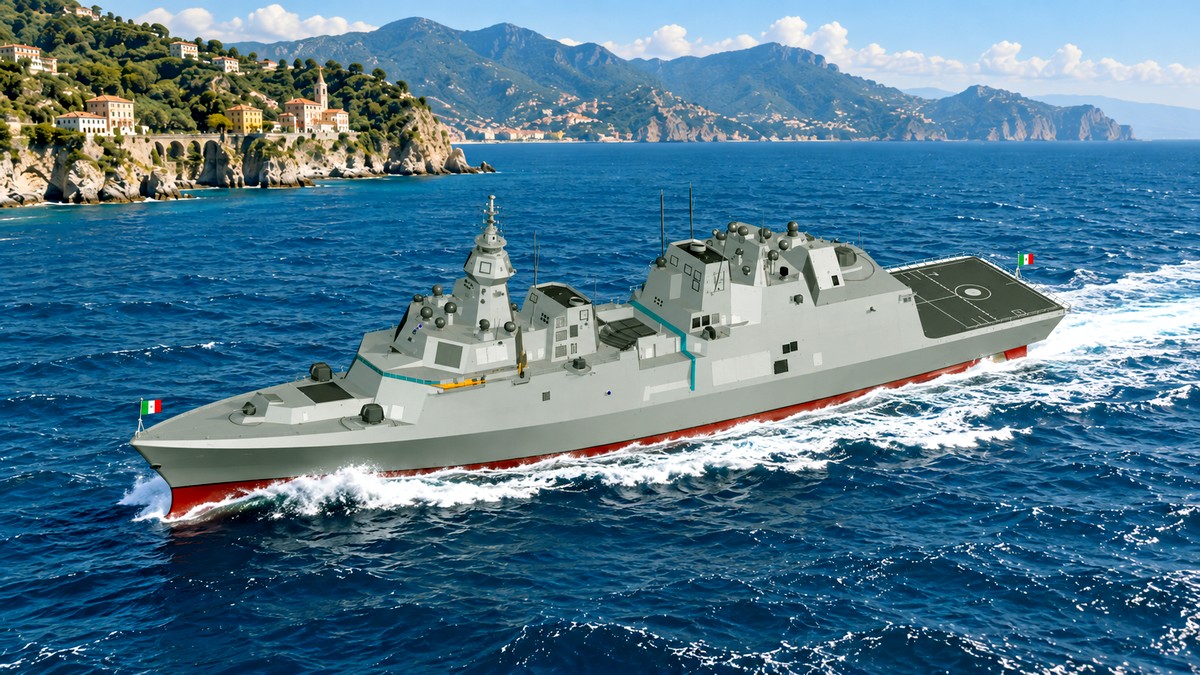
Italy has placed a contract for two new DDX destroyers for the Italian Navy, with the programme valued at approximately €3.7 billion including around €1.3 billion in options, according to Orizzonte Sistemi Navali.
The contract was signed between OCCAR and Orizzonte Sistemi Navali, the joint venture owned by Fincantieri and Leonardo, and covers development, production, logistics studies and initial in-service support. Fincantieri holds 51% of OSN and Leonardo 49%, with subcontracts expected to be placed in the coming weeks worth around €1.8 billion and €1.7 billion respectively.
The two ships are intended to replace the Italian Navy’s Horizon-class destroyers and will be considerably larger vessels, measuring around 180 metres in length and displacing 13,500 tonnes. Each will have a crew of 251 and a stated range of 4,000 nautical miles, with deliveries scheduled for 2033 and 2035.
Fincantieri will act as platform system integrator, while Leonardo will develop the combat system. OSN says the ships are being designed around a high degree of automation and digital integration, bringing together sensors, weapons, command-and-control systems and ship-management functions within a common architecture intended for multinational operations.
The combat system will include Leonardo’s SADOC 5 C5I system, a high-power fully digital S-band AESA radar and an MBDA weapons package. According to the company, the combination is intended to give the DDX an Integrated Air and Missile Defence capability against conventional missile, ballistic and hypersonic threats.
The platform will also incorporate a DC power sub-network with energy storage, a new stabilisation system integrated with the ship’s steering system and further development of Fincantieri’s digital ship-management architecture. The company says the design will also allow the destroyers to manage uncrewed surface and underwater systems as part of the wider combat system.
Pierroberto Folgiero, Chief Executive Officer and General Manager of Fincantieri, said: “The DDX programme represents a strategic milestone for Fincantieri and for Italy’s national defence industry. It is one of the most significant naval programmes launched in Italy in recent years and confirms Fincantieri’s role as an industrial and technological reference point in the design and integration of complex naval systems.”
Leonardo Chief Executive Lorenzo Mariani said: “Taking part in this programme – which is set to establish new standards in naval defence capabilities – confirms the Italian Navy’s confidence in Leonardo’s technologies, which are capable of meeting the need to operate in an integrated manner across different domains and in complex scenarios.”
The DDX design also incorporates Fincantieri’s Navis Sapiens concept, intended to bring together data generated across the ship for operational decision-making, technical management and maintenance. Connectivity with shore facilities is planned to support predictive maintenance, logistics and the transfer of mission information between ship and naval base.




Actually seems like a quite a reasonable cost for such a large and capable warship. All this talk of £3 billion for a Type 83 seemed a stretch to justify it’s cancellation imo. In fact I think these ships workout cheaper than a flight 3 burke.
Because they’re built in Europe’s shipbuilding capital, home of efficiency and cheap prices.
You reckon BAE, who has spent the last decade building Glasgow for a similar price to one of these Italian destroyers, has any particular interest in being cheap or efficient?
While I would like to believe that theory, UK defence procurement is considerably more complicated in reality.
The MOD does not simply hand contracts to companies such as BAE Systems and allow them to name their price. Defence procurements are subject to formal procurement procedures, supplier qualification, competitive tendering and published award criteria. Under the current Procurement Act, the MOD can use a competitive flexible procedure that effectively allows it to shortlist suitably qualified suppliers before inviting them to tender. Suppliers must demonstrate the financial, technical, and organisational capability required to deliver the contract.
A statutory system also controls pricing where genuine competition is not available. For qualifying single-source defence contracts, generally contracts worth £5 million or more, the MOD has access to detailed cost information and audit rights. At the same time, the SSRO regulates the methodology used to determine the contractor’s profit rate. For 2026/27, the baseline profit rate is 9.10%, although the actual contract profit rate is adjusted under the statutory formula and to the risks and circumstances of the individual contract. So the idea that defence contractors inflate prices and pocket whatever profit they want does not accurately describe how the system is designed to operate.
Where I think the criticism of MOD procurement has considerably more substance is on the Government side of the equation. The MOD has repeatedly struggled with the specification, management, development and delivery of major defence programmes.
The history of the Bowman programme is a good example. The replacement for the Clansman radio system faced years of delays, changing requirements, and technical problems. The National Audit Office reported that the original target for introducing Bowman by 1995 was missed, the MOD subsequently lost confidence in its preferred supplier, and it launched a fresh competition in 2000. The resulting Bowman and Combat Infrastructure Platform programme ultimately became a £2.4 billion programme. (National Audit Office (NAO))
That is the distinction worth making. There are mechanisms designed to control what defence companies charge. Mechanisms also exist for competition, supplier qualification, cost scrutiny and, where appropriate, regulated profit rates. But none of those mechanisms can compensate for poor government requirements, constantly changing specifications, weak programme management, unrealistic delivery assumptions or procurement decisions that are subsequently abandoned.
In many cases, the biggest financial risk is not simply what the contractor charges. It is what the Government asks industry to build, how clearly it specifies the requirement, how effectively it manages the programme and what happens when those decisions prove wrong.
I still think we should be investing in a bunch of T45 batch 2’s or a new destroyer until the CVV experiment conclusively demonstrates it’s capability. But for the Italians, with only two ships there will be gaps in availability.
It’s two ships, alongside their existing pair of Horizon-class DDGs. There’ll be a follow-up air defence programme to replace those two DDGs.