

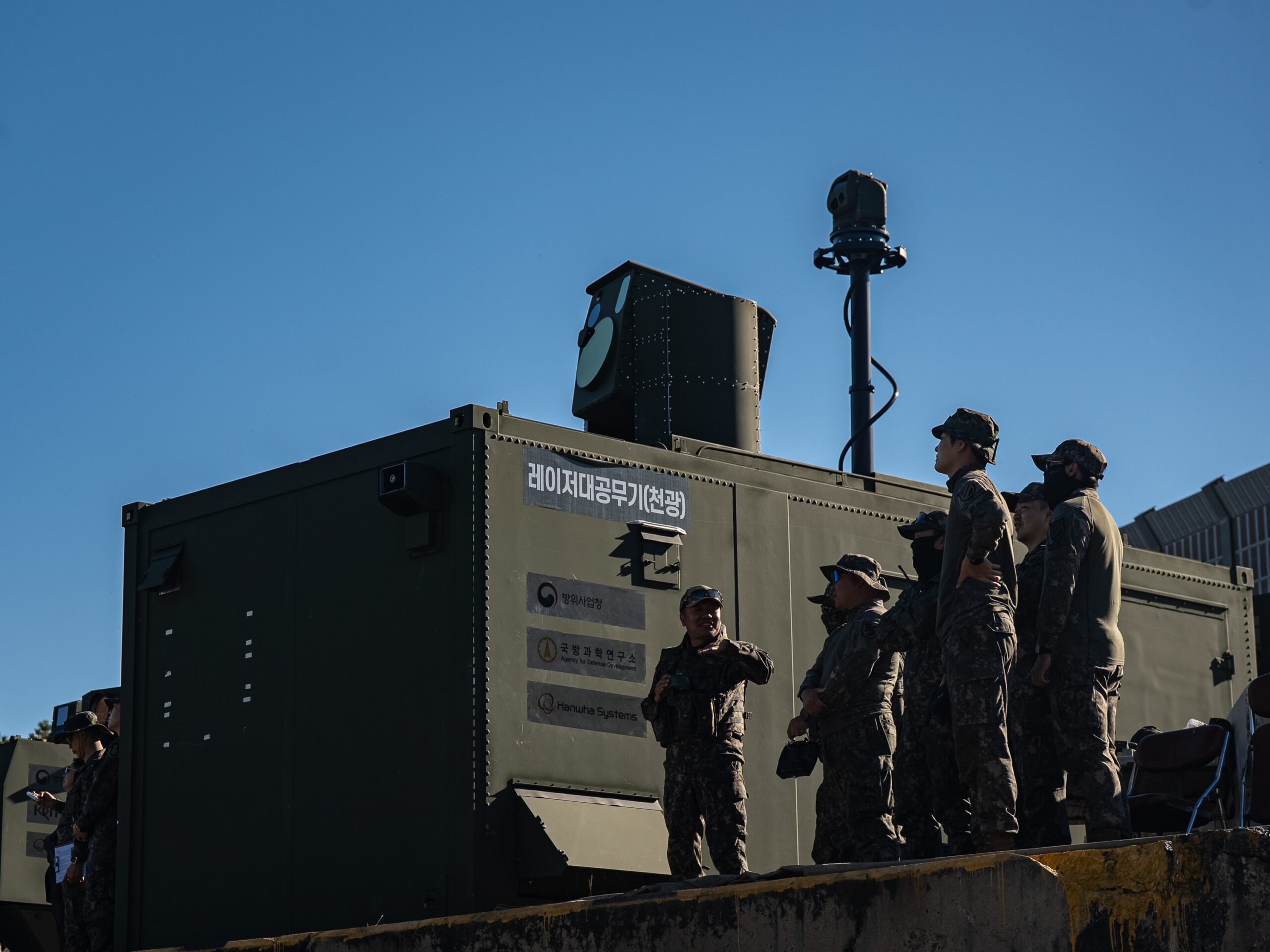
A South Korean laser air defence weapon destroyed all three target drones put up against it during a Republic of Korea Army exercise, at a cost the manufacturer puts at around one dollar fifty a shot, according to the company.
Hanwha Systems said its Cheongwang, the Laser Air Defence Weapon Block-I, and a 30kW class vehicle-mounted high energy laser cannon took part in the Army TIGER+ Future Warfare Integrated Combat Exercise run by Republic of Korea Army Headquarters on 14 October. Around five hundred people watched, among them the Chief of Staff of the Republic of Korea Army along with military officials, academics and industry figures.
Joohun Shin, head of the Laser Systems Business Centre at Hanwha Systems, said: “Laser weapons are core assets that will fundamentally change the game of air defense. Driven by unmatched technological capability and proven operational performance, we will accelerate our entry into the global market to establish both Cheongwang and the high-mobility, high-power 50kW Laser Armored Vehicle as key next-generation export items for K-Defense.”
Cheongwang, whose name means light of the sky, was developed by Hanwha Systems with the Agency for Defense Development and is the first laser weapon of its kind to be fielded operationally anywhere. The company puts the cost of a single engagement at about a dollar fifty and says the system can keep firing for as long as it has power, with no magazine to run down and no resupply chain behind it.
A Shahed type attack drone costs tens of thousands of dollars and the missiles fired at it cost far more, so an attacker generating cheap airframes in quantity wins on arithmetic even when every shot works. A laser inverts that, provided it can generate the power, hold the beam on target long enough to burn through, and see through the weather.
Hanwha ran a similar demonstration on 16 September at the 2026 Defense Drone Technology Exhibition, where it said Cheongwang neutralised four drones and two uncrewed aircraft in succession in front of domestic and international guests. It also showed a 50kW Laser Armored Vehicle there, a more powerful and more mobile system it is developing in-house for export, and took that vehicle to MSPO in Kielce in September, the largest defence exhibition in eastern Europe.
Britain has been working the same ground through DragonFire, the laser directed energy weapon developed by MBDA, Leonardo and QinetiQ with Dstl, which hit aerial targets in trials in the Hebrides in 2024 and is being accelerated towards installation on a Royal Navy Type 45 destroyer. The Strategic Defence Review committed further money to directed energy, and the Army has been trialling laser systems mounted on Wolfhound vehicles.




A Turkish 50kW laser was credited with taking down a Chinese drone in anger in Libya in August 2019. More recently, Iron Beam, an Israeli 100kW offering, has taken down Hezbollah rockets and was declared officially operational last year. So in what way is this the first of its kind to be deployed?
The Raytheon 15kW on Wolfhound is pretty much dead. DE&S created a £20m rapid procurement programme after the 2024 tests and it was never heard of again. The money was repurposed, some small part of it going to Dragonfire, the rest to R&D. I think the Raytheon laser support centre in Livingston survives.