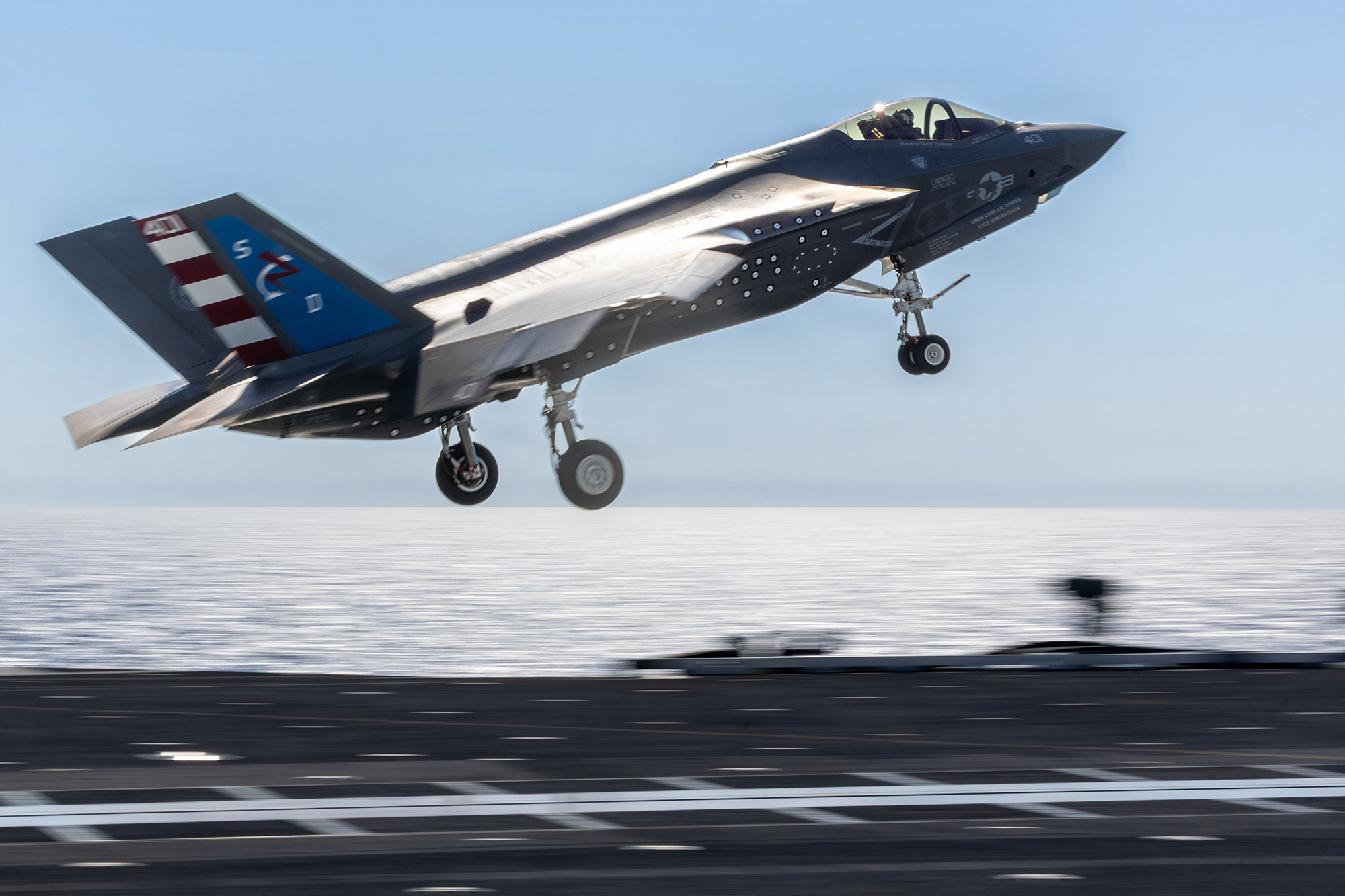
A US Navy F-35C Lightning II has completed the first arrested landing by the type aboard a Gerald R. Ford-class aircraft carrier, with the milestone taking place aboard the future USS John F. Kennedy during aircraft compatibility testing in the Atlantic, according to the US Navy.
The landing took place on 13 October aboard Pre-Commissioning Unit John F. Kennedy, designated CVN 79, as the second carrier of the Ford class continues testing ahead of its planned delivery to the Navy.
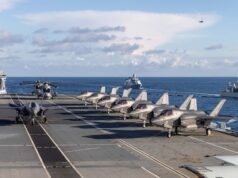
Aircraft from Air Test and Evaluation Squadron 23, known as the “Salty Dogs”, have been operating from the carrier during the trials. Imagery released the following day shows an F-35C conducting a touch-and-go from John F. Kennedy’s flight deck as testing continued on 14 October.
The current programme is focused on Aircraft Compatibility Testing, which assesses whether the ship’s launch and recovery equipment can safely and reliably support the different aircraft expected to operate from the carrier during service. For the F-35C, that means operating with two of the defining systems introduced by the Ford class: the Electromagnetic Aircraft Launch System, or EMALS, and Advanced Arresting Gear.
EMALS replaces the steam catapults used aboard the preceding Nimitz-class carriers with an electrically driven system for accelerating aircraft from the flight deck. Advanced Arresting Gear performs the other half of the carrier aviation cycle, absorbing the energy of an arriving aircraft when its tailhook catches one of the arresting wires stretched across the deck.
The F-35C is the carrier variant of the Joint Strike Fighter and was developed specifically for conventional US Navy aircraft carriers. It uses larger wings than the F-35A and F-35B, strengthened landing gear and a tailhook for arrested recoveries, allowing it to operate from carriers equipped with catapults and arresting gear.
Testing continued on 14 October with touch-and-go operations from the carrier. In imagery released by the US military, an F-35C from VX-23 is seen just above John F. Kennedy’s flight deck with its landing gear extended during one of the test sorties.
The US Navy said the carrier was underway conducting Aircraft Compatibility Testing, describing the work as an assessment of the operational capabilities of the ship’s aircraft launch and recovery equipment with Navy aircraft.
John F. Kennedy is the second Gerald R. Ford-class carrier, following USS Gerald R. Ford, which entered service in 2017. The class introduces a substantially redesigned aviation system compared with the Nimitz class, including EMALS, Advanced Arresting Gear, a revised flight deck layout and increased electrical generating capacity.
The carrier displaces around 100,000 tonnes at full load and is powered by two A1B nuclear reactors. Its flight deck measures more than 330 metres in length, with the class designed to operate a large embarked air wing including F/A-18E/F Super Hornets, EA-18G Growlers, E-2D Advanced Hawkeyes, helicopters and F-35Cs.
John F. Kennedy also differs from the lead ship in several areas, including its radar fit. From CVN 79 onwards, the class uses the AN/SPY-6(V)3 Enterprise Air Surveillance Radar together with the AN/SPQ-9B surface search radar rather than the dual-band arrangement installed aboard USS Gerald R. Ford. The ship remains in its pre-commissioning phase, with delivery expected in 2027. The latest aviation trials are part of the wider test programme required before the carrier can enter service and begin the process of integrating a full air wing.
The arrested landing on 13 October marked the first time an F-35C had completed a carrier recovery aboard a Ford-class ship, followed immediately by further flight deck testing as John F. Kennedy continues preparations for operational service.