

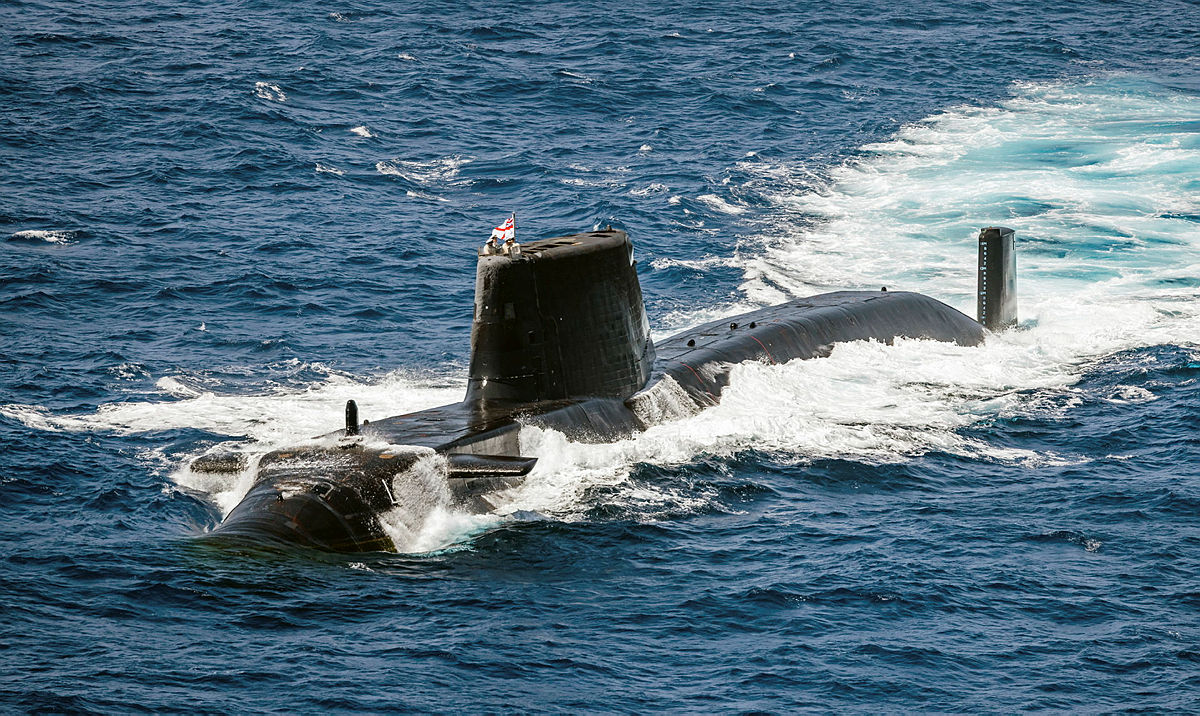
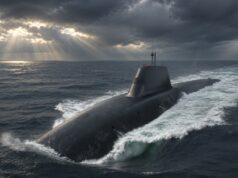
Two of the five Astute class submarines should be fully deployable and operational at all times, one patrolling northern waters or the Channel and a second working alongside the deterrent patrol, according to a briefing paper published by the 878 Institute.
The recommendation appears in the first of a planned series on the condition of the Royal Navy. It reads: “To ensure that two of the five Astute-class submarines are fully deployable and indeed operational at all times: one actively patrolling the North Sea, the Greenland-Iceland-UK (GIUK) Gap, or English Channel to deter increased Russian submarine activity around British waters; a second always patrolling alongside the CASD.”
It follows the paper’s account of the summer, which states: “Despite maintaining a fleet of five vessels, it was reported that not a single Astute-class submarine was operationally deployed through summer 2026, and that all five remained laid-up in British harbours. Only HMS Agamemnon (one of the two planned additions to the five in service) is at sea conducting trials.
“This is deeply concerning, given both the rise in Russian sub-surface activity around British waters, but perhaps more worrying because of the lack of available escorts for Britain’s nuclear deterrent.” The Ministry of Defence does not comment on submarine operations.
A linked recommendation asks for more money for the class, and warns of what follows without it. It reads: “To increase resource allocation for the troubled Astute-class submarines, all of which were in docks for a period from June 2026. Increased resources are needed to alleviate maintenance backlogs, industrial bottlenecks, and dockyard infrastructure limitations. Without this, the Astute-class must be said to be failing, and with it, Britain’s nuclear deterrent risks being left defenceless at sea or dependent upon allies for support, eroding the UK’s ‘sovereign’ nuclear deterrent.”
Setting a standing requirement of two boats available continuously would mean two fifths of the in-service class at sea at any moment. Sustaining that demands considerably more than two hulls, because the conventional planning assumption across submarine operating navies runs at roughly three boats for every one deployed, allowing for deep maintenance, work-up and crew training, so the recommendation implies six or seven available boats against a class of five with two more coming.
The Astute class carries two primary roles, hunting other submarines and protecting the Vanguard boats, and the paper describes both when it says the class exists for “anti-submarine warfare, as well as fleet protection for the nuclear-armed Vanguard-class.”
Devonport holds the only licence in Britain to refit nuclear submarines, and ministers told Parliament this week that the programme rebuilding the submarine berths there is being recovered after design difficulties, with construction still to start. The refit of HMS Vanguard at the same yard ran to seven and a half years against an original plan of three and a half.
Russian activity around British waters has risen, and the paper records that the Royal Navy spent twenty-one days in July alone monitoring Russian ships, and tracking operations rose twenty-five per cent on the previous year. The Defence Committee reported this month that availability among destroyers, frigates and attack submarines raises questions about whether Britain can meet its commitments in the High North, and that the department has accepted an anti-submarine warfare gap in northern waters.
The 878 Institute published a broader paper on British deterrence gaps in August, which UKDJ reported at the time.






Shouldn’t 1 be available to assist the QE’s when they depart?
Who are 878?
Big ask for a 5 boat fleet need another correct?
The gap between the reality of our SSN fleet and the ambition of AUKUS is so great that I’m surprised no one seems to be questioning whether it is realistic or affordable. I understand the logic that with an SSBN based deterrent, an SSN fleet may be needed in part to protect it.
But the main threats outlined by the think tank are close to home and could be countered by conventional submarines – cheaper to build and far easier to maintain. At present, we in effect have no operational submarines apart from SSBNs.