

It started not long after we reached the exercise area. On board the Swedish corvette HSwMS Helsingborg, the crew got louder and busier. Two men took the guns behind the bridge, orders were given and targets called out.
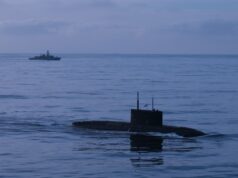
Then it came into view: a German submarine on the surface, and above it, maritime patrol aircraft descending through the cloud.
This was the first day of Exercise Dynamic Merlin 26, NATO’s anti-submarine warfare exercise in the Baltic, which ran from 9 to 13 November off the coast of Sweden. NATO calls it “a high-stakes game of hide and seek”. German and Swedish submarines try to stay hidden, while warships, helicopters and maritime patrol aircraft from eight nations, including the UK, try to find them.
From playbook to Dynamic
Merlin began as a smaller training event. This year, for the first time, it ran as a full Dynamic-series exercise, alongside NATO’s larger anti-submarine exercises in the North Atlantic and the Mediterranean.
“Before, it was a playbook, kind of working through some basic level exercises and some scenarios,” said Rear Admiral John Craddock, the US Navy officer who commands NATO’s submarine forces. “Now that it’s dynamic, [we’re] being able to bring it up to a more advanced level, to really challenge the interoperability of the crews, the ships, helicopters, to work together on a common problem set.”
The Baltic is often described as contested, congested and confined, and Craddock agreed with all three. “We have to make sure that everyone sees that we can do these operations, that we can demonstrate the interoperability, that we can show deterrence through those exercises,” he said.
A difficult sea
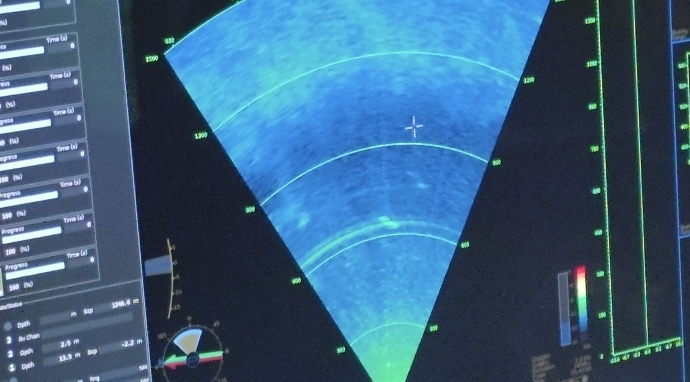
The Baltic is one of the hardest places in the world to find a submarine. It is shallow, crowded with shipping, and layered with cold river water that bends sound.
“The confined area here is actually the tricky part. The bottom is always in play,” said Rear Admiral Johan Norlén, Chief of the Royal Swedish Navy, at a press conference in Stockholm before the exercise. He called the Baltic “a very unique and in some ways extreme area” and “a hotspot for some time now”.
The traffic is relentless. On one flight during the week, the crew of a Canadian helicopter counted up to 60 ships in an hour. Craddock said that was simply part of the job. “We have to have that awareness of red dots, blue dots and white dots, to understand where everyone is, and then to protect shipping, and to minimise any kind of collateral damage to other vessels.”
It is also a sea where what happens beneath the surface now draws public attention. Days before the exercise began, a Finnish court jailed the Russian captain of the cargo ship Fitburg for dragging its anchor along the seabed and damaging telecommunications cables between Finland and Estonia. Craddock said protecting undersea infrastructure starts with awareness: “Understanding who, what ship is what, what they’re doing. […] Part of this exercise is to get out there and build that picture, both above the water and then through submarines and other technology under the water.”
The task group
At the heart of the exercise was Standing NATO Maritime Group One (SNMG1), five ships from the Netherlands, Germany, Canada, Denmark and Finland, led by the French Rear Admiral Nicolas Molitor.
“The main objective is also, of course, working on interoperability. So it’s about tactics, it’s about techniques, and to see how we can best integrate with allies,” Molitor said. “And of course, this all in the overarching aim is to show NATO’s unity and its ability to deter and act and operate whenever necessary.”
He said the exercise brought together two kinds of navy. “We have the blue water navies, which are used to working in the Atlantic Ocean with deep waters, and we are here in an environment where the waters are […] very, very shallow, and this is very specific.”
The group’s training is planned by a Royal Navy officer, Lieutenant Commander Jonny Miller. He said NATO’s shared procedures meant allies could work together at almost no notice. “If I’m driving my task group, sorry, I went full RN there, driving my task group through an open patch of water and I just encounter an ally, we have that ability to pick up the radio, get on the chat, and just say, ‘Hey, we’re going the same place. Do you want to do some training together?'”
For Miller, the point of it all is simple. “Deterrence is really the keystone of what NATO does,” he said. “We are watching what is going on, and if necessary, we can respond to what’s going on.”
A tanker in charge
The group’s flagship was not a destroyer or a frigate, but a tanker. HNLMS Den Helder, the Royal Netherlands Navy’s newest ship, entered service in October 2025 and was serving as a NATO command ship for the first time.
Her bridge is wide, bright and full of screens, and more than once during our visit people called it the Starship Enterprise. She carries about eight million litres of fuel and can refuel ships on both sides at once, while hosting the admiral and his staff of eight nations.
“It’s brand new,” said her commanding officer, Commander Cleo Ten Hoopen. “It’s the first time having a staff on board, so it’s good […] just to see what the ship is capable of, just to see what we can do, what we can’t do.” The secret, she said, was talking. “We eat in the same room and we talk. Well, we have to talk a lot with each other. And I think, we’re Dutch. We’re used to having other countries on board.”
The Canadian sub hunter
Alongside her in Stockholm was HMCS Ville de Québec, a Canadian Halifax-class frigate more than 30 years old and deployed since July. She is one of only two Canadian frigates fitted with an upgraded towed sonar, and carries a CH-148 Cyclone helicopter that her crew say can scan “nearly half the Baltic” in a single flight.
Her commanding officer, Commander Jason Knowles, said a ship built for the deep North Atlantic had to learn these waters. “Ville de Québec is designed as an anti-submarine frigate, and thus this is really our bread and butter. However, we are designed to operate in the North Atlantic, so it’s important to come to a different part of the world, train, and understand the waters here.”
He said it mattered to be seen doing it. “You need to demonstrate to both your own populace as well as any potential adversaries that you are continuing to train, continuing to develop, continuing to improve your awareness and understanding of how to operate in that complicated battle space.”
And he was candid about how hard the job can be. Submarines, he said, “are inside the environment and understand it so much better than we do. We’re only on top of it.” Sometimes, he admitted, the submarine wins.
Sweden’s home waters
For most of the navies taking part, the Baltic is unfamiliar. For the Swedish Navy, it is home.
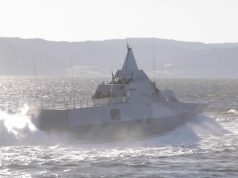
Helsingborg is one of Sweden’s five Visby-class corvettes: 73 metres long, built of carbon fibre, shaped to scatter radar, and run by a crew of around 45. Her weapons are hidden inside the hull, and the class is due to receive the British-designed Sea Ceptor air defence missile, which her crew are clearly excited about.
“It’s really [an] opportunity to practise subsurface warfare with our allies within NATO, in somewhat our own backyard in the Baltic Sea,” said her commanding officer, Theresia. Sweden joined NATO in 2024, and she was clear about what that has and hasn’t changed. “It really hasn’t changed the way that we operate in the Baltic Sea. It has changed in the way that we are operating together with our allied [partners] within the framework of NATO.”
Norlén said the exercise was a chance for NATO’s newest member to show what it brings. “This is one way for the Royal Swedish Navy and the Swedish Armed Forces to actually show what we can actually contribute with inside NATO, and in this regard, in the underwater domain.”
More than submarines
This year’s exercise went beyond the submarine hunt. Ships also faced live drone attacks they did not know were coming.
“We have to practice and train as we fight,” Molitor said. “The ships will be faced [with] real life situations, and they will then just have to react, and we will see if they are able to detect, to react properly, and to destroy these targets.”
Norlén said the real test was handling all of it at once. “We always talk about drones or anti-submarine warfare or missiles. The bottom layer here is that we are here to test and train together in all three dimensions at the same time. That is what makes it really complex.”
Heading home
Back on Helsingborg, the day went on. The sea stayed calm and the cold bitter. Patrol aircraft came thundering through the clouds, and the Canadian helicopter arrived, lowering its dipping sonar to listen for the submarine below. On every part of the horizon, there was a NATO warship. Then, after an action-packed few hours, Helsingborg turned for home and left the crews to their training, as she should. These ships were there to sharpen their skills, not to ferry journalists about.
We came ashore to sailors working with a steady, unhurried purpose. Of everything we saw that week, it was perhaps the clearest sign of how far things have come. The Swedish Navy isn’t finding its feet in NATO. It has found them.






interesting series of articles and videos
thanks 👍🍺