

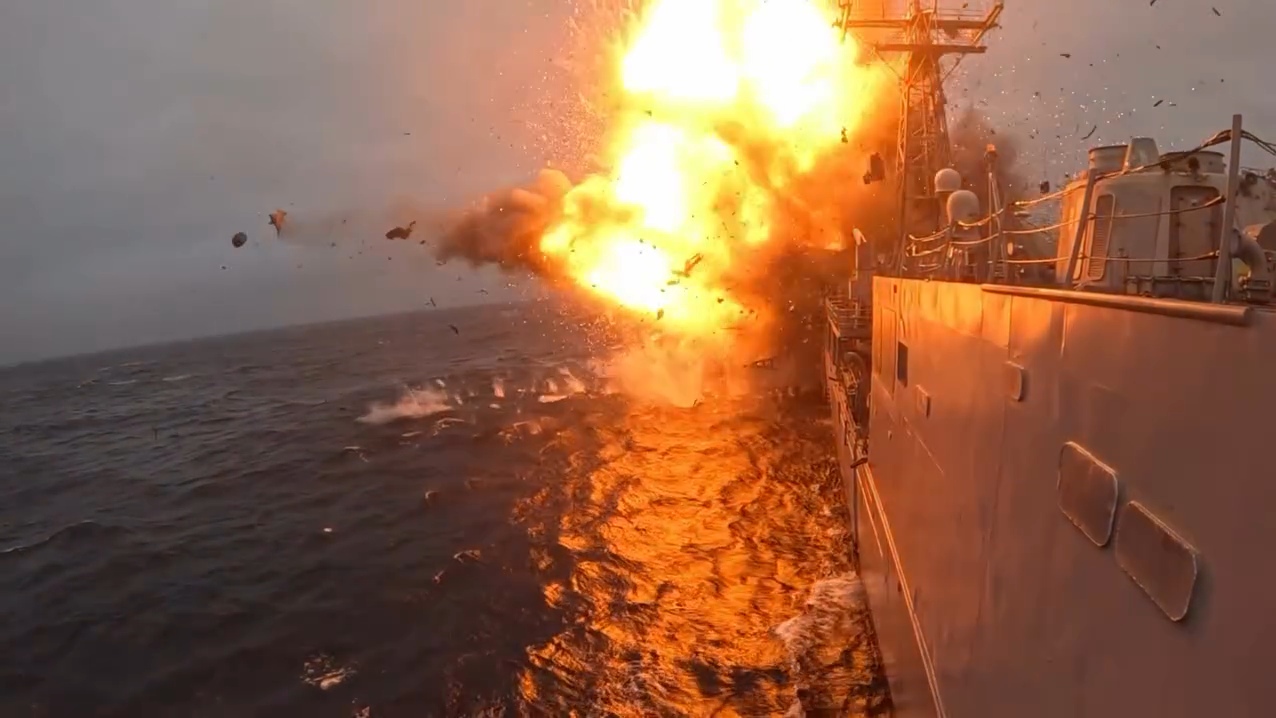
The decommissioned American frigate USS Klakring has been sunk off the Hebrides during the joint US-UK live-fire exercise Atlantic Thunder 2026, in an engagement that drew in warships and aircraft from both navies, according to US Naval Forces Europe and Africa, which has released footage of the strike.
The video shows the American destroyer USS Paul Ignatius launching a missile and the frigate being hit. Other attackers took part alongside her, among them aircraft and further surface vessels, and the full order of battle has yet to be set out.
We will be bringing you an in-depth look tomorrow at what happened off the Hebrides, how the engagement was put together and which units and weapons were involved.
Paul Ignatius is an Arleigh Burke-class Flight IIA destroyer, hull number DDG-117, commissioned in July 2019 and named for the former Secretary of the Navy who held the post under Lyndon Johnson. She has been forward-deployed to Naval Station Rota in southern Spain since June 2022, one of the American destroyers held in Europe for ballistic missile defence and wider tasking across the eastern Atlantic and the Mediterranean.
Klakring was an Oliver Hazard Perry-class frigate, decommissioned in 2013 and laid up at the Philadelphia Naval Inactive Ship Maintenance Facility until she was towed down the Delaware River on 12 August ahead of the Atlantic crossing, making first for Campbeltown. The exercise itself was originally planned for a window in May before moving to the second half of September at the QinetiQ Hebrides range in north-west Scotland.
A Request for Information issued by the Ministry of Defence in August 2025, inviting industry to take part, described Atlantic Thunder 26 as “a US-UK multi-domain exercise designed to validate SUW kill chains, build resilient kill webs and deliver strategic messaging through kinetic demonstration.”
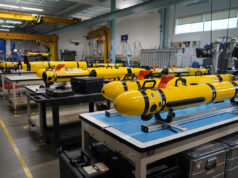
The strike was only one part of the exercise though, Klakring is expected to now settle at a depth of around 6,000 feet, where uncrewed underwater vehicles are to carry out battle damage assessment and seabed survey work, a phase the Ministry of Defence treated as central when it approached industry last year.
The precedent is Atlantic Thunder 22, held off the same range in September 2022, which ended with the sinking of the former USS Boone by HMS Diamond, USS Arleigh Burke, RAF Typhoons and US Navy P-8 Poseidons, and was billed at the time as the most complex multinational sinking exercise staged in UK waters.




Off topic, with apologies
Obviously, the high price of electricity is the BBC’s fault! I expect it’s because of the licence fee, as the right (Moggy, Redwood, Tice, Farage, Badenoch etc) launch yet another co-ordinated “bias” assault on the beeb, blaming them for “endless pro-renewables & pro-net zero propaganda”
It’s definitely not because of the unbelievable co-ordinated price gouging of “natural” gas by the fossil fuel cartel right across the globe then Or Trump’s war on the Ayatollah regime, which has only closed the Strait of Hurmuz for six months.
Zelenskyy should do as he’s told and follow Trump’s demand to stop bombing Russian diesel refineries, because his chum, the war criminal Putin, doesn’t like it. Or he won’t get any more Patriot missiles. Oh, sorry the leader of the free world already cancelled their last deliveries. Also the 155mm artillery ammunition and HIMARs orders already paid for by the EU. Hegseth has diverted them to the Middle East, as he rebuilds the many US bases recently totalled by the IRGC with Chinese and Russian help.
As our investment in wind and solar continue harvesting humungous amounts of free energy – exporting £1billion worth of renewable electricity to the EU 2023/2024 – we can look forward to another Big Oil/Gas doubling of the price this autumn, as global oil stocks run down
What was the price of diesel near me yesterday? £2.03 per litre. Remind me to email the BBC about it
Of course it is too. The anti capitalist progressive social status press instead of pushing for cheap energy pursues virtue energy productions by their socially rewards their aristocratic mindset.
I have no problem with wind, solar or whatever energy as long as make economical and strategic sense.
Btw if the Western countries had by happenstance most oil and most other natural resources in the world the BBC and its Marxist adjacent friends would be claiming that natural resources do not belong to a country but to the world and that resource priviledge is worse than inheritance.
All natural resources should be pooled and managed by UN…
correction:
…virtue energy productions that is socially rewarded in their aristocratic group.
I have a question for you. Where are we supposed to get our sulphur from if we eliminate fossil fuel entirely from the energy mix?
Not to mention polyester garments and lego bricks!
@GR
Volcanoes they pump out lots of sulphur
Two thirds of the world’s use of sulphur is used in the production of phosphate fertilisers. You don’t need to. Using sulphuric acid just a bit easier and cheaper then using nitric acid (which I think they still do in one of the Nordics). Much of the rest is used in mineral extraction. You can recycle or mine volcanic deposits to get what you need. Extraction from fossil fuels won’t be missed.
As a chemist I am very puzzled by the construction of your post.
The real issue is where you get the ammonium from if you are not running the Haber process.
That is the messy bit.
I don’t understand your confusion so if you could spell out why you found what I said confusing we can figure it out.
The question asked was about sulphur, not ammonia. I didn’t think Haber used sulphur even as a catalyst, but I’m not a chemist and will defer if you say otherwise. I doubt the Harber process is going anywhere, but the hydrogen will shift from blue to green over time. If I had to guess I’d say ammonia will come either directly off the back of nuclear, using the power station’s heat for both the hydrogen production and the ammonia, or via a green-hydrogen stage, electrolysed on the East Coast using windfarm power and stored in salt caverns. The emerging East Coast hydrogen economy centred on the Humber and Teeside is worth looking at.
Volcanoes.
Perhaps sir you would be better sticking to subject you might have something interesting to say. To the best of my knowledge you are the only one supporting the nounce club , but maybe your posts is in jest ?
The UK has amongst the highest industrial electricity prices in Europe and among developed nations.
Medium-sized industrial users pay nearly double the EU average, and large-to-extra-large users pay more than double compared to many continental counterparts. Small businesses face rates 30% to 40% higher.
Unlike most other countries we include green transition energy costs onto domestic bills rather than through general taxation. These are inconvenient facts for all of us.
I have no problem with a transition to renewables over time but not at the expense of UK industry or impoverishing domestic customers. Your £1 billion of revenue is peanuts compared to the cost of all this across the economy as a whole.
UK emissions are less than 1% of global emissions but let’s pretend we are a global leader because it makes some people happy and because of this mindset let’s not take the benefits in jobs and revenue by screwing every last £ from the oil and gas that remains in the North Sea like those rabid hard right fanatics in Norway?
As for your political points you are welcome to have an opinion some of which I happen agree with.
@sjb1968
” The UK has amongst the highest industrial electricity prices in Europe and among developed nations”
We do not. Ireland does, followed by Germany, Belgium and Luxembourg
For months, if not years, I have pointed out that onshore solar electricity is providing extremely cheap juice for British bill payers. All summer if you were on the right tariff you could be doing the washing, running the dishwasher, charging the EV, charging the home battery etc – all for free on Sundays. Indeed, some energy suppliers were paying folk to take electricity from them during these periods. Yet people posting here are still claiming that cfd’s are “subsidies” when that old chestnut has been debunked dozens of times.
Our beautiful planet was burning up this summer. There is every chance that next year will be worse. The great British public is overwhelmingly pro-net zero and has started buying EV’s, heat pumps, installing PV systems on their roofs etc with a vengeance. They are now buying exceedingly cheap plug-in solar panels that will reduce their electric bills even further
Maybe it’s time the right finds another gong to bang, because as the world burns up they have lost the energy transition argument. Two years ago, following Trump’s stance, the right was anti-Ukraine, pro-Russia and it’s war criminal “President” Putin was being praised by the likes of Farage and Tice. Trump then cut off all military support for brave Ukraine. What a bunch of grovelling sycophants.
In fact ‘the science’ has just retired RCP8.5., the emissions scenario on which net zero by 2050 is based.
But the point is (and that it is why it is worth discussing on this forum):
‘Net Zero is leaving Britain defenceless:
Military power has always depended on productive force…If the United States, the so-called arsenal of democracy, is already struggling to replenish critical munitions while confronting lesser adversaries like Iran, then the implications for a prolonged conflict with a peer competitor like China should be blindingly obvious. The problem is even more acute in Europe. Unlike the United States, we enter this period of renewed great-power competition with some of the highest energy prices in the developed world and (as a consequence) a much-diminished industrial base.
Oil refining in Britain is a good example. There is a tendency among politicians and in the media to treat refinery closures as manageable because cars can be electrified and planes can eventually use sustainable aviation fuel. But military demand is very different. F-35s, tanks, ships and logistics fleets still depend overwhelmingly on conventional fuels. Domestic refining capacity cannot easily be substituted in a crisis.
Unfortunately, the national conversation about rearmament is still framed far too narrowly around defence budgets, procurement and headline spending commitments. Those things are necessary, but they are not sufficient. Rearmament ultimately requires reindustrialisation. For Britain and Europe, that means confronting the policies driving structurally high energy prices – in particular, the climate agenda that is eroding the competitiveness of energy-intensive industry…
All of this points to a harder truth about UK defence and rearmament. It will require a break with assumptions that have shaped British policy for decades – namely, that a statutory Net Zero target can be pursued without weakening industrial capacity; that cheap imports from China are a cost-free substitute for domestic production; that Britain can safely dispense with its domestic oil and gas sector (or simply keep onshore and offshore resources in the ground); and that green industries can replace the strategic value of the heavy industries being lost.
Those assumptions were easier to sustain in a more benign international environment. They are much harder to defend today.’
(Spiked, Maurice Cousins, Sept 2026)
I have to agree as I have driven EVs since 2019 – the BEV bit is faultless and charge ON for peanuts; I’ve an oldish rooftop solar system that still chucks out a decent amount of kW; thinking of getting a 14kW plug in battery when they arrive to get the winter day time bills down to 1/4 of what they are now.
18 months payback on an AEG battery and even less if I’m using it to store the free solar in the summer rather than buying ON electricity.
“amongst” is the word, and we are not all in favour by any means if net zero bankrupts us which is what Labour seem determine to achieve.
This is an article about a Sink Ex, if you want to discuss electricity prices go on a social media platform.
you can fcuk off nobody is making you read anything on here
David, rules do require comments to be on topic.
Sorry George, point taken
Is there much to be said? We’ve commented before on the irony of an Anglo-American SINKEX using an American ship towed all the way to British waters when the RN is getting rid of maybe five large surface ships a year.
Perhaps there’s more humour to be milked from the Americans sinking a class of ship they are having such spectacular trouble replacing. I don’t know. Nothing wrong with a little off-topic occasionally.
Oh, I know. Why aren’t we turning these sunk ships into a scuba resort? It’s all such a wasted opportunity.😢
@Luke
Absolutely nothing from you about the government’s announcement late last year of a 90% reduction in electricity network charges for high-consumption industries, including steel, glass and cement. Around 500 of the UK’s most energy-intensive businesses were set to save up to £420 million per year on their electricity bills from April 2026
Some of the companies which will benefit from the change include Tata Steel at Port Talbot and INEOS in the Scottish town of Grangemouth. Even greater energy savings could have been made if businesses had shifted more production to summer weekends, where many energy companies were offering absolutely free solar electricity during the day. Some energy companies were actually paying firms to take electricity during these periods
Labour’s decision on energy costs has been completely ignored by the net stupid anti-swans Reform limited company and the Conservatives. Farage and Badenoch are still sticking to their discredited claim that our high electricity costs are “caused by net zero” and non-existent “subsidies” for our huge renewables sector. And definitely not our dependence on volatile imported “natural” gas
Let’s hear the truth about the falling costs of electricity, which is good for Britain – and less of the fossil fuel lobby propaganda put out by Big Oil funded right-wing think tanks. If you dont like reading the truth, you know what you can do
You sound like a very unhinged character. Article pops up about a SinkEx and you spend your Sunday morning writing about electricity. Very peculiar indeed.
Energy prices are at a three-year high and they are very likely to stay at this level or become even higher in 2027. There are many different factors in play.
The cost of net zero by 2050 is a major factor
NESO have already called for £169 billion of grid upgrades by the mid 2030s, but it is inevitable that these costs will balloon – public infrastructure projects always do. The subsea cable known as Eastern Green Link 1…120-mile electricity “superhighway” will help unlock Scotland’s renewable energy reserves by transporting enough power for two million homes southward. At an estimated cost of £2.5bn, it is probably one of the most expensive infrastructure schemes you’ve never heard of – perhaps because it lacks the visibility of a railway, road or bridge. The cable and its sister project, Eastern Green Link 2, were originally meant to cost a combined £3.4bn, a figure that has since doubled to an estimated £6.8bn.
Against the backdrop of a wider £200bn upgrade under way across Britain’s power network, Sam Richards, the chief executive of Britain Remade, a clean energy pressure group, adds: “The simple truth is that Britain is building too much grid, at too high a price.”….
Along with the Eastern Green Link cable schemes, a report quietly published by Ofgem in May revealed that a string of eight projects being built in Scotland by SSE were forecasting total cost increases of 284pc on average. This included a staggering 467pc projected cost increase for work to upgrade transmission lines between Loch Buidhe and Spittal.
Ofgem has not disclosed the potential cost of the overruns in cash terms, or what their impact could be on bills.
Consequently there is no extra funding available for defence, national security, as war continues on Continental Europe.
Dangerous times…
I wonder what the UK involvement was? The usual PIV.
Maybe some Martlet and Sea Venom?
NSM would be nice, don’t think RN ships even have it yet??
Have we tested Sea Venom before on a SINKEX? It’s useful enough. Other countries will test NSM.
I’ve no idea, I thought it only got to IOC fairly recently so maybe not.
NSM’s been fitted to Somerset, Portland and Richmond. It was taken off Portland for a while, but I think it’s back installed. Richmond’s of course decommissioned.
First test launch was about a year ago.
They announced the procurement back in November 2022, for 11 sets. So far we’re at ~2 ships fitted, Defender might be next.
Thank you.
I’m pretty sure the 2022 Sinkex of ex-USS Boone was by HMS Westminster, not HMS Diamond.
Electricity prices are linked to gas prices. De-couple them. Simples.