

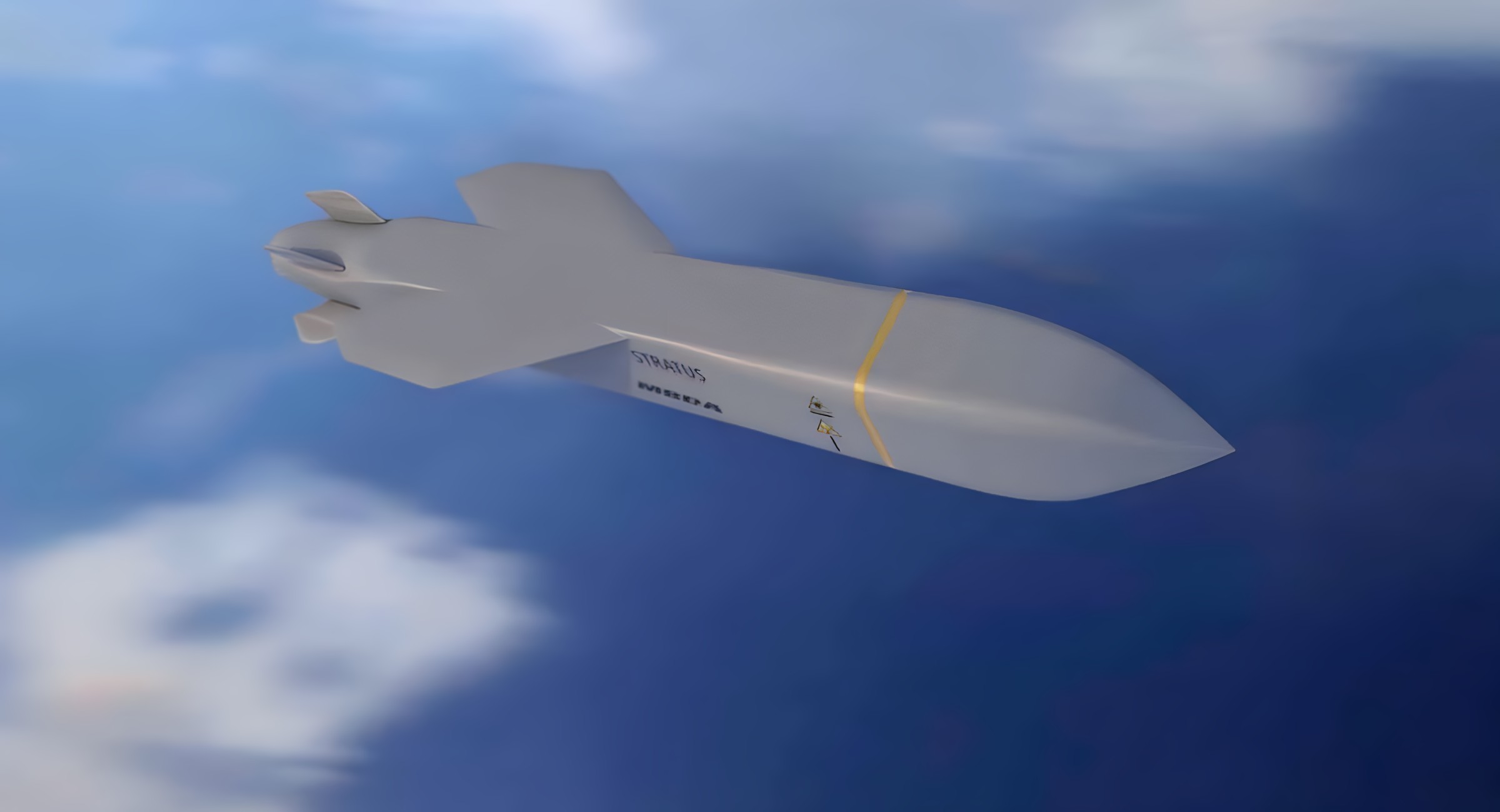
The Ministry of Defence says the Stratus future cruise and anti-ship missile programme is approaching its Demonstration Phase, with full-scale system testing scheduled to begin in 2028 and integration planned for Typhoon, Rafale and Royal Navy Type 26 frigates.
The first full-scale system tests of the UK’s Stratus future cruise and anti-ship missile are scheduled to begin in 2028, with development work already completed on the airframe, engine, warhead and seeker, the UK Defence Journal understands.
New parliamentary answers from Defence Minister Luke Pollard provide an update on the programme formerly known as the Future Cruise/Anti-Ship Weapon, or FC/ASW, which is being developed with European partners. Responding to Conservative MP James Cartlidge, Pollard said Stratus was continuing to raise its technology readiness and system maturity through modelling, subsystem testing and trials.
Pollard said: “To date, the programme has completed testing of the airframe design, engine demonstration, warhead and seeker performance. The first full scale system tests are scheduled from 2028.”
A separate answer to Conservative MP Ben Obese-Jecty confirmed that the programme remains on schedule and is expected to move into its Demonstration Phase shortly. Pollard said: “The Stratus programme with our European partners continues to progress to schedule. Development of the weapons and sub-systems is maturing, and the programme will transition soon to its Demonstration Phase.”
The Ministry of Defence also confirmed that Stratus weapons are planned for integration across both air and maritime platforms. Pollard said the weapon systems would be integrated “variously to Typhoon, Rafale and selected naval platforms including the Royal Navy’s Type 26 frigate.”
Stratus is intended to provide the UK and its partners with a new generation of long-range strike and anti-ship weapons. In British service, the programme is intended to succeed capabilities currently provided by Storm Shadow for deep strike and Harpoon for anti-ship warfare, although the precise configuration and performance of the future weapons remain sensitive.
The MOD has now given a further indication of the intended performance of the low-observable version of Stratus. Asked directly for its range, Pollard declined to provide a figure on security grounds but said it would considerably exceed the weapons it is replacing.
He said: “As he will recall from his time as a Defence Minister, the operational range for the Stratus LO missile is classified information. However, the range is significantly greater than the Storm Shadow and Harpoon weapons that it is replacing.”
That statement does not provide a specific range, however, but it confirms that the MOD expects the low-observable Stratus weapon to offer substantially greater reach than either of the existing British systems cited in the answer.
Storm Shadow is an air-launched cruise missile used for long-range strikes against fixed or hardened targets, while Harpoon is a ship-launched anti-ship missile used against surface vessels.
The planned Type 26 integration is particularly relevant to the Royal Navy, which is introducing eight of the anti-submarine warfare frigates.






Presumably it will be ship launched via Mk41 VLS so can also be carried on Type 31 when they get around to fitting the Mk41……
I really hope we get this on the SSN A as well.
I’d stick with TLAM for now. No point complicating the SS-A procurement any more than is required.
Hasn’t the US ceased production of the torpedo tube launched varient? If we run out of those, our subs will be limited to reconnaissance and sinking ships with torpedos.
There’s supposed to be a VLS pod on the new AUKUS subs. Would suggest there’s a plan to put something in it too.
Test in 2028, think about it between 2029 and 2034, change of mind in 2035, pause and start again in 2036. 🤔
Rinse and repeat
👍😊
Isn’t there meant to be 2 missiles that are part of the of Stratus family? Are both of them going to tested in 2028?
The French are responsible for the other one, the Stratus RS, and it looks like the UK probably won’t procure the RS in the near future.
None of the answers distinguished between Stratus LO and RS. Most likely they are referring to just LO, which is the British-led missile.
The plan to buy both was always tenuous as the reason for two missiles was that each country’s tests led to different conclusions as to the better form for an anti-ship missile.
Yes, we are getting the lo, which is the cruise missile variant. I was informed that the NSM is here to stay.
NSM for 11 ships I thought. Suggests T45s and T31s. Stratus for T26, CCV, QE and MRSS?
The LO Startus isn’t anti-ship, RS is apparently. The LO Stratus missile is Very Long Range, Stealthy High Subsonic & Nap-of-the-Earth, Passive Multimode Sensor Suite with ATR, Multipurpose Warhead (Bunker Killer & Surface Target). I was corrected by someone who currently working on naval projects, told me the NSM is pretty much here to stay appreantly.
Appreciate that clarification. 🙏
I wonder how many will be purchased? If current trends persist it will likely be one for each ship and plane, plus a spare. That’ll show em. Don’t mess with us brits. 😂
Not sure about the spare.
We need a stonking order of these things in due course. I think Storm Shadow order was around 800 originally. Needs to be way higher now given the security situation.
The original French order was 1200. So 2000 combined. But production has restarted, so impossible to say what the final number will look like.
And the platforms to put them on? We have too few aeroplanes and surface combatants which both numbers need expanding and no drones are not the answer. Even OPV’s and RFA’s could mount them as they will come in canister form too. But as the UK is really coming to be a pacifist state we will not see any number purchased.
“The UK’s Queen Elizabeth-class aircraft carriers will be equipped with deck-launched long-range missiles ”
UKDJ June 2025. Maybe MRSS too?
I hope that we do purchase some RS as well should be a great capability for time sensitive targets, SEAD/DEAD & anti-AWACS other high value air targets. Stratus LO does look a beast should be an excellent weapon against C2 bunkers etc.
Quicker we get this missile the better hope no delays.
Is STRATUS effectively replacing Tomahawk in RN service? Aside from the current stock of Tomahawks for Astutes. If SSN-AUKUS has VLS then surely it could also be used on those too.