

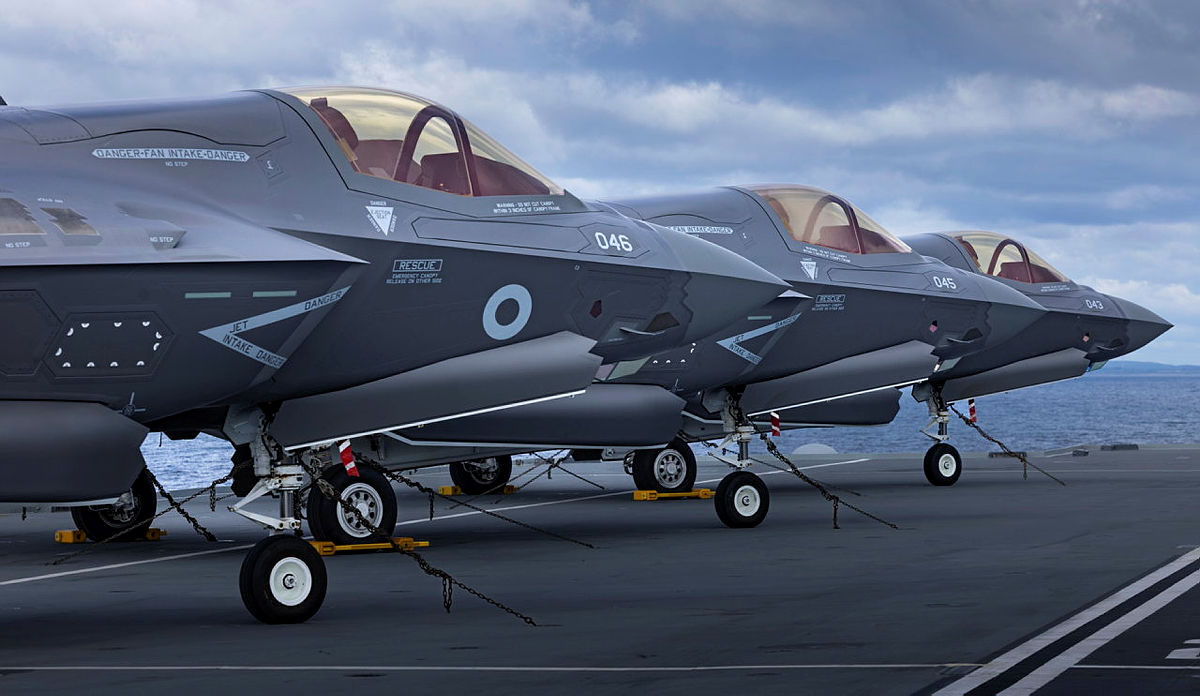
F-35 jets are flying NATO air policing operations from the deck of HMS Prince of Wales to protect the skies above Iceland and the High North, the first time the alliance has conducted such operations from a European aircraft carrier, the Ministry of Defence has announced.
Defence Secretary Dan Jarvis visited the carrier off Iceland accompanied by Icelandic Foreign Minister Þorgerður Katrín Gunnarsdóttir, with the Royal Navy flagship deployed under NATO command at the head of a Carrier Strike Group including the Type 45 destroyer HMS Duncan and the tanker RFA Tidespring, and more than 1,500 British personnel embarked across the group.
Air policing is NATO’s standing peacetime mission to guard the airspace of allies, and Iceland, which has no military of its own, has relied on allied aircraft operating from Keflavik in rotational detachments since 2008. Basing the mission on a carrier offshore rather than a land detachment marks a departure for the alliance, and the jets have already been put to work beyond policing duties, with two F-35Bs from the ship intercepting a Russian Tu-142 Bear F on 2 July after it made repeated low passes near the carrier and dropped tens of sonobuoys close by, activity the department called unsafe and unprofessional.
“We live in an increasingly dangerous and uncertain time, and it’s deployments like this, supported by allies and partners including Iceland, that improve our deterrence and defence as part of NATO,” Jarvis said, pointing to the £298 billion being invested in defence over the next four years “to strengthen readiness and ensure our people have the kit and technology they need.”
Gunnarsdóttir said the visit of the strike group “is a clear demonstration of NATO’s enhanced presence in this strategically important region, and one that Iceland is proud to support and contribute to,” adding that activities such as Arctic Sentry reflect the alliance’s shared commitment in the challenging environment of the North Atlantic and the Arctic.
The deployment coincides with the UK taking up two new alliance commands. British Special Operations Forces assumed leadership of the Special Operations Component Command within NATO’s Allied Reaction Force on 1 July, the element the department describes as the spearhead of the force, able to deploy anywhere in the world within days, while the UK simultaneously took command of the ARF’s maritime component under Rear Admiral Mark Anderson and his battle staff. HMS Queen Elizabeth, fresh from refit at Rosyth, is preparing to serve as the floating headquarters for that force later this year, giving both of Britain’s carriers alliance roles.







It’s an often over looked benefit of the carriers, if Russia ever did try to launch a cruise missile attack on the UK then it probably needs to deploy bombers around the Kola Peninsula to the Norwegian Sea. Parking a carrier in the area gives the ability to intercept Russian bombers long enforce they are in range of the UK. Without violating Norwegian airspace there is only a limited number of flight paths the Russians can take.
If these are such Dangerous times why are we underfunding Defence by £13 bn ??
plus the Goverments mysterious black hole funding gap of over £5bn…??
Intresting HMS DUNCAN was mentioned .
A type 45 Anti Aircraft Destroyer due to be cut from the fleet in 2035-38 and of course the Cancellation of the Unaffordable Type 83 in the DIP…. ??
Our Carriers will be sitting targets , hopefully a future Goverment with a little bit more Backbone will Revisit this….
Why will they be sitting targets any more than now?
Sea Viper, Samson, be it on an escort or dispersed on T91 and T94, or maybe other defensive ships, be it a CCV or an allied vessel, land based assets, land based AEW and AAR supporting the carriers fast air.
You comment as if T45 is cut with no replacement, did you not read about T91 94, and the CCV?
On top of that, you’d bot bet against T45 being extended.
Sitting targets are actually the RAFs airfields that cannot move.
Unproven and an Unknown Quantity…!
Totally agree with you on raf fields …
And in general were woefully under Prepared both land and sea for any serious conflict.. The few Conventional Assets (operational) we do have will probably be gone in 10 Days…
Nig e,
Defence being underfunded is a paper money illusion.
Your “…plus the Goverments mysterious black hole funding gap of over £5bn…?
To explain the mystery, as to my understanding: The £28 Billion black hole was centred the projected costs of the t83 programme, that project has gone, so the black hole is now down to £4.7 Billion.
Why £4.7 Billion? The extra £15 Billion injection given ontop of the £283 Billion for 4 years ACTUALLY only amounted to £10.3 Billion thus leaving a £4.7 Billion black hole.
To get the spurious extra £15 Billion injection –
£4 Billion is being taken by slashing capital and infrastructure budgets across Whitehall by 1%.
£2.7 Billion is being scraped together by aggressively cutting or pausing major domestic infrastructure projects, specifically targeting the Department for Transport (roads) and the Department for Energy Security (Net Zero funding). The rest comes from selling off government assets and a 10% reduction in MoD civil servants and heavy cuts to expensive external management consultants. The early retirement of older, high-maintenance legacy hardware, including 34 of the Army’s Wildcat helicopters and, halting or freezing expensive ongoing development programs that were falling behind, like the Storm Shadow missile upgrades.
There should be a 5 to 8 year buffer for the Royal Navy to get to know and understand the 94 and 91’s before the CCV’s arrive. In that time the T91/94’s plus the T92’s and T93 sub-hunting drones will have been training alongside the T45’s, T26’s and the T31’s. Shaping up before pairing up with a CCV.
In reality the RN has a massive buffer to get the T9x program sorted.. the T45s have the hull plate thickness to last 35 years without a major hull rebuild and they have only just had brand new power systems and we’ll all a capability upgrade that does not end until 2032.. these ships will easily with normal maintenance programs and 6 years refits last into the 2040s if needed.. and the DIP is actually very vague on their retirement.. with a statement saying the CCV will start to replace the T45 from 2035 onwards.. essentially the RN has 20 years to get this right… people are I think incorrectly likening this to the T23 fuck up.
Jonathon,
I agree with you.
The Type 23s were a victim of the lack of a clear follow-on plan. The Type 26 program was delayed so significantly that the Type 23s had to be ‘run into the ground’ to keep the fleet size at 13. The difference is that the CCV is not being designed in a vacuum. It is being built as a modular system that can be adjusted. If the initial CCV hulls perform well, the Navy accelerates; if not, the Type 45s simply remain in the rotational maintenance cycle a few years longer.
However … concerns remain, maintenance is expensive. The MoD’s risk isn’t that the Type 45s will fail structurally; it is that the cost of keeping them in service through the 2040s, combined with the cost of developing the CCV, will cannibalise the budget for the rest of the fleet.
The capability gap narrative is a product of misunderstanding the difference between a ‘planned retirement’ and a ‘hard expiry date.’ Given the engineering reality, the Type 45s are indeed one of the most durable assets in the current inventory.
We would not have spent £13bn by 2030 on the t83 project as these ships would not be in built and entered service until the end of the 2030s or early 40s …!
£15 billion as you stated over 4 yrs !!!
That is only a cumulative exta ~£1.55bn to the Defence budget per year over 4 yrs..!! …
Still welcomed but sounds more impressive than it is…!
Cumulative extra money is an old Blair trick…
the date is inconsequential, it was on the planning agenda, it was an upcomming cost, that cost has now been mitigated with a different but kinda … less costly cost.
1️⃣5️⃣ ➗ 4️⃣ 🟰 3️⃣⦁7️⃣5️⃣, not 1.55 (1.55 x 4 = 6.2, where does 6.2 come from?)
The decision is undeniably shaped by the reality that the UK cannot afford to build a full fleet of “next-gen” destroyers while simultaneously funding the nuclear deterrent and other major programmes like; Nuke Subs/GCAP Tempest and Wingmen/Nuke Warhead Refit/Various Missiles etc. The “Hybrid” model is the government’s way of attempting to maintain “hard power” while managing the reality of limited annual budgets.
It is not a “cumulative extra” in the sense of adding £15bn every year. It is a one-time total package of £15bn that is being distributed over the four-year period.
>If these are such Dangerous times why are we underfunding Defence by £13 bn
Because defending the UK has almost no votes associated with it, 81 years without a major war has led to voter complacency and even annoyance when someone cries “Wolf”.
Idiots Guide to Winning an Election.
1. Cutting social benefits to increase the defence budget will overall lose you lots of votes and key marginal constituencies.
2. Cutting the defence budget to increase social benefits will overall gain you lots of votes and key marginal constituencies.
3. To keep the maximum number of people happy, spend all available money on social benefits but with vaguely promise to increase spending at an undefined future date when economic circumstances allow.
4. If the international pressure to increase defence spending gets intense, make it someone else’s problem by saying with a straight face that it will increase substantially in the next Parliament.
How many aircraft are on her?
Andy, Navy Lookout website of today (6/7/26) says ‘about 8’.
I think Navy Lookout are incorrect on that one. The numbers have been bouncing between 8 and 12, and apparently jumped up to 16 at one point.
12 F35Bs.
A full squadron of 12 F-35B’s is probably right. The max number I’ve seen on deck in any photo is 6, but its very reasonable to keep them in the hanger as much as possible. There is no doubt that the Lightening Force has been operating at capacity since it stood up in 2019, waiting until 2033 (another 7 years!) for its third frontline squadron to form is just crazy, we need that squadron now.
Andy reeves,
Globally, the F-35 fleet struggles with an ‘mission-capable rate’ that hovers around 50% to 60% due to software bugs, parts shortages, and heavy maintenance requirements.
If you deploy 12 jets, the real world breakdown on any given morning in the rough, freezing High North looks close to this
6 Jets – Fully mission-capable.
4 Jets – “In work” (getting routine software updates, stealth-skin touch-ups, or minor component fixes).
2 Jets – Completely grounded waiting for a specific spare part to be flown out from the UK.
How do they keep QRA active with only 6 working jets?
To maintain a 24/7 QRA state, you technically only need 2 jets fueled, armed, and ready to launch at a moment’s notice, plus 2 backup jets ready to take their place if one suffers a technical glitch on startup; a common occurrence with the F-35.
So, out of your 6 working jets, 4 are permanently locked into the QRA cycle. This leaves exactly 2 jets available for normal training, routine patrols, or giving the pilots their required flying hours.
12 jets only is on the edge, there is absolutely zero margin for error. If one of those working jets gets a bird strike or a hydraulic leak; given that the ‘true combat-readiness rate’ of the F-35B at a staggering 16.2%*, the entire carrier’s operational rhythm could fracture.
note~ *16.2% figure comes directly out of the official U.S. Government Accountability Office (GAO) report on F-35 sustainment, published on June 11, 2026. The Pentagon isn’t denying the numbers; but, they are panicking over them. The Joint Program Office has just launched a desperate $13.7 billion “Global Support Solution Reset” with the explicit goal of dragging these abysmal numbers back up to an 85% basic mission rate and a 65% Full Mission Capable rate by 2030.
One would hope the Norwegians would intercept in that scenario.
Yes unless there airfields where under ballistic missile attack which is standard Russian practice.
A QE class in the high north gives UK air defence options. Not maybe its primary mission but a good secondary benefit.
the first time the alliance has conducted such operations from a European aircraft carrier, the Ministry of Defence has announced.
As this is the first time then clearly every other time they have launched policing missions from allied airfields, so why do we need carriers bobbing around in areas that can be protect from allied arifields. The answer is we don’t, carriers are very useful but at there most useful when deploy 1000s of miles from allied bases.
Note I don’t reply to comments, life is too short 🙂
then post at all, same more of your precious time, hmmm.
Make statements and then hasn’t the ‘time’ to actually debate so why bother?
Funny, because they used to reply.
I suspect its cowardice, not time saving.
With the drone and ballistic missile threat airfields in skandanavia might be useless just like the gulf.
Carriers are much more survivable.
Their really lack the Capabilites compared to American carriers or Even the French Carrier…
I would actually say the F35b and Merlin on a platform that can operate in higher sea states is a better capability for the high north…
ASW wise an Elizabeth has the greater capability than both a US or French carrier.
Does the DIP fund the deck mounted long range missiles for the carriers, per the SDR recommendation?
No as it was a s**t idea.
That it was Jim but it was one of the 62 recommendations proposed in the SDR and accepted by HMG.
Long Range Missiles, as in the likes of the Nyan OWE seen tested the other day?
I think HMG is happily ambiguous with the term “missiles.”
“Misguided Missile Policy”.
I suspect what we will see is a long range one way attack drone..
Launching a load of traditional missiles off the deck is a stupid idea.. where as having 20-40 long range one way drones with a 2000km range stashed in your hanger that can be deck launched is a very nasty thing.